Washington defends America from the outside in. Agencies, surveillance, endless spending. It has the threat model backwards. Security starts at home. Strong families. A real economy. Free, healthy citizens. My new book:
11 RULES FOR NATIONAL SECURITY.
Coming soon.
Public safety is the Army’s top priority, and I have directed Army Materiel Command to postpone tomorrow’s controlled detonation at the Iowa Army Ammunition Plant in Middletown, Iowa until Monday, November 23. This will delay the detonation until the latest possible moment prior to a forecasted temperature drop, which would risk further destabilization of the material.
In March of this year, the Army uncovered degrading Lead Azide housed in bunkers at the installation and immediately began communicating with stakeholders and the public in Middletown and the modeled impact area about the danger it posed. In coordination with the Environmental Protection Agency, experts, and the local community, it was determined that a controlled detonation was the option that posed the lowest risk to the public in the immediate and surrounding area.
Public communication is essential to public trust. Therefore, the Army will continue to actively engage with state and local officials throughout the region to distribute accurate, up-to-date information.
Ebright: It is a matter of public record...that authors of the 'Proximal Origin' paper knew that the conclusions of their paper were unsound and likely untrue at the time they drafted the paper...[T]he paper is, provably, a product of science fraud."
https://t.co/wq6DtNv1Xe
Nvidia has now a big problem
Researchers made LLM inference 8.47x faster by removing the CPU entirely.
Right now, every major AI serving stack, vLLM, TensorRT-LLM, SGLang, has a massive hidden bottleneck.
Your $40,000 GPU is constantly waiting on a CPU to tell it what to do.
Every incoming request, every batch, every token-level decision has to pass through the host CPU first.
If that CPU gets busy with literally anything else, your AI performance collapses. Datacenters are forced to leave massive amounts of compute sitting idle just to keep the CPU from choking.
So researchers built Blink.
An architecture that completely removes the host CPU from the inference path.
Instead of routing through the CPU, a SmartNIC catches incoming requests and beams them straight into GPU memory via RDMA.
Then, a persistent kernel running inside the GPU takes over. It handles all the batching, scheduling, and KV-cache management itself.
Zero CPU involvement.
They tested Blink head-to-head against TensorRT-LLM, vLLM, and SGLang.
And the results are wild:
• Up to 8.47× faster Time to First Token (P99 TTFT)
• Up to 3.40× faster token generation (P99 TPOT)
• Up to 2.1× higher decode throughput
• Up to 48.6% less energy used per token
And here is the craziest part.
When they introduced heavy CPU interference, existing systems degraded by up to two orders of magnitude.
Blink didn't even flinch.
RAG is officially cooked.
Researchers proved you can stuff 1 billion triple knowledge graph directly into an LLM using only 20GB of VRAM.
no vector DB, no Pinecone bill, no chunking nightmares.
Researchers introduced AtlasKV, and it makes the entire RAG pipeline look ancient.
Instead of bolting an external search engine onto an LLM, AtlasKV integrates billion-scale knowledge graphs directly into the model's inherent attention mechanism.
Using two new methods (KG2KV and HiKVP), it translates knowledge graph triples straight into the AI's internal memory with sub-linear time and memory complexity.
And the numbers are ridiculous:
• 1 billion knowledge triples integrated at scale
• Runs on less than 20GB of GPU VRAM
• Zero external retrievers
• Zero bloated context windows
• Zero retraining required when you add new knowledge
It maintains strong grounding and generalization without paying the latency tax of searching and reading massive prompts.
We spent years building clunky, fragile retrieval pipelines just to help AI look things up.
BREAKING: Security experts urge teams to update PHP immediately as the PHP Foundation releases patches for 18 security flaws, including 7 rated critical.
JUST IN - FCC votes to ban Chinese telecoms from direct access to US phone numbers — a measure designed to prevent scam-related robocalls, Reuters reports
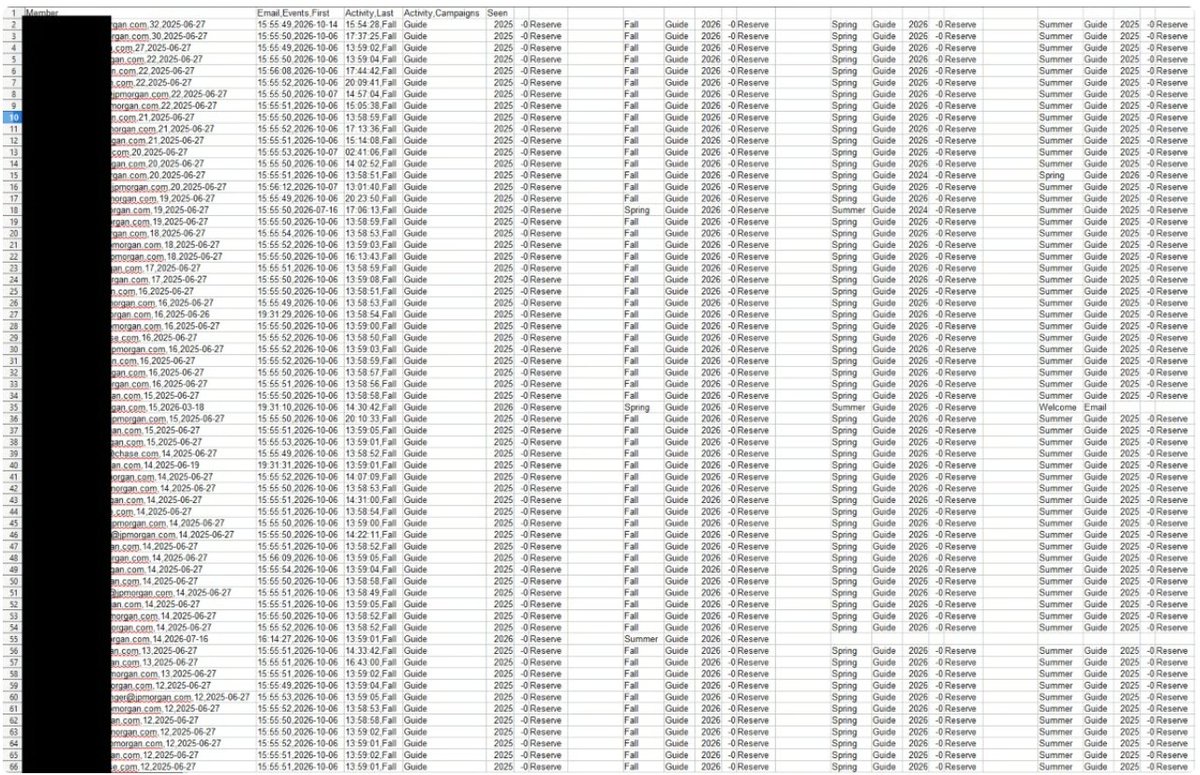
UPDATE: HACKERS LEAK JPMORGAN CHASE CUSTOMER DATA ON DARK WEB
Ransomware group n0n has published stolen data containing approximately 16,000 customer email addresses linked to JPMorgan’s invitation-only Reserve card program, typically reserved for clients with $10 million or more in managed assets.
The leak also includes some phone numbers, account IDs, and 124 bank employee email addresses.
Cybersecurity researchers warn the exposed high-net-worth clients could face targeted phishing attacks.
JPMorgan says the breach originated with third-party vendors, not its own systems, and is unrelated to Monday’s banking outages.
What Politico fails to acknowledge is that those of us calling for a retraction of 'Proximal Origin' are not doing it because we want the lab leak theory to be true. We are doing it because we believe the paper is a serious violation of scientific and ethical standards. Ensuring the integrity of the scientific system is one of the most important and challenging tasks of our time. Furthermore, the paper has been instrumental in the discrediting of an entirely legitimate hypothesis, thus preventing an open and objective search for Covid origins (the answer to which is still not determined). Huge thanks to @NIHDirector_Jay and his colleagues at NIH for pressing for a review what really happened behind the scenes when this paper was written. Any attempt to frame this as partisan politics is doing the whole scientific community a major disservice.
https://t.co/UFimYaQwd1