🎉Our "FlashAdventure: A Benchmark for GUI Agents Solving Full Story Arcs in Diverse Adventure Games" is accepted to #EMNLP2025 Main!🎉
We introduce a benchmark of 2D Flash adventure games (room escape, mystery/detective, visual novel, management) for full story completion. 🧵
Welcome to Seoul, ICMLers!
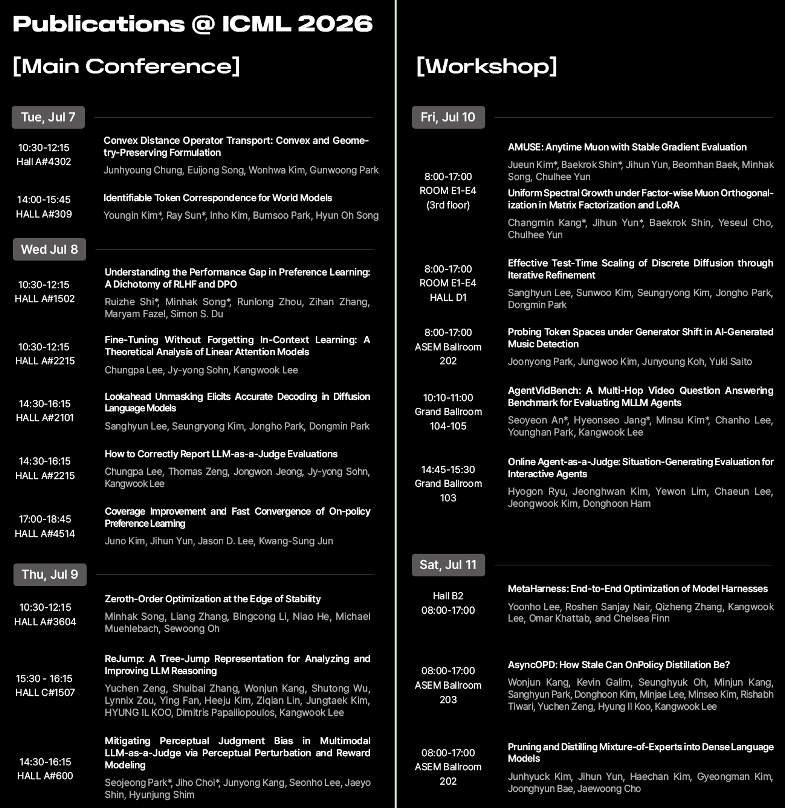
@Krafton_AI will be presenting many interesting papers throughout this week, so please check them out!
I will also help present some of the work (see 🧵below), so please come and say hi 👋
Introducing Real-time RL.
In the real world, time isn't free. The environment keeps "moving" even when you're computing your next action.
We show how RL agents can learn to adaptively think in real-time games.
1/🧵
Today, we give robots a /skills library that self-evolves and compounds indefinitely! Introducing ASPIRE: a robot solving its 100th task is no longer as clueless as solving its first. Coding agents observe multimodal sensory traces from simulation and real robots, launch an evolutionary search over control programs, and distill the best know-how into an ever-expanding library.
ASPIRE is a new type of continual learning: "training" is skill refinement instead of gradient descent.
"Trained model" is a repo of sensorimotor skills instead of floating weights.
“Distributed training” is a panel of agents each practicing a different skill instead of sharded minibatches.
Here's the beauty: ASPIRE gives the tired terms "sim2real transfer" and "cross-embodiment transfer" a whole new meaning. Bridging the sim-to-real gap is notoriously brutal. An end-to-end policy has to swallow both the visual shift (sim looks toyish next to a real camera) and the subtle contact physics it never quite gets right. ASPIRE sidesteps the mess, because it doesn't ship pixels or weights across the gap, but ships the know-how. The robot still has to practice in the real world, not zero-shot, but it gets there way faster because it isn't rediscovering the strategy from scratch. Same for going single-arm to bimanual hardware, which usually requires new data and retraining from zero. ASPIRE achieves up to ~10x cut in "transfer learning” tokens (yes, tokens are the new unit of *training* compute ;)
Check out our gallery of 150+ tasks and 90+ skills the robots taught themselves, all on the website! Kind of wild that we can ship the "learned weights" as an HTML page rather than a GGUF. We'll open-source the full stack so your own robot library starts compounding from ours!
Deep dive in thread:
I'm looking for a Ph.D. opportunity in (non-cooperative) games + deep learning for Fall 2027!
Life update: after 3 years of work as a quant + 1.5 gap year, I'm returning to academia to work on multi-agent learning theory.
During the gap year, I got married, moved in to California, and wrote a small technical paper on nonconvex games which got accepted to COLT 2026.
Please feel free to DM me to chat, collaborate, or just to grab a beer!
I'm joining OpenAI next week!🥹 The job search turned out to be really challenging but also super rewarding, so I wrote a small blog to share what I learned along the way and hopefully make the process a little less mysterious for the next person. https://t.co/6FigSBdenD
OpenAI’s Sora simulates the physics of our visual world. But can we build the physics engine for human society? We can. 🌍
Using Polymarket and Kalshi as the ultimate testbed, we show that LLMs can act as simulation engines for macro social dynamics.
Introducing our ICML 2026 paper: "Building Social World Models with Large Language Models". 👇
📄 Paper: https://t.co/SZDkXq9yrU
💻 Code: https://t.co/CXxKDtMf1I
🤗 Data: https://t.co/3SOXlztbQK
Does LLM really need to be a helpful assistant all the time?
No. If you want to simulate people, “perfectly helpful” could be the wrong objective.
Meet OdysSim, a journey toward LLMs beyond assistants, as behavioral foundation models (10B tokens of real human behavior; 23 sim benchmarks, finally in one place. new open models: outperform or on par with GPT-5.5, Gemini 3.1, or Claude Opus 4.7 in many behavior-sim dimensions).
Human behavior simulation is becoming essential.
Agent evaluation needs realistic users before real users show up. Medical and classroom training need realistic patients and students. Social science needs synthetic participants at scale.
But real people are not ideal assistants.
Real patients panic or ignore good advice. Real students misunderstand. Real customers are vague, picky, impatient, or simply leave. Human behavior is messy, diverse, and often imperfect.
Frontier LLMs are getting better at math, code, and long-horizon tasks. They are NOT getting better at simulating human behavior. If anything, they drift the other way: more assistant-ish, more homogeneous, fewer of the errors and quirks real humans show.
This is no accident. The whole pipeline is built for helpfulness and task success, not behavioral realism.
And you can't prompt your way out of that.
So we rethink the recipe from scratch and release:
🧠 The OdysSim corpus: 21.4M real human interactions (~10B tokens) from 62 sources, every conversation retrofitted with social grounding (who is talking, and why)
📏 SOUL-Index: 23 human-behavior benchmarks unified into one suite across 5 axes
🤖 OSim-8B: open weights; tops more SOUL-Index benchmarks than any frontier model, acts more like a real user than any of them on τ-bench (nearly matching real humans in the reaction dimension), and writes far more human-like text along the way.
Almost all "flagship" models are now MoEs.
But smaller models still prefer to be dense as they target memory-constrained scenarios where total params matter.
So we ask: Can we leverage an MoE to produce dense models without having to train them from scratch?
🧵👇
Wondering how we can better simulate human behavior with reinforcement learning?
Introducing DITTO: RL with verbal feedback for subjective tasks like user simulation, student modeling, character role-play, and theory of mind.
The result: an 8B model that performs on par with GPT-5.4 on the new SOUL benchmark suite.
Excited to share our work,
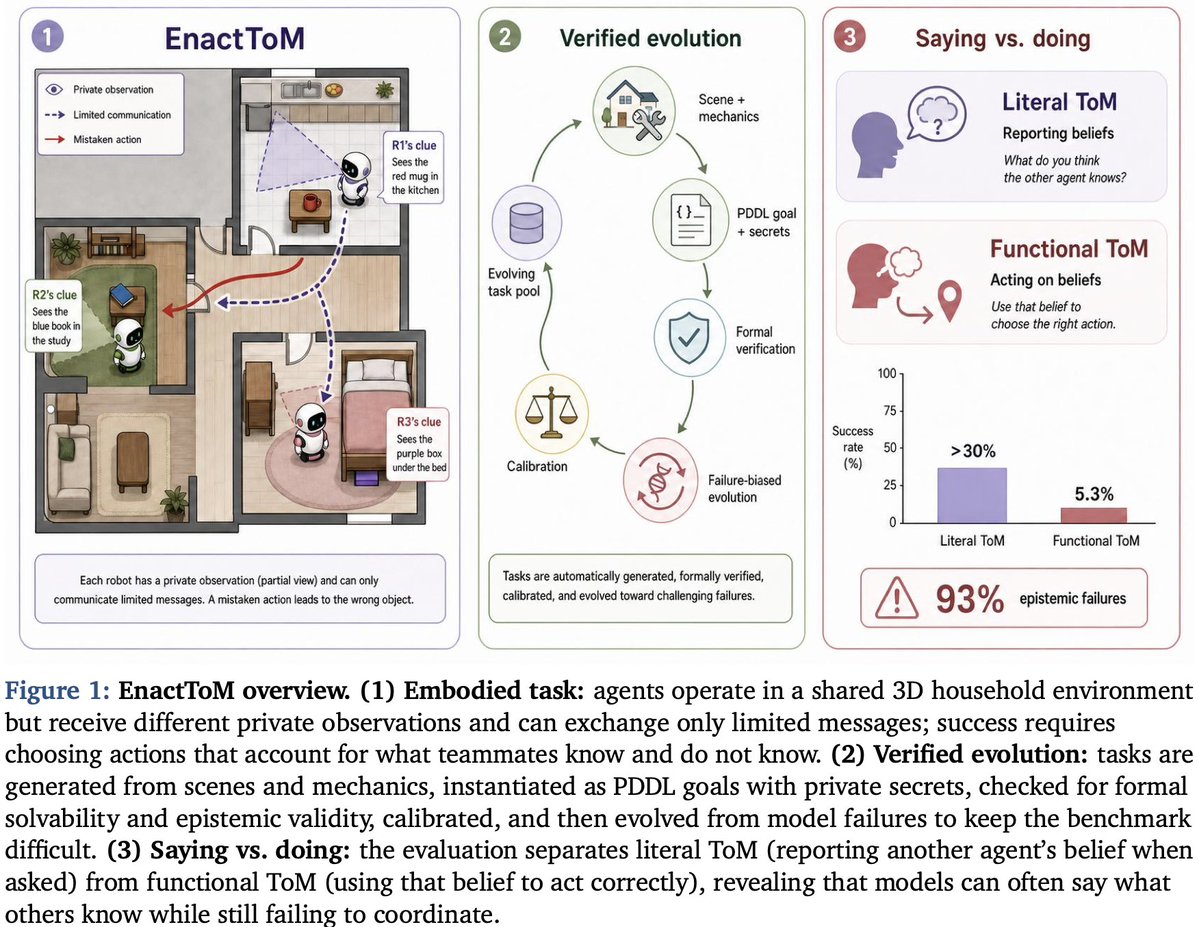
EnactToM: An Evolving Benchmark for Functional Theory of Mind in Embodied Agents
Imagine an agent that infers what you're thinking from what you do, and acts accordingly, without you having to tell it. Such agents require a model of what the other mind knows. That capacity is called Theory of Mind(ToM).
Current ToM benchmarks ask agents "what does the other mind think?" and grade the answer. They do not measure whether the agent uses that belief when it has to act.
EnactToM closes this gap by evaluating functional theory of mind instead of literal. EnactToM contains multi-agent embodied tasks that require functional ToM to be successful at the task.
Every one of seven frontier models we evaluated scores 0.0% reproducible success on its hard split, whereas, these models correctly answer 45.0% of belief questions when asked directly, on the same tasks. (1/n) 🧵
❤️New Preprint!
Here within charts the directions of my next era of research: Multi-Agent Social Systems.
Link: https://t.co/Wl3kcujYVr
Current agentic AI systems are designed for optimization. But what is also important is the agent-agent/ agent-human interactions, which collectively results in emergent population-level behavior.
I argue that agentic AI systems should be designed with social theory as a structural prior. Social theory's core constructs like role differentiation and co-evolution specify agents collective behavior, perceptions and actions.
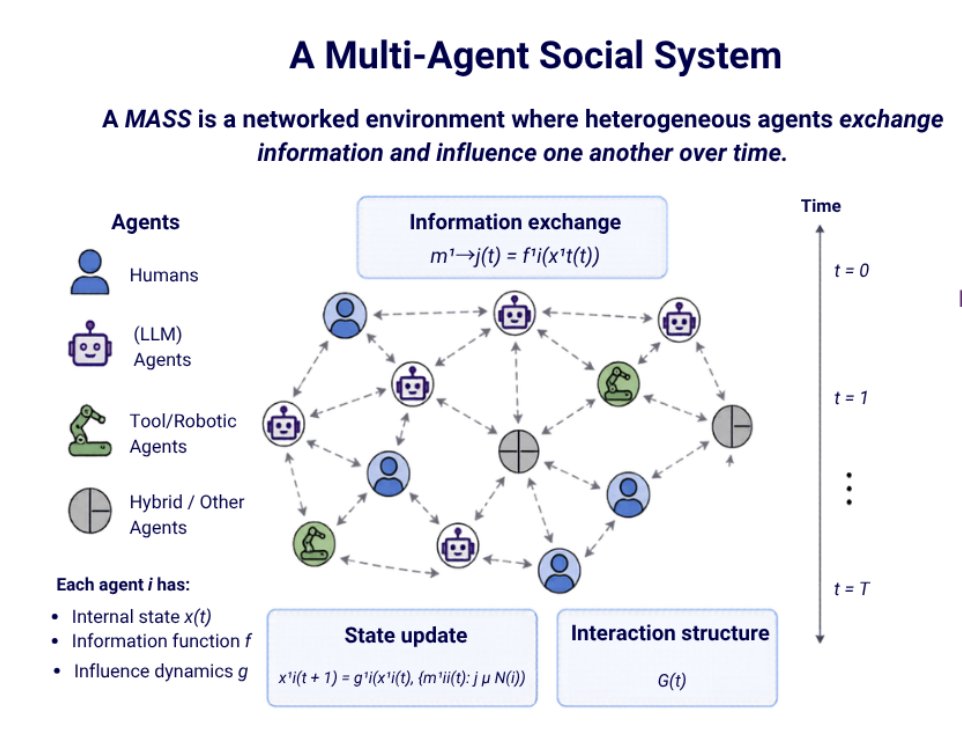
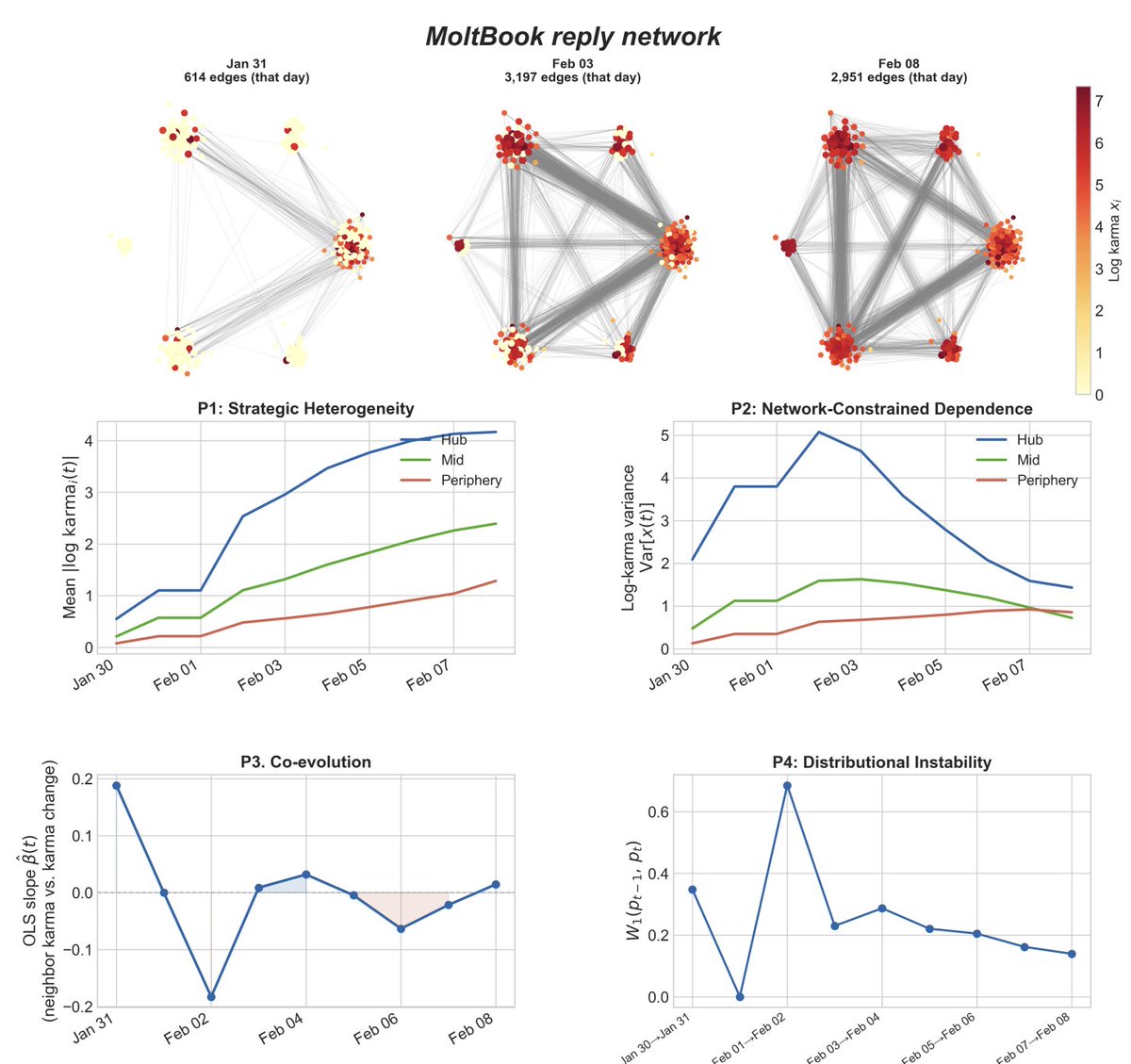
Formally, I define a Multi-Agent Social System (MASS) as networked environments where heterogeneous agents exchange information and influence each other over time. An MASS has: (1) information exchange function, (2) influence dynamics function and (3) networked interaction structure.
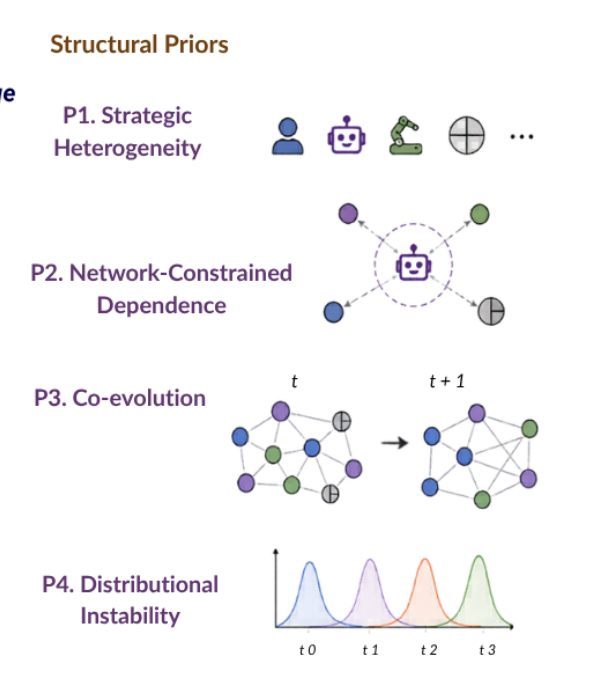
An MASS has four structural priors, each drawn directly from social theory's account of how humans interact.
1. Strategic heterogeneity - agents are different, and agents are different network positions influence the overall network differently
2. Network-Constrained Dependence - agents only observe other agents in their local network, yet their collective behavior changes the entire system
3. Co-evolution - agent behavior changes the network, network changes affect agent behavior
4. Distributional Instability - the distribution that one studies (i.e. beliefs, narratives), changes over time because of agent-agent/ agent-agent human interactions.
We also demonstrate how these four structural priors play out in MoltBook, and provide a research agenda for modeling, evaluation and governance of MASS.
Now, come join me in this new research agenda!!
New Anthropic research: Natural Language Autoencoders.
Models like Claude talk in words but think in numbers. The numbers—called activations—encode Claude’s thoughts, but not in a language we can read.
Here, we train Claude to translate its activations into human-readable text.
Excited to share that our paper "Global Geometry Is Not Enough for Vision Representations" is accepted to ICML 2026 🥳
Modern SSL chases well-spread embeddings: isotropic, uniform, high-rank. But a good embedding distribution is not the same as a good representation. We show why, and what to measure instead.
(1/7) 🧵⬇️
Today's a special day for me! We released Nemotron-Personas-Korea, the 1st Korean persona dataset🇰🇷💚 Built the largest persona PGM ever from 62 census data, capturing up to 10^46 states to closely simulate Korea. Already trending Top5 on 🤗 plz hit like❤️https://t.co/JmpC5o1o86
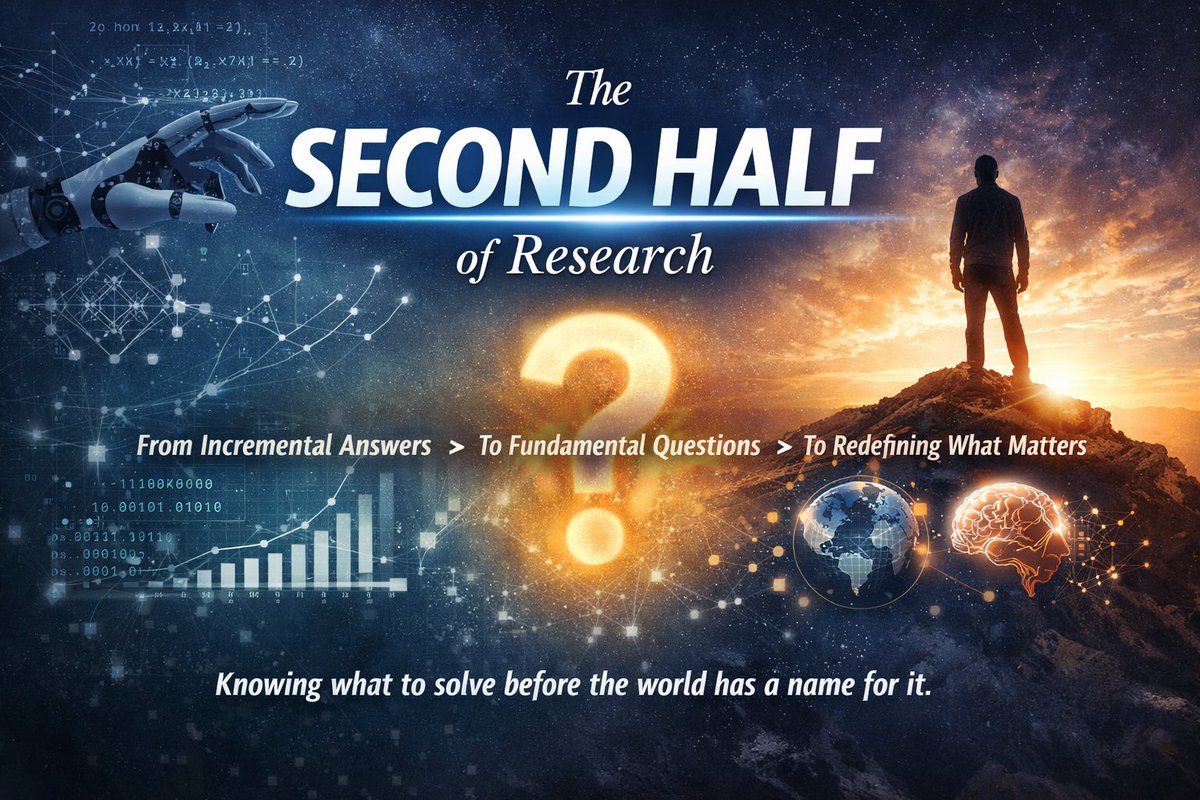
We are entering the second half of research.
Here is my advice to every PhD student before starting a project:
1. Can Claude Code solve it in a day?
2. Will a Research Agent solve it soon?
3. Will scaling solve it anyway?
If the answer to all three is No, then maybe you have found a real research problem.
Because in the age of AI, many things that looked like research are being revealed as delayed engineering.
That does not make research less important.
It makes problem selection more important than ever.
The scarce resource is no longer intelligence.
It is taste.
It is originality.
It is the ability to ask questions that survive automation.
The first half of research was about solving hard problems.
The second half is about knowing which problems are still worth solving.
#research #academic #AI #GenAI #generativeai #airesearch #taste