I'm looking for a Ph.D. opportunity in (non-cooperative) games + deep learning for Fall 2027!
Life update: after 3 years of work as a quant + 1.5 gap year, I'm returning to academia to work on multi-agent learning theory.
During the gap year, I got married, moved in to California, and wrote a small technical paper on nonconvex games which got accepted to COLT 2026.
Please feel free to DM me to chat, collaborate, or just to grab a beer!
[1/7] Recent breakthroughs in LLMs’ mathematical ability are genuinely surprising.
I recently solved a problem I had been unable to solve for seven years: the optimal acceleration rate for first-order methods under high-order smoothness assumptions in nonconvex optimization.
I'm excited to share some joint work done with @TaeHo_Y00N.
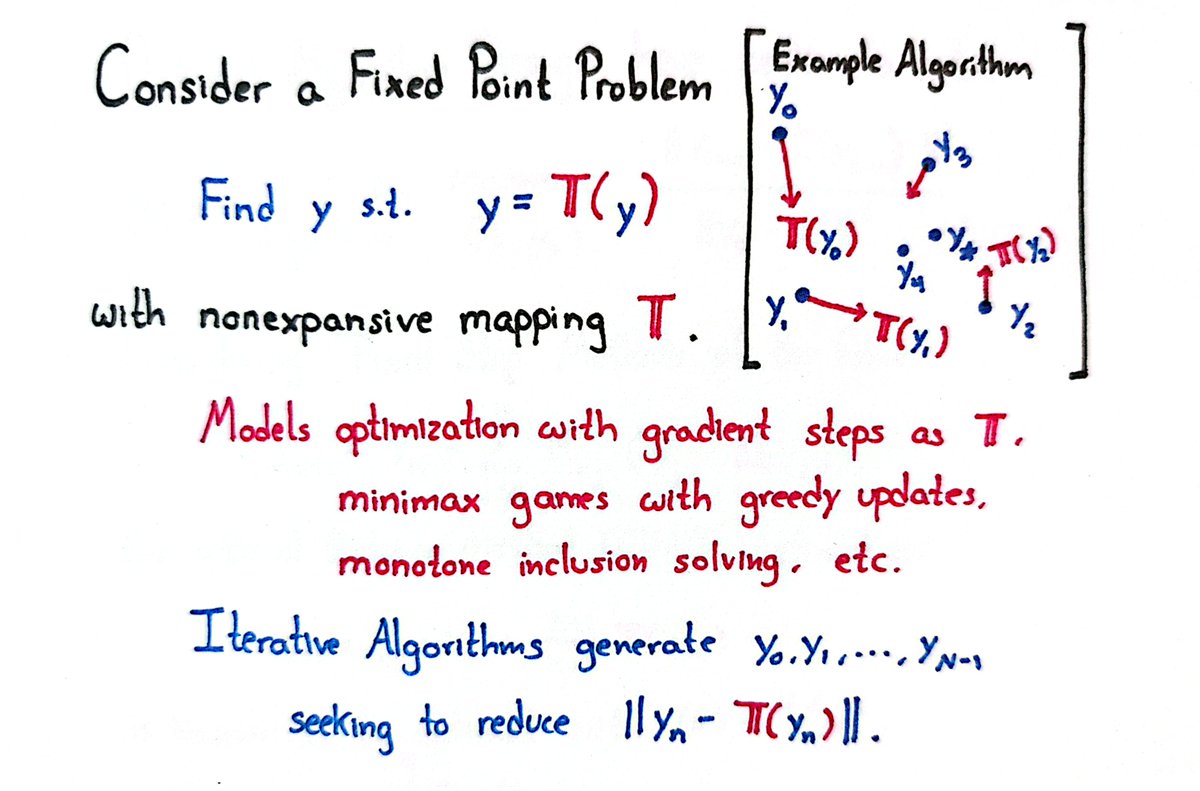
We considered algorithm design for fixed-point problems.
This area models gradient descent, minimax optimization, and more.
Below I give the wild ride of this paper.
Mathematically, it is gorgeous.
To solve hard open math problems, we need AI models to train and self-improve indefinitely without more external data.
Humans can self-improve, so AI should as well if it imitates humans.
So we let AI also conjecture, prove, and also be self-guided with some tastes.
New paper studies when spectral gradient methods (e.g., Muon) help in deep learning:
1. We identify a pervasive form of ill-conditioning in DL: post-activations matrices are low-stable rank.
2. We then explain why spectral methods can perform well despite this.
Long thread
Together with @yuxiangw_cs and Maryam Fazel, we are excited to present our tutorial "Theoretical Insights on Training Instability in Deep Learning" tomorrow at #NeurIPS2025!
Link: https://t.co/e4T1eI45Ql
*picture generated by Gemini
Adam prefers a different minimizer than SGD (exemplified below), but how? 🤔
Our NeurIPS 2025 Paper: Based on our Slow SDE approximation of Adam, we show that under label noise Adam implicitly minimizes tr(Diag(H)^½), whereas prior works showed that SGD minimizes tr(H).
🧵1/n
A common mistake that AI companies make nowadays is to not give their engineers enough time and mental calm to do their best work. Constant deadlines, pressure and distractions from daily AI news are poison for writing good code and systems that scale well. That’s why most AI APIs and products have reliability issues.
A good company culture that mixes excellence with focus and enough rest leads to faster and better results. The best example of how to do it well is the early Google culture from 1998 which resulted in one of the largest scale and most reliable services on the web in just a few short years. Founders should copy some of the strategies that Larry and Sergey used. They are still underrated IMO despite their huge reputation.
The Maximal Update Parameterization (µP) allows LR transfer from small to large models, saving costly tuning. But why is independent weight decay (IWD) essential for it to work?
We find µP stabilizes early training (like an LR warmup), but IWD takes over in the long term! 🧵