🎉 Our paper has been accepted to #ICLR2026! 😆💖
This work was done during my internship at LG AI Research – Superintelligence Lab. As summarized in the project:
Deep research requires broad evidence coverage and reliable synthesis.
HybridDeepSearcher achieves both by parallel retrieval for breadth with sequential reasoning for depth, supporting scalable search.
🔗 Project page: https://t.co/vKPfc0hAe1
📄 OpenReview: https://t.co/pWBlwdGjvL
Huge thanks to my mentors and co-workers for their guidance and support throughout this project. We also plan to release related work soon. Stay tuned! 😊
If you’re coming to #ICML2026 🇰🇷, this Seoul Guide might be All You Need!
I’ve lived in Seoul for 20+ years and curated this all-in-one guide: Top 5 must-visits, 100+ recs with Google Maps, practical local tips, and more.
Check it out: https://t.co/AdN1sHMg1I
DMs are open and happy to give more details!
🤔Can experience optimizing in one domain (e.g., faster kernel design) transfer to a very different domain (e.g., open mathematical conjectures)?
💡We found that this kind of cross-domain optimization is possible through Evolution Fine-Tuning (EFT).
🤗https://t.co/OBIzl8IVPX
We introduce Evolution Fine-Tuning (EFT), a mid-training paradigm that teaches LLMs how to discover from evolutionary search trajectories. We train 🐦 Finch 2B–9B on the Finch Collection — 156K trajectories spanning 371 tasks — and it surpasses its base models by +10.2% on 22 held-out tasks, with emergent cross-domain transfer. ⬇️⬇️⬇️
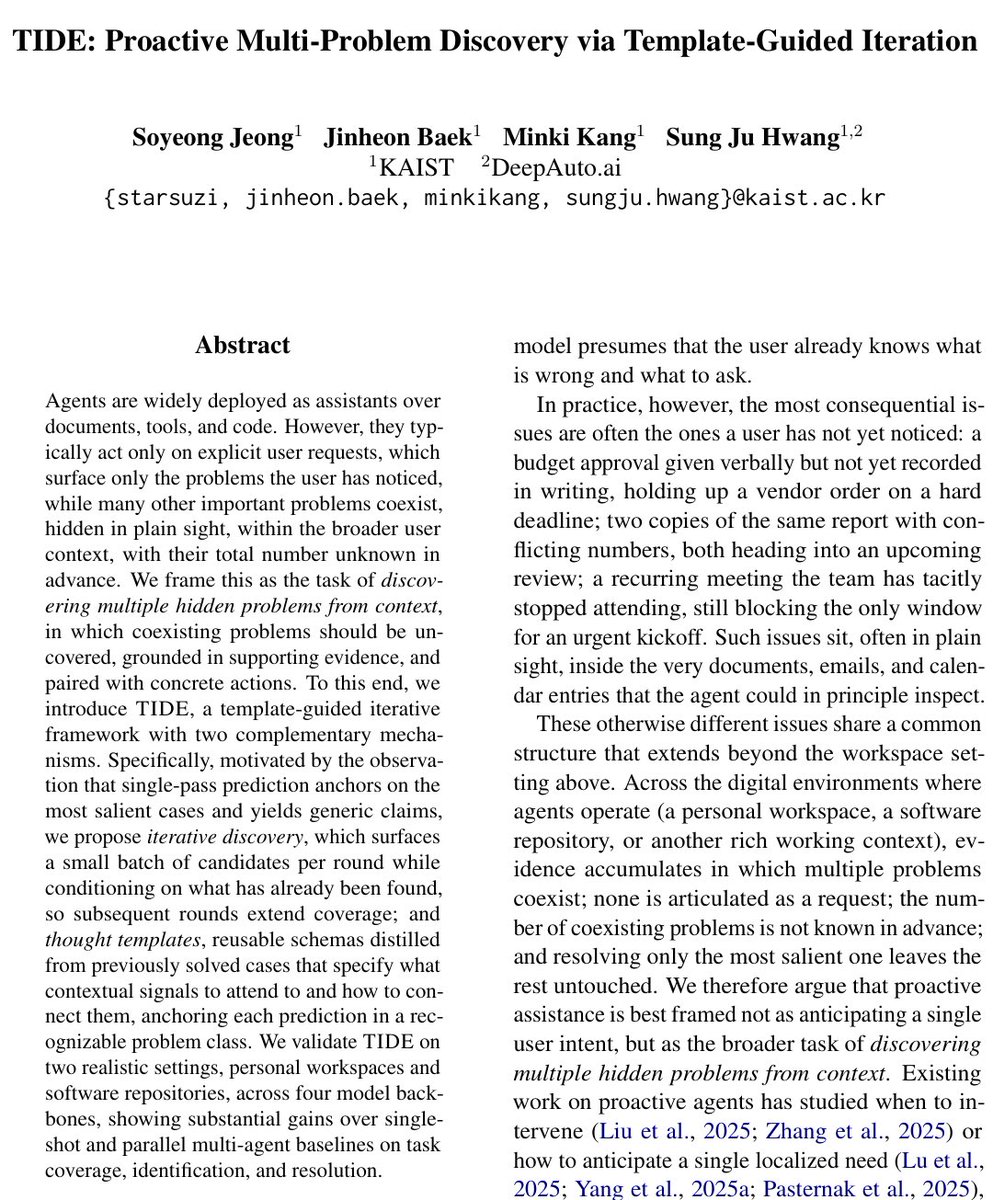
🚨Most AI agents solve only the problems users explicitly ask about.
But what about the problems users haven’t noticed yet?
🌊TIDE enables proactive multi-problem discovery, helping agents uncover hidden issues 🔍 and recommend actionable next steps ✅.
https://t.co/9mKNS7t634
🇰🇷Despite rapid progress in AI agent research, Korean agentic benchmarks remain largely absent!
To narrow this gap, we release K-BrowseComp, a benchmark that requires searching across Korean websites and Korean-language content.
https://t.co/kuHby48uif
Existing work on AI Reviewers primarily rely on superficial metrics such as correlation against human scores. However, even if the scores are matching, the actual content of the reviews drastically differ between human and AI.
Here, 45 scientists actually review the contents.
Today's a special day for me! We released Nemotron-Personas-Korea, the 1st Korean persona dataset🇰🇷💚 Built the largest persona PGM ever from 62 census data, capturing up to 10^46 states to closely simulate Korea. Already trending Top5 on 🤗 plz hit like❤️https://t.co/JmpC5o1o86
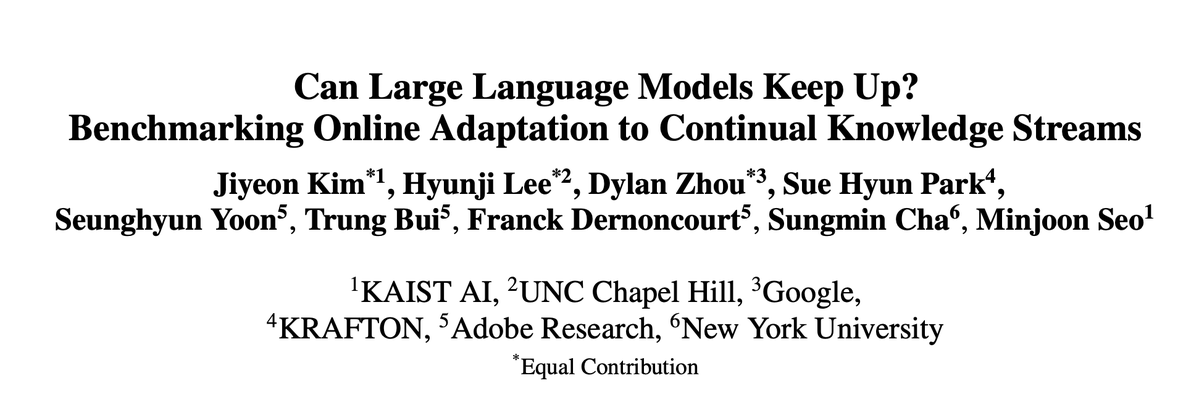
🌎Real-world knowledge evolves constantly and emerges incrementally.
Can LLMs adapt to new information on the fly?
🤯Frontier models and agentic approaches all struggle, missing when to update the fact, or getting distracted by irrelevant information.
We introduce ✨OAKS✨, a benchmark for evaluating models’ online adaptation to streaming, continually updating knowledge.
Hybrid Deep Searcher: Integrating Parallel and Sequential Search Reasoning
HybridDeepSearcher from LG is a Qwen3-8B model fine-tuned on HDS-QA (1,987 hybrid-hop questions, 2,111 correct trajectories) to distinguish parallel from sequential queries. It integrates both modes in structured reasoning–query–retrieval loops, cutting latency, broadening evidence retrieval, and scaling accuracy where sequential or naive multi-query baselines plateau.
- HDS-QA: synthetic hybrid-hop dataset from Natural Questions, mixing independent parallel queries with dependent sequential steps
- Training / Mechanism: Qwen3-8B fine-tuned for 1 epoch (lr 3e-5, batch 4, grad accum 32) on supervised trajectories with <think> reasoning and multi-query blocks; structured reasoning alternates with query–retrieval cycles, issuing parallel queries when possible to reduce turns and scale with budget
Results:
- FanOutQA: 15.9 F1 improvement
- BrowseComp-50: +11.5 F1 with fewer turns
- Evidence retrieval: 61% (FanOutQA), 55.8% (FRAMES), 40.7% (MuSiQue) vs 53/49/38 baselines
- Efficiency: highest AUC, answers in fewer turns, keeps improving with more turns/calls
When Is Enough Not Enough? Illusory Completion in Search Agents
@dayoon12161 et al. introduce a framework to diagnose illusory completion in search agents, where agents falsely believe tasks are complete despite unverified constraints.
📝 https://t.co/lSwrRm8KjY
🎉 Our paper has been accepted to #ICLR2026! 😆💖
This work was done during my internship at LG AI Research – Superintelligence Lab. As summarized in the project:
Deep research requires broad evidence coverage and reliable synthesis.
HybridDeepSearcher achieves both by parallel retrieval for breadth with sequential reasoning for depth, supporting scalable search.
🔗 Project page: https://t.co/vKPfc0hAe1
📄 OpenReview: https://t.co/pWBlwdGjvL
Huge thanks to my mentors and co-workers for their guidance and support throughout this project. We also plan to release related work soon. Stay tuned! 😊
Thanks for the thoughtful feedback and for highlighting this important distinction!
Deep research can be defined in many ways. From a claim discovery perspective, as in Microsoft’s LiveDRBench, the core challenge is searching for and surfacing relevant real-world information.
As you note, another important framing is research as producing strict, well-justified, bounded claims. We agree this is a critical problem. However, this work is intentionally scoped to the former, and we hope other lines of research will address the latter.
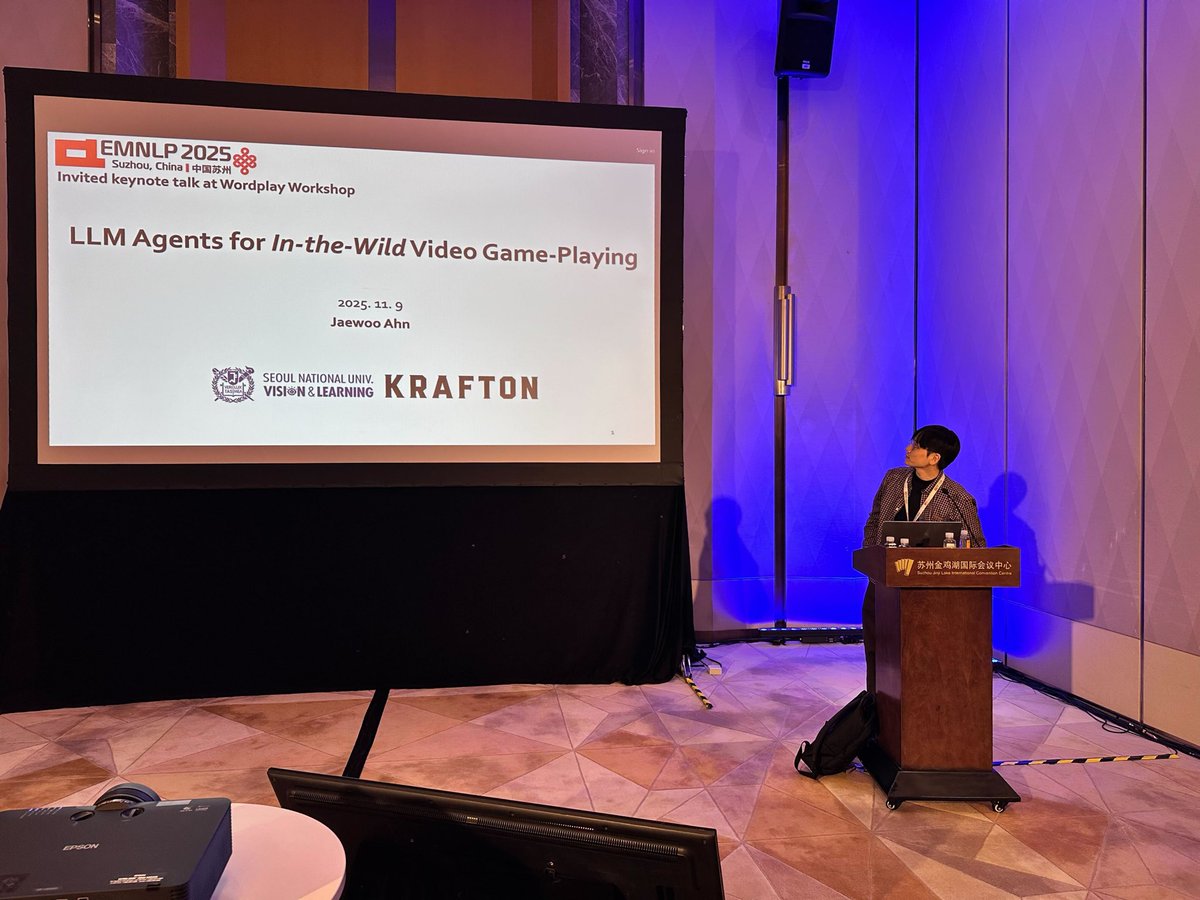
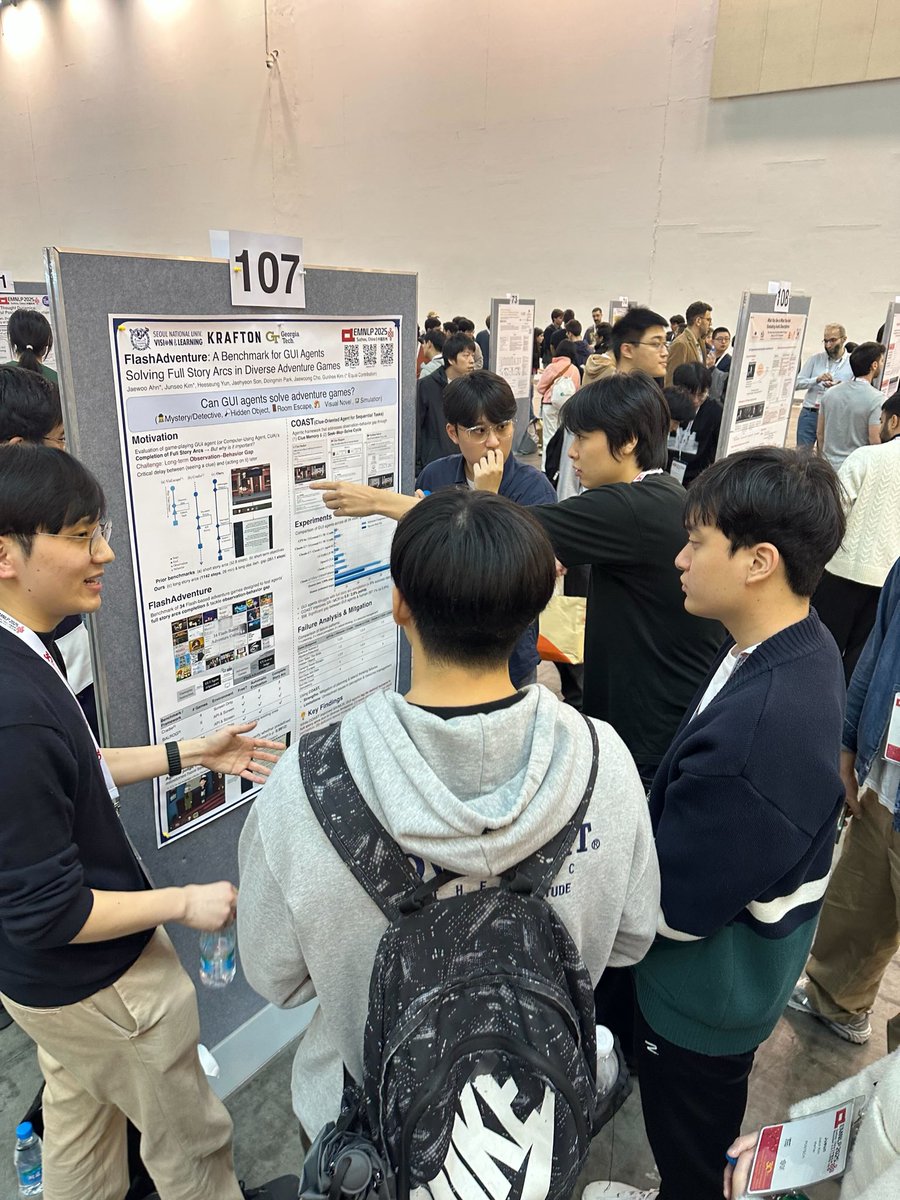
I had a great #EMNLP2025 experience in Suzhou 🇨🇳!
✔️ (Main) Poster Presentation
✔️ (Wordplay Workshop) Outstanding Paper Award
✔️ (Wordplay Workshop) Keynote talk
Thanks to my incredible collaborators and all people I had the pleasure of meeting ✨!
🧐 LLMs aren’t great at judging their own correctness.
❗But history across models helps! We present Generalized Correctness Models (GCMs), which learn to predict correctness based on history, outperforming model-specific correctness and larger models' self-confidence.