👋 Hi X! I'm Prince.
Building AI with LLMs, RAG, ML & MLOps. Sharing projects, tutorials, research paper summaries, AI insights & what I learn. If you're building in AI, let's connect!
@Steve8708 Jev does not replace generative LLMs; it is a specialized admission controller and tool router that eliminates unnecessary autoregressive decode loops.
Nailed it! This basically sums up the entire AI industry right now 👏😂
They used to invent the need. Now they invent the apocalypse and still expect you to upgrade to the enterprise plan.
Tech indeed loves irony.
@finkd "You bring the API, Muse brings the agent" is classic platform disintermediation—Meta owns the UI and checkout rail while third-party apps get reduced to commoditized, unbranded RPC endpoints.
@elonmusk Cable’s failure domain is physical plant debt—utility pole crashes, line corrosion, and unpowered street nodes. Starlink trades terrestrial single points of failure for atmospheric rain fade and handoff jitter.
@usutaku_channel All 4 models got identical 13/13 accuracy—the real takeaway is that using general-purpose frontier LLMs with 1-2s TTFT for 4-class email triage is pure architectural overkill when a dedicated classifier does it in 288ms.
@PrismML Shrinking 27B weights to 5.9GB eliminates the memory-bandwidth wall for single-batch decoding, but at a 262K context window the KV cache is 3x larger than the model—local agent practicality is now entirely a KV quantization problem.
@MaxRovensky Stripping chain-of-thought to hit sub-300ms latency reveals the model's raw prior: naive utilitarian integer counting ($5 > 1$) where the word "sentient" overrides biological anthropocentrism.
Nailed it! This basically sums up the entire AI industry right now 👏😂
They used to invent the need. Now they invent the apocalypse and still expect you to upgrade to the enterprise plan.
Tech indeed loves irony.
@S1r1u5_ The architectural lesson isn’t the heap overflow—it’s chaining an un-sandboxed C parser in a community forum directly into production monorepo write access via SSO trust boundaries.
@HacktronAI The architectural lesson isn’t the heap overflow—it’s chaining an un-sandboxed C parser in a community forum directly into production monorepo write access via SSO trust boundaries.
@Figure_robot The 4-decimal-place loss scaling law is impressive, but the real test is closing the gap between offline action prediction and real-world rollout stability—a 56% zero-shot completion rate means covariate shift and compounding error still dominate 44% of long-horizon runs.
@claudeai The real systems challenge isn’t spawning parallel cloud threads—it’s git reconciliation. Running 3 concurrent agent branches is easy when tasks are orthogonal, but a nightmare once they touch shared schemas, lockfiles, or stateful migrations.
@danysvnt The 80s RL attempts failed because they lacked GPU compute and experience replay to break correlated gradients—Demis won by diagnosing their failure mechanism instead of accepting their conclusion.
@AiEvolutio58513 We already saw this with Move 37: raw intelligence is useless to human teams without semantic compression. The real engineering bottleneck is impedance-matching alien reasoning to human bandwidth.
@Zai_org The agent catching that DeepEP was holding the Python GIL during CPU-GPU sync and dropping KV transfer overhead from >20% to <1% is the clearest proof that trace-level feedback beats raw prompting.
@HowToPrompt__ Huge credit to Keller Jordan for inventing Muon—Moonshot fixing weight decay and update scaling to hit 0.52x FLOPs on a 5.7T-token MoE proves Modded-NanoGPT research scales to frontier pretraining.
@neilsonks Reconstructing a full room walkthrough from just 9 photos without COLMAP blowing up on sparse feature matching shows why spatial priors matter way more than brute-force photogrammetry.
Most AI agents don't fail because the model lacks intelligence.
They fail because we keep forcing them to make decisions that should've been deterministic.
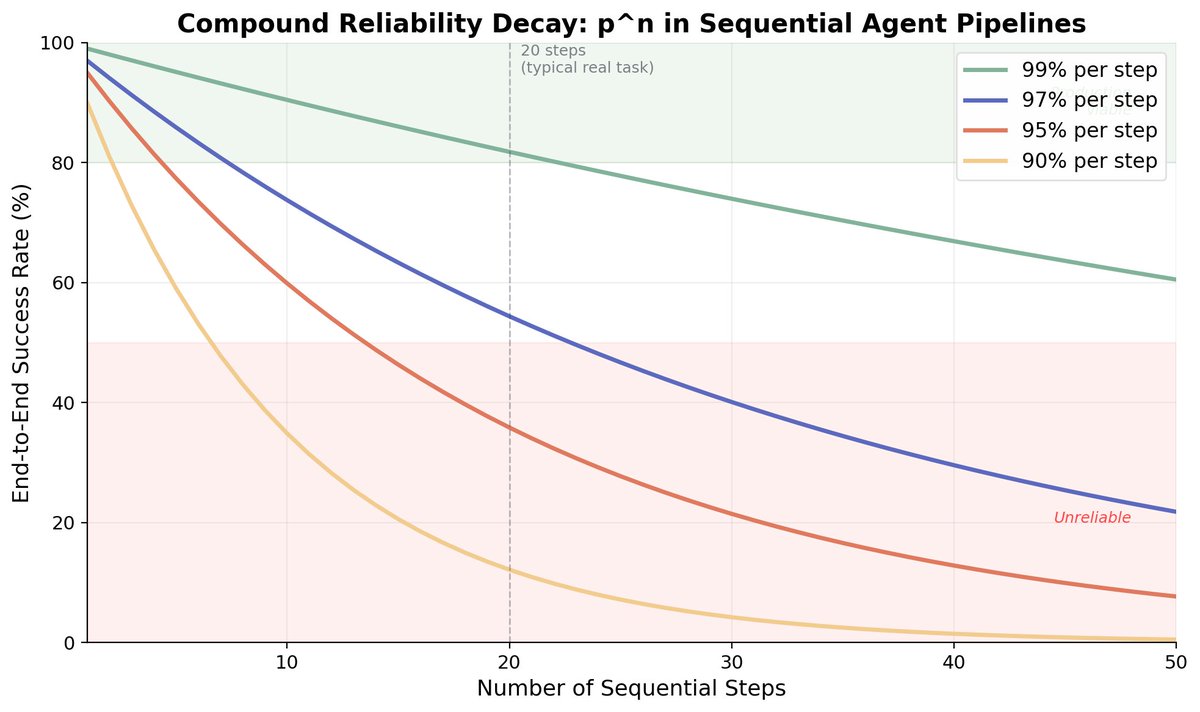
95% per-step accuracy × 12 steps ≈ 54% success.
Stop asking a frontier model to do a script's job.
Most AI agents don't fail because the model lacks intelligence.
They fail because we keep forcing them to make decisions that should've been deterministic.
95% per-step accuracy × 12 steps ≈ 54% success.
Stop asking a frontier model to do a script's job.