I decode the markets every week on Market Forces. High-signal insights for the modern investor. Follow here, on YouTube and my newsletter. | Founder & CIO
Bessent: “We will grow our way out of debt.”
Real GDP growth:
2023: +2.9%
2024: +2.8%
2025: +2.1%
2026: +1.5% (Q2 annualized)
US debt growth:
2023: +7.2%
2024: +6.9%
2025: +6.1%
2026: +7.5% (last 12 months)
Debt is growing 2–3× faster than the economy.
You don’t grow your way out of debt when the debt is outrunning growth every single year.
It’s not looking good.
Average token costs have collapsed from a high of $2.07/mil tokens on May 28 to $1.02/mil tokens. Main drivers are price cuts to OpenAI's models and new open-source models from Kimi & DeepSeek (which tend to be several multiples cheaper than closed-source models).
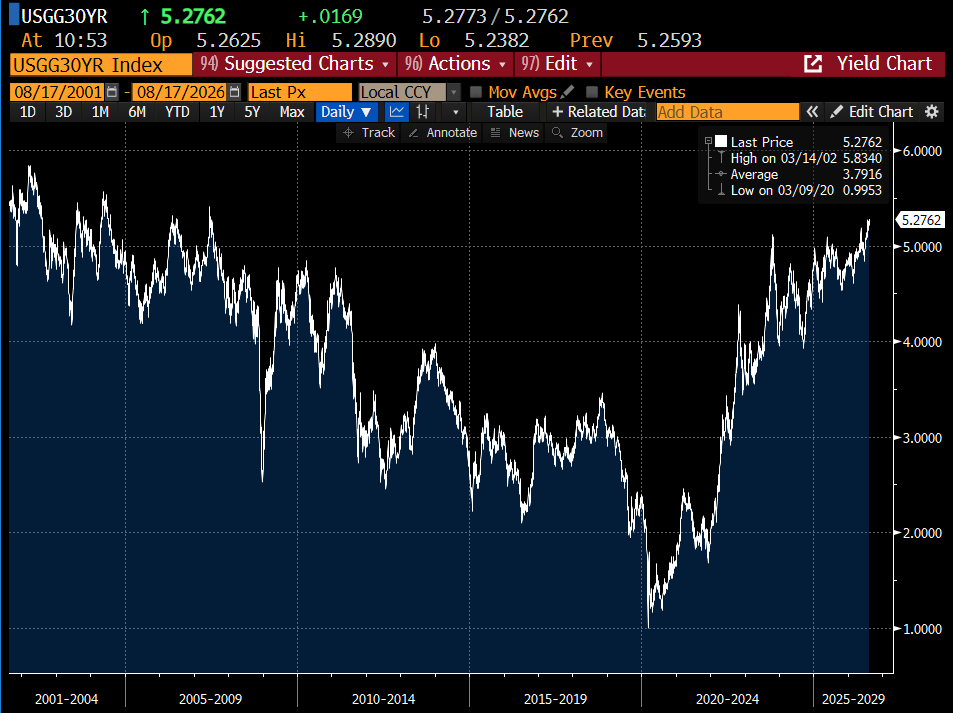
Slowly and steadily, the 30-year US Treasury yield is heading toward 5.30%, a level the economy -- and the housing market in particular-- has not seen in decades.
(Bloomberg chart below.)
#economy#housing#markets#bonds
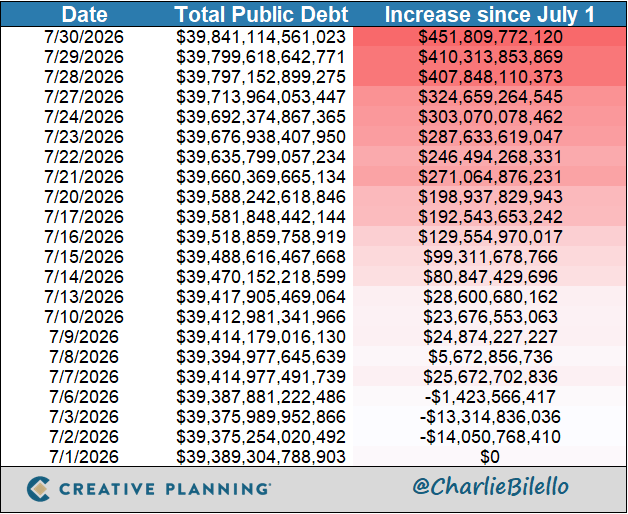
Absolutely insane stat: The U.S. has added $450 billion to the national debt since July 1. That’s over $15 billion a day.
“There are two ways to enslave a country. One is by the sword. The other is by debt.” – John Adams
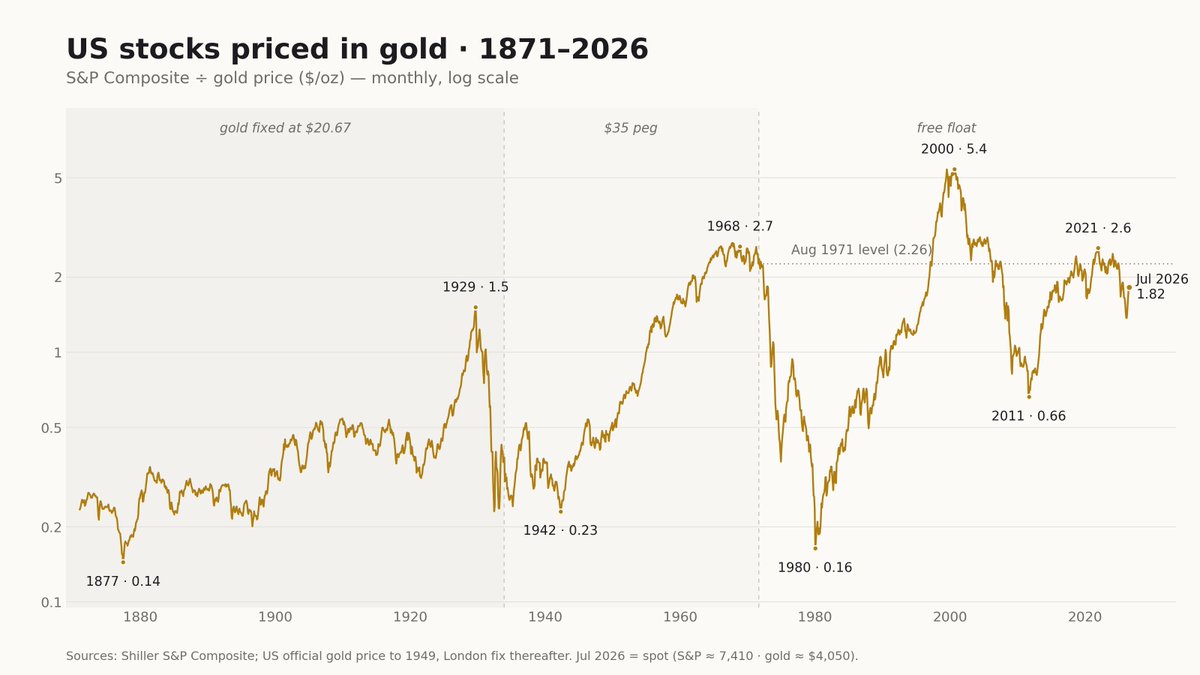
The US stock market peaked 26 years ago.
Priced in gold, the S&P 500 is still down 66% from its 2000 high.
It is LOWER today than the day Nixon closed the gold window.
You just don't see it — because you measure your life in dollars.
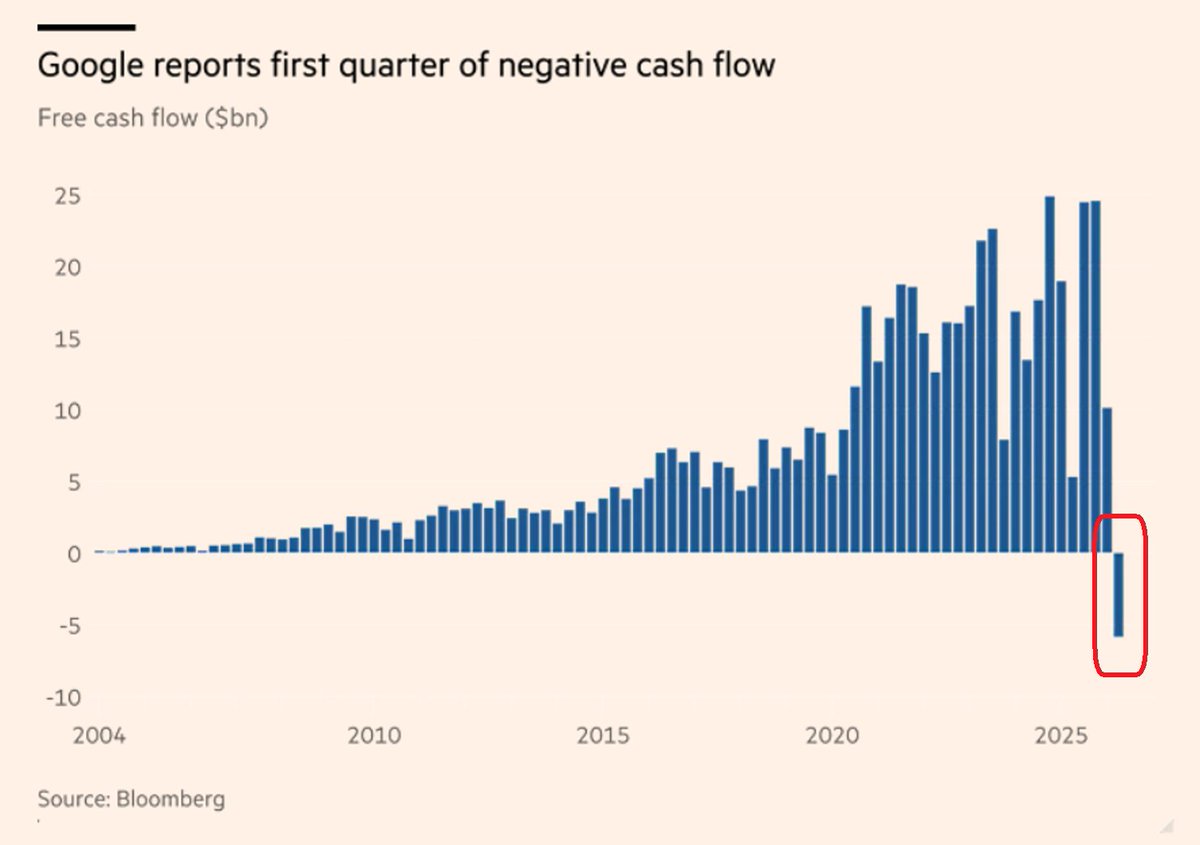
‼️Google just posted negative free cash flow for the first time since going public:
Alphabet's free cash flow turned negative to -$5.9 billion in Q2, marking its first negative quarter since the company's August 2004 IPO.
This comes as capital expenditures surged to $44.9 billion for the quarter, driving the company to raise its full-year 2026 CapEx guidance for the second time this year, to $195-205 billion from a prior $180-190 billion.
Alphabet, $GOOGL, has also taken on ~$100 billion in debt and raised ~$85 billion through its first share sale in over two decades, a sharp reversal after years of buying back its own stock.
As a result, investors are increasingly questioning whether the world's biggest hyperscalers are still investing to win the AI race, or spending at a pace that is beginning to erode the earnings power that justified the investment thesis in the first place.
Alphabet was seen as the hyperscaler best positioned to absorb the AI arms race, this quarter suggests even Google isn't immune to it.
Red or blue, the national debt only moves in one direction: up.
The one thing both parties seem to agree on is sending the bill to future generations.
Next stop: $40 trillion.
The problem with the $2 trillion in circular AI financing is that it is all contingent on the frontiers (Anthropic/ OpenAI) being money good on their $1.5+TN in unfunded commitments. Which they won't be if Chinese open LLMs grab market share
Hence the push against Chinese LLMs