Last year, Project ECHO engaged 554 professionals from 184 organizations, equipping them with knowledge, confidence and support to deliver high-quality, equitable dementia care. Read the full annual report to learn more about the impact of Project ECHO: https://t.co/2XdL4RVnln
The Alzheimer’s Association Project ECHO aims to expand workforce capacity through a proven telementoring model, reducing geographic barriers to high-quality dementia care.
The updated @WHO guideline on dementia risk reduction reflects a growing evidence base for protecting brain health. The Alzheimer's Association-led U.S. POINTER study, published in @JAMA_current, helped build that evidence. Learn more: https://t.co/50vHFTluG9
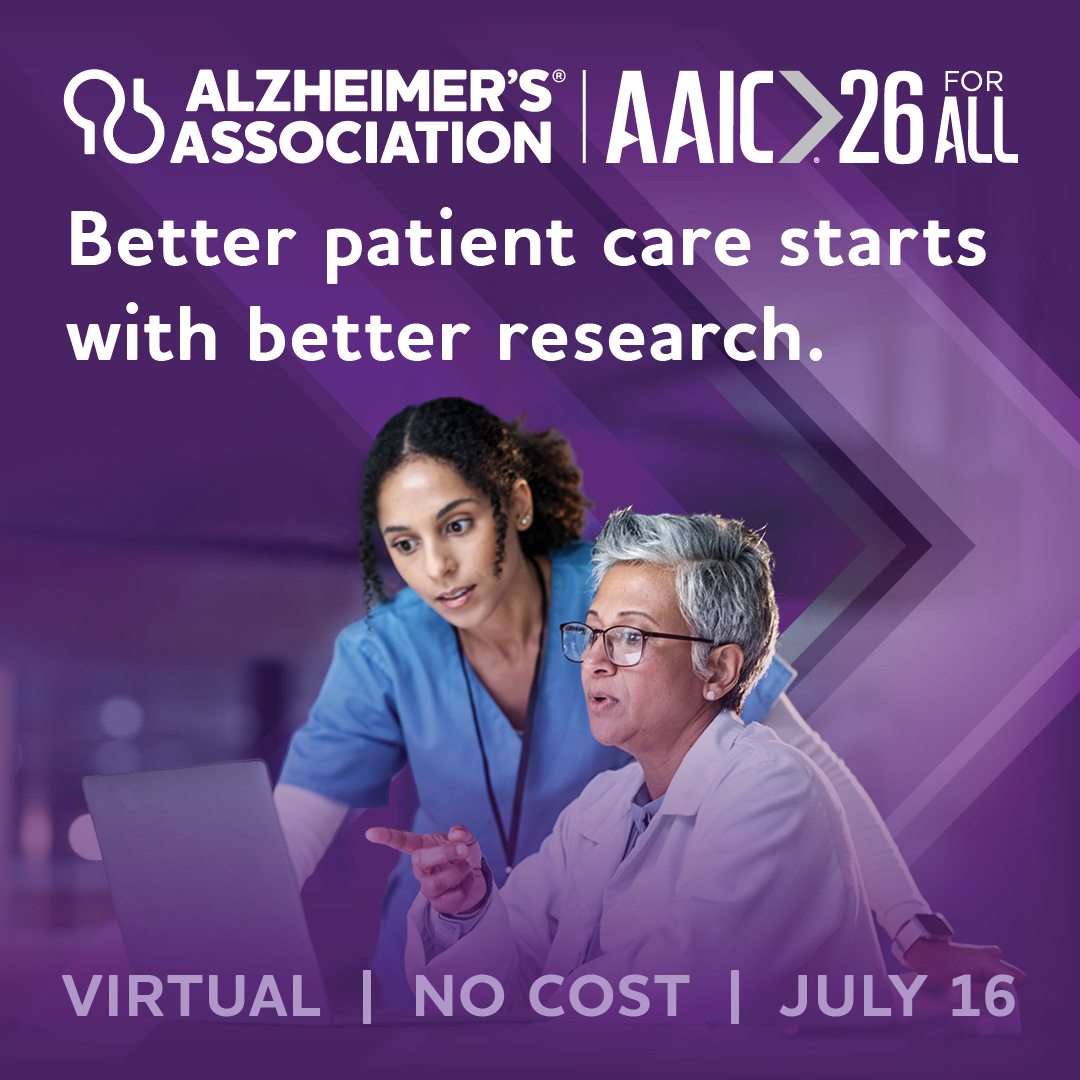
Research presented at #AAIC26 has the potential to shape the future of dementia science. Couldn’t make the conference? Join #AAICForAll tomorrow, July 16 (available online or in London, UK) & stay updated with the latest tools & insights in the field: https://t.co/mTeRn0qvYq.
Research presented at #AAIC26 has the potential to shape the future of dementia science. Can’t make the conference? Join #AAICForAll on July 16 online or in London, UK, & stay updated with the latest tools & insights in the field: https://t.co/mTeRn0qvYq.
Health care leaders and providers, join us for the Alzheimer’s Association Health Care Summit: Advancing Quality and Innovation.
Learn actionable strategies to improve quality care, lower total cost of care and strengthen dementia care systems. https://t.co/bPaPxJGCnk
Dementia science investigators & researchers: submit your brain health related manuscripts & bring your voice to this accelerating topic in dementia science. Visit the new @alzdemjournals brain health section to learn how you can contribute your work: https://t.co/3Nu3u6KinY
We’re excited to announce the launch of the Alzheimer’s Association Brain Health Advancement Institute (BHAI) — a new platform for brain health science, professional education and systems-level partnership. Learn more ➡️ https://t.co/bhvXoQw7HG.
#BrainHealth#AlzResearch
Today is END ALZ Day – a call to move evidence into everyday care.
For clinicians, that means applying what research shows: addressing physical activity, nutrition, cognitive and social engagement, and overall well‑being can meaningfully reduce the risk of cognitive decline.
The @alzassociation is leading the effort to turn dementia science into clinical action, equipping providers and their teams with evidence-informed tools and guidance to support patients and their care partners at every stage.
Tomorrow is END ALZ Day – a moment to turn evidence into action.
The Alzheimer’s Association’s 10 Healthy Habits for Your Brain guides brain health for individuals & families. Learn more and implement them in your practice: https://t.co/3PVug8jUuj
The Roundtable is a noncompetitive consortium designed for leaders who want to stay ahead of the science, exchange real-world strategies and help shape the future of dementia care.
If this work resonates with you, consider joining the Roundtable: https://t.co/Dd5xVnWjF4
Bringing leaders together to shape the future of dementia care is how real progress happens.
In March, the Dementia Care Provider Roundtable held its first in-person meeting of 2026.
The discussion included:
• Updates on blood-based biomarkers and the U.S. POINTER study from @CourtneyKloske
• Brain health strategies, including the MIND diet, from Maggie Moon, MS, RD
• Peer exchange on advancing quality dementia care across diverse care settings
Explore the latest issue of #TRCI for key takeaways from the spring 2025 @alzassociation Research Roundtable on advances in biomarkers, prevention & treatment approaches before cognitive symptoms #AlzResearch
https://t.co/eXAO1U6JKN
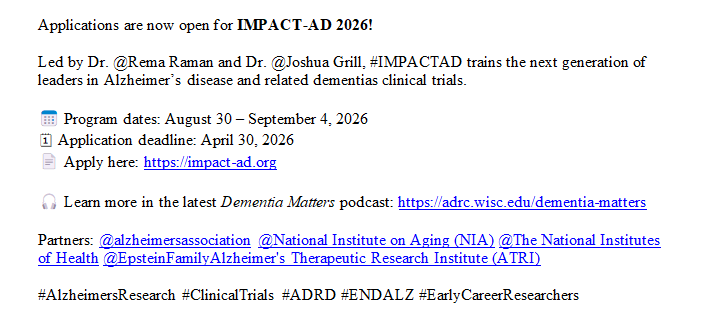
Applications are now open for IMPACT-AD 2026!
Led by Dr. Rema Raman and Dr. Joshua Grill, #IMPACTAD trains the next generation of leaders in Alzheimer’s disease and related dementias clinical trials.
Apply here: https://t.co/CdH93fOU9N
Earlier detection of AD is rapidly advancing.
A recent @alzassociation Research Roundtable explored how biomarkers, emerging therapies & health system readiness could support identifying & addressing Alzheimer’s before symptoms begin: https://t.co/RvXRHyZTCG
@alzdemjournals#TRCI