📢 @XilinxInc is now @AMDembedded
New name. Expanded content. Bringing together a highly complementary set of adaptive computing and embedded solutions to solve some of the world's most important challenges.
#togetherweadvance#adaptivecomputing
AMD ROCm software gives developers a path to carry CUDA code and years of engineering investment forward.
Explore HIPIFY, agentic AI skills, and free migration training from AMD.
Don’t rewrite. Migrate. https://t.co/ScRGGzqngB
Introducing AMD EPYC Embedded 9006 Series SP7 CPUs, featuring “Zen 6” architecture and up to 256 cores for semiconductor automated test equipment, enterprise storage controllers and next-generation firewalls.
Scale your next design with PCIe® Gen 6 and CXL® connectivity, and higher memory bandwidth, gen-on-gen. Strengthen long-term cyber resilience with dedicated security engines and post-quantum signature verification.
Explore AMD EPYC Embedded 9006 for your next design: https://t.co/igapUzJDuB
With AMD embedded and adaptive technologies, Kiloview delivers real-time 4K video processing in compact, scalable systems, helping broadcast and professional AV teams support more streams and flexible workflows.
Read the case study to learn more: https://t.co/GEfYR1iR82
Learn how the AMD Kria AI Developer Platform gives developers the CPU and GPU compute needed to build autonomous and robotics applications in this interview with Kirk Saban, CVP of embedded products and software solutions at AMD.
Full details: https://t.co/P8SyMtxcod
Physical AI comes to life when compute, software and robotics work together.
That system-level approach was at the heart of AMD’s presence at the Minds in Motion Physical AI Summit at MIT last week, from Mark Papermaster’s opening keynote to three packed developer workshops and live demonstrations of AMD powered robots. Across the workshops and demo floor, we connected with researchers, students, startup founders and industry leaders exploring how to bring intelligence into the physical world.
Thank you to Imagination in Action (@imaginationxyz) for hosting the summit in partnership with MIT, and to John Werner and Daniela Rus for hosting Mark’s keynote. Special thanks to @MassRobotics and to @MIT_CSAIL for helping bring this community together.
Robots that see, reason, and move have traditionally distributed those tasks across multiple processors, memory domains, and software stacks.
AMD Ryzen AI Embedded processors bring the CPU, integrated GPU, and NPU together on one chip with a shared memory pool, reducing data copies, eliminating the PCIe® hop to a discrete accelerator, and avoiding cloud round trips.
Join this webinar with @Ultralytics to learn our solution and carry over to your own workload. https://t.co/OPrYDDRHyx
Safety credibility is measured in certified flows and usable evidence, not a feature announcement.
Explore AMD tools and methodologies for adaptive SoC and FPGA functional-safety designs ➡️ https://t.co/VwdzsLqf7e
As robots take on more dynamic tasks, they need computing power to adapt in real time.
Michael DeGrace of @Universal_Robot discusses how AMD embedded technology can support that adaptability and why open architecture matters when building robotic solutions.
Decades of adaptive computing leadership. Innovation for what's next.
As intelligent edge systems and physical AI evolve, adaptive SoCs and FPGAs are becoming increasingly important.
In his latest blog, Salil Raje, SVP and GM of the AMD Embedded business, shares his perspective on the state of adaptive computing and opportunities ahead. https://t.co/JIeqrRNonH
More bandwidth. Less board space.
Discover how AMD Versal Premium Gen 2 Memory on Package integrates up to 32 GB LPDDR5X and delivers up to 288 GB/s to simplify design, reduce respins, and accelerate time to market. https://t.co/0auuONbJCq
In this interview with @theCUBE, Kirk Saban, CVP of embedded products and software solutions at AMD, discusses how AMD is simplifying the path for robotics developers with an easy-to-use platform that leverages AMD ROCm software and brings agentic AI capabilities into the embedded development stack.
View full discussion: https://t.co/lx7Y6ABFiP
The CEO of @G_Bionics, @Daniele_Pucci_, shares his perspective on the future of robotics in a conversation with Salil Raje, SVP and GM of the AMD Embedded business, and Kirk Saban, CVP of Embedded Products, Software and Solutions. Together, they discuss the evolving role of physical AI and the technologies needed to support it.
Watch here to learn more: https://t.co/nt569TlWfs
Peak specs tell only part of the story. In robotics, performance means keeping AI, perception, planning, and control moving together in real time.
See what the Open Navigation benchmark reveals about AMD Ryzen AI Embedded X100 Series: https://t.co/aX0kjXfkUj
AMD Vitis Hardware in the Loop (Vitis HIL) helps validate earlier, reduce costly lab iterations, and accelerate deployment.
See how Adam Taylor (@ATaylorFPGA) applies Vitis HIL to test real-world heterogeneous designs with greater confidence: https://t.co/UZ8GHmzrXw
Great to see the FPGA community come together at #FPGAHorizons London!
AMD highlights included Kirk Saban’s keynote and our hands-on Agentic AI workshop, showcasing how the AMD Ross Agentic AI Assistant is changing adaptive SoC development.
🎬 Take a look at the highlights!
Physical AI is about more than how fast a model can run. It's about whether the entire system can act in time.
Salil Raje, SVP and GM of the AMD Embedded business, explains why robotics needs a system-level approach, with the right compute for AI reasoning, real-time control and coordination.
Read the blog: https://t.co/LC682ihgHv
Embedded development, meet agentic AI.
Dive into @Forbes latest piece on AMD Ross, a new agentic AI assistant that dramatically accelerates the entire embedded design and development cycle by bringing natural-language tool interaction and expert-authored workflows together in a single agentic AI experience: https://t.co/IfW3OjWJ4E
And that’s a wrap on the 2026 Embedded Computing Summit (ECS) Global Technical Tour! 🌍
From North America to EMEA, Greater China & APJ, thank you to every customer, partner, speaker and AMD expert who joined us for technical learning, live demos & great conversations.
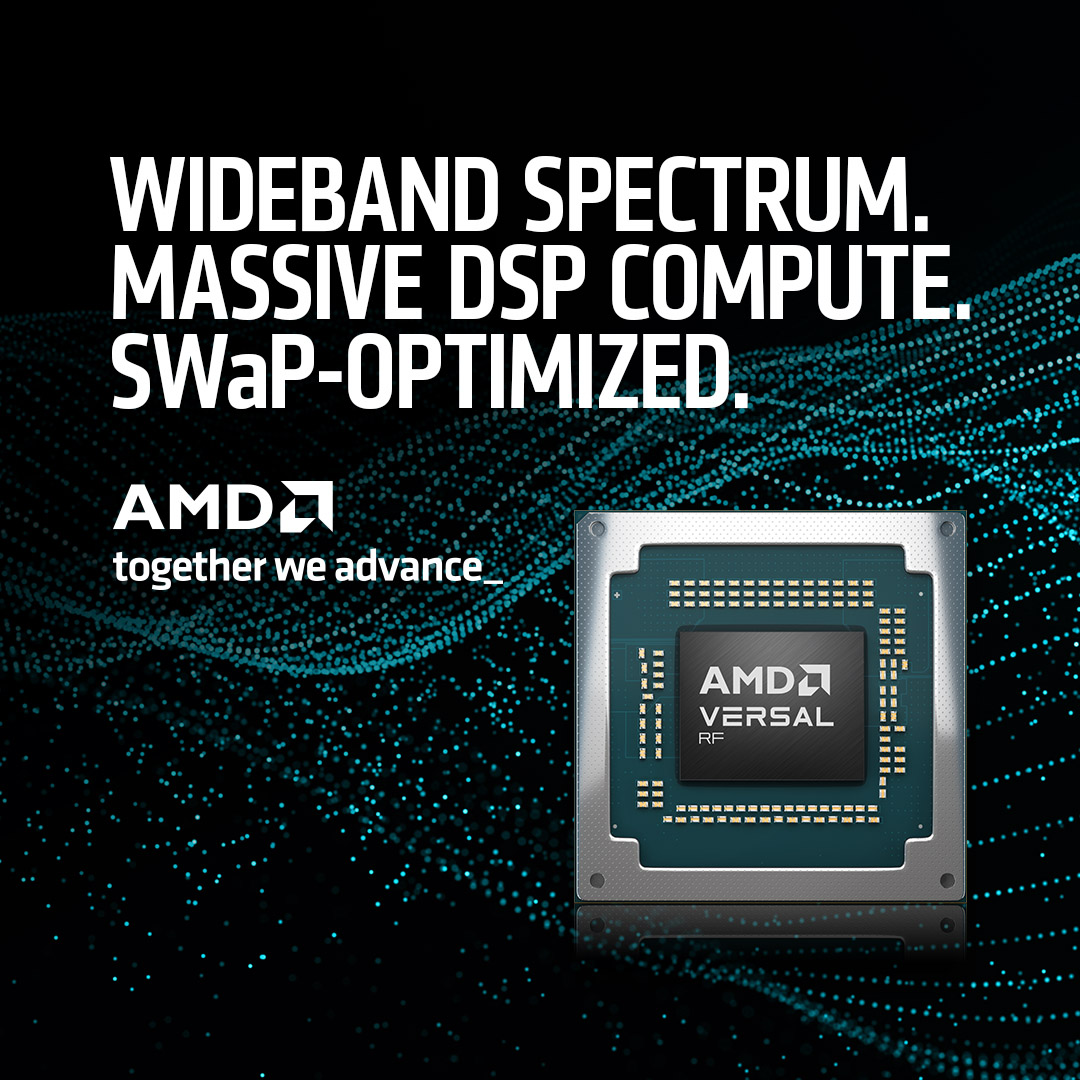
The fastest converter does not win the system. The architecture that turns wideband data into a decision with less movement, power, and integration risk does.
Explore the AMD Versal RF Series ➡️ https://t.co/IOfVNJSm48
Software-only simulation can't keep pace with complex heterogeneous designs.
AMD Vitis Hardware in the Loop runs your design on real Versal silicon, faster than AMD software simulation alone, using the MATLAB® or Python™ scripts you already have.
Learn more: https://t.co/14hL6bcxhL