Our paper was accepted as a #ICML2026 Spotlight!
Reasoning in LLMs has improved largely by chaining local steps. But is that the whole story?
Humans occasionally make inferential "leaps" across domains, a faculty known as analogy.
We design a synthetic task to show how small Transformers acquire analogical reasoning, and find that the same signatures appear in pretrained LLMs.
arxiv: https://t.co/1WCizIKWly
code: https://t.co/82kOKCtJo7
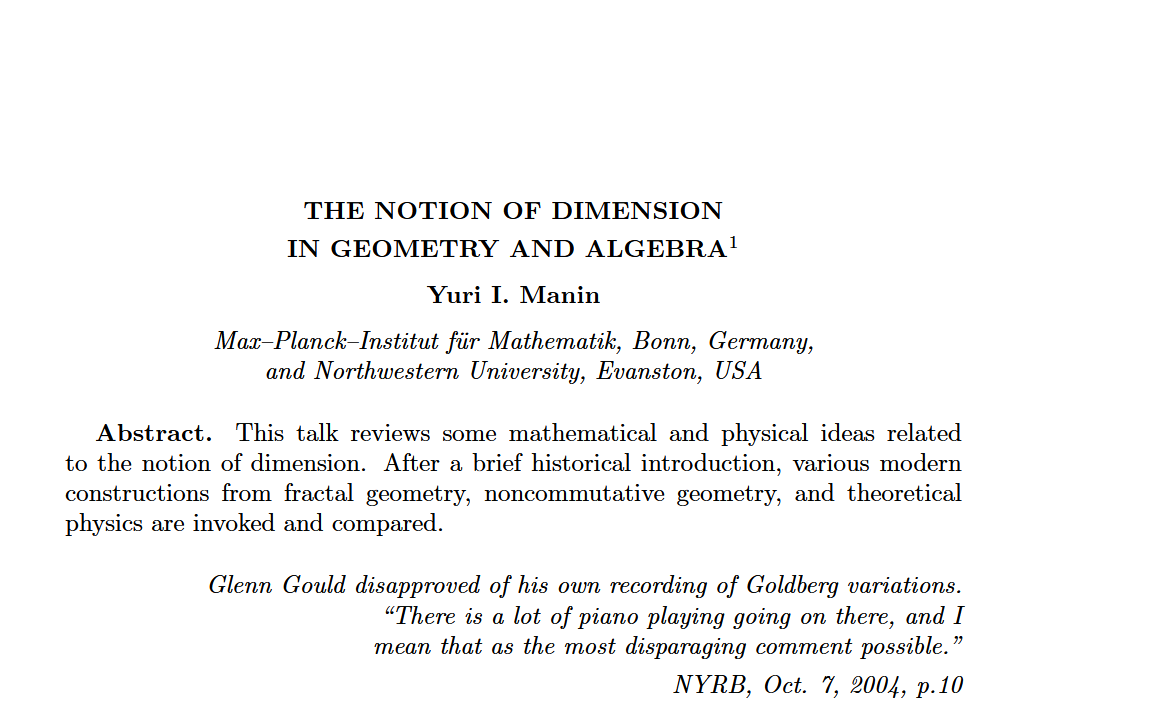
I would recommend anything written by the great Yuri Manin, therefore, today, I will suggest you to read this fantastic paper (29 pages) titled 'The Notion of Dimension in Geometry and Algebra'.
In this one, Manin marries mathematics, physics, philosophy, history and much more, a refreshing read, for those used to dry formalism.
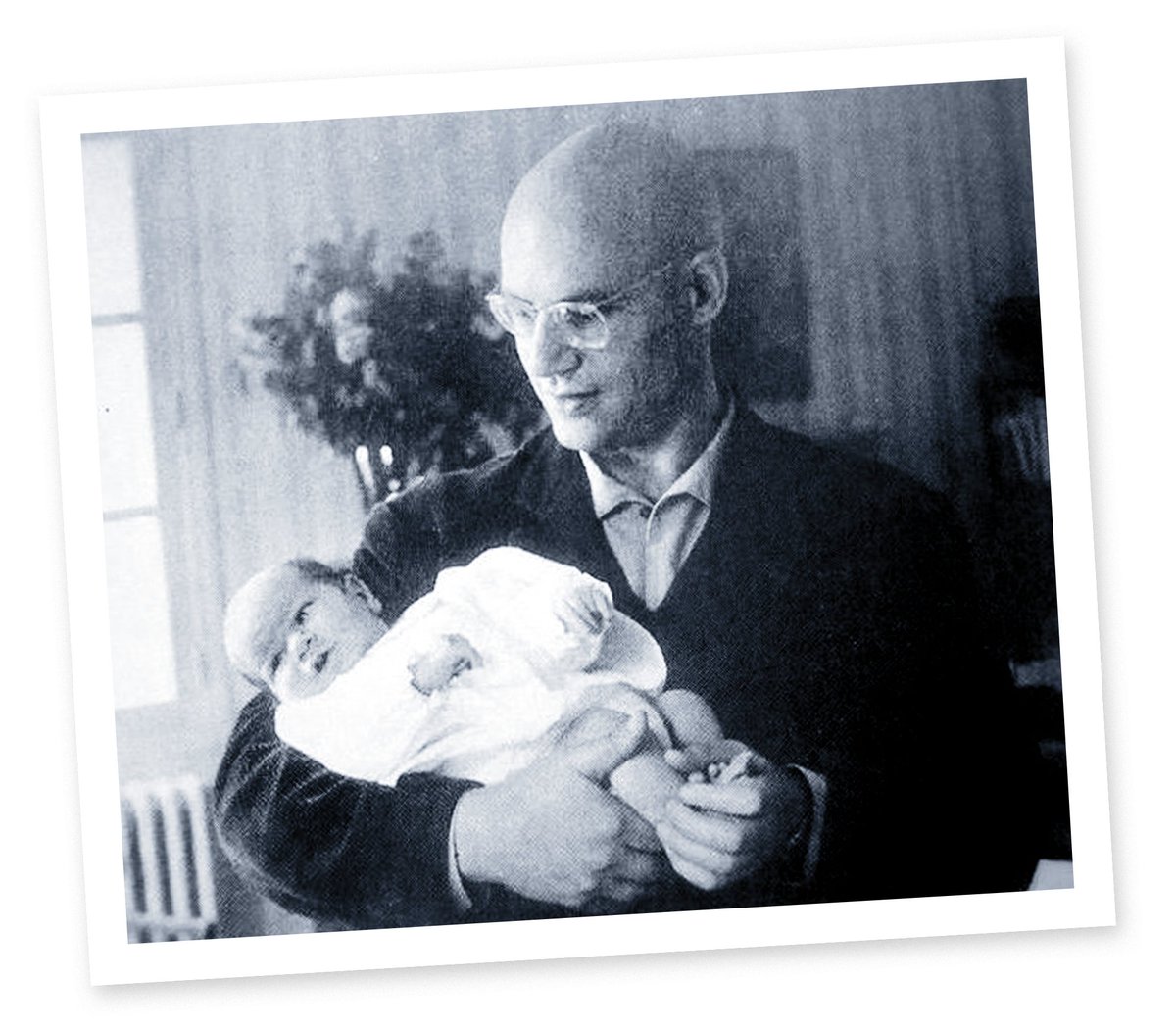
Yuri's view on mathematics deeply influenced mine, so give it go, I bet you'll like too.
Princeton Cognitive Scientist Says AI Researchers Are Wrong
Tom Griffiths (@cocosci_lab)
Timestamps:
00:00 The Math Behind How Minds Actually Work
00:30 Why Defining "Thought" Is Harder Than It Looks
04:30 What AI Gets Wrong About Consciousness
07:00 What ChatGPT Actually Revealed About the Field
08:10 Are Humans Really Irrational — Or Solving a Different Problem?
11:00 How Chomsky Turned Language Into a Math Problem
13:55 The Chessboard Analogy That Explains Generative Grammar
15:20 Why Aristotle Got Thought Right and Physics Wrong
19:45 The Man Who Tried to Build AI in the 1600s
22:40 What Everyone Gets Wrong About George Boole
25:25 From Boole to Turing: How Logic Became Computers
27:40 Why Your Brain Runs on Less Energy Than a Light Bulb
28:40 Jensen Huang Says AGI Is Here. Is He Right
31:45 Why the "AI vs. Human Intelligence" Scale Is Misleading
33:50 Why a Child Still Outlearns Every AI Model
35:20 The Fuzzy Boundary Problem That Broke Rule-Based AI
37:20 How Semantic Networks Rewired the Theory of Memory
39:30 Rosenblatt Built a Brain — Then Minsky Killed It
43:15 The Plane Ride Where Backpropagation Was Solved
44:20 Hallucinations, Sycophancy, and What Should Actually Worry You
47:00 What Has to Change Before AI Can Truly Generalize
50:10 What a Layperson Should Actually Take Away From This
Even the people who are building AI in SF are not AI-literate, what crazy times we live in.
> Dario unironically argued that software engineering might soon be automated (not a chance)
> Jack unironically argues below that AI might be "recursively self-improving" by the end of 2028 (even though each iteration costs millions of dollars)
> This week, Richard Dawkins said he couldn't convince himself that Claude wasn't conscious (no comment).
Trump now wants to approve models prior to release.
AI is making our brains drop out.
Did you read our extensive essay about this? 😃https://t.co/7p5uWFuS99
Heuristics are partial knowledge plus a goal. They're a form of optimisation: they get you to a known destination faster. That's an intelligence thing.
Creativity is the opposite. It's full coherent knowledge of the constraints, no goal, willingness to follow the path wherever it leads.
Optimisation is antithetical to creativity. The moment you optimise, you're pulling toward a destination you already know, which means you can't discover the ones you don't.
Transformative creativity, in Kenneth Stanley's framing (which we adopt in the article), is the creation of a new space, adding "new dimensions to the universe". i.e. his NEAT algorithm's complexification operators literally do this.
Picture the problem space as a graph: dense clusters of solutions joined by rare thin bridges to other clusters. Heuristic search inside a cluster is what current systems do well. Finding the bridges is something else.
Current systems are good at heuristic search because they've absorbed those patterns wholesale from training data. They're poor at creativity because that requires understanding, not optimisation.
Knowing where the walls are in the maze is how you reach rooms you've never been in.
1/ A 7B model just beat a 671B model at formal theorem proving. The secret is not more data, it is fixing the reward hacking loop in asymmetric self-play. Here is how Stanford researchers broke the RL scaling plateau. 🧵