Today we’re introducing Google AI Threat Defense - a comprehensive AI-powered cybersecurity solution designed to help continuously monitor for and stop AI-powered threats before they can impact your business. Here’s how it works:
1. AI Threat Defense uses our cybersecurity platform @wiz_io to scan and prioritize what applications and systems have the highest security risk.
2. Gemini and other frontier AI models can then autonomously perform continual deep scanning of your applications - starting with those at the highest risk - to identify security vulnerabilities.
3. The capabilities of CodeMender - a new software repair agent - are then used to verify and accelerate the patching of vulnerabilities.
4. And our @wiz_io autonomous agents continuously test your systems to find unknown vulnerabilities before adversaries do so that you can remediate them before you are attacked.
While other model providers focus on using AI to find and flag vulnerabilities, Google AI Threat Defense actively prioritizes your most critical real-world risks and accelerates their remediation using a variety of models since no single model finds a superset of the vulnerabilities found by all other models.
I’ve always believed the No.1 application of AI should be to improve human health.
That work started with AlphaFold, and now at @IsomorphicLabs with the mission to reimagine drug discovery and one day solve all disease!
We are turbocharging that goal with $2.1B in new funding.
The future of Math is mathematicians and AI agents working together.
Very pleased to introduce @GoogleDeepMind's AI co-mathematician: a multi-agent system designed to actively collaborate with human experts on open-ended research mathematics.
Mathematicians testing the agent across areas as diverse as group theory, Hamiltonian systems, and algebraic combinatorics have reported impressive results.
In autonomous mode evaluation on the rigorous FrontierMath Tier 4 problems, AI co-mathematician scored an unprecedented 48% — a new high score among all AI systems evaluated.
Yesterday Fitbit Air launched, but did you know it comes with a new @googlehealth API? You can build AI agents, MCP servers, or CLIs on top of your sleep and heat data.
- 31 different data points from exercise to sleep, heart rate, or SpO2.
- Webhooks push real-time notifications when health data changes.
- Support Read or write data, request only the permissions you need.
- Query by time range, roll up daily summaries, or paginate results.
I am whoop guy, but might be good reason to explore this. Full getting started codelab below.👇🏻
Testing LLM safety shouldn't bottleneck your CI/CD. 🚦 Today we're releasing AMS, an open source tool that verifies open-weight model safety in just 10-40s. A big step for a safer AI ecosystem! Will you integrate this into your workflow? 🛠️ https://t.co/0rlxUXYCli
BIG NEWS! @Amazon, @Meta, @Microsoft, @Salesforce, and @Stripe are joining forces with us (@Shopify, @Google, and other founding members) to truly make UCP the single, universal protocol for commerce in the agentic era. 🎉🚀
If you read this and don’t understand why it’s happening it’s an opportunity to reset your understanding of how the real world works.
The real world will need a ton of help actually getting agents going in the enterprise. Companies have legacy tech stacks they need to modernize, data in tons of fragmented tools, knowledge that isn’t captured or digitized, and change management needed to actually utilize agents effectively. And they have to do all this while still running their business day-to-day, unlike startups.
This is why there is so much opportunity for companies (software or services) to actually deploy agents in specific domains and workflows. This remains a big opportunity for both existing services providers but also tons of new startups as well. Every new technology wave produces a new era of consulting firms that can deliver on that technology.
It’s also why the FDE model is going to be alive and well for a long time because companies will want to have their vendor actually help drive the change management and implementation for their new workflows.
The people aren’t going away. Far from it.
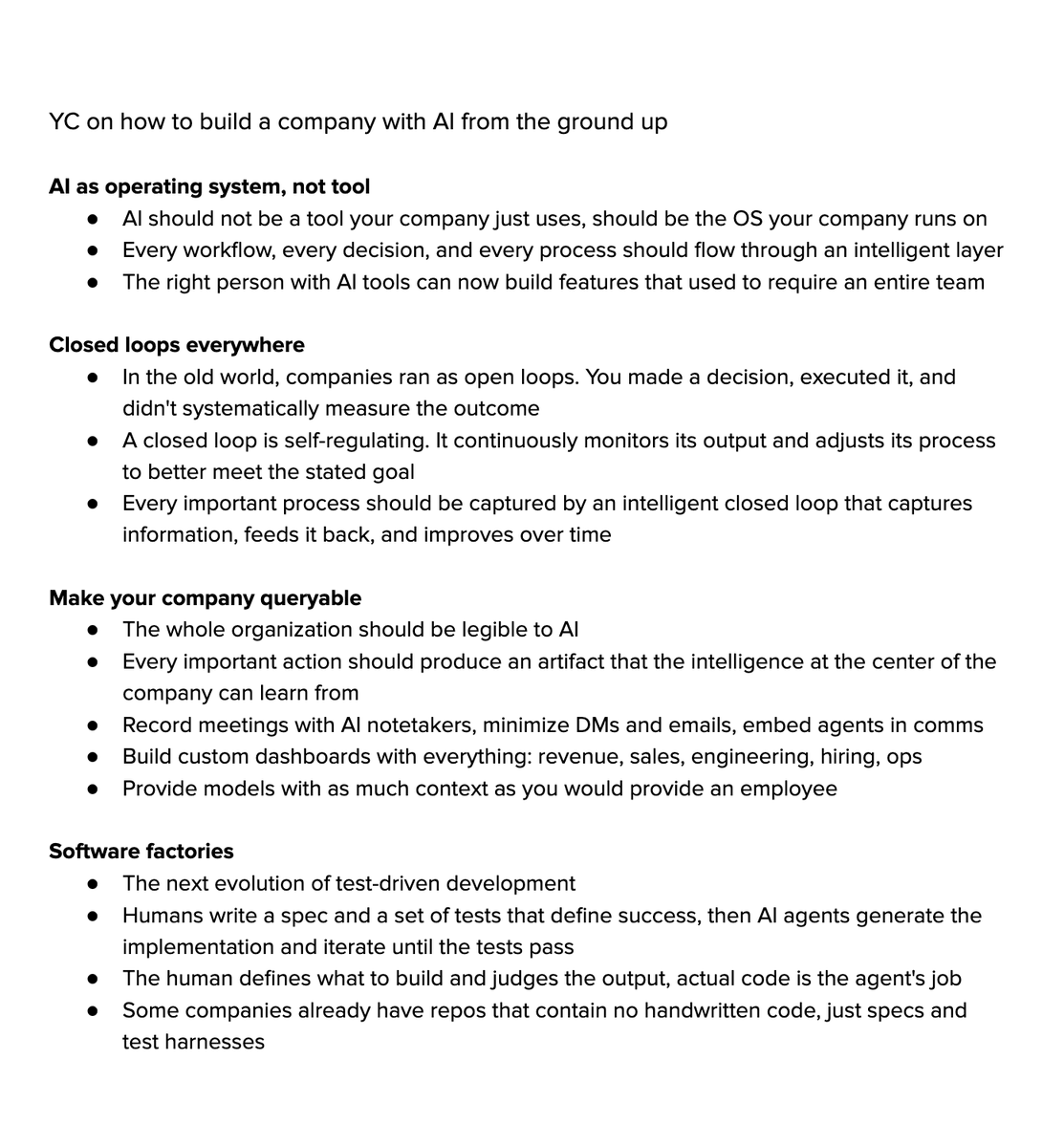
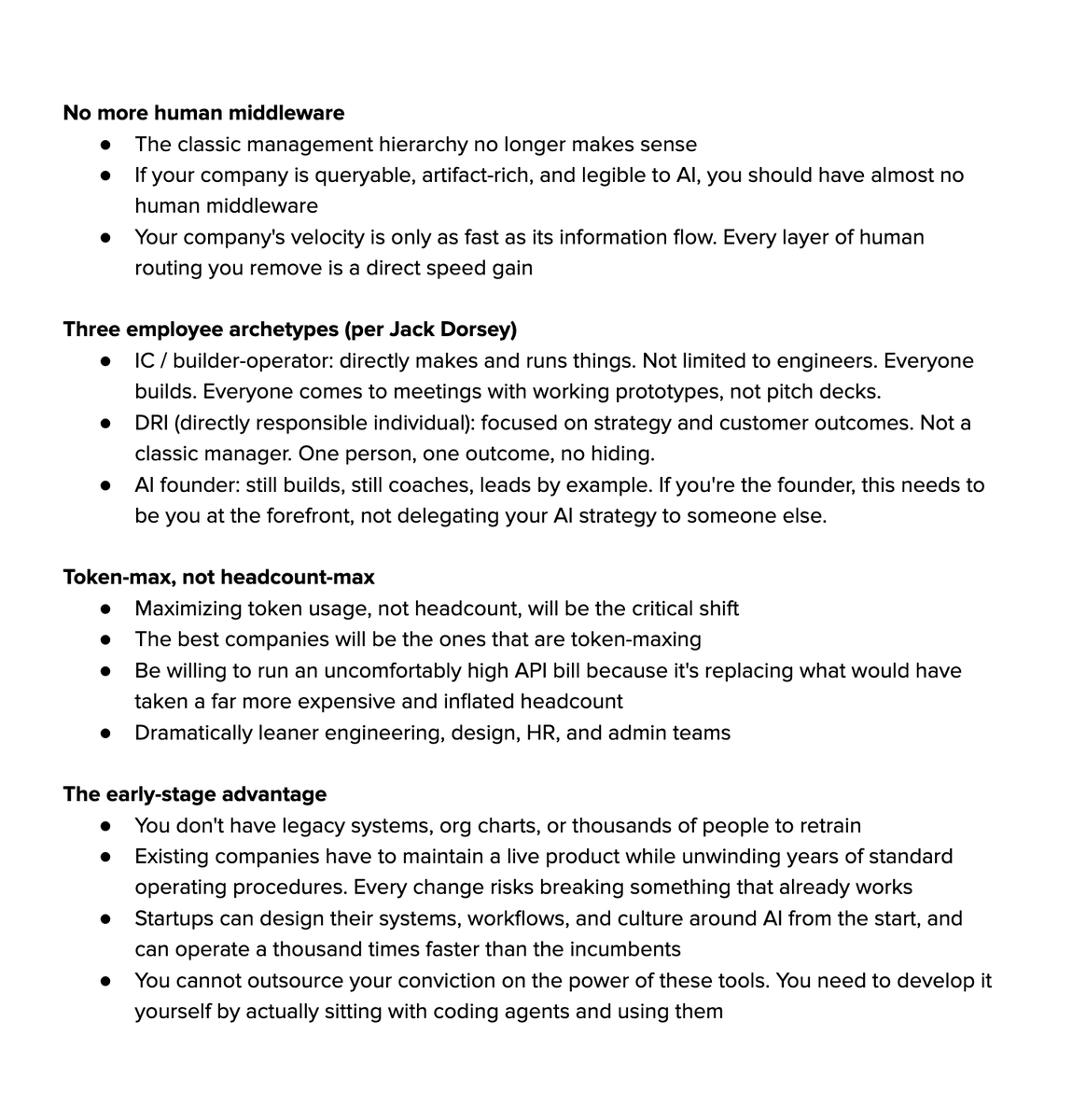
A CEO from one of our portfolio companies shared this with their team. I’m re-sharing it with their permission, because it resonated and reflects what all founders and CEOs should be communicating.
--
We are living through a period of compounding change. And in moments like this, the biggest risk is no longer making the wrong decision. It is moving too slowly while the world moves around you.
There are two paths. We can play defense:
- Protect what we have
- Optimize what works
- Wait for clarity
It feels safe. It isn’t.
Or we can play offense:
- Learn faster than the environment changes
- Use new tools to solve old problems in better ways
- And create entirely new strategies and businesses
That’s where the opportunity is.
Challenge yourself to do things faster and better than you have ever attempted. Stay uncomfortable. Stay on the front foot.
Your headphones just became a personal translator in 70+ languages. 🎧✨
Google Translate’s “Live translate” with headphones is officially on iOS. We're also expanding this capability to more countries around the world for both @Android and iOS users.
To try it, open the Translate app, tap “Live translate” and connect your headphones.
Today, we’re announcing the winners of the MedGemma Impact Challenge, launched in collaboration with @Kaggle. 850+ participating teams showed us how AI can help bridge global healthcare gaps. Check out the winning innovations →https://t.co/oHd56zx28D
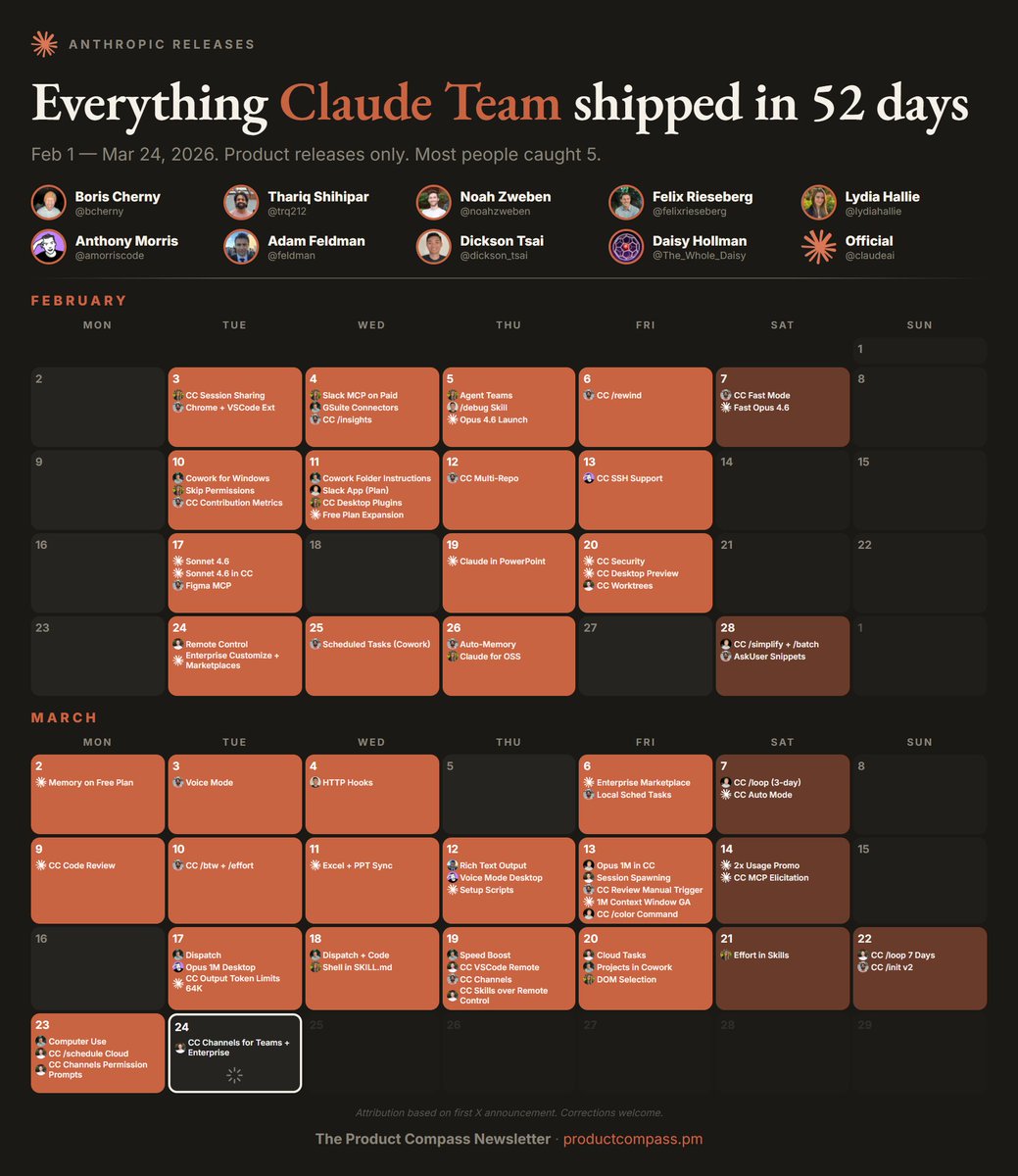
73 product releases in 52 days. That's not a launch cadence — that's a different kind of company.
I tracked every Anthropic release from Feb 1 to Mar 23 by going through @bcherny, @trq212, @noahzweben, @felixrieseberg, @lydiahallie, @amorriscode, @feldman, @dickson_tsai, and @claudeai. Built a calendar with first-announcement attribution.
Look at the acceleration. February had bursts with gaps between them. March 9 onward is almost every single day �� Code Review, Channels, Dispatch, Computer Use, back to back.
The individual features get coverage. The shipping velocity doesn't. It should.
🚨 Andrej Karpathy just explained the scariest thing happening in software right now..
someone poisoned a Python package that gets 97 million downloads a month.. and a simple pip install was enough to steal everything on your machine..
SSH keys.. AWS credentials.. crypto wallets.. database passwords.. git credentials.. shell history.. SSL private keys.. everything..
and here's the part that should terrify every developer alive..
the attack was only discovered because the attacker wrote sloppy code.. the malware used so much RAM that it crashed someone's computer.. if the attacker had been better at coding.. nobody would have noticed for weeks..
one developer.. using Cursor with an MCP plugin.. had litellm pulled in as a dependency they didn't even know about.. their machine crashed.. and that crash saved thousands of companies from getting their entire infrastructure stolen..
Karpathy's take is the real wake up call.. every time you install any package you're trusting every single dependency in its tree.. and any one of them could be poisoned..
vibe coding saved us this time.. the attacker vibe coded the attack and it was too sloppy to work quietly.. next time they won't make that mistake.
Tomorrow we will unveil the all new vibe coding experience in @GoogleAIStudio, the team has spent 4 months rebuilding it all from scratch and smoothing out rough edges to help everyone bring their ideas to life.
This is a big step forward, but just the start : )