Claude Code vs Cursor vs Codex
Claude Code vs Cursor vs Codex is the wrong question.
The right question is which one fits your exact workflow today.
Here is the honest breakdown with zero brand loyalty and zero hype:
☑️ 1. Claude Code
→ Terminal-based AI coding agent built by Anthropic.
→ It reads the codebase, plans a solution, and executes it.
→ Writes, edits, deletes, and runs files without you touching a single thing.
↳ MCP servers connect Claude to 200+ external tools and databases.
Best for:
→ Solo founders building a full MVP from a one-paragraph brief.
→ Developers delegating an entire feature while working on something else.
→ Ops people automating recurring workflows without writing any code.
✦ Pros: Best for long, multi-step agentic tasks.
✦ Cons: Terminal-based, not beginner-friendly. No visual IDE.
☑️ 2. Cursor
→ AI-native code editor built on VS Code.
→ Autocomplete suggests code as you type.
→ Composer mode makes multi-file changes from a single plain English.
↳ Works like an editor you already know from day one.
Best for:
→ Developers writing React components by describing them in plain English.
→ Teams working across a shared codebase with shared rules files.
→ Non-technical founders editing and understanding code for the first time.
✦ Pros: Best IDE experience. Natural pair programming feel.
✦ Cons: Struggles with very long agentic tasks.
☑️ 3. Codex
→ OpenAI's cloud-based AI coding agent.
→ Works in a sandboxed cloud environment and then opens a pull request.
↳ Parallel tasks. Run multiple agents simultaneously on different issues.
Best for:
→ Teams assigning bug fixes overnight and reviewing PRs in the morning.
→ Developers running Codex and Claude Code in parallel on different tasks.
→ Non-technical founders creating GitHub issues and letting Codex resolve them.
✦ Pros: Fully async, no babysitting. Native GitHub integration.
✦ Cons: Less context awareness than Claude Code for complex codebases.
☑️ Quick Reference — Which Tool Wins on What
→ Autonomy: Claude Code wins. Cursor medium. Codex high.
→ IDE Experience: Cursor wins. Claude Code and Codex have none.
→ Beginner Friendly: Cursor and Codex win. Claude Code is medium.
→ Long Agentic Tasks: Claude Code wins. Codex good. Cursor medium.
→ Team Collaboration: Cursor wins. Codex good. Claude Code medium.
→ Tool Integrations: Claude Code wins with MCP. Codex GitHub only. Cursor limited.
The answer is not which tool is the best.
The answer is which tool fits the job.
- Follow @coder_surya for more.
- Save the post.
- Repost to your network.
- Join AI Community: https://t.co/ioQEJKhjbS
----------------------------
If you want to get good at AI engineering (in 2026), learn these concepts:
1 LLM Evals Explained
↳ https://t.co/nv3Ol8W53p
2 Design Knowledge Q & A System
↳ https://t.co/9ymm6mtHug
3 How OpenClaw Works
↳ https://t.co/eHRWegcsf8
4 AI Agent Workflow
↳ https://t.co/JvnPd9773A
5 How MCP Works
↳ https://t.co/wgf8gHnnkn
6 Design AI Chat Assistant
↳ https://t.co/nNWq3onTnW
7 How RAG Works
↳ https://t.co/cGmunPTUlb
8 Agentic Patterns Explained
↳ https://t.co/8YdBBWvTj1
9 AI Coding Workflow 101
↳ https://t.co/paIf9ksIU9
10 Machine Learning System Design 101
↳ https://t.co/9MkHcLb5e0
11 Multi-Agent Architecture Explained
↳ https://t.co/rS5QQS7Jln
12 How AI Agents Work
↳ https://t.co/JvnPd9773A
13 How Vector Databases Work
↳ https://t.co/FVxan8xHH3
14 AI Agents: Memory, State & Consistency
↳ https://t.co/v8H7O00jub
15 AI Agents Design
↳ https://t.co/tk3zkCjRvg
16 Context Engineering 101
↳ https://t.co/OMkiZhkODL
17 What is Reinforcement Learning
↳ https://t.co/AVpl9j1oit
18 LLM Concepts - A Deep Dive
↳ https://t.co/5lCKxq2g4N
What else should make this list?
===
👋 PS - Want my System Design Playbook (for free)?
Join my newsletter with 201K+ software engineers now:
→ https://t.co/ByOFTtOihX
===
💾 Save & RT to help others get good at AI engineering.
👤 Follow @systemdesignone + turn on notifications.
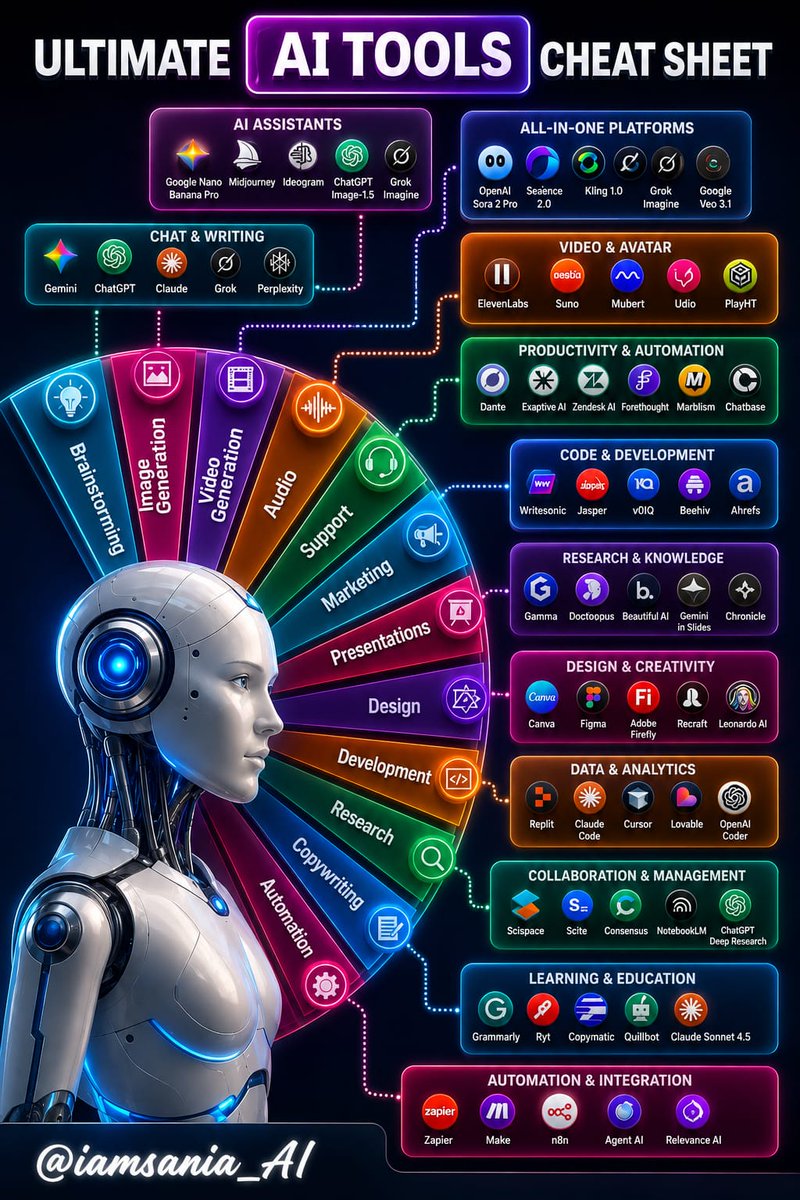
🚨 Most people think AI is just ChatGPT.
They're wrong.
AI is an entire ecosystem of tools designed for different jobs.
Here's the Ultimate AI Stack for 2026 👇
🧠 Brainstorming & Strategy → ChatGPT → Claude → Perplexity
🎨 Image Creation → Midjourney → Ideogram → Adobe Firefly
🎬 Video Generation → Runway → Pika
🎧 Voice & Audio → ElevenLabs → Suno
💻 Coding & Development → Cursor → Replit
📊 Research & Learning → SciSpace → Consensus
✍️ Writing & Content → Grammarly → Jasper
⚙️ Automation & Workflows → Zapier → Make
The biggest mistake?
People jump between 20 AI tools hoping for better results.
Instead, build a system.
📌 Simple Formula:
1️⃣ Use one tool for ideas
2️⃣ Use one tool for creation
3️⃣ Use one tool for distribution
4️⃣ Automate repetitive tasks
That's how you turn AI into a real productivity machine.
Stop collecting tools. Start building workflows.
The people winning with AI aren't using more tools.
They're using the right tools together.
🔖 Save this AI stack for later.
Follow for more practical AI insights, workflows, and growth hacks. 🚀
THIS IS THE MOST PROFITABLE BITCOIN STRATEGY EVER. 🤯
Buy during the US Midterms.
Sell in the bull market years after.
The track record:
2010 Midterms: +273,924%
2014 Midterms: +7,574%
2018 Midterms: +2,088%
2022 Midterms: +689%
4 for 4. Never failed for $BTC.
You already know what to do now.
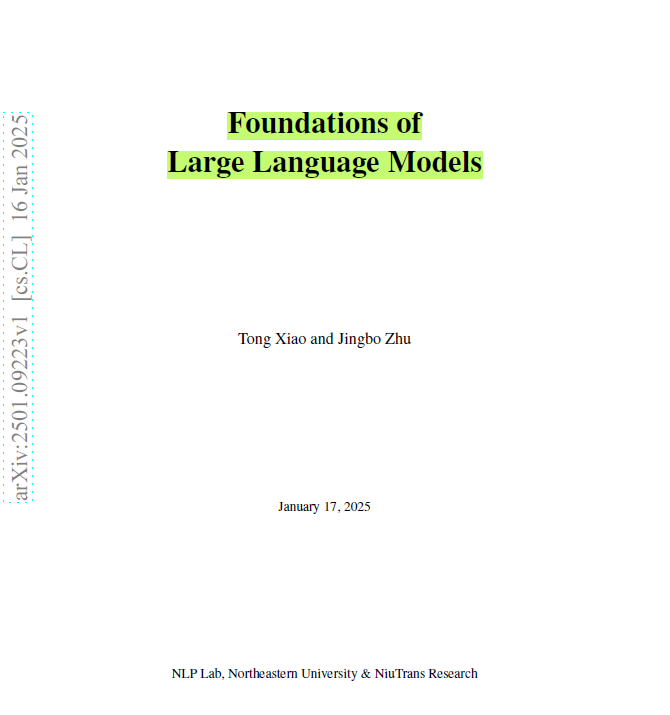
This 230-page book unlocks the secrets of LLMs.
https://t.co/wr2arLKqaf
Master LLMs step by step.
> with clear explanations of core concepts
> pre-training, fine-tuning and human alignment
Foundations of Pre-training
> Core concepts behind pre-training, the backbone of LLMs.
> Covers common objectives, techniques, and model architectures.
Building Generative Models
> How generative models are developed.
> Covers the training pipeline, scaling strategies, and handling long texts.
Prompting Techniques
> Prompting methods for LLMs.
> Includes basic strategies, plus advanced ones like chain-of-thought reasoning and automatic prompt design.
Aligning Models with Human Intent
> Alignment methods for LLMs.
> Focuses on instruction fine-tuning and human feedback alignment.
Retrieval systems answer questions. AI Agents take actions. 🧠⚡
If you are still confusing RAG (Retrieval-Augmented Generation) with AI Agents, you are missing the shift happening in enterprise AI right now.
While both leverage Large Language Models (LLMs), their architecture, capabilities, and purposes are fundamentally different. Here is the breakdown you need to know:
🔹 RAG: The Smart Librarian 📚
Think of RAG as a hyper-efficient research assistant. It takes a user query, searches an enterprise database or document archive, finds the right context, and uses an LLM to generate a grounded, accurate answer.
Workflow: Linear and single-step (Query ➡️ Search ➡️ Generate ➡️ Answer).
Memory: Limited to the immediate context window.
Autonomy: Reactive. It only speaks when spoken to.
Best For: Enterprise search, document Q&A, and customer support chatbots.
🔸 AI Agents: The Intelligent Operator ⚙️
AI Agents don’t just find information—they execute multi-step workflows autonomously to achieve a high-level goal. They reason, plan, adapt, and use external tools.
Workflow: Dynamic and recursive loops (Goal ➡️ Plan ➡️ Use Tool ➡️ Evaluate ➡️ Repeat until done).
Memory: Persistent (remembers past actions and learns over time).
Autonomy: Proactive. It determines its own sub-tasks and calls APIs, writes code, or automates browsers.
Best For: Autonomous research, end-to-end workflow automation, and AI copilots.
The Bottom Line:
RAG is phenomenal for bridging the gap between static LLM knowledge and your private enterprise data. But if you want to automate actual business processes, orchestrate workflows, and let AI execute tasks independently, you are building an AI Agent.
#AIAgents #RAG #GenerativeAI #ArtificialIntelligence #LLM #MachineLearning
Salesforce deployed 20,000 enterprise AI agents. The biggest lesson? The work is inverted!
Traditional software → 90% of the effort comes before launch
AI agents → 90% comes after
We sat down with John Kucera, CPO of Agentforce, to learn what separates agents that deliver real value from those that stall after a good demo.
Teams that treat launch as the finish line stay stuck in pilot mode. Teams that treat it as the starting line scale.
The full playbook covers:
- Why most enterprise agents fail
- Pre-launch foundations (scope, KPIs, guardrails)
- The feedback loop that gates scaling
- 3 anti-patterns from 20,000 deployments
- Where agent architecture is heading next
Full article linked in the tweet below 👇