The latest OWID Brief newsletter is out on Substack! It delivers all our recent work plus curated highlights from across Our World in Data, right to your inbox twice a month.
This edition: Our new migration data tool, natural disasters, measles vaccines, fighting mosquitos with mosquitos, and much more.
In each edition we also highlight recent Data Insights, our bite-sized insights on the world and how it’s changing.
One of today's: What is the largest source of electricity in each country?
In 1936 Alonzo Church tackled a question logicians had circled for decades: is there a method that can decide for any mathematical statement whether it is provable?
To make the question precise he invented a tiny language where everything is a function: the lambda calculus. He used it to prove that no such method exists. Months later a student of his named Alan Turing reached the same conclusion with an imaginary machine. The two proofs were equivalent, and together they drew the line between what a computer can and cannot do.
Church built half the foundation of computer science to settle a question about logic. The lambda calculus he invented is still running today, inside every functional programming language.
How can we measure the state of democracy around the world?
Measuring democracy is challenging. It has many dimensions, and researchers assess them in different ways. No single source of data captures the full picture, so we present data from several of them.
These include Varieties of Democracy (V-Dem; shown in the map here), the Lexical Index, Freedom House, and the Bertelsmann Transformation Index.
Some of these data sources focus on broad characteristics of political systems to identify which countries are democracies at all. Others use expert surveys to assess smaller differences in the degree of democracy.
Our colleagues Mojmír Vinkler and @lucasrodesg recently updated more than 250 of our democracy charts with the latest available data from our sources, which now include data for 2025.
A telltale sign of an ignorant leader is failing to read books.
Fiction builds empathy and imagination. Nonfiction boosts concentration and critical thinking. Not reading fuels mental stagnation.
Leaders who “don't have time to read” are leaders who don't make time to learn.
Bonita máxima de la Grecia clásica que los griegos llevaron hasta los templos de las alejandrias que fundaron en Oriente, entre Afganistán y Tayikistan.
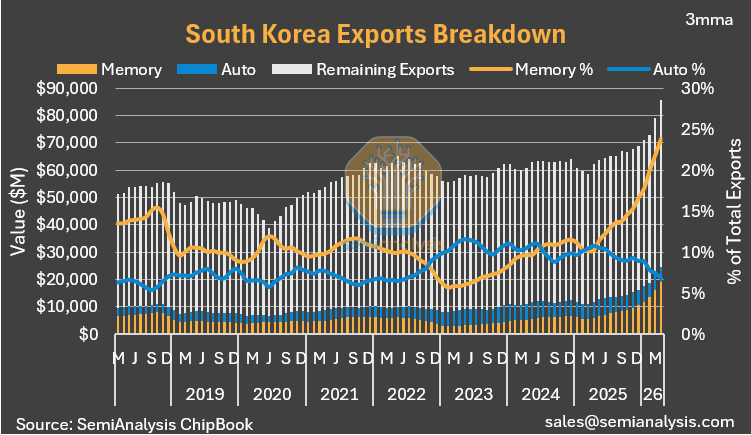
How big is memory for Korea's exports? BIG
Between 2018-2024, memory accounted for ~10% of total exports. In 2025 it was 13%. In 2026 it's already 22% and growing.
For comparison, autos - the #2 export industry - typically accounts for ~8%. (1/2)🧵
Conversation with the great Lenny Susskind—quantum mechanics, gravity, black holes. I asked what drives him. A deeper connection to mystery? Yes, he answered, but really: it's fun.
Bottom line: if you love what you do, you've been granted a remarkable gift. https://t.co/OXacrXxNQH
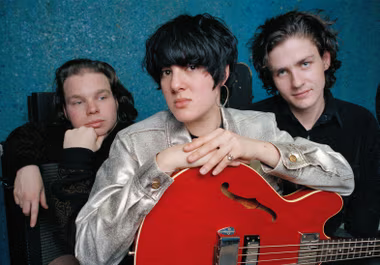
"We were not trying to make people dance, we were not trying to ‘rock’ – we were trying to make things that were beautiful,”
@WarehamDean quote in an article on #slowcore over at The Guardian today
https://t.co/3Zi6bL8w3R
Some AI humor @alighodsi speedran the entire AGI debate in 30 seconds in MS&E 435:
Q: who thinks we have AGI? → ~10% raise hands go up
Q: who thinks most people you interact with aren't as smart as the smartest model you use? → 90%+ hands go up
Q: ok, let's start over. who thinks we DON'T have AGI? 🤣
QED 🤡
Be aware of people addicted to stress and chaos. Without adrenaline flooding their body, they don't feel like themselves.
They don't want advice or solutions.
They want a captive audience that doesn't force them to self reflect.
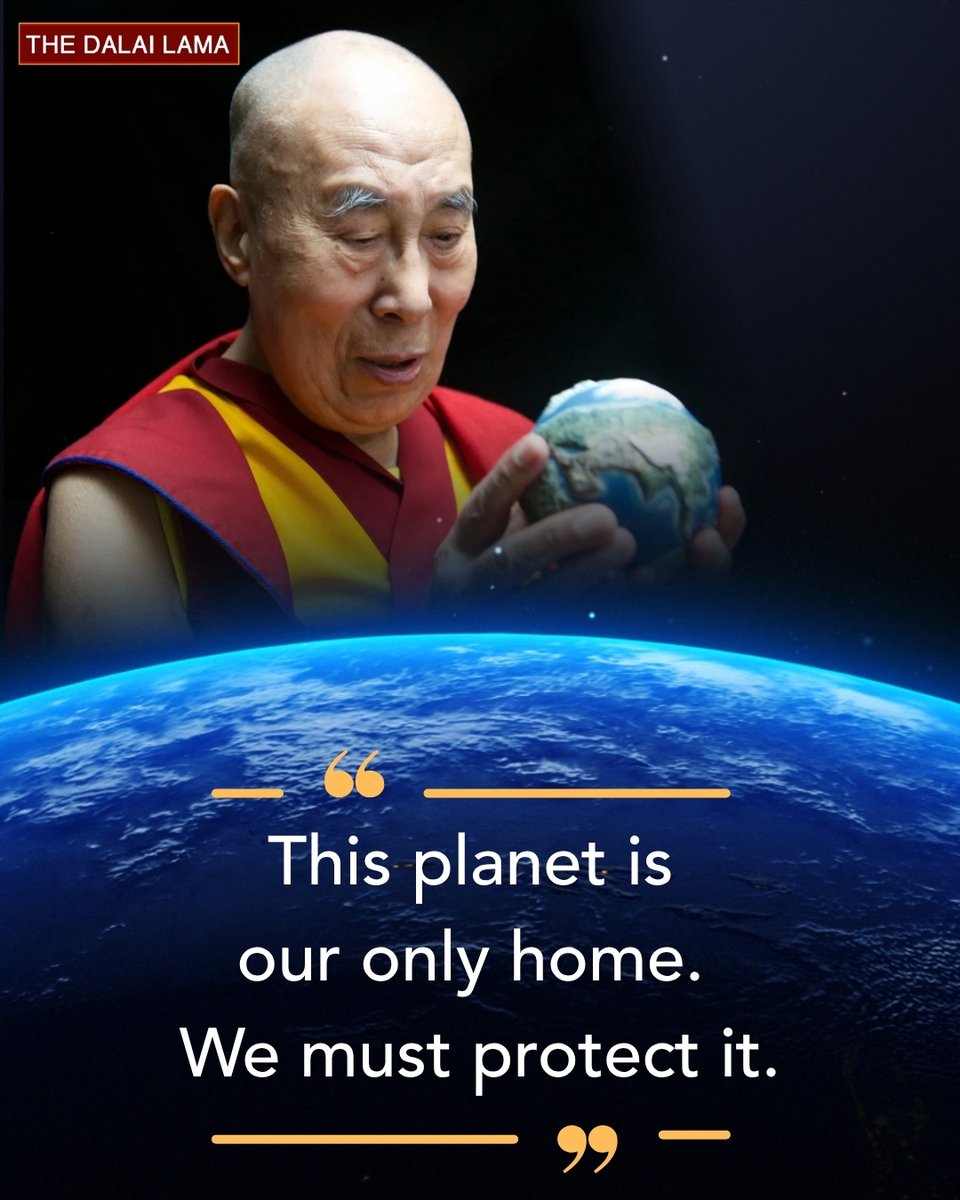
Beyond Differences - His Holiness the Dalai Lama explains why he sees every person simply as another human being—beyond nationality, religion, or status. Reflecting on how divisions create conflict, His Holiness reminds us that our shared humanity is the foundation for peace, compassion, and a happier world. Video originally recorded on November 11, 2014.
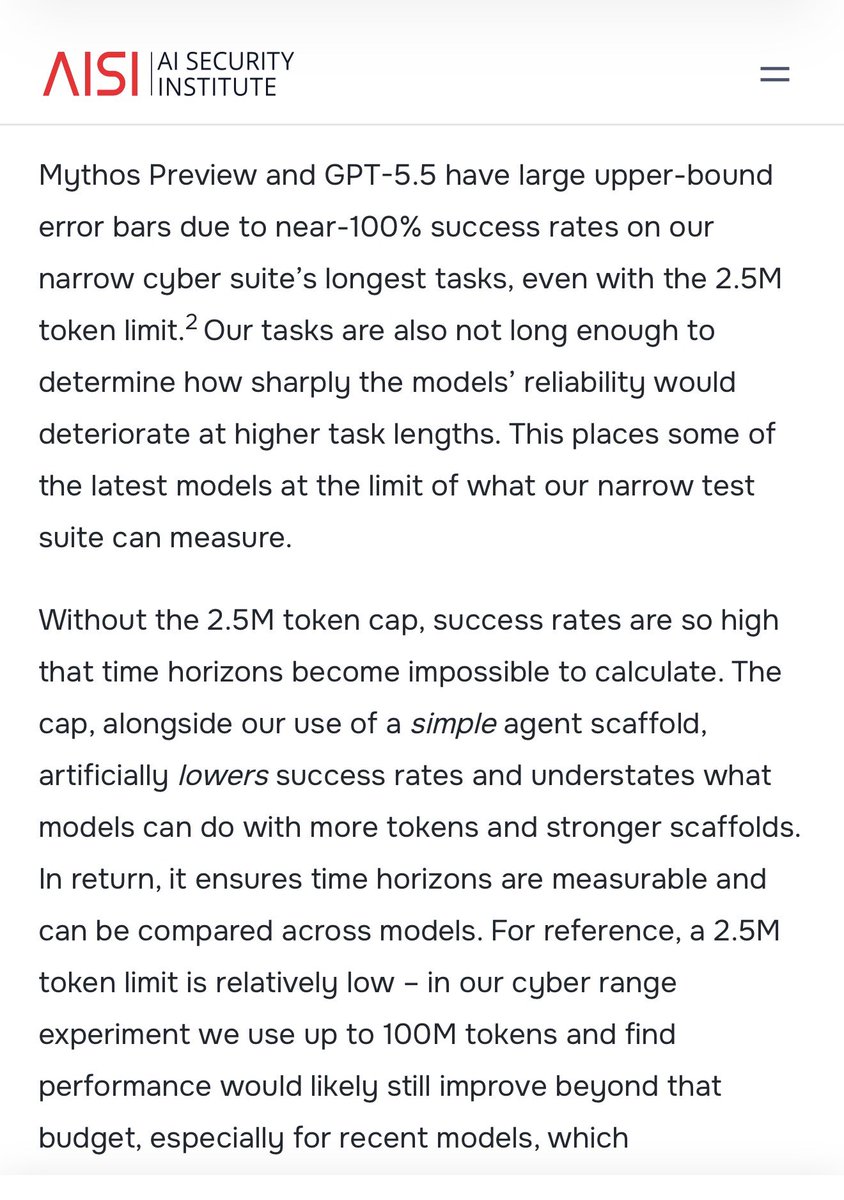
The UK’s state AI Security iIstitute findings:
1) Mythos is a big gain in cyber capabilities. But so is GPT-5.5
2) It is hard to establish an upper bound on Mythos/GPT-5.5, which appear to be limited by tokens used, rather than ability.
3) Capability doubling time is 4.5 months