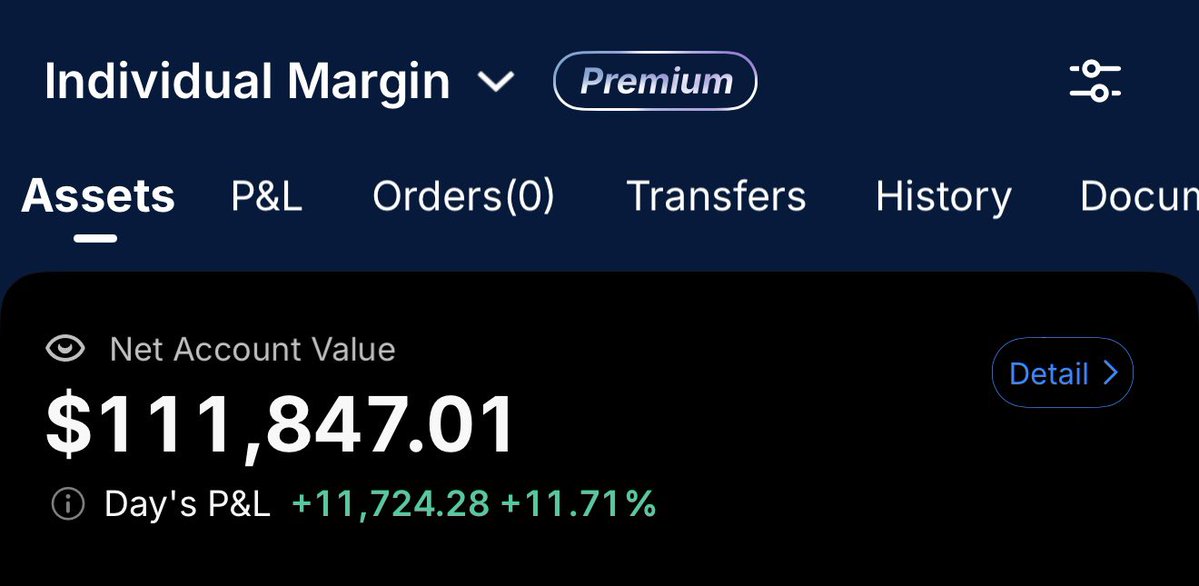
THE PEOPLE HAVE SPOKEN!🏄♂️
I AM OFFICIALLY RESTARTING THE $1K TO $100K CHALLENGE NEXT MONDAY!💰
THIS WILL BE DONE IN A PRIVATE X GROUP CHAT WHERE I WILL POST ALL MY TRADES WITH ENTRY & EXIT FOR FREE!💬
LIKE, REPOST, & COMMENT “$1K” TO BE ADDED!🚨
YOU MUST BE FOLLOWING ME!☢️
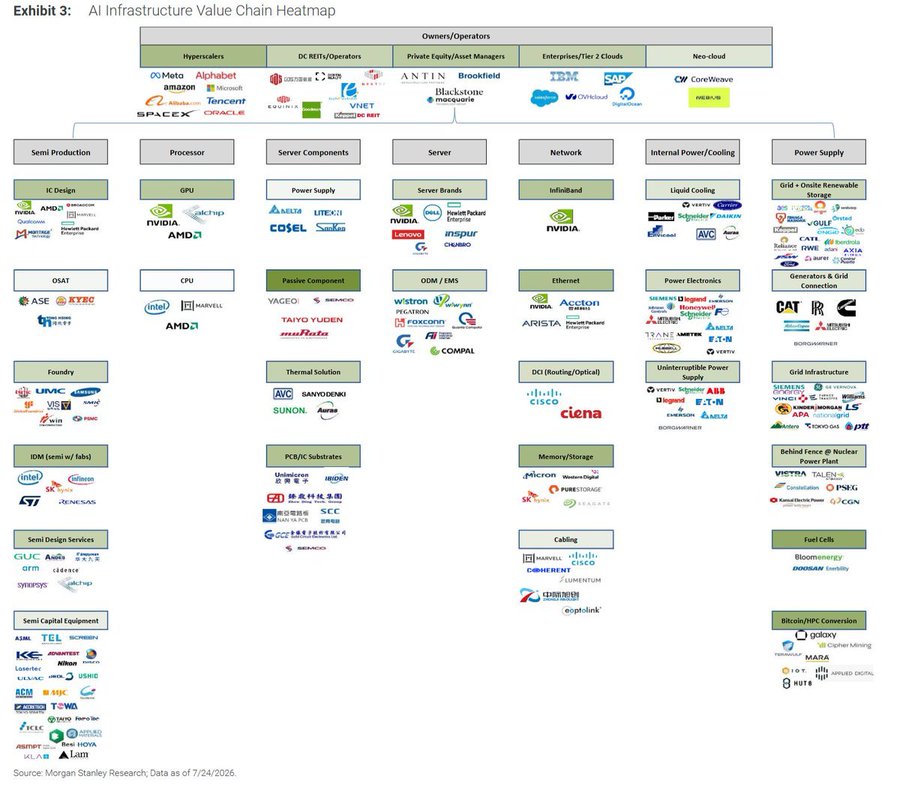
Morgan Stanley mapped out the entire AI infrastructure supply chain and it reveals who actually gets paid at every layer of the trillion dollar buildout (Save this).
This heatmap breaks the AI infrastructure value chain into two dimensions those who owns and operates the data centers at the top and what physical and technical components get built underneath to make those data centers function.
At the top sit the owners/operators, the hyperscalers like Meta, Alphabet, Amazon and Microsoft, alongside data center REITs, private equity giants like Blackstone and Brookfield, enterprises and neoclouds including CoreWeave and Nebius.
These are the companies writing the massive capex checks that fund everything below them.
Below that sits the actual build out, split into seven layers, semi production, processors, server components, servers, network, internal power/cooling and power supply.
Semiconductor production is dominated by names your audience already knows well, Nvidia and AMD for GPUs, TSMC adjacent foundries, ASML and Applied Materials for capital equipment, and Micron and SK Hynix under memory/storage.
But the less obvious money is in the physical infrastructure layers most retail investors never look at.
Server components include passive parts from Yageo and Murata, thermal solutions from Sanyo Denki, and PCB substrates from companies like Unimicron.
Network infrastructure includes InfiniBand and Ethernet gear from Nvidia and Arista, plus optical/DCI routing from Cisco and Ciena.
Internal power and cooling is arguably the most underappreciated category here.
It includes liquid cooling specialists like Vertiv and CoolIT, power electronics from Siemens and Eaton, and uninterruptible power supply makers like ABB and Legrand, all companies solving the literal heat and electricity problem created by cramming more GPUs into less space.
So who benefits from all of this?
Everyone in every box benefits in some way but the real insight is that value doesn't concentrate at just the GPU layer anymore.
The hyperscalers at the top are distributing capex across seven distinct physical layers which means the picks and shovels opportunity set has expanded well beyond Nvidia into cooling, grid infrastructure, and power generation.
Bullish on AI infrastructure, make sure to follow @MelvinInvests for more AI infrastructure insights, and if you want to see exactly what I'm buying as an analyst at Milk Road Pro, you can check out the link below for more.
"The biggest challenge is mental: preventing overconfidence. You've proven the system works. The temptation is to take bigger risks or deviate from the rules that got you here."
From Options Trading A to Z: An In-Depth Guide to the Technical Foundations and Strategies to Scale From $50K to $500K
Andrew Lo showed MIT students how to find the “correct” price of an option before knowing where the stock goes next
if the market charges more, you can rebuild the same payoff cheaper
the difference is profit
Lo is an MIT finance professor and founder of a multibillion-dollar quant firm. in a 67-minute lecture, he explains the model Wall Street uses with high-school algebra
it was created in 1979 by John Cox, Stephen Ross and Mark Rubinstein
bookmark this. after it clicks, option prices stop looking like random numbers on a screen
the setup is almost stupidly simple
a $100 stock can go to only two prices tomorrow: up or down. the option pays a different amount in each outcome
Lo then rebuilds those exact two payoffs using shares and a risk-free bond
if the option and the rebuilt portfolio pay the same tomorrow, they must cost the same today
if one costs $10 and the other costs $8, you buy the $8 version, sell the $10 version and keep the $2 gap
you no longer need to guess where the stock goes
you only need to know what the same payoff costs somewhere else
that is the part quants are paid for: turning uncertainty into something that can be priced
the lecture gives the intuition
read the article below to see how the two-price example expands into the machinery behind Black-Scholes
BLOWN AWAY by the Support How I made 440k this year with over 95% Win Rate in 1 year STEP BY STEP!
My FULL OPTIONS COURSE from Beginner to PRO
$SPY $NVDA $DRAM $AMD Now over 8 figures
To celebrate I will also throw in my CHECKLIST and Indicators
Just comment "ME" and DROP A 👍!
@HighYieldHustle how about combining $CHPY with $SOXS by going long $SOXS? This gives you an implicit hedge for $CHPY. You can even boost that by selling covered calls on $SOXS thereby capturing massive premiums as additional income.
Warren Buffett literally gave a 9-minute masterclass on what makes a business worth owning, inside the interview where he explains why he broke his own rule on technology.
Eight things he teaches:
1. A good business is not one that grows. It is one that earns high returns on capital for a long time. His words: "something that you can expect to earn high returns on capital over a long period of time." Growth without returns on capital is just a bigger version of the same problem.
2. Measure it against doing nothing. Buffett points out he can put huge amounts of money into government bonds and collect payments every year with no risk. So a good business has to earn a lot more than treasuries, and be expected to keep doing it. If your business does not clear the riskless rate by a wide margin, the capital has a better home.
3. The gap between similar-looking businesses is enormous. Most banks earn 13 or 14 percent on capital. Ask anyone to guess American Express and they say something similar. It earns 30 percent plus, and Buffett is clear it "does not incur more risk in doing so than the banks that earn 13 or 14 percent." Same industry, more than double the return, no extra risk taken.
4. Charlie Munger's test: the cash has to be real. Munger pounded the idea that a business was not good just because it was doing sexy things. It had to be earning real cash, be able to pay that cash out if it wanted, and better yet be able to put it back to work inside the business. A company that earns high returns but cannot redeploy the money is worth less than one that can.
5. Time is the multiplier, so duration is the thing to protect. Buffett says a long period of time "gets to be very important because it doubles later on to the very big numbers." One great year is noise. The rate is what compounds.
6. When the facts change, retire the rule. Buffett spent decades known for not buying technology, and said so himself. His explanation for buying now is that the business changed: Google and its competitors are "laying out hundreds of billions," they are big capital spenders, and that is real money. When they were asset-light he passed and the market loved them. Now that they spend heavily, shareholders like them less and he thinks they are more likely to win. He did not change his test. He noticed the business had moved into the category his test rewards.
7. Nobody is measuring the thing that matters. Buffett says he cannot recall a report on Wall Street that gets into the internal rates of return a business is actually earning, and calls the fixation on next quarter ridiculous. He rates Alphabet ahead of 90 or 95 percent of what gets merchandised through Wall Street, on the record rather than the story. If your own reporting tracks growth and headcount but not return on capital, you are measuring what is easy.
8. Every wonderful business gets attacked, so ask how long it stays wonderful. In 1958 he helped start Data Documents, after IBM was forced by an antitrust settlement to divest half the capacity of its best business. That advantage ran out after 10 or 15 years, and he knew some of the people who caused it to run out. His closing line is the whole lesson: "It's not a question of whether it was wonderful yesterday. The question is, how long is it going to be wonderful?"
The move for an operator: run the test on your own business this quarter. What return are you earning on the capital in it, how does that compare to doing nothing, and what would have to be true for that return to survive the next ten years.
Warren Buffett with Becky Quick, CNBC Squawk Box, July 2026.
@HighYieldHustle I’m with @BeatTheBotz on liking this mix (I do this but have $TDAX in it) but can also recommend taking a long look at $NDIV in place of MLPI.
A shipping stock crashed 90% and Mohnish Pabrai bet big because the numbers made no sense
"Okay, so now you have Frontline losing 8,000 per day times 75 ships"
"the stock got taken out back and shot. Like a 90% drop, okay?"
"So, what I realized is that if Frontline got into a crunch where they were having cash problems, they could just sell three ships"
"So, I said, Okay, we really can't lose money here. So, I put 10% of my fund into Frontline"
P.S. I made a playbook breaking down 100+ most powerful decision making mental models used by history's greatest thinkers.
5,000+ downloads.
113 five-star reviews.
Grab a free copy here:
https://t.co/u2q1uUm9vD
If you're new here, follow @GeniusGTX for content on the greatest minds in economics, psychology, and history.
— Mohnish Pabrai, fund manager, on Sean Kelly's My First Million
Thomas Peterffy never read a single investment book - just borrowed $100 from his father and built the world's best $110 billion brokerage firm
he finally opened up about the one principle behind every trade he's ever made
"every two cents the stock goes down, I buy a thousand shares - then sell as it climbs - I prefer trading profits to position profits"
he landed in New York at 21 with no English - "learning to code was easier than learning the language" - so he let computers do what he couldn't, and built the first machine that traded on its own
Goldman Sachs came knocking with a $900 million offer - he turned it down -then said "$3 billion" just to end the conversation - today his firm is worth over $110 billion
on the AI bubble: "we're not there yet - but we will be AI works where behavior can be predicted - molecules, atoms - general intelligence is still far away"
bookmark & watch ↓