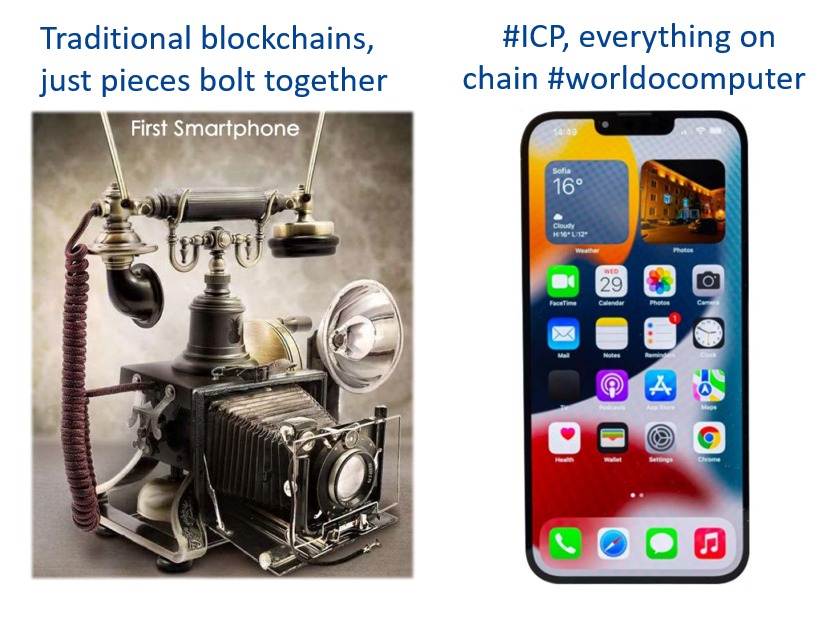
If you compare #blockchains, on the left you see traditional blockchains consisting of many individual pieces bolt together. On the right you see #ICP where all software/components run on chain and decentralized without AWS etc. The future is here $ICP #worldcomputer#web3
I'm a devoted #ICP fan and believe in decentralized cloud computing, but at this point 'soon and upcoming' isn't just a phase - it seems to be a whole lifestyle 😅.
@tomserres I wonder what happens when the core activities that have defined human civilization - problem-solving, creation, discovery - become augmented or automated? Interesting times ahead with a lot of opportunity
Vly is proud to be the world's 1st to pioneer continuous social airdrop by distributing $Like to the top 1,000 KOLs on @_Kaitoai ’s Yapper Leaderboard!
Airdrops are no longer one-time events. Engage, share, and get rewarded—every week or every day.
@Zforever97@deliacapital This happens all the time in startups. Technical founders often are not the best people to scale a business. In my opinion, bringing in experienced business leaders is a good development
So, $USDC sucks. I'll just say it. #Cardano should move on, for now anyway. I'll explain. They charge an absurd one-time fee and yearly fee to begin with, and they actively work to drain liquidity from your chain into their chains (SUI, for example).
Other communities in similar situations from other chains like polkadot and algorand paid circle for USDC and felt that they got scammed.
USDC/Circle promised them the world (without explicitly stating so) with tons of vague promises about how impactful it would be for volume and liquidity.
They got zero meaningful activity, and instead, they noticed outflows to SUI and learned that SUI was partially owned by circle. See how the game is played?
They could have spent that money on huge roadmap items that would have put these projects much farther ahead, years in fact, with the amount of money they paid. We should learn from their lessons, just as we learned technical ones from Ethereum's mistakes.
It takes about 30 million in liquidity, minimum, to get traction and use for any stablecoin. It costs about 15 million just to get USDC now, and then we have to pay another 30 million to mint/seed that liquidity, as neither Tether nor USDC will provide that.
45 million can do wonders for development and progress. This is why RLUSD by Ripple is a good path forward. Why? @IOHK_Charles offered to pay to get it on our ecosystem for starters. RLUSD is less established and has a big incentive to seed liquidity to increase the adoption of their coin, particularly in a big ecosystem like ours.
If they launch here and no one uses RLUSD, it will look like their stable is a big flop, so they are incentivized to seed liquidity. Another advantage is they are a US based stablecoin. That has a huge advantage over the others in our current market climate.
Also, if circle scams you or goes insolvent, you have to deal with foreign legislation to have any recourse. RLUSD doesn’t have that luxury. If they mess up, any minter in the US has direct legal recourse.
If Tether and USDC see $ADA adopting a major new competitor, they may very well come to cardano for free. At the very least, the growth of the ecosystem as a result of RLUSD would allow us to eventually fund Tether fees and liquidity should we choose, as USDT does not explicitly engage in the kind of activity circle does as stated in the beginning.
Food for thought.
So, $USDC sucks. I'll just say it. #Cardano should move on, for now anyway. I'll explain. They charge an absurd one-time fee and yearly fee to begin with, and they actively work to drain liquidity from your chain into their chains (SUI, for example).
Other communities in similar situations from other chains like polkadot and algorand paid circle for USDC and felt that they got scammed.
USDC/Circle promised them the world (without explicitly stating so) with tons of vague promises about how impactful it would be for volume and liquidity.
They got zero meaningful activity, and instead, they noticed outflows to SUI and learned that SUI was partially owned by circle. See how the game is played?
They could have spent that money on huge roadmap items that would have put these projects much farther ahead, years in fact, with the amount of money they paid. We should learn from their lessons, just as we learned technical ones from Ethereum's mistakes.
It takes about 30 million in liquidity, minimum, to get traction and use for any stablecoin. It costs about 15 million just to get USDC now, and then we have to pay another 30 million to mint/seed that liquidity, as neither Tether nor USDC will provide that.
45 million can do wonders for development and progress. This is why RLUSD by Ripple is a good path forward. Why? @IOHK_Charles offered to pay to get it on our ecosystem for starters. RLUSD is less established and has a big incentive to seed liquidity to increase the adoption of their coin, particularly in a big ecosystem like ours.
If they launch here and no one uses RLUSD, it will look like their stable is a big flop, so they are incentivized to seed liquidity. Another advantage is they are a US based stablecoin. That has a huge advantage over the others in our current market climate.
Also, if circle scams you or goes insolvent, you have to deal with foreign legislation to have any recourse. RLUSD doesn’t have that luxury. If they mess up, any minter in the US has direct legal recourse.
If Tether and USDC see $ADA adopting a major new competitor, they may very well come to cardano for free. At the very least, the growth of the ecosystem as a result of RLUSD would allow us to eventually fund Tether fees and liquidity should we choose, as USDT does not explicitly engage in the kind of activity circle does as stated in the beginning.
Food for thought.