Argentina ya era un país grande en 1880 en la presidencia de Roca @AdrianRavier y bajo su gobierno, en 1884, se insistió ante el gobierno británico por las Malvinas.
Insistió en 1885 y tampoco le dieron bola.
Es más, Roca propuso un arbitraje. Y después los otros gobiernos, entrado el siglo XX insistieron ante el Reino Unido.
De manera que ser un país grande no significa que te vayan a devolver las Malvinas.
Dejen de copiar a Trump con MAGA que todavía estamos en inflaciones del 30% anual y una de las tasas de inversión más bajas de la serie histórica.
Fast Fourier Analysis in action.
Any complex waveform, sound, or shape can be perfectly reconstructed as the sum of simple rotating circles (epicycles).
"Life is not easy for any of us. But what of that? We must have perseverance and above all confidence in ourselves. We must believe that we are gifted for something, and that this thing, at whatever cost, must be attained."
-- Maria Skłodowska-Curie (1867-1934)
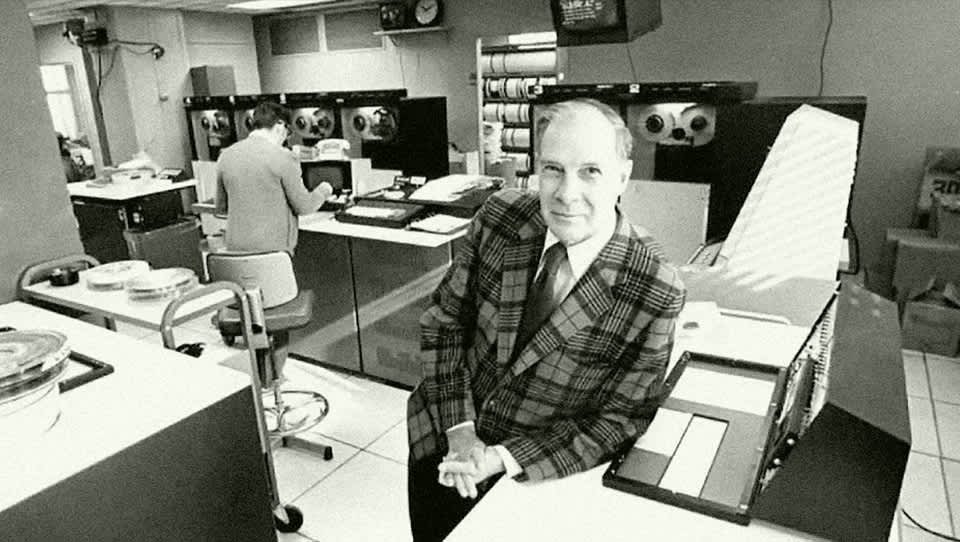
A mathematician who shared an office with Claude Shannon at Bell Labs gave one lecture in 1986 that explains why some people win Nobel Prizes and other equally smart people spend their whole lives doing forgettable work.
His name was Richard Hamming. He won the Turing Award. He invented error-correcting codes that made modern computing possible. And he spent 30 years at Bell Labs sitting in a cafeteria at lunch watching which scientists became legendary and which ones faded into nothing.
In March 1986, he walked into a Bellcore auditorium in front of 200 researchers and told them exactly what he had seen.
Here's the framework that has been quoted by every serious scientist for the last 40 years.
His opening line landed like a punch. He said most scientists he worked with at Bell Labs were just as smart as the Nobel Prize winners. Just as hardworking. Just as credentialed. And yet at the end of a 40-year career, one group had changed entire fields and the other group was forgotten by the time they retired.
He wanted to know what the difference actually was. And he said it wasn't luck. It wasn't IQ. It was a specific set of habits that almost nobody is willing to follow.
The first habit was the one that hurts the most to hear. He said most scientists deliberately avoid the most important problem in their field because the odds of failure are too high. They pick a safe adjacent problem, solve it cleanly, publish it, and move on. And because they never swing at the hard problem, they never hit it. He said if you do not work on an important problem, it is unlikely you will do important work. That is not a motivational line. That is a logical one.
The second habit was about doors. Literal doors. He noticed that the scientists at Bell Labs who kept their office doors closed got more done in the short term because they had no interruptions. But the scientists who kept their doors open got more done over a career. The open-door scientists were interrupted constantly. They also absorbed every new idea passing through the hallway. Ten years in, they were working on problems the closed-door scientists did not even know existed.
The third habit was inversion. When Bell Labs refused to give him the team of programmers he wanted, Hamming sat with the rejection for weeks. Then he flipped the question. Instead of asking for programmers to write the programs, he asked why machines could not write the programs themselves. That single inversion pushed him into the frontier of computer science. He said the pattern repeats everywhere. What looks like a defect, if you flip it correctly, becomes the exact thing that pushes you ahead of everyone else.
The fourth habit was the one that hit me the hardest. He said knowledge and productivity compound like interest. Someone who works 10 percent harder than you does not produce 10 percent more over a career. They produce twice as much. The gap doesn't add. It multiplies. And it compounds silently for years before anyone notices.
He finished the lecture with a line I have never been able to shake.
He said Pasteur's famous quote is right. Luck favors the prepared mind. But he meant it literally. You don't hope for luck. You engineer the conditions where luck can land on you. Open doors. Important problems. Inverted questions. Compounded hours. Those are not traits. Those are choices you make every single day.
The transcript has been sitting on the University of Virginia's computer science website for almost 30 years. The video is free on YouTube. Stripe Press reprinted the full lectures as a book in 2020 and Bret Victor wrote the foreword.
Hamming died in 1998. He gave his final lecture a few weeks before. He was 82.
The lecture that explains why some careers become legendary and others disappear is still free. Most people who could benefit from it will never open it.
Lamentamos profundamente informar el fallecimiento de Melanie Meis, docente e investigadora del Departamento de Ciencias de la Atmósfera y los Océanos (@DCAO_UBA ) de la Facultad.
Melanie se graduó y doctoró en la Facultad, siendo su especialidad la climatología aplicada y el estudio de eventos compuestos de precipitación y temperatura en Sudamérica. Trabajó en colaboración con el Instituto de Cálculo y, con una Beca Posdoctoral CONICET, integró el Centro de Investigaciones del Mar y la Atmósfera (@CIMA_Science ) de la Facultad.
Su pronta partida deja un dolor inmenso entre sus colegas, quienes destacan su calidad humana y vocación docente.
Acompañamos a sus seres queridos en este triste momento.
Los LLM como Claude no tienen memoria.
Cada conversación empieza desde cero.
Eso significa que el agente no sabe nada del proyecto en el que estás: ni la arquitectura, ni las convenciones, ni cómo funciona el equipo.
Para evitar tener que explicarle todo otra vez, Claude Code usa un mecanismo llamado Memory.
Memory permite que el modelo recupere información del proyecto cada vez que empieza una conversación.
Tenés 2 sistemas:
1) CLAUDE.md
- Podés correr /init en tu proyecto y Claude genera un archivo markdown analizando el código. También lo podés escribir vos.
- Ahí va todo lo que necesita saber: estándares de código, arquitectura, convenciones del equipo y comandos.
- Claude lo incluye en el contexto de cada conversación.
2) Auto Memory
- A medida que usás Claude Code, el modelo va tomando notas por su cuenta.
- Si le corregís algo o le explicás un patrón, puede decidir guardarlo.
- Se guardan como archivos markdown en tu máquina y Claude las consulta automáticamente cuando las necesita.
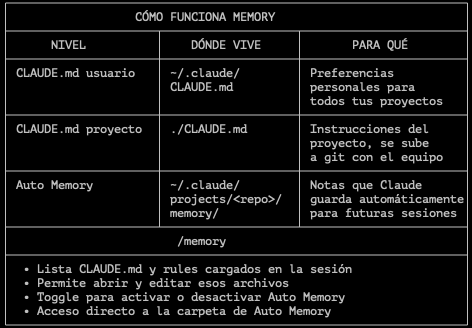
Claude puede recordar información en distintos niveles: CLAUDE.md a nivel usuario (tus preferencias personales), CLAUDE.md del proyecto (instrucciones del equipo) y Auto Memory (notas que Claude guarda solo).
¿Qué gana Claude con esto?
Que cada nueva conversación empiece con el contexto del proyecto ya cargado. No tenes que explicarle siempre lo mismo.
Tip:
podés ver y editar todo ejecutando /memory.
MIT offers 12 Books on AI & ML (FREE TO DOWNLOAD):
1. Foundations of Machine Learning
https://t.co/h934g1XrEH
2. Understanding Deep Learning
https://t.co/Dt8sFKkUGa
3. Algorithms for ML
https://t.co/S3dFDAEV4s
4. Reinforcement Learning
https://t.co/jums9Zy2h6...
5. Introduction to Machine Learning Systems
https://t.co/vEIS6crSfX…
6. Deep Learning
https://t.co/ZfDA9RWXwu
7. Distributional Reinforcement Learning
https://t.co/yLP1u5UKbC…
8. Multi Agent Reinforcement Learning
https://t.co/El9e00Wuzn
9. Agents in the Long Game of AI
https://t.co/yLP1u5UKbC…
10. Fairness and Machine Learning
https://t.co/qQ3L4kWZsq
11. Probabilistic Machine Learning
❯ Part 1 : https://t.co/VoZS9khRNJ…
❯ Part 2 : https://t.co/Wp6mxYKZ4j…
This is insane 😳
Most people are just using AI tools
Very few actually understand how they work
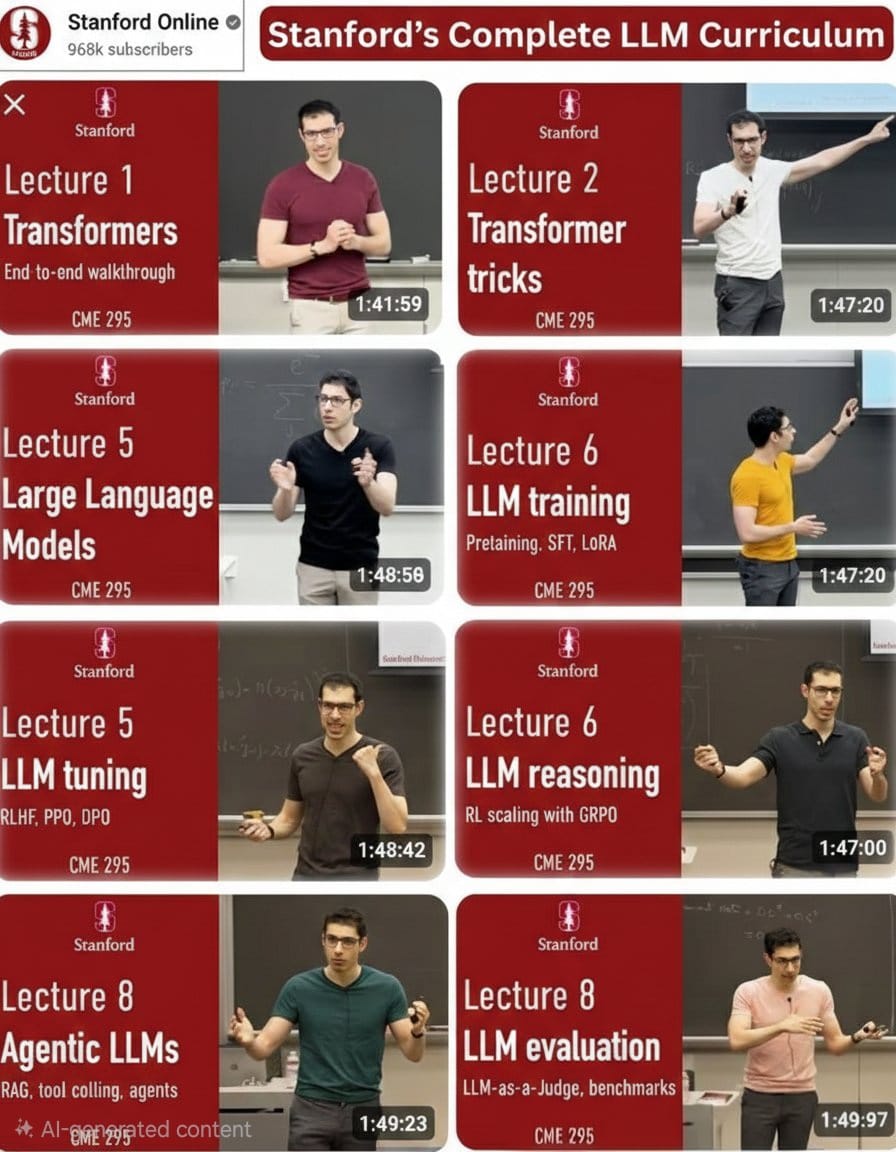
So I collected Stanford’s complete LLM curriculum
and turned it into a step-by-step learning path
Worth over $500
Giving it away free for the first 4,500 people
Transformers → Training → Alignment → Agents → Evaluation
Study this once and you’ll stop guessing with prompts
and start thinking like a real AI engineer
How to get it:
Follow must (so i can dm you)
Rt and comment 'LLM'
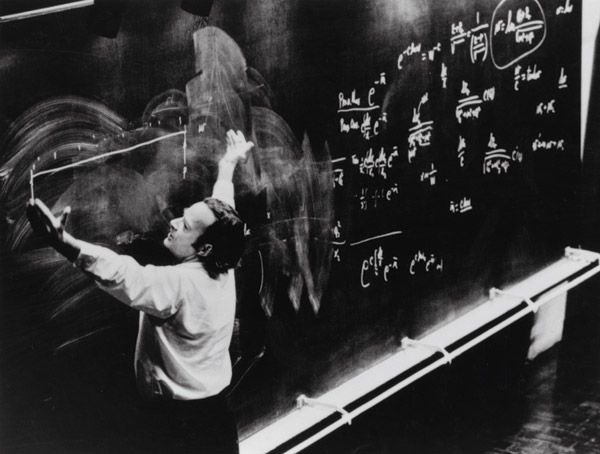
Fall in love with some activity, and do it! Nobody ever figures out what life is all about, and it doesn't matter. Explore the world. Nearly everything is really interesting if you go into it deeply enough. Work as hard and as much as you want to on the things you like to do the best. Don't think about what you want to be, but what you want to do. Keep up some kind of a minimum with other things so that society doesn't stop you from doing anything at all.
No entiendo el sentido de esta medida si realmente se concreta.
Para qué mandarlos a la Argentina?
No podemos sacar de la pobreza a los que están acá y van a mandarnos más gente?
Por qué no los mandan a su país de origen directamente de USA?
Somos el depósito de lo que no le gusta a Trump?
Según The New York Times, Trump y Milei negocian un acuerdo para que Argentina reciba a los deportados de Estados Unidos
https://t.co/qyYjTpjZO2
You will never live if you are looking for the meaning of life. Fall in love with some activity and do it! Nobody ever figures out what life is all about and it doesn't matter.
Los interesas a pagar este viernes son Gasto Corriente, no son deuda. Deuda es la amortización.El Gobierno y sus acólitos crean una enorme confusión contable mezclando amortización con intereses y también con intereses capitalizados y deuda a valor de mercado vs face value.
También confunden con Reservas Brutas (papel pintado) vs. RIN acorde con metodología de FMI (las verdaderas).
Además, en vez de quemar al BCRA, lo han fundido operacionalmente con el Tesoro.
Pueden tratar de confundir, pero la realidad es que no tienen un dólar disponible y tienen que salir a pasar la gorra a último momento.
Me hace acordar a la Lluvia de Dólares de Macri, que nunca llegó.
A pesar del apoyo del FMI y del Tesoro de USA, las verdaderas RIN siguen cayendo.
Evidentemente no son capaces de resolver la escasez de divisas. Podrían dejar que el libre mercado lo haga.