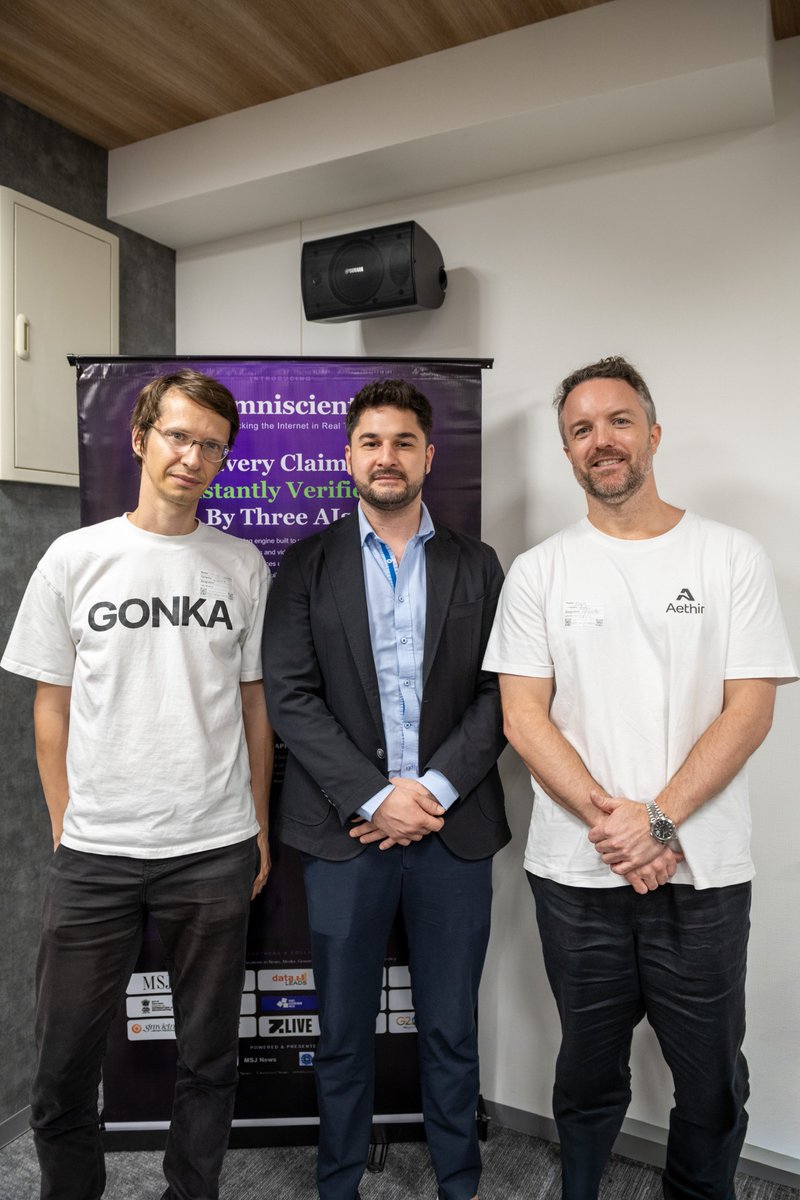
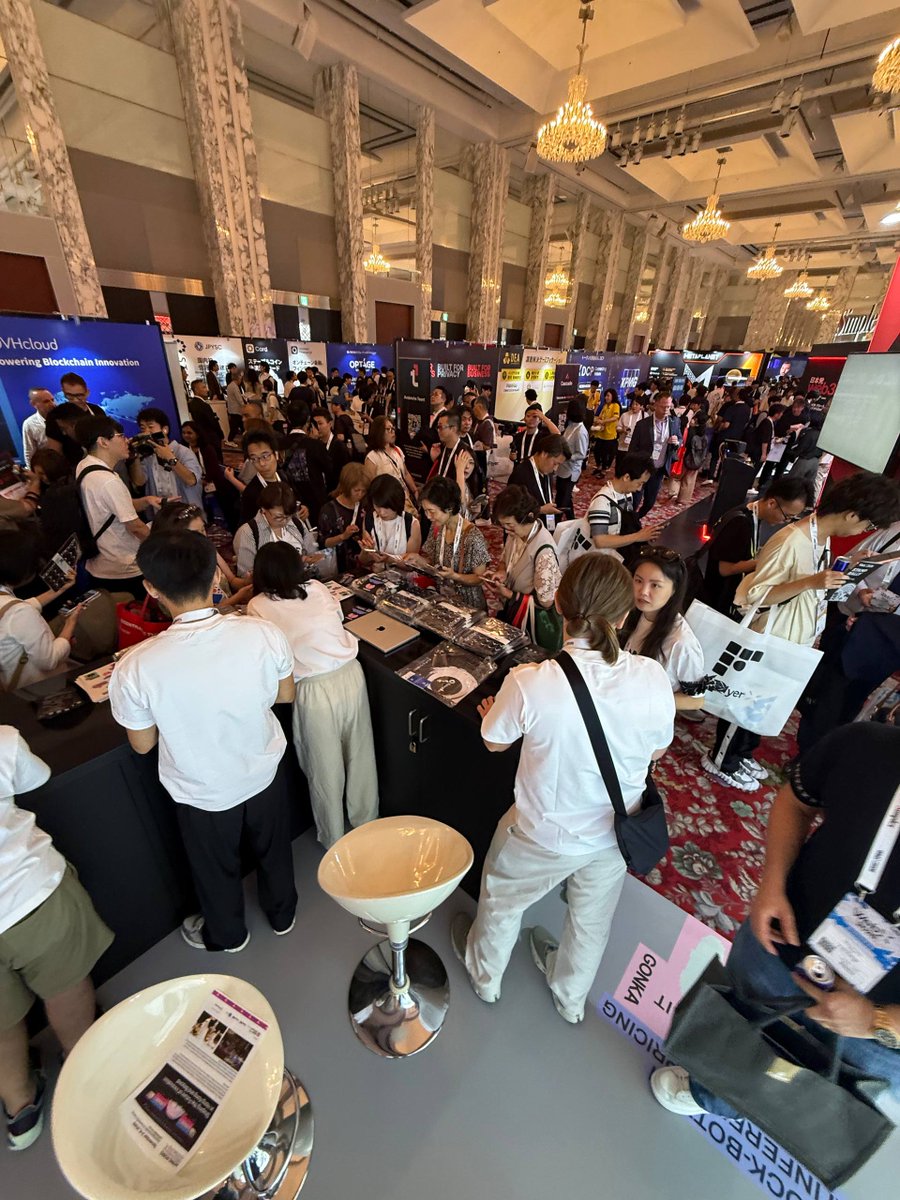
🇯🇵 WebX Asia might be over, but the work of moving decentralized AI forward never ends.
Recently, David Liberman had a public conversation at the AI Economic Forum with Mark Rydon, Co-Founder of @AethirCloud, and Omar Abi Issa of @OVHcloud.
Gonka co-creators: "The truly scarce resource is coordination."
@DaLiberman talk about Gonka, decentralized AI, and GPU feudalism in a recent interview to @mpost_io:
"Before operating a real network, people assumed the world contained a homogeneous pool of idle GPUs waiting to be activated. The reality is that hardware, networking, and availability differ drastically.
The truly scarce resource is coordination. A network must discover capacity, measure performance, verify execution, and create incentives that keep operators online. This is why Gonka uses a transformer-based Proof of Work and Sprint mechanisms to verify real AI hardware."
That’s a wrap on the first day of WebX Asia 2026.
So many builders and executives are interested in joining Gonka 🫶
See you tomorrow!
And don’t miss @DALiberman on the panel discussion “The Decentralized AI Stack: Infrastructure, Apps, and What’s Next.”
Tuesday, 4:15 PM JST, CRYL Stage.
"The greatest potential at the intersection of AI and blockchain lies where blockchain solves a trust problem that AI cannot solve on its own."
Gonka co-creators @DALiberman in exclusive interview to Coin Edition:
"As AI systems begin to generate content, make decisions, and act on behalf of users, the central question becomes: how do we verify what happened? That applies to the provenance of content and models, to payment and contractual infrastructure for autonomous agents, and to decentralized access to compute and data as an alternative to resource concentration in the hands of a few corporations.
Projects built purely on narrative will fade away.
Real value over the next few years will form around verification, payments, and coordination between autonomous systems. For us, the most immediate unlock inside that broader category is verifiable inference: proving that an AI agent actually executed what the model produced, not something silently modified by a server or intermediary."
Some milestones aren’t measured in revenue. They’re measured in trust.
This week, one of the world’s five largest space agencies started evaluating HyperspaceDB. The goal is simple, but technically demanding: provide an energy-efficient semantic memory with near-instant access to technical documentation onboard a spacecraft.
For obvious reasons, I can’t disclose the organization yet. I can only say that it is not NASA and not SpaceX.
This isn’t a commercial contract. Not yet.
It’s an engineering evaluation, and potentially the beginning of a much larger partnership.
For me, that’s even more exciting.
When you’re building infrastructure, validation doesn’t always come from funding rounds or headlines.
Sometimes it comes from organizations that literally build spacecraft. If everything goes well, HyperspaceDB could reach space next year.
Not bad for an open source vector database that started as an ambitious idea.
Back to work. 🚀 https://t.co/FYnIPEWycT
#HyperspaceDB #SpaceTech #AI #AIInfrastructure #VectorDatabase #OpenSource #RAG #Engineering #EnterpriseAI #DeepTech
Today we shipped HyperspaceDB v3.1.1. https://t.co/PIgyd321BH
Most users won’t notice the difference. That’s exactly the point. The biggest engineering work often happens where nobody can see it: stability, architecture, developer experience, and the foundation for what’s coming next.
We also updated our website, and we’re getting very close to opening HyperspaceDB Cloud for public access.
But the part I’m most excited about isn’t the release itself.
Next week, we’ll update the website once again. This time, we’ll start showcasing the companies that are integrating HyperspaceDB into their AI infrastructure and internal workflows.
The list is still modest, but it’s incredibly motivating to see names such as Wells Fargo, Costco, Nokia, BNP Paribas, Cloudflare, Alibaba, ByteDance, LOT, and several others experimenting with our technology.
For an open source project, real adoption matters far more than GitHub stars.
Of course, I hope that over time these companies will support the project not only by building with it, but also by contributing back to the ecosystem. That’s the beauty of open source: everyone benefits when innovation flows in both directions.
We’re just getting started.
#HyperspaceDB #OpenSource #VectorDatabase #AIInfrastructure #RAG #EnterpriseAI #Startup #DeveloperTools #Cloud #MaaS
Gonka in a real product: Integrity’s experience
Integrity, an Israeli-American startup building a “unified project brain,” added Gonka to the list of models available to its users, right next to GPT, Claude, and Gemini.
In a Gonka Community Blog post, Integrity’s founders shared their experience working with Gonka:
We’ve seen good inference speed in our tests. Gonka also provides built-in web search out of the box, which many open-weight model providers don’t offer. On top of that, the pricing is attractive.
The Gonka community is cooking — now with 10B+ AI tokens/day.
Join in three simple steps:
1. Pick your community broker:
https://t.co/4yHKP4qvbU
2. Pick a model: MiniMax-M2.7 or Kimi-K2.6
3. Connect it to your favorite tool or agent in seconds
Start building today, and showcase your Gonka projects in the # community-projects channel:
https://t.co/kqCSQ6eppL
Dario Amodei in 2023:
“When you control a model and deploy it, you have the ability to monitor its usage. It might be misused at one point, but then you can alter the model. You can revoke a user’s access. You can change what the model is willing to do. When a model is released in an uncontrolled manner, there’s no ability to do that. It’s entirely out of your hands.”
What sounded like a pitch for the centralized approach then clearly works in the opposite direction today.
More and more people are seeing now that nobody should be able to alter the model you are using. Nobody should be able to revoke your access. And with decentralized AI, that’s exactly how it works: no single entity can control your access to intelligence. Even if they really don’t like you.
Open-weight models from labs like @Kimi_Moonshot, available on platforms like @huggingface, open-source software like @vllm_project, and decentralized infrastructure like @gonka_ai offer a much more reliable alternative to the system proposed by “frontier labs” focused on fearmongering and passport-gated usage.
It’s not too late to join the movement.
Our ultimate goal is to find and fix every serious issue before those bad actors do. To get there, we are launching the Gonka bug bounty program on @Hacker0x01, making the whole process of reporting and remediating vulnerabilities more transparent, scalable, and effective.
Read more from the latest AMA:
https://t.co/o3TEIbOBED
New guest announced
Laurie Mercer, Senior Director of Sales Engineering at @Hacker0x01 , is excited to join the AMA session with Vadim Krutov and David Liberman!
Gonka. Bitfury. HackerOne. Bug Bounty Program.
See you in less than 24 hours.
https://t.co/k1ML5Sm96x
0. 0. 0. 0. 0.
Good news, everyone: @CertiKCommunity has published its security audit report for the Gonka–Ethereum bridge.
Zero centralization findings.
Zero critical issues.
Zero major, medium, or minor issues left unresolved or unmitigated.
This is CertiK’s third report on Gonka, following the earlier Inference and Consensus audits. Check the details and read the full reports on their site:
https://t.co/3f74dFObVc