@polybacktest Yes but the issue is the book prices this very accurately and if you enter directionally at 57c you need a 57% win rate to BE
So it’s getting in when the book disagrees but the book is informed so it’s hard
@jtrevorchapman Hey! How do you handle mid round flips?
My bot does very well in directional markets but when I’m buying yes at 55,56,57 and no at 0,44,43,42 it’s all good but then if no becomes 0.55,56 I’m now pairing older yes with new expensive no and worst and best profit become negative
@daresoftware@raychi_god@banksUSDC You don’t need the 5 minute market data, unless your exploiting poly orderbook microstructure
BTC 5 min candles go back years lol
My cousin works in weather insurance. Last week she showed me how her company prices storm damage 48 hours before any news outlet reports the risk.
I asked her if she ever looked at Polymarket.
She said: Those odds are basically free money for anyone with real data.
We were at her apartment in Chicago. She had just finished a 14 hour shift modeling hurricane probabilities for a reinsurance firm.
I was venting about losing $200 on a temperature bet in Miami.
She looked at my phone. Laughed. Then said something that changed how I see these markets.
You're betting against people who price billion dollar policies on this exact data. The public forecast is their leftover scraps.
She pulled up her work dashboard. Not weather. Not AccuWeather.
Raw ensemble models. Probability distributions. Temperature bands down to the half degree. Updated every 6 hours from sources most people don't know exist.
Insurance companies can't afford to guess. We pay millions for data that's 12-24 hours ahead of what retail forecasts show. When we see 94% chance of a temperature hitting a certain range, the public might still see 60%.
For her this was Tuesday. Routine risk modeling.
For me it was a revelation.
If the insurance industry prices weather with near certainty 24-48 hours out, and Polymarket odds lag behind
Someone with that edge could buy YES at 5 cents when the real probability is already 90%.
Not predicting weather. Just reading the answer before the market catches up.
I went home. Couldn't sleep.
Started digging through Polymarket weather wallets.
Forty minutes later I found this:
→ Wallet: https://t.co/dV4s4m7olX
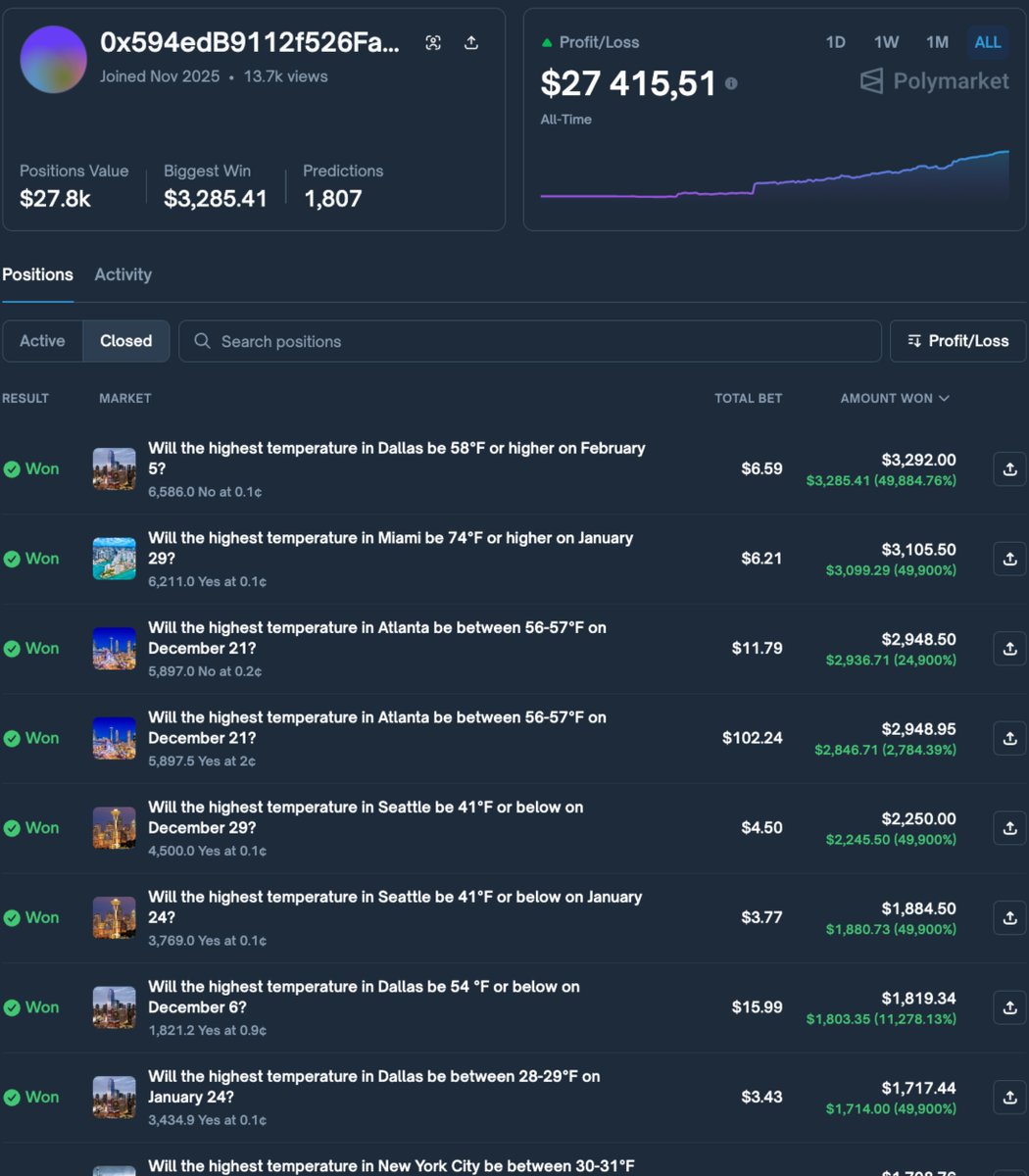
Started with almost nothing. Current profit: $27,415.
Every position is weather. Temperature ranges. Specific cities. Specific dates.
Atlanta. Miami. Dallas.
1,807 predictions. The profit curve goes straight up.
Look at the positions:
- Will Atlanta hit 70F on February 9? 2,728 shares at 98c. Value: $2,713.
- Will Miami stay below 65F on February 10? 1,527 shares at 97c. Value: $1,525.
Biggest single win: $3,285.
The pattern is always the same. Enter when odds are mispriced. Buy cheap. Wait for reality to confirm what the data already showed.
No guessing. No gambling. Just information asymmetry.
I texted my cousin the wallet link.
She looked at it for two minutes.
Then wrote back:
This is exactly what I was talking about. Someone's doing their homework.
Right now there's a temperature reading updating somewhere. An insurance actuary is adjusting a model.
And on Polymarket, the odds probably haven't moved yet.
The window exists. This wallet proves it.
My cousin works in weather insurance. Last week she showed me how her company prices storm damage 48 hours before any news outlet reports the risk.
I asked her if she ever looked at Polymarket.
She said: Those odds are basically free money for anyone with real data.
We were at her apartment in Chicago. She had just finished a 14 hour shift modeling hurricane probabilities for a reinsurance firm.
I was venting about losing $200 on a temperature bet in Miami.
She looked at my phone. Laughed. Then said something that changed how I see these markets.
You're betting against people who price billion dollar policies on this exact data. The public forecast is their leftover scraps.
She pulled up her work dashboard. Not weather. Not AccuWeather.
Raw ensemble models. Probability distributions. Temperature bands down to the half degree. Updated every 6 hours from sources most people don't know exist.
Insurance companies can't afford to guess. We pay millions for data that's 12-24 hours ahead of what retail forecasts show. When we see 94% chance of a temperature hitting a certain range, the public might still see 60%.
For her this was Tuesday. Routine risk modeling.
For me it was a revelation.
If the insurance industry prices weather with near certainty 24-48 hours out, and Polymarket odds lag behind
Someone with that edge could buy YES at 5 cents when the real probability is already 90%.
Not predicting weather. Just reading the answer before the market catches up.
I went home. Couldn't sleep.
Started digging through Polymarket weather wallets.
Forty minutes later I found this:
→ Wallet: https://t.co/dV4s4m7olX
Started with almost nothing. Current profit: $27,415.
Every position is weather. Temperature ranges. Specific cities. Specific dates.
Atlanta. Miami. Dallas.
1,807 predictions. The profit curve goes straight up.
Look at the positions:
- Will Atlanta hit 70F on February 9? 2,728 shares at 98c. Value: $2,713.
- Will Miami stay below 65F on February 10? 1,527 shares at 97c. Value: $1,525.
Biggest single win: $3,285.
The pattern is always the same. Enter when odds are mispriced. Buy cheap. Wait for reality to confirm what the data already showed.
No guessing. No gambling. Just information asymmetry.
I texted my cousin the wallet link.
She looked at it for two minutes.
Then wrote back:
This is exactly what I was talking about. Someone's doing their homework.
Right now there's a temperature reading updating somewhere. An insurance actuary is adjusting a model.
And on Polymarket, the odds probably haven't moved yet.
The window exists. This wallet proves it.
@RohOnChain Your so far from the money you have no idea, this is not what gabagool is doing, all these Twitter posts explaining are wrong, if they were right they would build it and keep the edge. Also knowing what he does and replicating it are two different things