An extremely bright sprite was recently captured from the ISS
Sprites are discharges of cold plasma in the upper atmosphere that sometimes form during severe thunderstorms. They occur at altitudes of 50 to 130 km and can be up to 60 km long.
Heroes of World War II, code talkers used their native languages to create an unbreakable code that protected American communications from the enemy. Learn more about them at https://t.co/hGSdXeajYw
#NativeAmericanHeritageMonth
The Peregrine Falcon is a common fall visitor to Dry Tortugas. This raptor is the second largest falcon in North America and is related to American Kestrels and Merlins.
Have you seen a Peregrine Falcon on a recent visit to Dry Tortugas? 🌍✨
NPS Photo by Andrea Knapp
Today we celebrated the expansion of the Winnebago Tribe's bison herd in Nebraska, where this iconic species has been central to cultures and lifeways for millennia. Together, @USFWS & their partners are building a future where bison can thrive on their ancestral lands.
The policy of genocide against the Armenian population of the Ottoman Empire started with the annihilation of the male population and subsequent deportation the rest of the people into the Syrian deserts. These deportations quickly turned into “death marches”. Deportation caravans mostly consisted of old people, women and children. En route many of women were kidnapped either by Ottoman Turkish soldiers or Kurdish bands or Bedouins killing any who tried to oppose them: tens of thousands women and children perished on the way to deserts, while others, in order to escape humiliation and violence, committed suicide.
Armenian genocide resulted in the kidnapping of thousands of Armenian women from their families, usually during deportations or overnight stops. After the organized mass killings of the Armenian male population, during the first stage of state-orchestrated policy of extermination, the Ottoman governors implemented another pre-meditated phase of the genocidal policy: the destruction of the rest of Armenian population in the Ottoman Empire, this time targeting the elderly, women and children.
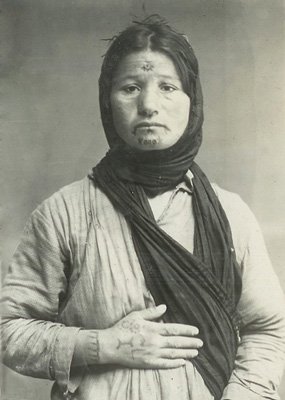
Some of those individuals who were kidnapped and integrated into Muslim family life, over time forgot about their Armenian ethnicity and even lost the ability to speak their native language. In order to save their own lives and the lives of their loved ones many Armenian women forcibly to adopted Islam. They eventually were married off to Muslim men and in keeping with local tribal customs, were marked with specific tattoos. Tattoos were extensively used as amulets in the Middle East and Islamic countries, with the wearers believing that the mark imbued them with magical powers. These tattoos were often in the form of dots or a small “x” and provided protection, strength or fertility. These new markings represented new belonging and a marked change in their life.
After the end of the First World War, many Armenian organizations and foreign missioners helped rescue Armenian women and children from their captors. These rescue missions turned into large-scale operations, rife with danger. Particularly, Karen Yeppe, a Danish missionary who, with the assistance of some Arab tribe leaders, up until 1928, rescued approximately 2000 Armenian women and children from Muslim captivity. She helped establish special rescue homes in several locations which helped put an end to the tragic and painful ordeal many Armenian women had suffered.
Many volunteers paid dearly with their lives for being involved in these rescue operations and many Armenian women felt victim during their escape attempts.
The kidnapping of Armenian children and women and their subsequent rescue efforts outlines one of most tragic and dramatic episodes of the genocidal policy implemented by Ottoman Turkish government against Armenian population in the beginning of the 20th Century.
📷 : Islamized and tattooed Armenian woman, Karen Yeppe alboom, 1920s, AGMI collection.
#archaeohistories
One of many petroglyph sites in Utah, Newspaper Rock is unique because of the large time span in which the petroglyphs were drawn. It is a look into the past lives of those who lived in Utah before us...
Newspaper Rock is located along the Scenic Creek Corridor Scenic Byway in the Bears Ears National Monument, created on the cliffs that go through all of Indian Creek Canyon. Newspaper Rock is about 24 miles northwest of Monticello and 50 miles south of Moab. The actual petroglyph site is around 200 square feet across. It is located along the main road to the Needles District of Canyonlands National Park. There is no fee to access this site, and it is open all year long. Formerly a state park, Newspaper Rock currently carries the designation of a National Monument.
The petroglyphs that cover the group of rocks collectively known as Newspaper Rock were drawn across a wide span of time ranging from 1200 to 200 years ago. The petroglyphs are thought to be drawn by a variety of people including the Ancestral Pueblo, Fremont, Basket Maker, and Navajo peoples.
As a hunter-gather people living around 100 CE, Ancestral Puebloans’ diet relied upon hunting. Later, they transitioned to a sedentary lifestyle and relied more upon agriculture. They occupied the southwest area of the modern-day United States until droughts destroyed their agricultural economy and forced them to move away from Utah, Arizona, Colorado, and New Mexico to other areas with more water. The Fremont also inhabited this area around the same time as the Ancestral Puebloans. Similarly, they developed agricultural practices, but hunting remained an important part of their culture until devastating droughts hit the region. By the fifteenth century, the Diné (Navajo) arrived and, like their predecessors, participated in hunting and gathering. When the Diné moved into the southwest, they adapted some of the Puebloans’ agricultural practices and cultivated corn, beans, and squash while supplementing their diet through hunting.
Ancestral Puebloans, Fremont, and Navajos all added carvings to this rock over the course of centuries. As a result, there is no linear story that can be understood from the pictures. Most of the pictures remain unidentified and uninterpreted because there is no way to discover their meaning. It is unclear why this particular rock was such a popular place for petroglyphs, but its popularity in the ancient world has made it popular again in the modern world. European explorers added more names and dates, and curious visitors come to see the pictures etched by ancient peoples long past.
In Navajo language, Newspaper Rock is called Tse’ Hane, which means, “rock that tells a story.” What do these ancient storytellers reveal about the Native American Indians who created These mysterious images? Though there is no exact translation known for many of these petroglyphs, it is possible to infer some things about the people from their rock art. These markings, engravings, and drawings tell us about stories, hunting patterns, crop cycles, beliefs, and mythologies of their existence. Some modern Native American Indians have interpreted the drawings on the rock to include family or clan symbols, spiritual meanings, and calendar events. Images include those of animals, people, tools, and other items. We know that the drawings were compiled over time by different groups who were in the area. Earlier drawings resemble snakes, wagon wheels, lizards, footprints, and broad shouldered, animal headed people. Some we can tell were made later, depicting men on horseback, potentially referring to the coming of the Spanish and other colonizers who threatened some groups and brought prosperity to others. These petroglyphs help us add to the tales we already know about these ancient people as we build on the foundation of what we know about them from other artifacts and oral histories.
#archaeohistories
Elon has stopped engagement with this tweet because it is exposing his strategy, I’ve heard from 3 accounts that they aren’t able to retweet. I’ve been told he can’t stop screen shots however.