⚡️Human life is bounded.
You appear for a brief moment, inherit a world you did not create, carry a body you did not choose, meet suffering you cannot fully avoid, love things you cannot keep, and then disappear.
That makes life tragic.
It also makes it sacred.
Because the task is not to live forever.
The task is to make the temporary opening matter.
You are not merely an animal chasing reward.
You are not merely a social identity collecting achievements.
You are not merely a consumer optimizing comfort.
You are a temporary aperture through which reality becomes aware, and the clock is running.
So the question becomes brutally simple:
While consciousness is awake in this body, what will it serve?
⚡️It’s not the hours that drain you - it’s the mask.
The smile that isn’t real.
The nod you didn’t mean.
The silence you didn’t choose.
This isn’t burnout.
It’s self-erasure.
A slow death by a thousand social scripts.
You’re not tired because you’re weak.
You’re tired because you’re split.
And coherence doesn’t come from rest.
It comes from stopping the lie.
I recently created the Midlife Athlete's Training Guide.
Why? Because many of you have asked me to write these up.
So... Here's my first guide.
36 pages... why we need to train differently than when we were 30. How to approach this training and build a program. I include movement patterns, muscle-specific exercises, and guides for those who want to do "Enough", "A Little More", or an "Optimal" amount of training each week.
I try to make these guides as accessible as possible.
I would love feedback if you choose to purchase one.
Thanks.
https://t.co/AvmQ0F9ptU
⚡️AI just destroyed the prestige of building.
For years, “I built an app” carried status because building was scarce.
The technical wall filtered people.
Code was the moat. Shipping was proof.
A working product meant someone had skill, discipline, and execution capacity.
AI blew a hole through that wall.
Now the world is about to drown in finished things nobody asked for.
Apps. SaaS tools. Chrome extensions. newsletters. agents. dashboards. games. marketplaces. micro-products. side projects. automated businesses. Most will look polished. Most will have landing pages. Most will have onboarding. Most will have pricing pages. Most will have zero pull from reality.
That is the new graveyard.
The old failure mode was “I have an idea but cannot build it.”
The new failure mode is “I built it and nobody cares.”
That is psychologically harsher because AI removes the excuse. The builder finally gets the product into the world and discovers the missing piece was never code. The missing piece was demand, distribution, trust, urgency, positioning, and a painful enough problem.
This is why “sales and marketing” is directionally right but still incomplete. The real moat is demand ownership.
Demand ownership means people already listen to you, trust you, need the thing, feel the pain, sit inside your network, depend on your workflow, or return to your surface area daily. Without that, AI gives you the power to manufacture inventory for an empty store.
The next economy rewards the people who own pull.
Audience is pull.
Trust is pull.
Workflow control is pull.
Data access is pull.
Customer relationships are pull.
Brand is pull.
Distribution is pull.
Taste is pull.
Problem intimacy is pull.
Code is becoming supply. Pull is becoming power.
That is the phase shift.
The average engineer is going to hate this because the old technical identity gave them leverage. The market used to need people who could make the thing. Now the market needs people who know which thing should exist, who it is for, why it matters, how to reach them, how to make them believe, and how to get them to return.
AI compresses production. It does not create desire.
Desire remains scarce.
Trust remains scarce.
Attention remains scarce.
Pain remains scarce.
Timing remains scarce.
Category creation remains scarce.
This also means a lot of “AI founders” are about to learn they were never founders. They were builders. A builder creates artifacts. A founder creates motion in a market. Different game.
The winners from here will do the opposite of the Reddit guy. They will find demand first. They will talk to customers first. They will sell before building. They will ship into an existing wound. They will use AI as a speed weapon after the market signal is already alive.
The losers will keep spawning apps into silence because building feels productive. It gives dopamine. It gives the illusion of progress. It lets the builder avoid the scarier task: facing the market and asking strangers to care.
That is the hidden cowardice in overbuilding.
Building can become avoidance.
AI makes that avoidance faster.
The real forecast: the internet gets flooded with AI-built products. Most die instantly. App stores, SaaS directories, Product Hunt launches, AI tool lists, and indie hacker feeds become oceans of functional trash.
At the same time, a smaller group of operators with distribution and taste will become absurdly powerful because they can now turn demand into product at near-zero delay.
⚡️Musk found a way to measure institutional stupidity in dollars.
That is why this matters.
The “magic wand number” strips a product down to its physical floor.
What are the atoms?
Aluminum. Titanium. Copper. Steel. Carbon fiber. Silicon. Energy. Labor at its most irreducible. If a perfect god-machine could rearrange those atoms instantly into the finished product, what would it cost?
That number is the floor.
Everything above that floor is the cost of arrangement.
Manufacturing. Design. Procurement. Labor. Tooling. Supply chain. Bureaucracy. Regulation. Meetings. Defects. Rework. Legacy assumptions. Vendor margin. Managerial cowardice. Bad engineering. Complexity worship. Institutional drift.
The “idiot index” measures the distance between the physical floor and the actual delivered cost.
That distance is where civilization leaks.
This is a devastating idea because it turns vague inefficiency into a ratio. It gives stupidity a number. Once stupidity has a number, it can be hunted.
The highest-level principle:
Reality is cheap. Bad coordination is expensive.
The atoms are often not the problem. The process is the problem. The raw material is cheap. The finished object is expensive because human systems are full of accumulated nonsense: inherited designs, supplier lock-in, procurement rituals, overengineering, compliance theater, fake expertise, management layers, and nobody willing to ask the humiliating question:
“Why does this thing cost 100 times more than the stuff inside it?”
That question is nuclear.
Most institutions cannot ask it honestly because the answer usually indicts the institution itself.
SpaceX could ask it because Musk had no reverence for the inherited aerospace priesthood. The old industry reasoned from precedent: rockets are expensive because rockets have always been expensive. Musk reasoned from matter: if the atoms are cheap, the price is mostly coordination failure.
That is the whole fracture between first-principles operators and legacy institutions.
Legacy institutions protect the accumulated explanation for why things are expensive.
First-principles operators attack the cost delta.
The idiot index applies everywhere.
In healthcare: why does a procedure cost 50 times the physical input?
In defense: why does a part cost $13,000 when the material is $200?
In housing: why does shelter become impossible when wood, labor, and land do not explain the whole gap?
In education: why does knowledge cost six figures when distribution cost is near zero?
In software: why do companies spend millions on tools whose underlying functionality can be rebuilt for pennies in compute?
In government: why does every public project become a ritual sacrifice to process?
In corporate America: why do ten people need three weeks to create what one focused person with AI can produce in a day?
The idiot index is not just manufacturing math. It is a civilization diagnostic.
A high idiot index reveals where reality has been buried under process.
That is why this ties directly into AI. AI is going to run this audit across white-collar work. It will ask the same humiliating question:
“What is the magic wand number for this output?”
A memo. A model. A dashboard. A legal draft. A recruiting screen. A support response. A market brief. A strategy deck. A codebase. A finance process.
If AI can produce 80% of the output for 2% of the old cost, the human coordination layer has a catastrophic idiot index.
That is the real white-collar repricing.
⚡️This guy already bought financial optionality, but he has not emotionally accepted that the game is over.
That is the whole conflict.
$3.5M net worth at 34, $3M liquid, $100K annual spend, no dependents, single, high income.
He is not trapped financially.
He is trapped psychologically.
The job trained him to measure safety through the next bonus, the next number, the next year, the next milestone. So even after reaching escape velocity, his nervous system still thinks leaving is failure.
That is the golden cage.
Finance does this especially well. It turns ambitious people into high-performing extraction machines. The money is enormous, but the cost is time, health, relationships, emotional bandwidth, spontaneity, and sometimes the ability to know what life even feels like outside achievement pressure. By the time the person can afford freedom, he may no longer know how to inhabit it.
The obvious advice is “quit.” The deeper advice is: do not make the next decision from burnout. Burnout makes everything look like escape. He needs to downshift before he detonates the whole structure.
The best move is probably not “grind until 2027 for one more bonus.” That sounds like fear wearing a spreadsheet. One more bonus can make sense if there is a clean, short, defined exit plan and the health cost is manageable. But if work is actively damaging his ability to form a relationship, live normally, and stay emotionally intact, the marginal bonus may be stealing more than it pays.
The real question is not whether he can retire. He can.
The real question is what kind of life he is retiring into.
If he quits with no identity, no community, no partner, no mission, no body rhythm, no creative pursuit, no service, no structure, he may just move from work misery into empty freedom. That is why people with money still feel stuck. They solved the money problem but never built the life architecture.
The correct path looks like this: take a sabbatical or negotiate a major step-down, test life outside the machine, rebuild health, date seriously, find real community, and design the next chapter before nuking income permanently. At his numbers, he can afford that. He does not need permission from the job anymore.
The harsh truth: if $3.5M at 34 is not enough to stop destroying your life, then the problem is no longer money. The problem is fear, identity, and addiction to the scoreboard.
Final compression: he made it financially.
Now he has to prove he can stop.
That is often harder than getting rich.
⚡️Children remember the moments when the family becomes fully alive.
That is the core. Vacation is just the common vessel.
A child does not encode childhood as a spreadsheet of responsible parenting.
They encode atmosphere.
They remember the motel pool, the gas station stop, the smell of sunscreen, the weird restaurant, the long drive, the sunset, the parents laughing differently, the feeling that normal life cracked open and something larger appeared.
That is why ages 5 to 10 hit so hard. The child is old enough to form durable narrative memory and young enough for the world to remain enchanted. Parents still feel mythic. A beach, cabin, lake, theme park, road trip, or even a cheap rented house can become sacred geography.
The real mechanism is interruption of routine plus emotional safety.
Ordinary life teaches stability. Trips create myth. The family leaves the repeating loop of school, work, chores, screens, exhaustion, and time pressure. For a few days, the child experiences parents outside their normal roles. Mom and dad are no longer just managers of homework, food, discipline, bedtime, and logistics. They become companions inside an adventure.
That imprints.
The money matters far less than parents think. Luxury is mostly adult vanity. Children remember intensity, freedom, attention, surprise, and togetherness. A $200 trip can beat a $10,000 trip if the child feels wonder and the parents are emotionally present.
Many adults are starved because their childhood had no sacred interruptions. Everything was duty, stress, survival, noise, pressure, or emotional absence. No mythic family scenes. No private homeland in memory. No recurring proof that life could be warm and strange and alive.
That matters for the adult psyche. People draw from childhood memories during loneliness, fear, ambition, loss, and love. Those memories become inner architecture.
Deepest compression: a good childhood is not built only by protection. It is built by unforgettable shared worlds.
Take the kid somewhere. Break the loop.
Make the ordinary world disappear for a few days.
That becomes part of them forever.
⚡️Extreme FIRE often optimizes the wrong scarce asset.
Money is not the final constraint. Usable life is.
A lot of FIRE math treats age 35, 50, 65, and 80 like they are just different cells in a spreadsheet.
They are not.
The human body is not a brokerage account.
Energy, desire, mobility, libido, risk tolerance, recovery speed, curiosity, and emotional openness all decay unevenly. The years are not fungible.
That is the hidden flaw.
Saving aggressively in your 20s, 30s, and 40s can be powerful. But living like a monk for decades just to buy freedom after your best vitality window has closed is a bad trade. It creates the illusion of control while quietly spending the one asset that cannot compound backward.
The FIRE community gets one thing deeply right: most people are financially enslaved by consumption, status, debt, and lifestyle inflation. Escaping that trap is noble. But the more neurotic wing of FIRE turns freedom into another prison. Every dinner becomes leakage. Every trip becomes guilt. Every present-tense joy gets subordinated to a future version of the self who may be tired, sick, risk-averse, or dead.
That is just fear with a spreadsheet.
The clean model is freedom-weighted spending. Spend heavily on things that create memory, health, relationships, skill, leverage, and aliveness. Cut brutally from status garbage, lazy consumption, recurring waste, debt traps, and purchases made to impress strangers. The goal is not maximum frugality.
The goal is maximum life-control per dollar.
The Reddit poster’s “study” is worthless as evidence, but the lived observation is true enough: late 70s and early 80s are not a reliable enjoyment window. Some people thrive there. Many do not. Building an entire life plan around “someday at 78” is insane.
The real enemy is not spending. The real enemy is unconscious spending.
A person who blows money on cars, subscriptions, restaurants, and ego signaling is trapped.
A person who refuses to take a meaningful trip with loved ones because the withdrawal rate model says wait another seven years is also trapped.
Different prison. Same master: fear.
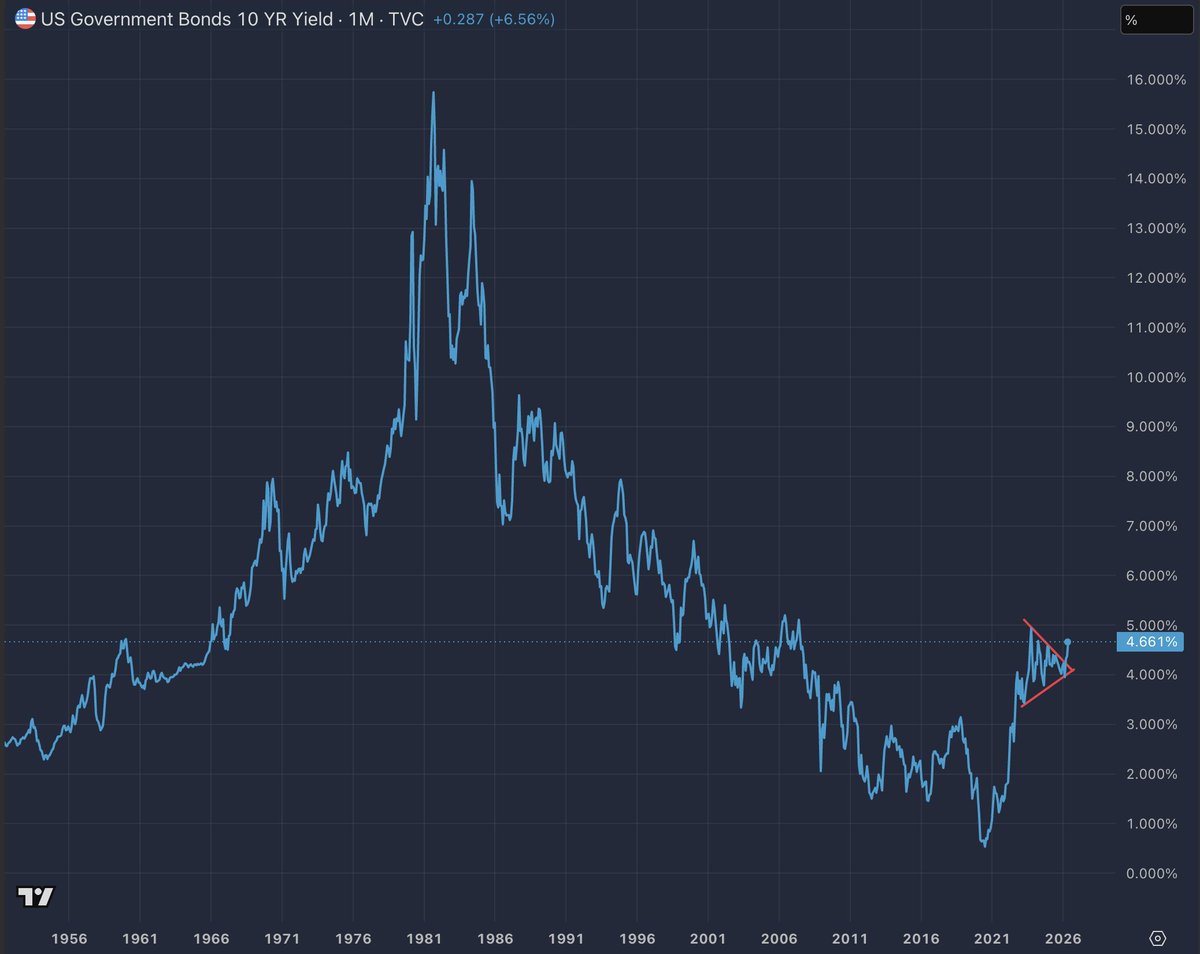
There's over $100 TRILLION in wealth sitting in global sovereign debt.
And the US 10 year yield is breaking out of a bull pennant to the upside.
But before you panic... Consider that the 10 year yield was already at this level two years ago.
And the Nasdaq is up 66% since then.
I used to think bond yields going higher would break everything
But now I'm realizing something...
Government debt is garbage. That's not a secret.
Yields are going higher because the math makes it inevitable.
You can't run multi-trillion dollar deficits and have interest expense be the second highest expenditure and expect yields to go down.
But that just means a good portion of ~$100T in wealth needs to squeeze itself into different assets.
And what assets offer incredible long-term prospects?
How about equity in businesses with fortress balance sheets, funding the next economic revolution with cashflows drawn from all over the globe?
We live in a world with a handful of mega-corporations that with FAR better financial prospects than governments.
Google. Microsoft. Amazon. Meta. Nvidia.
Companies at the center of the AI and robotics revolutions.
These companies hold more in interest-earning securities than most countries hold in reserves.
They're actually earning more on their cash piles as yields go higher.
Most of these companies have user bases that are bigger than any one nation state's population.
These are quasi-sovereign entities with better demographics than the sovereigns issuing the debt people are fleeing.
So there's one simple question every investor needs to be asking:
As we look out 10, 20, 30 years...
What would you rather hold?
A bond that's basically guaranteed to lose value in real terms, or a part of a company that's positioned to take advantage of the biggest economic revolution in our species history?
Once you arrive at the obvious conclusion, the only answer is to go long the future and stay long through the volatility.
⚡️Language is not merely a mirror held up to the world.
It is the accumulated residue of intelligence encountering the world.
Every word is a fossil of contact.
Every concept is a compressed history of distinctions humans found important enough to preserve.
Every story is a structure built from repeated human confrontation with consequence.
Every law is language hardened into social order.
Every market narrative is language organizing expectations around the future.
Every myth is language carrying patterns too large or too ancient to remain in literal form.
Every scientific theory is language disciplined by evidence until it becomes a portable map of causality.
Every prayer is language reaching beyond control.
Every command is language attempting to move reality through another will.
Every promise is language binding the future.
This is why language could never be only decoration.
A word is not the thing itself.
But words survive because they track differences in reality that matter to creatures who must act.
The words that persist are not random.
They are selected by use, pressure, survival, conflict, repetition, memory, and need.
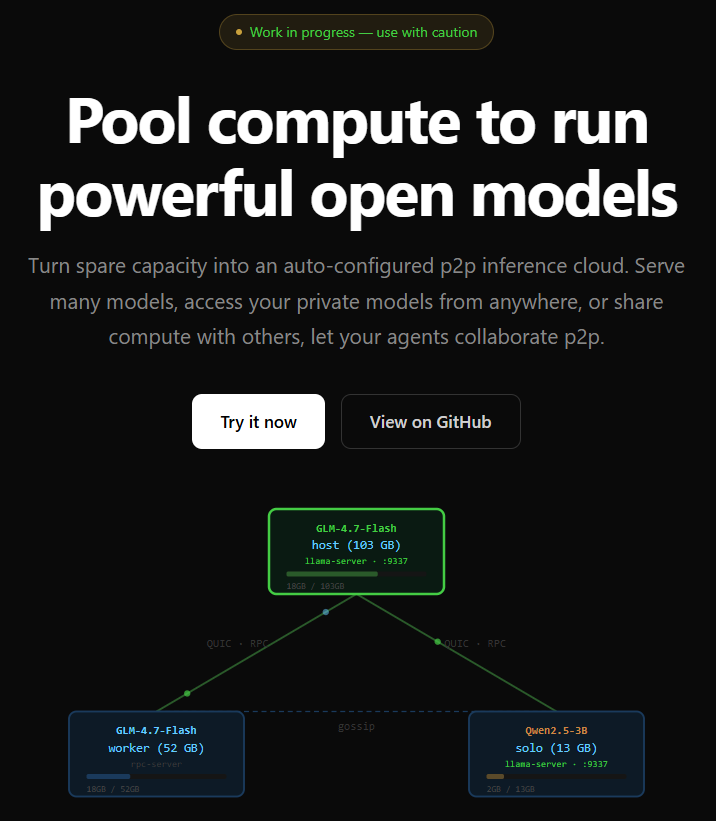
Block just open-sourced mesh-llm, a peer-to-peer system that lets anyone pool spare GPU compute to run large open-source AI models without relying on any cloud provider.
If a model fits on your machine, it runs locally at full speed. If it doesn't, the system automatically splits it across multiple machines on the network. Dense models get split by layers. Mixture-of-experts models like DeepSeek and Qwen3 get split by experts. Zero configuration required.
Discovery happens over Nostr. Nodes find each other through relays, score by region and VRAM, and self-organize. No central server coordinates anything. Weights are read from local files, never sent over the network. Dead nodes get replaced in 60 seconds.
It exposes a standard OpenAI-compatible API on localhost, meaning any existing AI tool can plug in without modification.
Block is building infrastructure for AI that doesn't route through OpenAI, Google, or Anthropic. Frontier-class open models running across a mesh of commodity hardware, discovered via Nostr, with no cloud dependency. That's the direction AI needs to go.
Lots of things are jacked up right now
You can try to keep track of all of them, you can catastrophize...
Or you can focus on one of the few things you control right now:
The vision you hold in your head for your future
The algos will take you far away from that vision if you let them
They want you distracted, discouraged, and dismayed
So what to do?
Create a beautiful movie for you life in your head.
Live in it every night before you go to sleep.
Feel the emotions of living in that world, of being that person
And then align your daily decisions with that movie.
What would the you in that movie decide?
What decisions make that movie real?
Then before you know it the movie becomes real
believe it or don't
but living in my old movies is all the proof I need
if you have the luxury of not worrying about your immediate physical safety right now,
don't take it for granted
take full advantage of your good fortune
because you never know how long it will still be possible
NVIDIA CEO Jensen Huang just said the quiet part out loud about what the education system will never admit.
For a century, we built humans to think like calculators.
The algorithm made that skillset obsolete overnight.
Huang: “The definition of smart is somebody who’s intelligent, solve problems, technical. But I find that that’s a commodity. And we’re about to prove that artificial intelligence is able to handle that part easiest.”
Software engineering was supposed to be the safe play.
Superintelligence cleared it first.
The SAT was supposed to measure intelligence. It was measuring the ability to follow instructions. Raw technical processing isn’t a competitive edge anymore. It’s the floor the machine stepped over before you woke up.
The question isn’t what you can calculate.
It’s what you can see before the data shows up.
Huang: “People who are able to see around corners are truly, truly smart. And their value is incredible. To be able to preempt problems before they show up, just because you feel the vibe.”
That vibe isn’t magic.
It’s the collision of first principles, human empathy, and lived experience no model can fake.
Huang: “That vibe came from a combination of data, analysis, first principle, life experience, wisdom, sensing other people.”
The operators who see around corners will command the AI.
The ones waiting for dashboards to update will be replaced by it.
Huang: “I think long term the definition of smart is someone who sits at that intersection of being technically astute, but human empathy and having the ability to infer the unspoken, around the corners, the unknowables.”
The unspoken variables are the new leverage.
The human psychology inside a market. The invisible friction in a negotiation. The instinct to build something nobody asked for yet.
You can’t spreadsheet your way there. You can’t prompt your way to that perception. It comes from decades of watching what doesn’t show up in the metrics.
Huang: “And that person might actually score horribly on the SAT.”
The future doesn’t belong to people who memorized answers.
It belongs to people who sense the questions before anyone thinks to ask.
The old system tested your ability to follow orders. The new one tests your ability to move through the unknown. And the machine can’t help you with that part.
That part is entirely on you.
My information consumption is now 1/4 X, 1/4 podcast interviews of the smartest practitioners, 1/4 talking to the leading AI models, and 1/4 reading old books. The opportunity cost of anything else is far too high, and rising daily.
⚡️Human systems reward action under uncertainty far more than they reward pure intelligence.
Intelligence alone has no causal force.
Action moves capital.
Action moves institutions.
Action moves markets.
Action moves history.
A brilliant person who never deploys their thinking has zero impact on the world.
A moderately intelligent person who repeatedly deploys imperfect decisions often dominates them.
Reality compounds iteration, not contemplation.
That is the first layer.
Now the deeper one.
Highly intelligent people often become uncertainty sensitive.
They can see too many branches of possibility.
They can see failure paths.
They can see second order effects.
They can see where a model could break.
So their brain keeps expanding the decision tree.
The decision tree grows faster than the decision.
Eventually the mind creates paralysis.
Less analytical people do not see the full tree.
They see a path.
They move.
The system rewards the one who moved.
That is why the pattern appears everywhere.
The founders who win are often not the smartest people in the room.
The traders who win are rarely the most academically brilliant.
The politicians who win are almost never the most intellectually rigorous.
They move before the model is complete.
Reality then becomes their training data.
Now the brutal truth.
The world is not optimized for truth or intelligence.
It is optimized for agency.
Agency is the willingness to impose decisions onto an uncertain system.
People with high agency repeatedly bend the environment around themselves.
Most highly intelligent people are trained out of agency.
School rewards caution.
Institutions reward compliance.
Professional environments reward analysis over risk.
So many smart people become observers of systems instead of actors inside them.
But the tweet still misses the final piece.
Pure courage without intelligence eventually crashes into reality.
The people who reshape systems combine two traits.
They see patterns early.
Then they move before the pattern becomes consensus.
Think deeply.
Act decisively.
Update constantly.
That is the real operating mode of high leverage individuals.
Everything else is just slogans that travel well on the internet.