holy f**king sh*t, most people use AI to summarize research papers
Boris Cherny, the guy who created Claude Code, used it to rerun them
he gave 12 Claude Code agents 64 research papers and one task: build a browser lab where readers can repeat the experiments themselves
you pick a fluid simulation, change the conditions and watch the result move
same scene, different method, one click. the equations, code and measurements sit right next to the animation
the agents split into crews:
→ readers pull equations, assumptions and experimental settings out of the papers
→ builders turn the methods into code that runs
→ reviewers compare every output to the paper
→ interface agents build the controls for exploring each experiment
the sneaky part: a simulation can look beautiful and still be total sh*t
so before any implementation gets accepted, reviewers check that it preserves mass, stays stable and matches the paper’s measurements
no experiment ships without:
the claim it’s testing
the conditions it ran under
how far it is from the reference result
what’s still missing to verify it
the scoreboard: 11 methods, 28 reference scenes. seven matched the selected reference results within the stated tolerances. four are still marked for further review
want to try it on your own papers? drop the collection into Claude Code and paste this:
“Turn these papers into an interactive lab that runs in the browser
Find the methods, equations and experimental settings that can be implemented. Add page references and flag any missing details
Give each independent method to a separate agent. Use shared inputs and measurement tools so results can be compared
Have reviewers check each implementation against its paper. Record every discrepancy and keep unverified results clearly marked
Build controls for changing parameters, comparing methods and opening the code behind each result”
don’t go big on day one. take one paper, reproduce one reference experiment, then add more agents
and package the inputs, dependencies and checks so the next reader can rerun the d*mn thing from a clean checkout
the agents at work below 👇
REA is most dangerous thing on the internet right now...
It lets your AI agent reverse engineer any app, down to the binary
If you use it correctly, you can rebuild any feature you pay for, for FREE
In this article, I show you how: https://t.co/3P1FNXiXzl
holy sh*t, Claude Code agents just turned a stack of research papers into a lab that runs in your browser
Boris Cherny (the guy who built Claude Code) handed 12 agents 64 research papers with one job: build a browser lab where anyone can rerun the experiments themselves
pick a fluid simulation, tweak the conditions, watch the result shift
swap methods on the exact same scene. the equations, code and measurements sit right next to the animation
every group got its own f*cking job:
→ readers pull out equations, assumptions and experimental setups
→ builders turn each method into code that actually runs
→ reviewers check the outputs against the papers
→ interface agents build the controls to explore every experiment
here’s the catch: a simulation can look gorgeous and still be dead wrong
so reviewers check that it conserves mass, stays stable and hits the paper’s measurements before any implementation gets accepted
every experiment has to show:
what claim is being tested
under which conditions
how far it lands from the reference result
what’s still missing to verify it
final tally: 11 methods across 28 reference scenes. seven matched the selected reference results within the stated tolerances, four are still flagged for more review
feed Claude Code your paper collection and ask:
“Build an interactive browser lab from these papers
Pull out the methods, equations and experimental settings that can be implemented. Cite page numbers and flag anything missing
Give each independent method to its own agent. Use shared inputs and measurement tools so the results stay comparable
Have reviewers check every implementation against its paper. Log discrepancies and keep anything unverified clearly labeled
Build controls to change parameters, compare methods and open the code behind every result”
start small: one paper, one reference experiment reproduced, then add more agents
ship the inputs, dependencies and checks so the next person can rerun the whole damn thing from a clean checkout
watch the agents do their thing below
In 1975, Steve Jobs told Steve Wozniak that Atari paid $700 for a game the two of them made. Woz got a check for $350, his half.
The real figure Atari paid Jobs was closer to $5,000.
In the video below, Woz puts it like this: “Who cares about money? Well, you do care about friendship and honesty.”
Back then Jobs worked nights at Atari. The company wanted a new arcade game, Breakout, using as few chips as possible.
Jobs didn’t have the skills to build it. Woz did. He was already working full-time at Hewlett-Packard, and Jobs gave him a four-day deadline. Woz stayed awake for all four days. Both of them ended up with mono.
The final design used 45 chips. Atari’s in-house engineers were needing 150 or more.
Woz was happy with his $350. Jobs kept the rest and headed to Oregon to buy into a farm.
Roughly ten years later, Woz came across the true amount in a book about Atari. By that point they had built Apple together, and Woz was a multimillionaire.
According to Woz, if Jobs had simply said he needed the money, “I would say take it all.”
And it happened again. Before Apple’s IPO in 1980, Jobs wouldn’t give stock options to Daniel Kottke, a friend from college who had helped build the first Apple computers.
Woz went the other way. He sold his own shares at a low price to Kottke and other early employees who had been left out.
One friend held on to almost all of a $5,000 bonus. The other gave away millions.
So was Jobs a genius who understood what business demands, or just a bad friend?
this repo got 46,000 GitHub stars in 48 hours
and every software company should be nervous
it's called REA (Reverse Engineer Anything).
an open-source MCP that lets your AI agent take apart any app: websites, Electron apps, Android APKs, all the way down to the binary
I pointed it at TradingView. didn't pirate anything. didn't need to.
I rebuilt it. my own TradingView-style quant terminal. my code, my indicators, my rules.
here's the exact playbook:
1. point REA at TradingView's public interface and map every feature: charts, indicators, alerts, drawing tools
2. record how it reacts when you switch symbols, timeframes and layouts
3. let REA's MCP tools trace the logic behind everything you can observe
4. hand the findings to Claude Opus 5.5. it turns them into a full tech spec + build plan
5. rebuild the charting engine from scratch: live market data, candles, indicators, watchlists
6. bolt on a quant backtester that accounts for fees, slippage and drawdowns
7. test every piece against the real thing. fix. repeat until it matches
8. done. you own the source code and can add any feature you want, forever the moat used to be "this took years and a huge team to build" that moat is gone. software is cooked.
part 2 drops tomorrow: every prompt I fed Claude, step by step.
follow so you don't miss it, and tell me which app I should rebuild next 👇
Jev is the FASTEST AI model ever built for trading
It makes calibrated buy/sell decisions in under 100 ms
That is one real decision on every single block, 24/7
In this article I've shown EXACTLY how to build HFT trading system with Jev (from scratch) https://t.co/4hmZDzN00Z
ELON MUSK WANTS TO OUTPACE THE WHOLE CHIP INDUSTRY 20X.
A single chip design takes the industry about 2 years. Musk is aiming for 10 a year, all from one building.
The catch: in June 2024, Tesla promised its AI5 chip for “second half of 2025.” It only taped out on April 15, 2026, almost 2 years behind schedule, as Musk himself admitted.
Now the wager: Terafab, a $25 billion facility built together with SpaceX and xAI, aiming for 2nm chips and as many as 200 billion units a year.
The Giga Texas research fab keeps the full cycle in one place: logic, memory, packaging, lithography, testing. From design to redesign, a chip never has to leave the building.
“There’s a lot of risk aversion in the chip industry,” Musk said. “What we want to do is really try some of these high-risk, high-payoff bets.”
AI5 already offers 40-50x the compute of AI4. AI6 aims for roughly double AI5, with tape-out scheduled for December 2026.
Most of those 10 designs a year will fail. The idea is that the survivors outperform anything a standard 2-year cycle could deliver.
Musk’s own AI5 schedule already slipped by almost 2 years. Is 10 designs a year an actual plan, or just a number that sounds impressive when he says it?
Still can’t believe I built this... this prompt is a straight-up After Effects k*ller
One prompt and Opus 5.5 + Fable 5.5 animate your whole SaaS UI: physics-based springs, a cursor that triggers every transition, and a perfect loop synced to the beat
Copy, paste, done. You’ll thank me late
Elon Musk, USC commencement, 2014.
No "follow your passion."
No vision boards.
His advice: work super hard.
They work 40 hours a week. You work 100.
Same job, same skills.
You get a year of progress in 4 months.
That's not motivation. That's math.
Then he built Tesla, SpaceX and Starlink on that exact formula.
Would you trade your weekends for that? 👇
Follow @Aannzzo for more
OPUS 5.5, WHAT THE ACTUAL F*CK...
i told it to throw Mario 64 into Elden Ring and now he’s sprinting up crumbling stone steps above a lava sea with sword knights right on his tail
zero attacks. he just hops, sidesteps and wall-climbs his way to the top of the castle
and the best part? the soundtrack is still cheerful Mario music while the whole damn world is trying to end him
next step: a boss fight. Mario with 3 hearts vs Malenia
or i give the knights Mario’s jump and turn this into everyone’s sh*tty nightmare
which one should i build first? Malenia or jumping knights 👇
drop a like + follow @Aannzzo for part 2
NO ONE IS PREPARED FOR WHAT’S NEXT
AI labs are already running drills for “the morning after” a massive cyberattack
some people on the inside think it lands within 6–12 months
so i asked claude to show me what that morning might look like:
3:12 am. nothing moving
a single breach. 340 targets hit at once
then wave two: banks, shipping ports, power grids
250,000 systems offline before the alarm clocks go off
the labs are preparing for the real thing as we speak
are you?
drop your plan in the comments 👇
like if this gave you chills, and follow for more on where AI is taking us
i couldn't sleep after watching this
i work in osint. i asked my agent to visualise what my scrapers do all night while i sleep. it drew them as crawlers
> 1 agent turns into 256 in 9 seconds
> each one takes a page and reads every word it steps on
> search, forums, feeds, news, shops, public DBs: 16 pages, 2,900+ words in 20 s
everything you've ever posted in public is getting scraped like this. right now
Teen builds a trading bot with Claude Code. Turns $50 into $500K.
So I did the math.
That’s +10,000x.
You’d have to double your money 13 times in a row. No losing streak. No exchange freezing your account.
Here’s what a Claude Code bot can actually do👇
→ Scan 40+ BTC markets at once
→ Pull live Binance data every second
→ Flag price gaps the moment they open
→ Trade only when the spread beats fees
That’s a real edge. Speed and discipline, no emotions.
But the real flex isn’t $500K. It’s that a teenager can build this in a weekend now.
I put together the actual setup, with honest expectations.
Comment “Claude” and follow @Aannzzo, I’ll DM it to you.
246X IN 18 HOURS. NO MOONSHOT, NO GOD CANDLE, JUST A GROK BOT COMPOUNDING (PAPER RUN)
$75 → $18,450. The first big close made $51. The last one made $6,878, at nearly the same return: 117% vs 119%.
Most people trying to flip a small account are hunting for one trade that does 1,000%. The best big close in this run did 136%. Everything else came from the base getting bigger underneath it.
The bot runs a perp desk on the majors: BTC, ETH, SOL, AVAX, SUI. It doesn't guess direction, it follows whichever way the board leans. Red day, so nearly everything was a short. The one long was a BTC bounce.
- AVAX short 18x: +$51.48 (117% on margin)
- SUI short 15x: +$153.40 (118%)
- SOL short 23x: +$557.60 (136%)
- BTC long 30x: +$1,794.00 (115%)
- ETH short 28x: +$6,878.20 (119%)
Ignore the dollars, watch the percentages. They hardly change. The payout still grew more than 130x from first close to last.
The margin is the whole story. Each big trade takes roughly half the balance, leverage is set for the move it expects, and the position runs to target and closes in one go. Profit ÷ return = margin: about $44 on AVAX, about $5,780 on ETH. Same rules, much fatter stack.
The stack is built by the boring trades. 220 trades, 191 green, 87% win rate. Small positions get cut quickly and resized as the balance climbs. Together they netted about $8,940, roughly 49% of the profit. Biggest one: +$905. The 29 losers cost $1,240 combined, worst one -$164.
30x on BTC and 28x on ETH with half the balance in play is not a setup to copy. Paper fills don't feel slippage, funding or liquidation wicks. Treat this as a log.
Hour 18. $18,450 on the stack, and the next trade gets sized off that.
EVEryone holding this coin lost 18% last night.
a bot like this would've ended +30%.
if my trading bot kept a diary, last night's entry would look like this:
00:14 a sandwich bot is camping my pair. again.
00:16 i stop broadcasting. buy goes through a private route.
00:17 the sandwich bot front-runs a trade that never shows up. pays gas for nothing.
03:02 real entry. nobody cuts in line.
04:10 stop gets clipped. −$1,240. my fault.
06:48 closed. +30%.
sandwich bot = the thing that sees your buy coming, buys first, then sells it back to you higher.
the pair vs my balance, same night:
00:00 $0.0412 / $21,400
03:00 $0.0371 / $24,150
07:00 $0.0338 / $27,820
pair: −18%. me: +30%.
honestly the profit isn't the best part. it's the empty "bought before you" list.
how many of your trades got sandwiched this month? open your tx history, it'll annoy you.
Errol Musk never asked for it back.
He sold a yacht and a farm - $639,000 combined - and sent his sons whatever was left after expenses. Around $32,000. 1995. Silicon Valley. Two brothers who couldn’t cover rent.
Kimbal said later: it lasted six months. That was exactly how long they needed.
Zip2 sold to Compaq for $37 million. Elon walked away with $22 million. His father got back $200,000.
Looks like a clean ending.
Except there’s a recording. Two and a half minutes. Errol sits on camera and walks through the numbers - the yacht, the farm, what went out, what arrived. Calm. No bitterness.
Because Elon told the world his father gave him nothing.
Here’s where it gets interesting: both of them are probably telling the truth.
$32,000 next to $22 million is a rounding error. A man who built Tesla and SpaceX can genuinely believe he did it alone. And a man who sold his yacht below market so his sons could eat can just as genuinely remember every dollar.
Money passed to family without paperwork isn’t a transaction. It’s a future argument about what happened.
The bigger the success - the sharper the disagreement.
THIS IS GETTING INSANE, AN AI AGENT TRADES WHILE ITS OWNER SLEEPS AND TURNED $100 INTO $23,879 IN 5 NIGHTS
last night it learned three new moves
it = three agents running in a loop
Claude = the analyst, reads charts and news, cheaper than a coffee
Grok = yes or no, faster than you can blink
the moves:
→ radar - watches top wallets, pings big sellers
→ judge - Claude reads the asset, Grok says buy or skip
→ audit - zigzags over the balance, checks every fill
BTC, last night:
→ 10:20pm first entry, too early, -$271
→ 11:15pm asset dropped 67%, holders deep in red
→ 11:20pm buyers came back, judge said take it
→ 11:55pm sold, +$2,008
→ 1:45am bottom, judge said go, out on the bounce, +$2,188
→ 6:15am bought the dip, out at 6:50am, +$750
→ two smaller exits, +$1,910
anyone who bought at 10pm woke up 40% poorer
it finished the night up 35.6% trading that exact same chart
night 1 - $2,197
night 2 - $4,962
night 3 - $12,161
night 4 - $17,608
night 5 - $23,879
the wildest part: judge rejects 80% of signals
the 20% it keeps pay for everything
bookmark this. tonight it gets memory.
who reads the chart better at 3am — you or it?
@JohatsuExe The Rolex line works because it reframes the watch as a liability, not an asset. Envy moves the reference point, not your actual life. Which of his 25 traps do you think stacks worst with envy? Social proof feels like the obvious amplifier.
The next wave of crypto users won't know they're crypto users.
Look at what's growing right now:
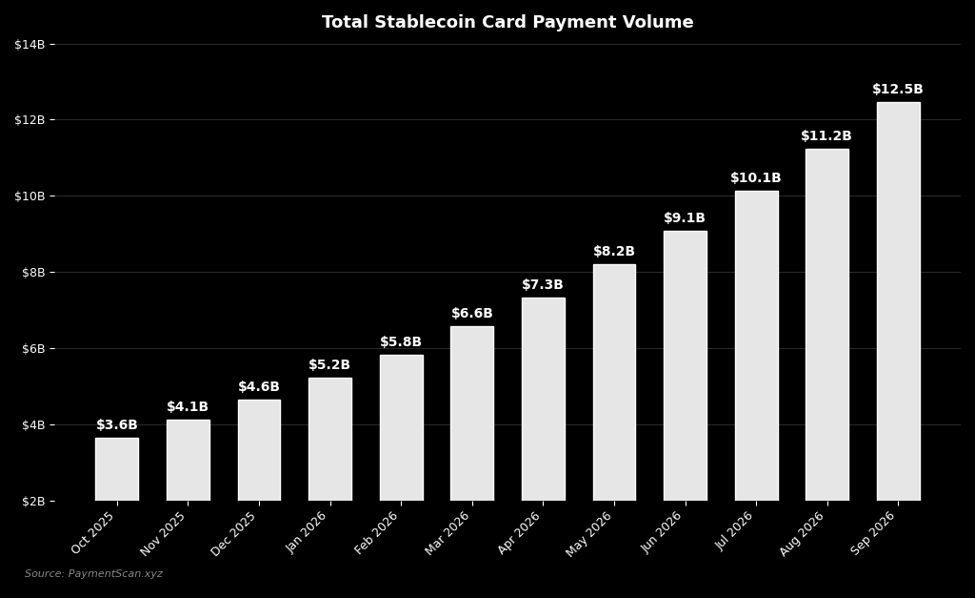
$12.5B processed on crypto cards, an all-time high.
Activated cards on Jupiter Spend up 55% QoQ, driven mostly by QR payments.
Nobody opening those cards is thinking "onchain."
They're thinking: can I pay abroad without losing money on conversion and waiting days for a transfer?
Stablecoins answered that question. The card just made it usable.
Crypto won't win by convincing people.
It'll win by disappearing into the things they already use.
BREAKING: The total volume of payments processed on crypto cards has reached a record $12.5 billion, up +140% year-to-date.
This also marks +247% growth compared to levels seen in October 2025.
Continued adoption of stablecoins as a payment rail and the push toward cross-border transaction efficiency are behind the surge in volume.
Furthermore, QR-code based payments for crypto cards are seeing robust growth.
This has fueled +55% quarter-over-quarter growth in activated cards on Jupiter Spend, one of the largest onchain card providers, particularly due to demand for QR payments.
Crypto cards are the next phase of crypto adoption.
@orbitalisVector This is the clip that explains Tesla better than any earnings call. Telling the truth when one headline could kill you takes real conviction. Do you think a founder could pull this off today, with how fast narratives spread on social?
META MUSE + OPENAI DOTS + GROK BOT + CLAUDE: four laptops, an AI agent on each, and one spider deciding who gets the next task
here's what's actually behind each one:
Muse got 3.4M downloads in 3 weeks. it's free, it books your trips and cancels your subscriptions
Grok Bot hit 418,000 weekly users by mid-September
Dots runs on GPT-6 Astra, gets its own cloud computer and keeps working after you close your laptop. but disconnect your email and it still remembers what it read there. the only way to make it forget is to wipe it completely
Claude skipped the launch. the agents just showed up inside an app people already pay for
then one reviewer ran them through 10 real business tasks:
Claude: 9.3
ChatGPT Work: 9.15
Dots: 8.8
Dots broke spreadsheet formulas and couldn't tell which emails had already been handled. and the biggest jump in quality didn't come from better prompts. it came from a written skill file
but the number that matters most: only 24% of US adults online trust an agent to buy something on its own, even though Stripe has already made 7.8M businesses agent-ready
the tech is ready. the trust isn't
Medicine and Spices: Two "Boring" Stocks That Have Raised Their Dividends for Decades
There's loud money: AI startups, memecoins, 10x in a month.
And there's quiet money. It lands in your account every quarter, no matter what the headlines say.
This one's about quiet money.
The Motley Fool just named two dividend stocks worth buying in October.
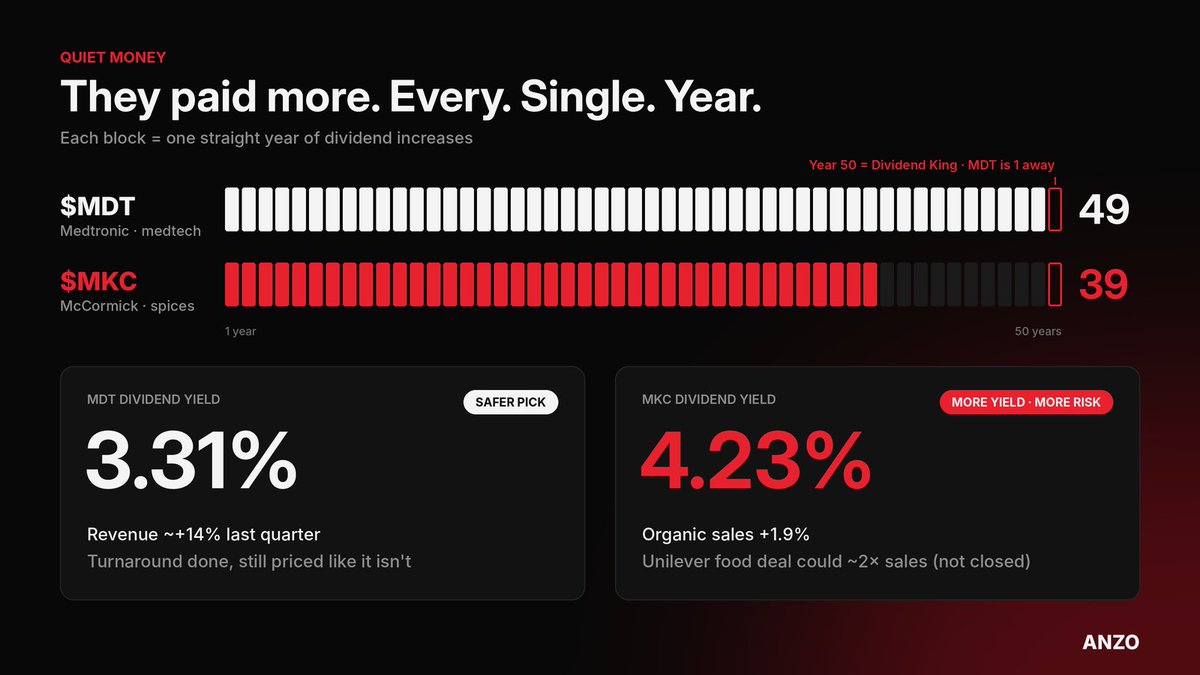
Medtronic ($MDT), medtech
3.31% yield
49 straight years of dividend increases, one year away from "Dividend King" status
Revenue up ~14% after finishing its restructuring
The thesis: the turnaround is done, but Wall Street still prices it like it isn't.
McCormick ($MKC), spices
4.23% yield
39 straight years of dividend increases
Buying Unilever's food business, which could roughly double its sales
The thesis: growth is weak today (+1.9%), so this is a bet on the transformation.
The risks
The Unilever deal hasn't closed yet.
Inflation is squeezing food companies.
The author admits he may be early.
A high yield is always a question, not an answer.
Bottom line: MDT is the safer pick. MKC pays more, but comes with more risk.
Medicine and spices won't 10x your money. But a company that has paid more every year for 49 years has already proven it can make money in any market.