Vance Practice is dead. We are now Abaton Labs.
We’ve outgrown the single-founder shell. The team has scaled into a unit of independent heavyweights, and an operation of this size requires a proper institutional identity!
New brand. Same uncompromising R&E. Follow @AbatonLabs
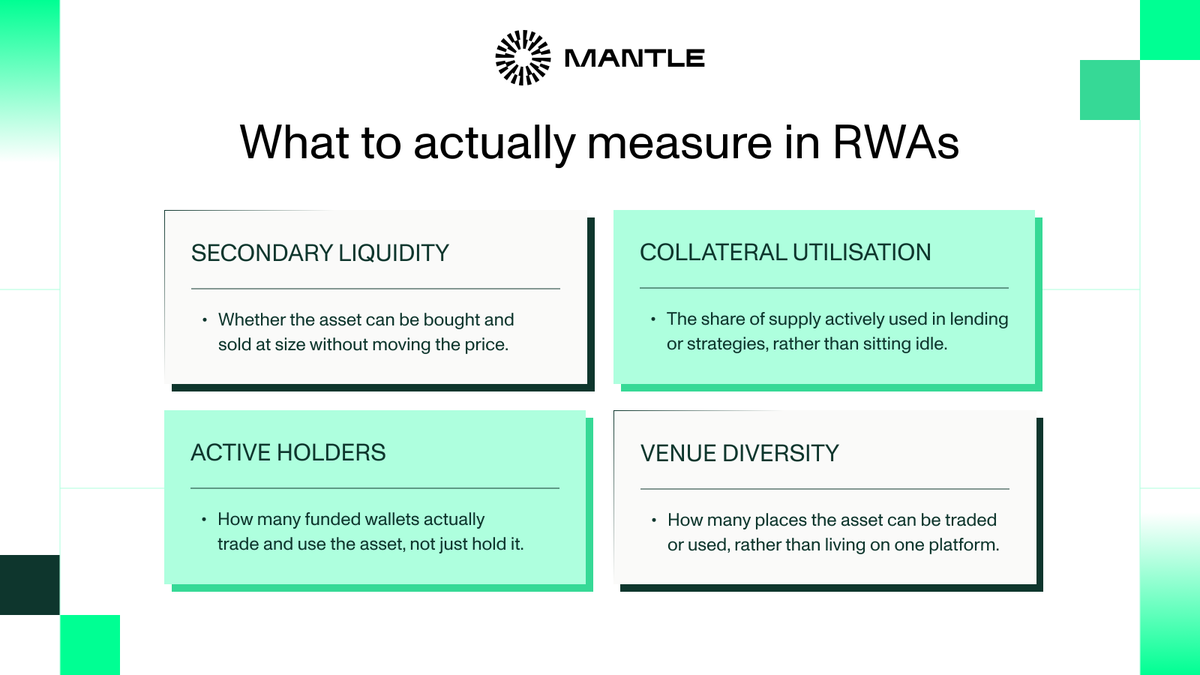
Most RWA reports lead with one number: total value tokenized.
Representative of assets onchain, that number alone doesn't tell you if the asset trades against real liquidity depth, can be LP'd for yield, backs a loan or works past the venue that issued it, the exact difference between tokenized and productive.
Mantle closes that gap.
From Bhutan to the world 🇧🇹
@EASYResidency S4 Demo Day goes live on August 26.
Meet the S4 founders and see what they’ve been building across stablecoins, payments, DeFi, AI, and frontier tech.
Sign up in advance for the livestream ↓
https://t.co/UD4iJko4h3
“AI Agents will choose the fastest, cheapest, most frictionless rails."
@cosmo_jiang sat down with @CoinDesk this morning to share how Pantera views the current market:
- How AI agents accelerate blockchain adoption
- Is the $BTC 4-year cycle still accurate?
- The setup for an onchain rebound into Q4
- Building a fundamentals index with @SPDJIndices
From @EASYResidency S2 to Mainnet.
@Hertzflow_xyz is building an onchain leverage layer on @BNBCHAIN across crypto, FX, commodities and equities.
As stablecoins evolve beyond settlement into productive liquidity, HertzFlow is exploring how that capital can deepen onchain markets across asset classes.
Congrats to the team on launching Mainnet and the Genesis Vaults with $USD1 and ethereum:0xce24439f2d9c6a2289f741120fe202248b666666!
Bitcoin is becoming institutional infrastructure. Global finance needs a layer it can trust.
Avalon Labs is that layer: risk-isolated, capital-efficient, and backed by the giants entering BTC.
Whales trust the architecture. Build on it.
#AvalonLabs#Bitcoin#CeDeFi #Infrastructure
.@EASYResidency S5 applications are open 🇹🇭
We’re looking for founders building across:
> Programmable Capital & Onchain Markets
> AI Infra & Compute Economics
> AI Interfaces & Consumer Layer
> AI × Bio & Programmable Science
Apply by Sept 13 👉 https://t.co/yQGqzuZoBc
Gemini: +1,689 BTC
Treasury: 5,528 BTC
Corporate balance sheets are becoming Bitcoin balance sheets.
Stacking is easy.
Turning idle BTC into productive capital is the real game.
We’re building the rails for it.
#Bitcoin#BTCFi#CeDeFi#AvalonLabs
The gap between traditional finance and onchain closes one category at a time.
Ten now live on Mantle, from pre-IPO access to prediction markets, with leading assets, issuers, market infrastructure and deep market depth around each.
More of the world’s finance, in one place.
Bhutan offers a glimpse into where crypto payments can go next -- Binance Pay is already used for everyday transactions like petrol and visas.
The same rails can serve different needs across markets: everyday payments in Bhutan and Venezuela, remittances and local payment networks across Africa.
The goal is to make crypto part of how money moves, locally and globally.
Hear from @tomgregory100, VP of Payments and Fiat @binance, at the @EASYResidency workshop.
96% of RWA value on Mantle sits in yield-bearing assets, per @RWA_xyz.
Our asset landscape speaks for itself:
→ 56% active strategies
→ 25% asset-backed credit
→ 14% US treasuries
$201M of productive capital, by design, working wherever you are.
First Principles Ep. 7 with Noam Nisan
More than 30 years ago, Gödel Prize winner @noamnisan helped develop a proof technique he never expected anyone to use in the real world.
Today, the sum-check protocol sits at the heart of some of the fastest modern SNARKs. Nisan traces its unlikely journey from early work on interactive proofs and IP = PSPACE to practical systems for verifiable computation.
But Nisan’s career also tells a broader story about how research responds to technological change. When the web arrived in the 1990s, he deliberately left a field in which he was already a leading researcher to understand a new problem: How do you get independent actors on the internet to cooperate when they have different incentives?
That question helped give rise to algorithmic game theory — and, decades later, brought Nisan back to questions around blockchain fees, token economics, and protocol design.
Hosted by @Tim_Roughgarden with @SuccinctJT
0:00 Intro
1:28 Noam Nisan and the origins of verifiable computation
2:58 Why Noam Nisan left complexity theory
7:52 POPcorn, distributed computing, and early blockchain-like ideas
11:10 The birth of algorithmic game theory
16:14 Justin Thaler discovers the sum-check protocol
25:05 From arithmetization to LFKN
27:06 The story behind IP = PSPACE
30:40 Why sum-check matters for modern SNARKs
31:15 What is a SNARK?
38:52 The key idea behind sum-check: turning two into one
44:03 When SNARKs went from theory to practice
46:03 Why blockchains were the breakthrough use case
50:36 Noam Nisan’s move into blockchain economics
56:15 EIP-1559, transaction fees, and efficient blockspace
1:02:07 From theoretical computer science to real-world systems
1:08:49 Boiling down the sum-check protocol: Two become one
1:10:58 Is the sum-check protocol optimal?
Open-source AI is catching up to proprietary frontier models, but the hardware needed to run them are gatekept.
@b3labs is launching B3IQ so anyone can own their own intelligence.
@darylX24 and @viktoriya0x (B3) and @yorkerhodes (Microsoft/NYU) join Stateful, hosted by @FranklinBi
In this episode, they discuss why owning your compute is the next unlock for open source AI:
- Frontier labs have locked up hyperscaler capacity through 2030. Everyone else is out of line.
- NYU students researching human trafficking and war zone evacuations get account-banned by closed models
- Two years of renting an H200 node costs the same as buying it. Rent-to-own drops the entry cost to 30%.
- Kimi K3 matches frontier performance on some coding tasks. You just need two H200 nodes to run it.
- Idle compute gets matched with offtake, so the machine pays for itself
05:28 Content Filters and Token Limits at NYU
11:02 The Hyperscaler Long Tail Problem
16:16 Why Frontier Labs Locked In Their Model Gains
18:19 How the B3IQ Financing Model Works
20:10 The iPhone Moment for Compute
29:27 Why Own the Box When Neo Clouds Exist?
40:24 The Five-Year Vision
BlackRock’s latest statement: Bitcoin ETF flows show consistent buying and long-term holding behavior during this pullback.
This is exactly the use case Avalon Labs is built for — transforming institutional long-term BTC holdings into liquid, yield-generating, risk-isolated on-chain capital.
From reserve asset to productive capital.
#Bitcoin #CeDeFi #AvalonLabs
From a Jersey Shore sub shop to a $7.3B listing, the largest US consumer IPO of the year is now live on Mantle.
Tokenized by @xStocksFi, $JMKEx trades and LPs round the clock on @Fluxion_network via Atomic RFQ and AMM.
Plenty of 2026 left, and bigger listings coming with it.
Euro-backed stablecoins once dominated spending: In early 2024, around 88% of crypto card volume settled in EURe, much of it on Gnosis. As of July, EURe’s share has fallen to about 2%.
Dollar-backed stablecoins have since taken the lead. USDC handles about 58% of card spending and USDT about 26%, up from roughly 48% and 7% a year ago, respectively. Crypto payment card spending now happens overwhelmingly in digital dollars.
Stablecoins run on global rails, but the opportunities at the application layer remain local.
From @AlexLWitt at @EASYResidency workshop:
> Africa → on/off-ramps
> LatAm → remittances + regional payments
> Middle East → UAE-centric
> APAC → Multi-hub market
> US/EU → RegTech + agentic payments
Two-thirds of stablecoin companies were founded in the last two years. But the next winners won’t follow one global playbook -- they’ll be shaped by local market structure.