$MRLN ✈️
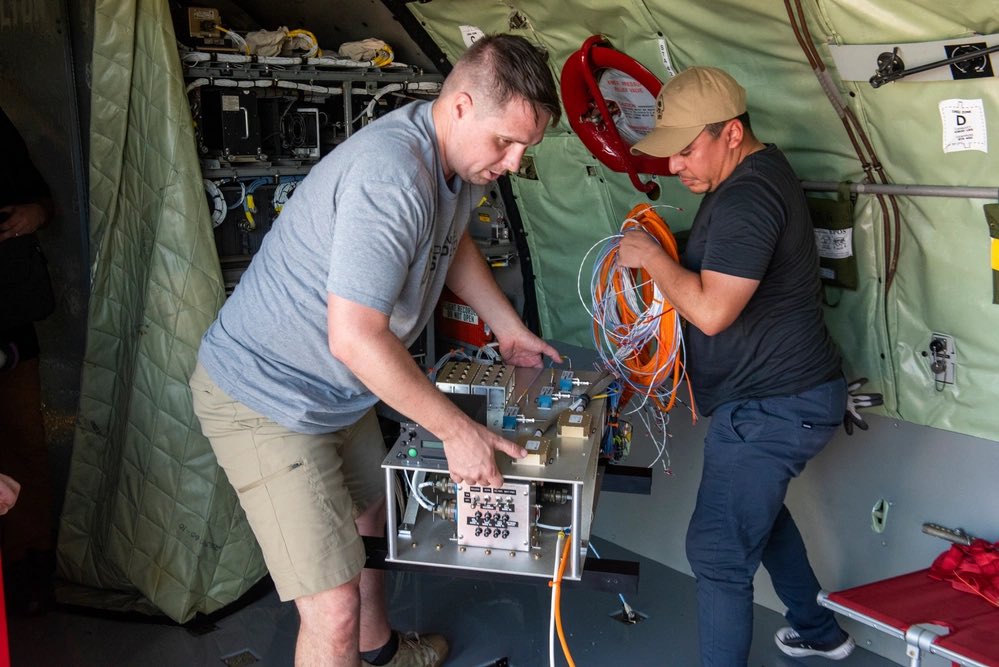
Merlin Labs is building autonomous flight systems for the US military’s most critical aircraft.
Most investors have never heard of them.
This account changes that.
@23Titan31@CrossroadsOnX@darkstarsats To fail to comprehend how low band transforms the user experience and therefore the utility of the D2D to consumers overall, is grotesque incompetence.👇🏼
“you don't have enough signal to overcome things like roofs, glass, modern vehicles. And so you cannot provide a reliable experience to customers in 70% of the time where they spend is in buildings or in cars, modern vehicles.”
👀👀👀👀👀
makes ya wonder about combining much larger and more powerful phased arrays from orbit and lowband spectrum. a perfect recipe for BlueBird satellites 🙏
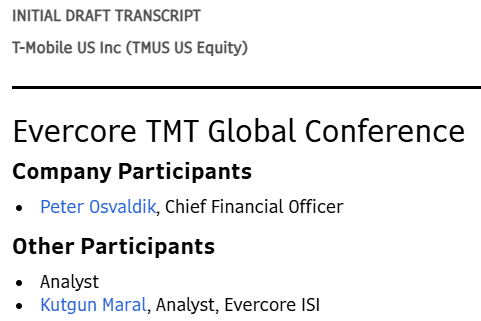
@23Titan31@CrossroadsOnX@darkstarsats I could try but something tells me we’d both be better off banging our heads into the wall. I mean if the CFO of T-Mobile’s commentary at evercore the other day hasn’t woken him up to the necessity of premium low band in D2D I’m near certain nothing will.
“you don't have enough signal to overcome things like roofs, glass, modern vehicles. And so you cannot provide a reliable experience to customers in 70% of the time where they spend is in buildings or in cars, modern vehicles.”
👀👀👀👀👀
makes ya wonder about combining much larger and more powerful phased arrays from orbit and lowband spectrum. a perfect recipe for BlueBird satellites 🙏
$ASTS: The CFO of T-Mobile was at Evercore today and was asked about satellite service as a potential terrestrial competitor. His response was very defensive and clearly directed towards Starlink (350km orbit, thousands of satellites, V2, etc).
I've never seen T-Mobile respond like this about Starlink. In prior periods, they would have said they're happy with their partnership and that Starlink Mobile is a complementary service. Instead Peter goes into a detailed dressing down of Starlink.
As we've known, not all is well in the Magenta paradise.
Kutgun Maral: Analyst Evercore ISI
Understood. And maybe switching gears a little bit, but still talking about competition. You can fill-in the gaps over here, but I want to talk about satellite. And, there are certain satellite operators that sound pretty confident in their ability to compete with broadband against -- not with broadband, but against terrestrial providers in direct-to-sell. Can you help us understand whether there's a real business case for these satellite operators and especially as they kind of move towards their next-gen satellite launches and/or close on some of their spectrum deals?
Peter Osvaldik: T-Mobile CFO
Yeah. Well, the short answer is No. There's no effective way for them to compete with a terrestrial network and they're not limited by money or number of satellites. They're limited by the laws of physics. And here, let me get into that a little bit more. Two fundamental things that are the problem.
One of those being just signal power. So when you're thinking about a terrestrial network, you've got a site that's probably I'm going to go kilometers now for the second, like a kilometer away from you, obviously has a lot of spectrum and is putting out a lot of power.
Compare that to, for example, a satellite, remember, these are different constellations in the broadband satellites, a satellite that's 350 kilometers up, which is probably as low as you can go. You go any lower, you're going to have a lot of propellant needed to keep the things stabilized, which means you get in a catch-22 cycle of then larger power arrays, which mean more atmospheric drag, which just so 350 kilometers is probably the lowest that you can go.
So now you're trying to send a spectrum signal think about this is like a garden hose, water through a pipe. And you're trying to shoot at 350 kilometers away to a mobile device. It's a lot different than the broadband product, which is shooting to an outdoor large antenna. You're trying to not only shoot a small mobile device, but it's mobile.
And the problem is the basic physics of that water through the -- through the pipe and through the outlet is what we call OpenSignal loss. And this is just the amount of signal loss that you get with no obstruction is not just linear in terms of the distance, it's actually an inverse square.
And you cannot put enough power. You can put 100,000 satellites up with all the spectrum of all three MNO operators and you will never be able to project enough power to overcome that OpenSignal loss of 350 kilometers. What that practically means is by the time you get down to earth where the mobile phones are, you don't have enough signal to overcome things like roofs, glass, modern vehicles. And so you cannot provide a reliable experience to customers in 70% of the time where they spend is in buildings or in cars, modern vehicles.
So you can't service a customer in 70% of the time that they're spending on a mobile device. And again, you can put up all the satellites you want to, the fundamental laws of physics will not allow you to generate a beam signal strong enough to actually overcome obstacles. So that's the first and most basic reason why it cannot be a competitor to terrestrial networks.
The second is capacity. And there's a theoretical limit also to the beam size. When we do estimates around one of the operators out there who is going to have a of V2, a D2C or D2D, however you want to think about it satellite, that beam size is significant. For example, if you think about Manhattan, New York, where you're in New York a lot, that beam size is roughly multiple six to 15 times depending on how you define Manhattan, but multiples the size of Manhattan.
And that V2 service is going to be able to provide a decent service, outdoor service, see the previous conversation I had to about 10 concurrent users. So think about that. A beam size larger than the size of Manhattan that can reliably provide service to 10 concurrent outdoor users. It's just not an experience that customers demand.
And so for those two fundamental reasons, it's just not an over-comeable situation. Now that doesn't mean it doesn't have a place. Like we've long said, it has a great complementary place in outdoor areas, particularly areas like national parks where the economics just don't make sense to build a terrestrial network, but it can be a great added complementary benefit for customers and that's where we see it play-out. That's where we see the hotspots are. If I look at the last week of data, D2D traffic on our network was count the zeros, 0.002% of traffic. And that's because it -- for the first two reasons, I said, it's just not where 70% of people are, but it does make sense in that place where terrestrial networks just don't make feasible economic sense.
And that was the whole purpose of the JV is how do we make this a win-win for satellite operators, for consumers and make it economically viable for the carriers as well. So how do we stimulate competition in this space, give consumers the coverage in those few limited outdoor areas like national parks where, by the way, by pulling our spectrum together, we can take care of the hotspot needs of a Yosemite or a Yellowstone National Park and have it be a great complementary service. That was the whole thought process behind this.
But in terms of a competitor to a mobile network operator, it's just not physically possible. And this is also the reason why we said, well, well, you've given them an MVNO, said, well, it doesn't differentiate you, like there's no differentiation. So no, we're not going to give them an MVNO. It doesn't make sense for us to give them an MVNO The answer is no.
I may be crazy but the absolute biggest layup on the tape that I see is Nintendo long as balls. $NTDOY $7974. It is a complete and total layup for a 3x.
$ASTS. From the geniuses who brought you “the sats won’t fit on a f9 rocket” comes “a satellite company reliant on launches didn’t plan for any issues with launches or bet their whole company on an unproven launch platform”
$ASTS - Connecting Dots - AST SpaceMobile: The final bridge to universal human connectivity.
Now available in 20 languages. 🌐
To ensure this critical research reaches every corner of the globe, this special episode is available on YouTube with full multilingual audio.
Listen to this deep dive in your preferred language:
🇸🇦 Arabic
🇧🇩 Bengali
🇳🇱 Dutch
🇫🇷 French
🇩🇪 German
🇮🇱 Hebrew
🇮🇳 Hindi
🇮🇩 Indonesian
🇮🇹 Italian
🇯🇵 Japanese
🇰🇷 Korean
🇮🇳 Malayalam
🇵🇱 Polish
🇵🇹 Portuguese
🇮🇳 Punjabi
🇷🇺 Russian
🇪🇸 Spanish
🇮🇳 Tamil
🇮🇳 Telugu
🇺🇦 Ukrainian
-------------------
In this special edition, we are presenting an AI-narrated audio version of the groundbreaking research report, "Connecting Dots - AST SpaceMobile: The final bridge to universal human connectivity".
Authored by Ryan O'Connor and Adam Brass of Crossroads Capital, this comprehensive piece breaks down the massive market opportunity, the technological milestones, and the underlying economics that position ASTS to revolutionize global telecommunications.
We know reading a full investment thesis isn't always practical on the go, so this AI-read edition brings Crossroads Capital's thorough analysis straight to your feed for hands-free listening—anywhere in the world.
What you will hear in this report:
The core investment thesis behind AST SpaceMobile's disruptive potential.
An analysis of the direct-to-cellular market and the economics of the "universal broadband" model.
Strategic insights from Ryan O'Connor and Adam Brass on why ASTS is uniquely positioned to connect the unconnected.
Because of YouTube limitations (2h limit on automatic audio translations), this episode has two parts. Part 1 linked below.
https://t.co/3nkjUygARA
The pure Apex move would be for Abel to have booked $1bn of additional SpaceX launches on Friday on the condition that it has to be publicly announced next week.
That way, all of Wall Street asks and learns about $ASTS during the SpaceX IPO roadshow. It would be a pure Olympic medal winning move by @scottwisniews
$ASTS - Folks forget AST management has said several times over the past few earnings calls they have OVERBOOKED launches over the next year in order to get to their 45 satellites by year end.
Nothing had changed. A few months delay won’t change what is coming in the next 1-2 years. We are also not only building 1 constellation. The grand plan is 4 over 2-3 years. Think bigger picture!
“The gap between being right and being rewarded is where most investors lose their nerve. Our portfolio is not built to outperform in any particular quarter. It’s built to compound over years as the transformations we‘ve identified play out on their own schedule—not the market’s, and certainly not ours.”
- Crossroads Capital
Congratulations to @AnthropicAI on raising $65bn.
When Claude 3.5 launched, their engineers asked Claude which database to use. Claude recommended ClickHouse.
Fast forward a year and we launched ClickHouse Agents. powered by Claude. Here's to building together.
https://t.co/nuosoc1JsZ