The most important companies of the next decade won't iterate on the present. They will extend the map of what's possible, delivering a step-function change in the human experience.
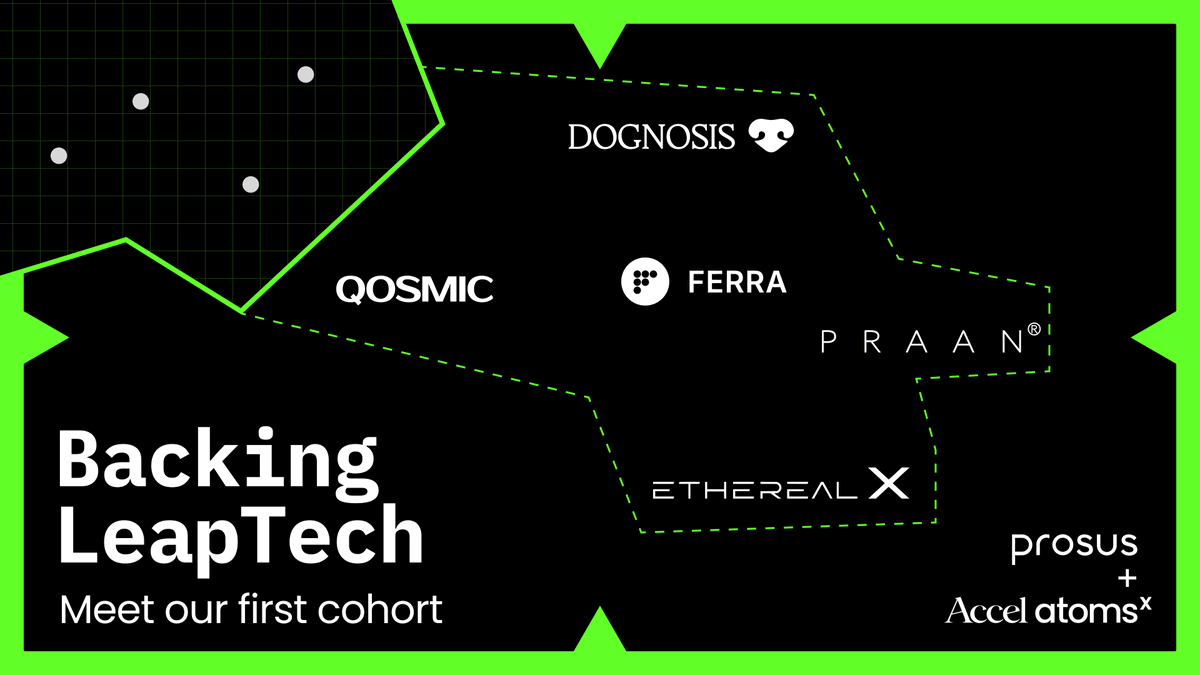
That's LeapTech. Today, we're proud to announce the six startups that embody it—introducing Atoms X cohort, backed by Accel & @Prosus_Ventures.
Read the full piece on Financial Express to know what Deepak thinks the next generation of engineers needs to do differently, and the three things he says they should start doing now.
https://t.co/GaAZBW8NPz
The barrier to shipping has never been lower. The bar for thinking has never been higher.
@ddhanak, Co-Founder and COO of @rocketdotnew, says vibe coding has permanently shifted what it means to be a great developer.
A year ago, a developer's day was spent translating ideas into code, picking frameworks, wiring boilerplate, and debugging plumbing. Today, AI handles that translation layer.
The ones gaining the most leverage aren't the fastest prompters. They're the ones who can describe a problem precisely and hold a sharp definition of what a good product looks like.
Congratulations to @akadogluk and @Itamar_Bitan on reaching this milestone. Next come real-world programmes across multiple Indian states, followed by a U.S. study.
The improbable, pursued until it isn't. That's LeapTech.
For more than two decades, we've known that dogs can detect cancer from breath. @dognosis makes it real.
Last week, their work was published in the Journal of Clinical Oncology, the world's leading cancer journal. For a breath test to clear that bar is a genuine leap for what non-invasive diagnostics can be.
Read the full study here: https://t.co/qdRratWqpH
The study shows that trained dogs working alongside a Bayesian statistical model can detect cancer across seven major types with 90%+ accuracy, and rule it out with 91%+ accuracy. Most importantly, that performance holds at Stages I and II, when catching cancer early can dramatically improve survival.
In India, where rising cancer incidence remains a major challenge, nothing quite like this has existed: a low-cost, repeatable, and non-invasive tool that could be transformative for detection and care at scale.
Researchers don’t spend most of their time actually researching; they spend it reading, trying to map what’s already been said before they can say anything new.
@TimothyKassis lived that loop for years and eventually asked a simple question: What if the research process itself is the bottleneck?
So he built @k_dense_ai, an AI co-scientist that takes prompts like “draft a PhD proposal,” “map the literature on X,” or “find the gaps in Y,” and turns them into structured, long-form research outputs.
It scans 250+ databases, works across 200+ scientific formats, synthesises findings, suggests hypotheses, and produces technical documents that would normally take weeks.
The ambition isn’t to replace scientists; it’s to make sure they never have to work alone again. If the hardest part of research is navigating what already exists, this flips the equation.
Read the full story on @FinancialXpress: https://t.co/ZqdENZFurU
Before @ZingrollIndia, @leharshit spent years building consumer apps: an anonymous social network across Ivy League campuses, an AI meme app gaining traction in Bay Area schools.
Each one taught him something about what people actually want when they open their phones. What they don't want is 20 minutes of scrolling to find nothing worth watching.
That frustration became Zingroll, an AI-native streaming platform built on a simple thesis: every taste group deserves new content every few days, not every few months.
Read about the builder, his career-long obsession with consumer habits, and why he thinks 2026 is the year mainstream cinema changes forever on @FinancialXpress: https://t.co/oJ2W7xSYin
@AngadDaryani, Founder & CEO of @praan_inc, grew up with asthma in Mumbai. Every Diwali, his family had to leave the city so he could breathe.
That struggle turned into an obsession. He dropped out in Class 9, built robots before he was a teenager, and eventually landed at Georgia Tech, carrying a 5-ft metal prototype across campus, asking: what if we could rebuild the air itself?
Read about the inventor, the obsession, and the mission that's only just getting started here: https://t.co/YLdSYMgBMj
Humbled and excited to bring @praan_inc Sanctuary to over 6 Million Sq.Ft starting next year with this new partnership. This completely reimagines how humans will breathe for the next 100 years!
Watch the video here: https://t.co/PY72RLuD8g
We're actively reviewing early applications for future Atoms X cohorts. If your idea extends the map of human potential and bends reality, it belongs here. Apply early at https://t.co/DKBmpc8mcs.
Yesterday, we announced the six startups selected for the inaugural Atoms X cohort, backed jointly with Prosus Ventures.
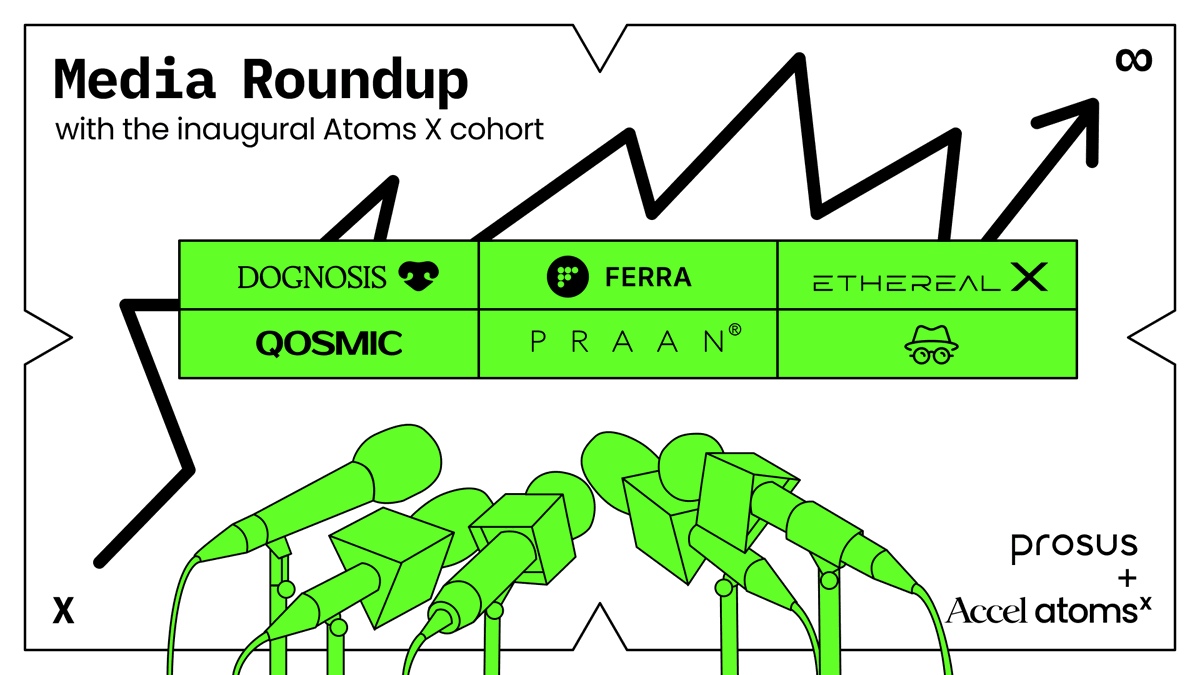
Our program leaders, @_pagarwal, Partner at @Accel and @Ashutosh_Blr, Head of India Ecosystem at @Prosus_Ventures spoke to media across technology, business, and science. Here's what stood out.
What's next for these companies?
We approach Atoms X with a long-term mindset. Many of these companies are working on problems that may take years to commercialize and even longer to scale globally. Our goal is not quick exits. It is to support founders through the full journey of building enduring, category-defining businesses on timelines that are materially longer than traditional software startups.
What excites us most is what this cohort signals about where India is headed. Indian founders are now building in areas traditionally dominated by the US, Europe, and China: deep science, advanced engineering, and frontier hardware. The shift toward real-world, physical impact is underway. Breath-based cancer detection, reusable rockets, optical satellite infrastructure, these are not software products with an AI layer. They are new categories entirely.
Read more on @moneycontrolcom: https://t.co/fBVb8hFlWC