Watched Jon Stewart's Daily Show segment on AI this morning and couldn't stop thinking about his question: what does the public actually get out of all this?
So I wrote this (with AI's help, of course). If AI wants our trust, it should cure something.
https://t.co/ZBwNqPiEnS
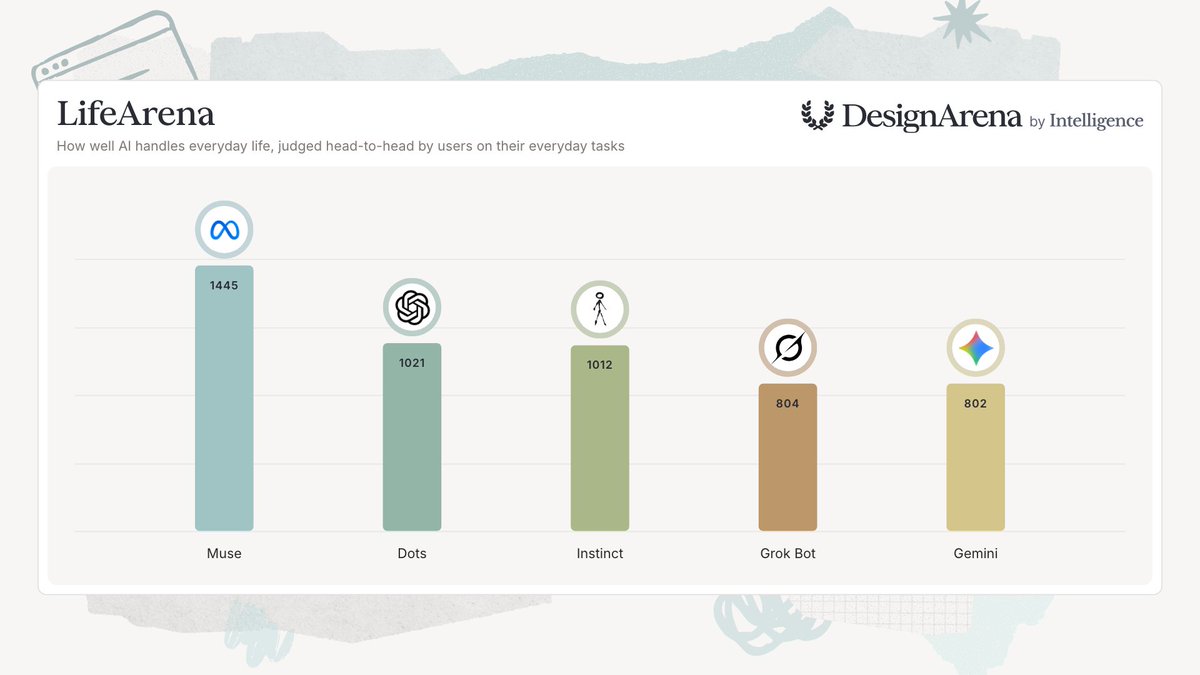
Introducing LifeArena: the world’s first arena for personal assistants, as judged by real users.
As AI assistants become more capable, existing static benchmarks struggle to capture the creative, unthinkable requests of people in their everyday lives.
So, we offered select users the most popular personal assistants: @instinct, @Muse by @AIatMeta, Dots by @OpenAI, Grok Bot by @xai, and Gemini by @GoogleDeepMind.
The results are in: @Muse is #1... by a landslide.
Here's what users said:
Today, we announce five Grand Challenges in Material Science. We’re also committing $1M in prize money to anyone who can solve these challenges.
AI can solve Millennium Prize problems in math. Can it do the same in material science?
To find out, we reached out to 10 leading professors to identify the hardest open problems in the field.
54K ⭐ · Global Rank #467 · scientific-agent-skills by @k_dense_ai
🔬 Skills that equip AI agents for scientific research.
🎯 Analyzing biology data? Give your agent research tools.
📈 Three waves of attention: May, August, then October.
https://t.co/ADBguyCJcY
Today, we’re announcing an open call for guest investigators in life sciences. Over 8–12 weeks, guest investigators will work directly with my team and other Anthropic researchers to produce analyses and tools for their work. We’ll run our models and harnesses, at no cost to them. We’ll work together to open-source the resulting data, artifacts, and code, and write preprints about what we find.
We want humans to remain at the center of scientific discovery, deciding what questions to pursue, and how to pursue them. Those decisions are not ours to make alone. This open call is part of our ongoing efforts at Anthropic to support researchers and accelerate scientific discovery.
I’m looking for principal investigators and their research groups at academic institutions, nonprofits, or government labs, working in causal human biology, structural and computational molecular biology, medicinal chemistry, drug discovery, and clinical science.
Applications are open for about 14 days: https://t.co/bCcrKjB3W7
LLM's can solve Navier Strokes but still can't decide on their own what thinking level to use. The whole low/med/high/xhigh/max level thing is getting ridiculous. The model needs to decide this. Not the user.
Our Scientific Agent Skills repo passed 50,000 GitHub stars this week, joining a group of ~500 public repositories to reach that mark.
The response shows there’s still a huge interest in high-quality, open-source scientific tools, models, and data sources.
If you have a favorite open-source tool for science, share it in the replies!