Your state government’s economic development strategy relies on the argument that politicians, bureaucrats and lobbyists are getting together behind closed doors to decide which corporations get millions or even billions of tax dollars, but they’re doing that for YOUR benefit.
It is simply untrue that stadiums generate "a massive amount of economic activity." NFL teams host only as many customers in a year as an average-sized American supermarket does (~700,000). In reality, stadiums spend almost their entire lives dark, empty & silent.
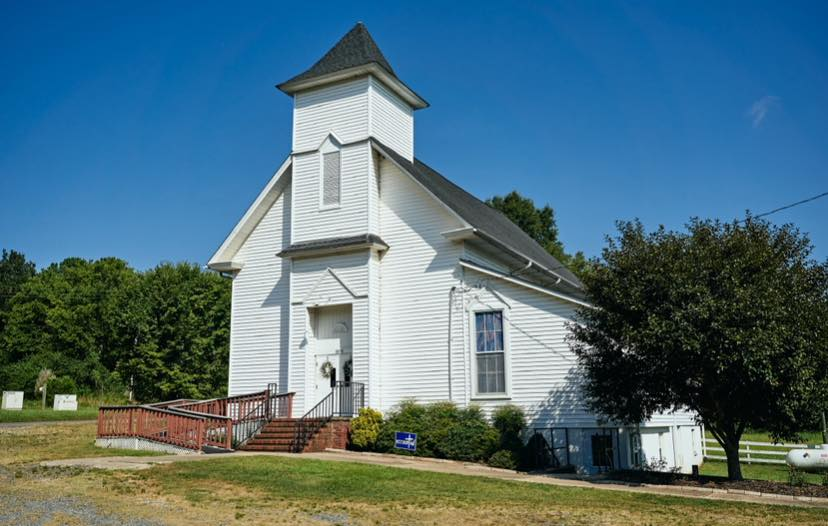
Here's the historic church the State of NC tore down last year (after invoking eminent domain) to make way for the VinFast EV factory that was never built. The state's now suing VinFast to get some taxpayer money back, but the church and several homes/biz are gone forever.
Projects in North Carolina won our Worst Economic Development Deal of the Year Awards for 2021 (Apple R&D center) and 2024 (Panthers stadium). Vinfast was a finalist in 2022 but lost out to Georgia’s Rivian boondoggle.
It’s time for North Carolina to change the way it does economic development.
https://t.co/F03LTHKtG2
No, they've spent two decades trying to get *taxpayers* to build them a new stadium. It's not the "building the stadium" part that's the problem as much as the "sticking someone else with the bill for it" is.
(And their existing stadium is only 35 years old.)
Glad to contribute some quotes to this great article on Richmond, VA's "Big Projectitis" model of economic development policy, and how the price tag for subsidized projects constrains the city's ability to provide basic public services. https://t.co/wTh3Q1el00
Recent reporting from the @KCBizJournal underscores how broken the process is for taxpayer-subsidized projects in Kansas City:
https://t.co/e10qwjEbI0 | #moleg
We should spend less time catering to the companies who pay no property taxes, like the Bears or Pritzker’s Hyatt Corporation, and more time addressing our record breaking taxes on the companies who don’t get headlines.
We need property taxes caps for all of Illinois.
So yes, states should stop subsidizing data centers. They should also stop making it harder than it needs to be for utilities to build power plants to serve new data centers (and homes and offices and factories and churches and schools and...)
TL;DR - Let supply meet demand.
Yes, data centers are a terribly dumb thing for a state to subsidize. That's not because data centers or AI are inherently bad, but because federal & state energy policies have kneecapped the energy marketplace.
(And because subsidies are bad in general.) https://t.co/kVpzBSQHqg
Data centers aren't uniquely energy-hungry. One aluminum smelter draws as much power as all of Nashville.
Utilities used to build power plants to meet that demand but today, regulations & litigation make that almost impossible.
We need more power plants, not fewer data centers.
Stories like this are why politicians shouldn’t be allowed to hand out millions of taxpayers’ dollars to cronies and special interests in the name of “economic development.”
CEA president (and @ReasonFdn senior fellow) @johnmoz writes in @reason about the way politicians are abandoning their principles in pursuit of sports stadium deals. https://t.co/Adu5UyEArU
Business leaders in Colorado correctly identify tax and regulatory barriers that have made their state unaffordable for residents and unattractive to businesses. "Policymakers should adopt a simple guiding principle: do no harm."
https://t.co/dN1F9wuH8r
After the Cowboys moved from Irving to Arlington in 2009, Irving's population growth accelerated and Arlington's growth slowed.
Stadium subsidies are a bad deal.
Independent researchers have been following the real-world results of economic development subsidy programs for decades. What they've found isn't pretty. Learn more: https://t.co/C84b1AaBxO
Energy costs, availability & reliability have become top-line factors in companies' site selection decisions.
States & regions that allow the construction of enough generation and grid capacity to reliably meet demand will host the next generation of American industry.
Correct. Stadium subsidies are a terrible idea, but if we're going to have them it should at least be up to voters, not backroom deals between politicians and team owners. https://t.co/AW5awcETvD
Studies upon studies show public funding of sports stadiums don’t live up to their subsidies. The only real debate is are they worth “civic pride,” i.e. is it worth paying hundreds of million/billions for a mascot. Hillsborough County should at a let the votes vote on it.
https://t.co/DEAvh3Vveb