The market today is a dead player.
Actually existing markets refuse to price in political developments that aren't clear to the average white collar normie.
It's not just about oil: the closure of Hormuz leaves a Qatar-shaped hole in gas markets that will be hard to fill.
- "If Qatari infrastructure suffered little or no damage and exports resumed after 15 days, annual global LNG output would decline by 4.3% this year. If this stretches to a month, the loss would be over 14%."
- After being switched off, liquefaction equipment needs to be cooled back down: "Reaching full capacity may take anywhere between four and six weeks."
- The world's LNG export capacity is virtually tapped out; the only producer that could fill the gap is Russia, and that would require European buyers to lift sanctions. https://t.co/gMLYeulyFr
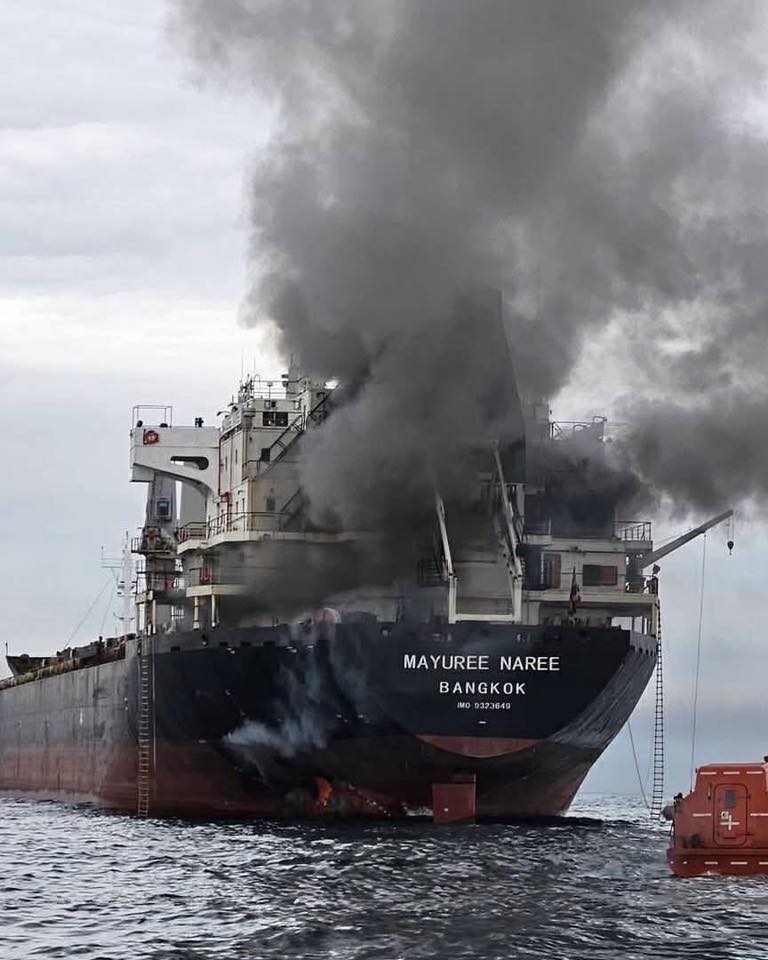
Thai-flagged vessel attacked near Strait of Hormuz, three crew reported missing
A Thai-flagged cargo vessel was reportedly attacked near the Strait of Hormuz on March 11, leaving three crew members missing, according to media reports.
The vessel, MAYUREE NAREE Bangkok, was hit near its stern while sailing in waters near Iran. The ship had 23 crew members on board.
Initial reports said three crew members were unaccounted for following the incident.
Shipping data from MarineTraffic showed the vessel had departed from Dubai, United Arab Emirates, and was heading to India at the time.
#Thailand #Iran #Israel #US #อิหร่าน #อิสราเอล #สหรัฐ #สงคราม
🛢️BREAKING: About 35% of the oil that normally transits the Strait of Hormuz is still reaching export markets, Bloomberg’s Javier Blas reports. Saudi Arabia’s move to ramp up exports in the Red Sea will cause that number to jump to ~ 63% “in the next couple of days.”
🔸Pre-war crude flows through the Strait of Hormuz averaged about 15 million barrels per day (b/d). Current estimates suggest about 5.5m b/d is still moving, according to energy analyst Javier Blas.
🔸Blas reports Saudi Arabia’s state oil giant Saudi Aramco is rapidly ramping up exports via its East–West pipeline to the Red Sea, which could lift total crude reaching markets to about 9.5m b/d within the “next couple of days.”
💢 Here’s the breakdown Blas shared on oil still transiting Hormuz:
➤ Iran: about 1.2m b/d still transiting the Strait of Hormuz (pre-war production levels)
➤ UAE: about 1.8m b/d exported via the Fujairah pipeline, bypassing the chokepoint
➤ Saudi Arabia: more than 2m b/d currently moving toward the Red Sea. Blas says Aramco expects the East–West pipeline to reach full capacity of about 7m b/d within days as tankers arrive to load crude outside Hormuz (roughly 6m b/d diverted from the strait).
➤ About 0.5m b/d estimated from tankers operating with AIS tracking turned off
I agree that the SPR release is necessary. You have to do it just to slow down demand destruction even a little bit.
But even if they're considering a coordinated release of 300-400 million barrels like the FT reported, all that volume isn't hitting the market instantly.
After the US decided to release 180 million barrels of SPR in 2022, the most they ever released in a single week was 8.4 million barrels in the week ending 2022/9/4.
We've got a supply disruption of over 10mb/d in the Middle East, but the historical max release rate is only ~1.2mb/d.
The US, which holds the most SPR among Western nations, stores its oil in underground salt caverns, not regular surface tanks.
These salt caverns are spread across four major sites along the Gulf Coast of Texas and Louisiana: Bryan Mound, Big Hill, West Hackberry, and Bayou Choctaw.
They're artificial caves drilled into giant salt layers a thousand feet underground, and each cave is big enough to fit the Empire State Building.
To pull the oil up, they inject freshwater into the bottom of the cave. Since water is heavier than oil, it pushes the oil upward.
In theory, the max release capacity of the US SPR is estimated to be around ~4mb/d. In reality, there were several physical constraints that kept the weekly max at 8.4 million barrels.
Every time you inject water to push the oil out, the salt walls dissolve a little(Leaching). If you keep releasing at a large scale for a long time like in 2022, it can mess up the cavern's structural stability.
If the cave gets too big or the walls get too thin, there's a risk of collapse, so the DOE had to control the release speed to protect the caverns.
The oil pushed up from the caves has to travel through pipelines to nearby refineries or port terminals. At the time, the SPR volume overlapped with commercial oil flows, and pipeline capacity hit a saturation point.
Also, since the tanker berths and pump capacities for loading oil onto ships are limited, it takes physical time to handle all that volume pouring out at once.
Lastly, SPR releases happen through an auction process. No matter how much you want to release, the refiners or traders who buy it need to have the storage space or refining capacity to actually take it.
Given the current logistics network of the US oil industry, there’s bound to be a limit on how much the winners can take at their desired timing.
In conclusion, everyone could've predicted the SPR release. But what we need is oil that's available right now.
With refineries and petrochemical plants already declaring force majeure, if they don't get feedstock immediately, more of them will have to shut down.
So they're desperate to get feedstock somehow. You can't offset a loss of over 10mb/d with a supply rate of 1-2mb/d.
Without a solution to the fundamental problem (Strait of Hormuz), the upside pressure on the front end of the curve won't go away.
It’ll just let out a little steam, but it’ll still be hot.
#oott #com
I agree that the SPR release is necessary. You have to do it just to slow down demand destruction even a little bit.
But even if they're considering a coordinated release of 300-400 million barrels like the FT reported, all that volume isn't hitting the market instantly.
After the US decided to release 180 million barrels of SPR in 2022, the most they ever released in a single week was 8.4 million barrels in the week ending 2022/9/4.
We've got a supply disruption of over 10mb/d in the Middle East, but the historical max release rate is only ~1.2mb/d.
The US, which holds the most SPR among Western nations, stores its oil in underground salt caverns, not regular surface tanks.
These salt caverns are spread across four major sites along the Gulf Coast of Texas and Louisiana: Bryan Mound, Big Hill, West Hackberry, and Bayou Choctaw.
They're artificial caves drilled into giant salt layers a thousand feet underground, and each cave is big enough to fit the Empire State Building.
To pull the oil up, they inject freshwater into the bottom of the cave. Since water is heavier than oil, it pushes the oil upward.
In theory, the max release capacity of the US SPR is estimated to be around ~4mb/d. In reality, there were several physical constraints that kept the weekly max at 8.4 million barrels.
Every time you inject water to push the oil out, the salt walls dissolve a little(Leaching). If you keep releasing at a large scale for a long time like in 2022, it can mess up the cavern's structural stability.
If the cave gets too big or the walls get too thin, there's a risk of collapse, so the DOE had to control the release speed to protect the caverns.
The oil pushed up from the caves has to travel through pipelines to nearby refineries or port terminals. At the time, the SPR volume overlapped with commercial oil flows, and pipeline capacity hit a saturation point.
Also, since the tanker berths and pump capacities for loading oil onto ships are limited, it takes physical time to handle all that volume pouring out at once.
Lastly, SPR releases happen through an auction process. No matter how much you want to release, the refiners or traders who buy it need to have the storage space or refining capacity to actually take it.
Given the current logistics network of the US oil industry, there’s bound to be a limit on how much the winners can take at their desired timing.
In conclusion, everyone could've predicted the SPR release. But what we need is oil that's available right now.
With refineries and petrochemical plants already declaring force majeure, if they don't get feedstock immediately, more of them will have to shut down.
So they're desperate to get feedstock somehow. You can't offset a loss of over 10mb/d with a supply rate of 1-2mb/d.
Without a solution to the fundamental problem (Strait of Hormuz), the upside pressure on the front end of the curve won't go away.
It’ll just let out a little steam, but it’ll still be hot.
#oott #com
Trump on timeline of Iran war:
It’s always been a four week process. We figured it will be four weeks or so.
It’s a big country, it’ll take four weeks — or less.
When Trump met Nvidia CEO Jensen Huang in the Oval Office, he said that whenever he spoke with China’s Xi Jinping about Taiwan, Xi would “breathe heavily.”
Trump didn’t like it.
Source: NYT
Carney: "American hegemony in particular helped provide public goods, open sea lanes, a stable financial system, collective security ... this bargain no longer works. Let me be direct. We are in the midst of a rupture, not a transition ... recently, great powers have begun using economic integration as a weapon. Tariffs as leverage ... "