@GMengel Are there any studies/documentation on this phenomenon of "rain recrystallizing into snow"? I have always read that vapor deposition process is necessary to form snow crystals.
More/better Hurricane Melissa videos now that the furlough/gov shutdown is over and I can get the go ahead to post revised versions. What was originally posted three weeks ago were quick edits/crops exported in 720p which were good enough but not all that they could be. I will include a link to YT so those inclined can watch in 4K. Today I’m posting thread from pass 5 which was approx 1645-1648Z time.
This first one is GoPro Max footage that I finally got around to editing. It starts very similar to the post from a few weeks ago but with a twist. 1/5
The most persistent climate scare story over the last two years has been this hypothesis that a vital North Atlantic Ocean current, the Atlantic Multidecadal Overturning Circulation (AMOC), will collapse by the end of the century, if not sooner.
The implication of this would be that Europe get sent into the icebox as surface air temperatures drop by at least 1°C per decade, eventually stabilizing at 5-15°C below current averages (Westen et al., 2024). This will then trigger Arctic sea ice expansion, probably causing the rest of the Northern Hemisphere to cool as well, albeit to what extent is uncertain.
🔗https://t.co/kbbSY4t4AL
From a climate pant soiler's point of view, I don't really see why this would inherently be a bad thing considering that they, most of whom live in western Europe (especially the United Kingdom), think that the planet is too hot and that the climate during the Little Ice Age was more ideal for human civilization. But, who am I kidding, they're never consistent.
Now, for the laypeople out there, what exactly is the AMOC?
Well, ocean water is always being circulated around the globe by ocean 𝑐𝑢𝑟𝑟𝑒𝑛𝑡𝑠. And, there are three main types of ocean currents.
1⃣ 𝑇𝑖𝑑𝑎𝑙 – driven by the gravitational effects between the Earth, moon and sun
2⃣ 𝑆𝑢𝑟𝑓𝑎𝑐𝑒 – driven by wind speed and direction
3⃣ 𝐷𝑒𝑒𝑝 𝑤𝑎𝑡𝑒𝑟 – currents that extend from the ocean surface to the sea floor; they are driven by density gradients resulting from changes in salinity and water temperature.
The last one is critical to understanding the AMOC.
🌡️ Cold water is denser than comparatively warmer water, so it sinks.
🧂 Saltwater is denser than freshwater, so it sinks as well.
These large and slow-moving deep ocean currents are what oceanographers call the 𝑡ℎ𝑒𝑟𝑚𝑜ℎ𝑎𝑙𝑖𝑛𝑒 𝑐𝑖𝑟𝑐𝑢𝑙𝑎𝑡𝑖𝑜𝑛. 🔁
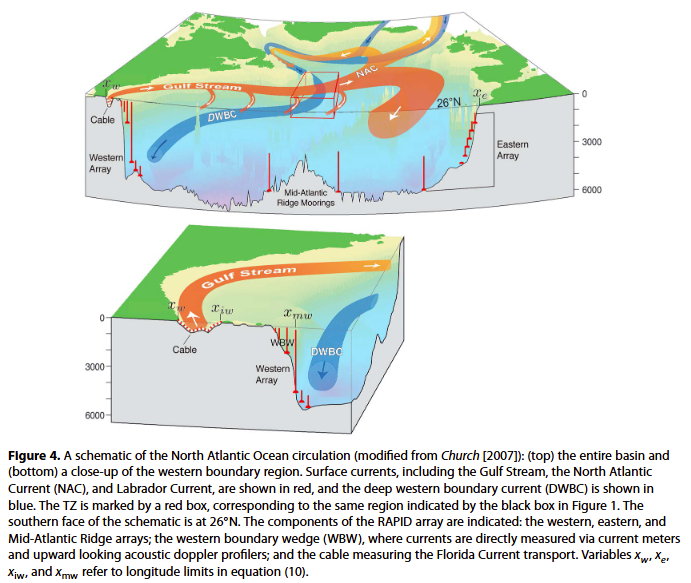
One of these conveyor belts is in the Atlantic Ocean, and it is called the “Atlantic Multidecadal Overturning Circulation” (AMOC). This current is responsible for transporting warm, tropical water poleward and vice versa. Warm water in the tropics is carried north by the Gulf Stream, a surface-based current. As the water flows poleward, it cools and some of it will eventually freeze, forming sea ice. 🧊
When water freezes, it leaves the salt behind in the cold (but not frozen) liquid water, which makes the water denser, causing it to sink and be carried back to the equator where it eventually becomes warm enough once again to rise to the surface, and then the process repeats itself.
🔗https://t.co/0vp8Qw7X7C
However, this process is extremely slow! 🐢
1 m³ of water is estimated to take over 1,000 years just to complete the cycle. 🕑
Although the process itself is slow, there have been a few papers published that suggest the AMOC is weakening due to high freshwater melt flux off of the Greenland ice sheet. Caesar et al. (2018), for example, found that AMOC speed has declined by 15% since 1950. The follow-up paper, Caesar et al. (2021), found that it the AMOC is 20% weaker now than it was during the mid-20th century.
🔗https://t.co/MtHgIyC6gG
🔗https://t.co/DphKabLl7I
Weakening has also been suggested in other recent papers such as aforementioned Westen et al. (2024) and the paper of interest here, Ren et al. (2025), which was just published in the journal Nature Communications Earth & Environment.
🔗https://t.co/ZnzmO6XE6L
These studies contend that the AMOC is nearing a “tipping point” due to Greenland ice sheet-induced freshwater melt flux. If it isn't stopped, some scientists suggest it could raise sea levels significantly along the east coast of the U.S. while causing Europe to cool rapidly, as mentioned earlier.
However, there is significant disagreement about this because AMOC strength is not directly measured, and different proxies are used to estimate its strength (e.g. subpolar North Atlantic sea surface temperatures, air-sea heat flux, etc.). Several other recent studies found that the AMOC has actually been remarkably stable, or at the very least, 𝑟𝑒𝑠𝑖𝑙𝑖𝑒𝑛𝑡 (e.g., Fu et al., 2020; Parker & Ollier (2021); Worthington et al., 2021; Latif et al., 2022; and Terhaar et al., 2025).
🔗https://t.co/OKhZSu33LM
🔗https://t.co/ovJWaOAkQH
🔗https://t.co/YKEG8Kc0nY
A couple of these are interesting:
In Fu et al. (2020), the authors assembled a multi-decadal observational data set drawing on repeated hydrographic section measurements in both the subtropical and subpolar North Atlantic spanning from the early 1990s through the 2010s. Contrary to climate model projections, the study found no robust decline in observed AMOC transport in the Atlantic over the last three decades. The transport estimates in the most recent decade are “not distinctly different” from those in the early 1990s.
🔗https://t.co/AJlr5gnNU8
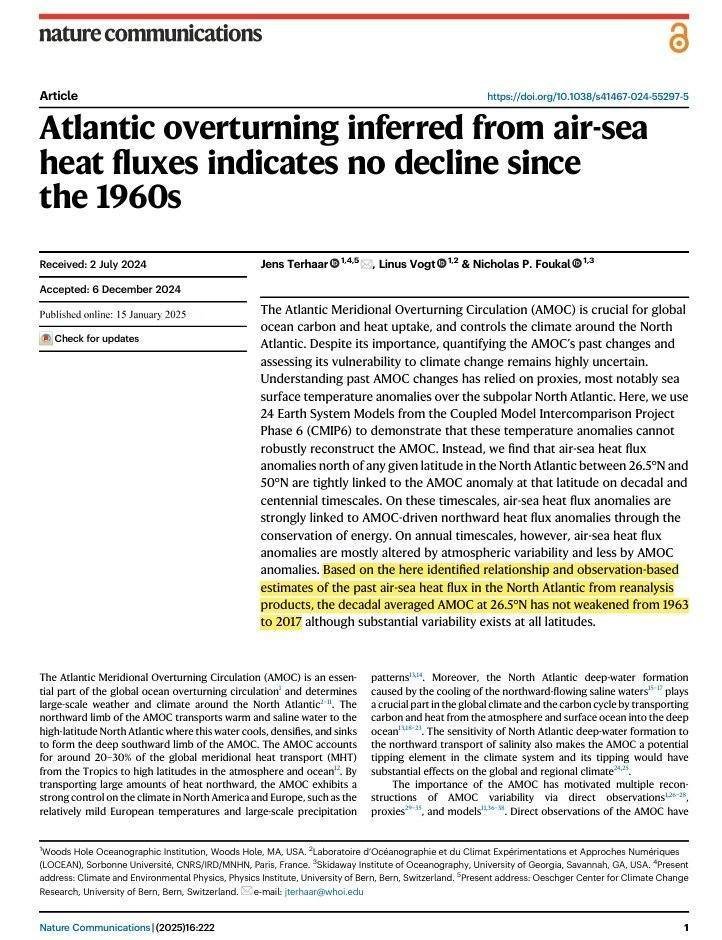
And, in Terhaar et al. (2025), the authors used air-sea heat flux in the North Atlantic from 26.5-50°N as an AMOC strength proxy. They found no AMOC weakening over a longer period, specifically between 1963 and 2017.
🔗https://t.co/5tiACrZIJC
In many of the modeling studies, scientists can only get the AMOC to collapse (i.e., shut down) by imposing a strong and unrealistic freshwater forcing in their models and running it for several centuries. Westen et al. (2024), for instance, put in a freshwater forcing from Greenland ice sheet melt that translated to a sea level rise (SLR) rate of 6 cm / year, which is greater than the rate caused by the collapse of the ice sheet covering North America at the end of the last glacial maximum.
In fact, under that forcing, the authors had to run the model 400 years before natural variability's dominance waned and then out to virtual year 1,750 to get the AMOC to shut down. This is unrealistic, even under the IPCC's worst-case, high-emission SSP5-8.5 / RCP8.5 scenario.
While the AMOC has never completely shut down (to our knowledge) in historical records, it has slowed down in the past naturally (that had nothing to do with us) and that too can have similar, albeit less severe downstream impacts. In any case, based on all of the weight of evidence here, I fail to be convinced that this is something seriously worrying about.
Future projections on AMOC strength are speculation based on modeling and questionable assumptions; they're far from scientific fact.
@hausfath I agree, but the initial question is whether we are clearly detecting a significant acceleration in the global average temperature. We cannot say that this is evident at the moment. Even less so to say that it is accelerating faster than expected, as some media outlets are doing.
@hausfath Problem is that the more sensitive the approach, the greater the risk of false positives. Furthermore, trying to detect a signal that is below a certain value has little practical interest. The major problem with climate change is first-order (well described by a linear model).
This is a very cool, impressive @Nature paper that is worth reading. But the accompanying @CNN headline is very misleading and almost certainly wrong, for the following reasons (links in next post):
1) The paper projects crop impacts forward assuming SSP3 economics and population, and RCP8.5 warming. This scenario is impossible, even in model land. There is no SSP3-8.5 scenario in the IPCC scenario database. SSP3 economics and population don't produce enough energy demand to produce 8.5W/m^2 warming, even with no policies, worse renewable vs. coal economics than exist now, and a world going all in on coal for the whole century. That scenario (no-policy) for SSP3 is SSP3-7.0, which has ~1 degree less warming than RCP8.5. The authors' (milder) RCP4.5 projections are much more realistic and IMO should have been the main-text projections (though they, too, are subject to caveats 2) and 3) below). SSP3-RCP4.5 is close to business as usual, given current information (subject to the population caveat below).
2) SSP3 assumes a 2100 population of 13 billion people, far more than most forecasts project (and their projections are continuing to fall). A more realistic population trajectory, all else equal, would result in less energy demand and less warming.
3) The paper assumes that past adaptations predict future ones. This is a good (and impressively painstaking) thought exercise with the available data, which provides an important advance to the field. But, if one doubts that there could be out-of-sample innovations in crops over the next 75 years, consider the fact that only ~60 years ago, the Green Revolution hadn't happened, and people were predicting a "population bomb" that would wipe out the UK and India (and 65M Americans) due to food shortages. That didn't happen. Global yields have more than tripled, and US yields have doubled, over the past 75 years (time frame of projections to 2100).
tl;dr: This paper is an impressive attempt to document the state of climate effects on crops and adaptation options that exist *today*. It is worth reading and provides an important advance. But US crop yields will not decrease by half this century. Journalists should be more discerning in their coverage.
@rpallanuk@gunnarmy@ScienceMagazine Given that CERES record is relatively short, this could also mean that the models' performance is mainly at the climate and not decadal timescale ? So, maybe not a strong constraint for future warming.
@RARohde The key problem with the warming is the first order, very well explained by the linear component. Focusing on the second order component, which is much weaker even in the future, is not really essential. I think this debate is taking up too much of our thoughts.
@AllieScarlettWx@nsf_icechip@ibhshailstudy Amazing! It would be interesting if you could explain what we see in these sections: why the opaque/translucent layers, why these protrusions on the edges, etc.
Article: Observational constraints suggest that the projected weakening of the Atlantic meridional overturning circulation in the 21st Century will be less severe than previously anticipated
https://t.co/aeAXmX0yS1
@sambrandt99 I understand, but this is no longer a simplification since it's irrelevant to what's happening on a rotating sphere. By the way, I don't understand the "sigh". Any exchange should be considered positive as long as it's done with mutual respect.