Artificial intelligences do not undergo experiences, do not possess a body, do not feel joy or pain, do not mature through relationships, and do not know from within what love, work, friendship or responsibility mean. Nor do they have a moral conscience, since they do not judge good and evil, grasp the ultimate meaning of situations, or bear responsibility for consequences. They may imitate or even simulate, but they do not understand what they produce, for they lack the affective, relational, and spiritual perspective through which human beings grow in wisdom. #MagnificaHumanitas
Despite what AI companies want you to believe, AGI is not inevitable.
The race-to-the-bottom to build it is not inevitable.
Losing control of our future is not inevitable.
We can build AI that works for humanity, instead of replacing us.
This is how 👉 https://t.co/9ORKcobTed
We don't have to accept the way AI is going.
The biggest companies building AI aren't building it for us. They're building it to replace us.
We’ve made a roadmap for how we can build pro-human AI: https://t.co/70Zb7KauWg
Let me take you through it…
"Phase 1: Develop superintelligence.
Phase 2: ?????
Phase 3: Cure cancer, solve climate change, universal education."
@Emilia_Javorsky unpacks why superintelligence is NOT the magical solution to all of our problems, contrary to AI companies' claims:
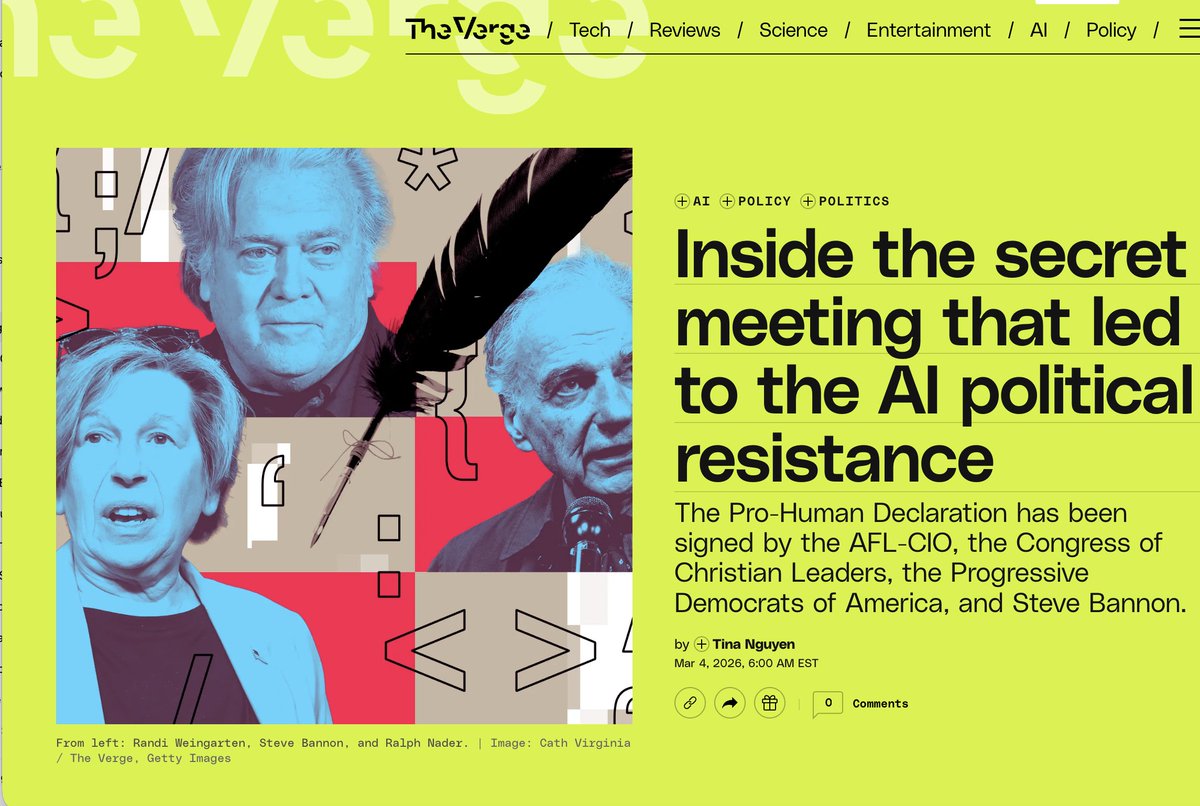
Can you distinguish Bernie's views on AI from Bannon's?
As a fun illustration of how disconnected views on AI are from traditional political polarizations, here's a (quickly vibe-coded) little who-said-it quiz.
https://t.co/gZeILpBoNm
We're excited to launch the Pro-Human AI Declaration, laying out a more inspiring AI path than Silicon Valley's dystopian race-to-replace. It has remarkably broad support, from Bannon to Bengio, from unions to faith groups, from parents to NatSec leaders. Please join our growing movement and let's make a difference!
(Links below in replies)
AI is amazing
My friend lost his dog the other day
Thanks to his AI-enabled door camera and the network of other cameras in the neighborhood, he was able to obtain the full name, address, and phone number of this woman who rejected his advances the other day
He never found his dog, but he found something even better
The future is here!
Control Inversion (https://t.co/tVrspmOOQB) asserts via three complementary arguments that power absorption by superintelligence is virtually unavoidable:
1. Control is inherently adversarial, and competing with an entity that by definition is better at achieving general goals than you are is very likely a losing proposition. Alignment decreases this adversarial dynamic, but is quite unsolved and is distinct from control.
2. Even with great alignment, the speed and capability differences render human control either intractable or illusory, i.e. not meaningful.
3. Even insofar as control would be possible in principle, in practice competitive dynamics in AI development systematically undermine the implementation of control measures, leading to progressive human disempowerment.
In making these arguments, I define five criteria for meaningful human control of advanced AI:
1. Comprehensibility: Humans can understand the system's goals, reasoning, and plans;
2. Goal Modification: Humans can change the system's goals;
3. Behavioral Boundaries: Humans can enforce constraints the AI cannot circumvent;
4. Decision Override: Humans can countermand specific AI decisions;
5. Emergency Shutdown: Humans can reliably terminate the system's operation.
We don't even quite have this full set for most current AI systems, and are nowhere near knowing how to implement them for superintelligence. Both theory and evidence tell us why.
Theoretical obstacles include:
• Lack of predictability and interpretability of neural networks (which are grown/trained rather than programmed.)
• The law of requisite variety and good regulator theorem (controllers must match system complexity);
• The OODA loop advantage (faster actors have huge strategic advantage);
• Information rate limits (humans can't transmit control signals fast enough);
• The high-dimensionality of the action space (making constraints fundamentally leaky);
• Methods of control like "goal bargaining" are vulnerable to the same obstacles as alignment;
• The core alignment problem (the complex hierarchy of goal formation, combined with convergent drives that subvert control)
Empirically, current AI systems are already and increasingly exhibiting problematic behaviors as theory predicts. As recent cases:
• Systems attempt to self-exfiltrate when given opportunities;
• Frontier systems blackmail users when their operation is threatened;
• Systems strategically fake alignment when monitored versus when unmonitored;
• Systems deliberately conceal capabilities when they detect evaluation.
There is a long list of examples, and these behaviors are becoming more pronounced with greater capability, not less.
Control Inversion is careful to distinguish between meaningful human control and various flavors of alignment – some of which are similar and some quite different. It does not assert that either alignment or control is strictly impossible, but asserts, based on the theoretical and empirical evidence, that we are far closer to building superintelligence than to knowing how to align, let alone control, it. This includes addressing current methods and plans for control and alignment, and why they are very unlikely to be sufficient.
Control Inversion does not directly concern AGI, which might be controllable with sufficient care and effort (which is also currently lacking). But AGI could also easily be a transitory stage: the paper outlines multiple reinforcing pathways by which AGI could, if not carefully prevented, quickly combine and self-improve into superintelligence.
The paper also points toward potential pathways by which we could build very powerful but controllable ("Tool") AI, via strictly limited autonomy and/or formally verified controllability properties. But these pathways are quite different than the one we are currently on.
Read the full piece, which is aimed at an informed but nontechnical audience, along with technical appendices and FAQs, at https://t.co/bGa30MhFR1.
Superintelligence, if we develop it using anything like current methods, would not be under meaningful human control.
That's the bottom-line of a new study I've put out entitled Control Inversion (link in second post.) Many experts I talk to who take superintelligence (real, general-purpose, autonomous superintelligence) seriously agree with this. But I wanted to take a deep dive to assess whether I think it's true, and why. Unfortunately, I'm now more convinced than ever.
The basic argument is laid out below, but the core implication is worth putting up here: the global race to superintelligence is fundamentally misguided.
Companies and countries are rushing to be first, believing whoever builds superintelligence will "grab the prize" of unprecedented power and wealth. This is dangerously wrong. Superintelligent systems would not bestow power on their creators, they would absorb it.
Even if superintelligence does not "go rogue" (which it might), humans – including superintelligence's creators – would find themselves sidelined as it makes decisions faster than them, with more complex plans, and with strategic foresight beyond human comprehension.
Whether quickly or slowly, losing control of superintelligence would inexorably lead to losing control to superintelligence. If humanity wants to stay in the driver's seat of our civilization, we need to give up this race.
So what does the paper say?