Many of the early countermeasures to cheap OWA drones are also relatively cheap, such as mobile machinegun teams. This requires the modernization of the drones, employing them in greater numbers, and new methods of employment to overcome cheap countermeasures, which increases their costs. To destroy important targets now, Russia will employ complex and expensive strike packages that can include more than 50 heavily upgraded OWA drones, more than a dozen cruise missiles, and 3-5 ballistic missiles. Likewise, there is a reason why Ukraine is so focused on developing cruise and ballistic missiles to augment its deep strike capabilities with OWA drones. We should be careful about drawing the wrong conclusions about cost ratios and OWA drone effectiveness after only two weeks of war with Iran.
Poland is in talks with France and a group of closest European allies on the programme of advanced nuclear deterrence. We are arming up together with our friends so that our enemies will never dare to attack us.
If accurate, this would be a far more favorable outcome. An active force of 800,000 people would be the largest standing army in Europe, and it is doubtful that our current real number is even there now. Setting emotions aside, very few countries can even pay for such force
Thank you for being part of The 11th GSSC Vilnius Forum.🤝
Our sincere thanks to all speakers, moderators, volunteers and partners for your insights, time, and trust.
And thank you to our audience and GSSC team - you are what makes this Forum meaningful.
See you next year! 🌍
🎥Watch The 11th GSSC Vilnius Forum on @LRTenglish Mediateka:
https://t.co/UUykfeQvt6
@KASonline@Lithuanian_MoD@MunSecConf@AtlanticCouncil@GLOBSEC@LRTenglish Baltic-American Freedom Foundation
After moving through mostly open ground for the past 18 months, Russia is now trying to take three major urban areas: Kostyatynivka, Lyman and Pokrovsk-Myrnohrad. It will take many months and massive casualties to take any one of these, let alone all three. They may not manage.
Quite a number. Russian analysts say 38% of the country’s oil refining capacity is currently offline, with 70% of that due to Ukrainian drone strikes and the rest to repairs/maintenance. No wonder there is no gasoline in many parts of Russia. https://t.co/5CF9OtsY9r
Just published via RUSI... I suspect this one may generate some strong opinions but I think it's an important set of factors for military planners especially in the Land domain to engage with:
NATO Should Not Replace Traditional Firepower with ‘Drones’
https://t.co/MYmWSfGW1O
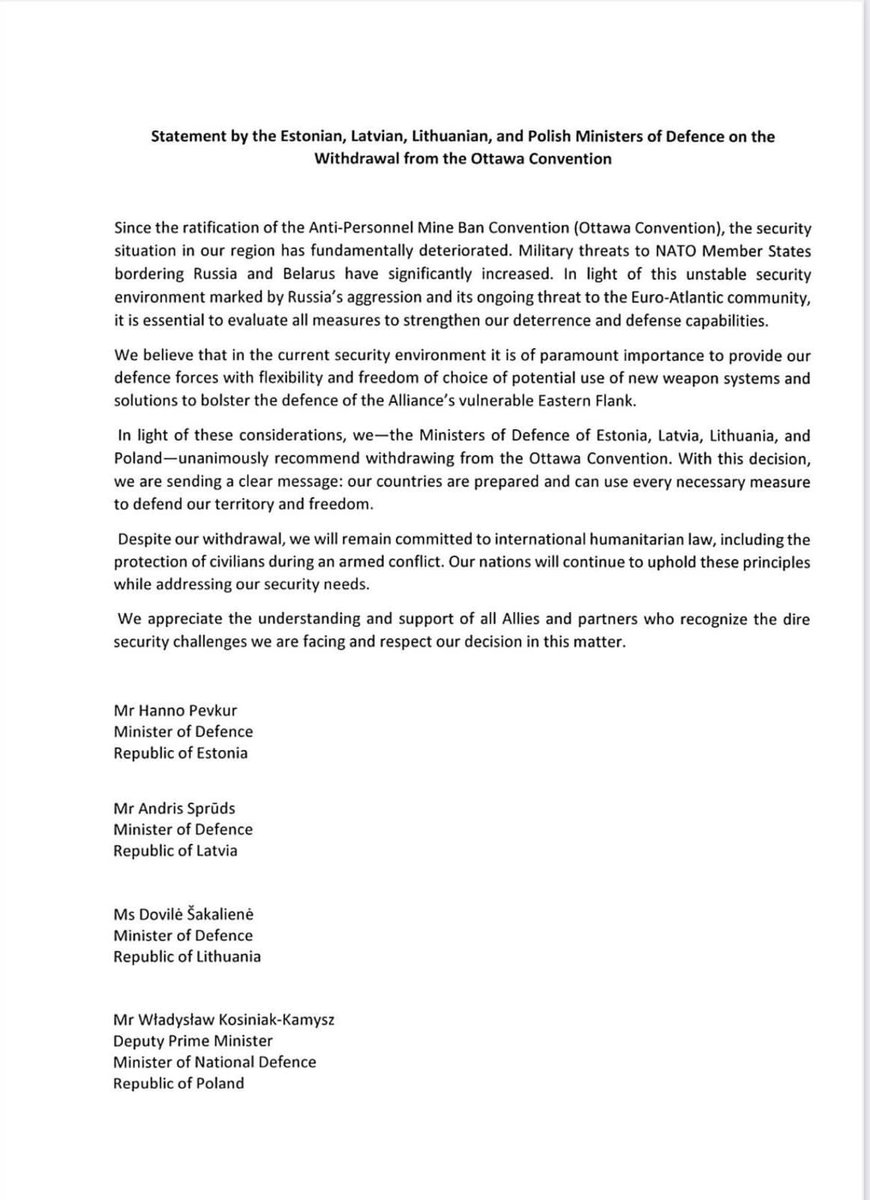
It is official: Lithuania is withdrawing from the Ottawa Convention, a move that was approved by the @LRSeimas today. The withdrawal will take effect in six months.
‘A Patriot air-defense system that was based in Israel will be sent to Ukraine after it is refurbished, four current and former U.S. officials said in recent days, and Western allies are discussing the logistics of Germany or Greece giving another one.’ https://t.co/pnSzL1zYF0
Wojska USA zostają w Polsce! Zgodnie z decyzją podjętą na szczycie NATO w Waszyngtonie zmienia się charakter misji w Jasionce. Dotychczasowe zadania wojsk USA w Jasionce przejmowane są przez kolejnych sojuszników. Wojska USA pozostają w Polsce, ale w innych lokalizacjach. Teraz w misję w Jasionce zaangażowane są głównie wojska norweskie, niemieckie, brytyjskie i polskie oraz inni sojusznicy.
NATO w ramach misji NSATU– przejmuje odpowiedzialność za funkcjonowanie Jasionki, o czym informowaliśmy od lipca 2024 roku.
Russia hasn’t achieved its objectives in this war, including capturing all of Donetsk and Luhansk oblasts. As long as Russian forces are advancing—even slowly—the war will likely continue. Any prospects for a durable cease fire or peace deal will depend on preventing further Russia advances and convincing Russia’s leadership that Ukraine can sustain its defense.
https://t.co/aU5SUKW9N2
Before you think that Russian agriculture is suffering from sanctions, consider that Russia just achieved a historical record in grain exports last year, despite a bad harvest. Agriculture products are not sanctioned.
This and similar posts have been trending on my timeline today, so a quick comment. Nope, no evidence of a build-up at all. It is highly unlikely that the Russians would open up a new front as long as the war in Ukraine is ongoing and the situation there has stabilized. I also believe people tend to exaggerate the usefulness of exercises like Zapad, Kavkaz, Vostok, and Centre as a disguise for concealing force movements ahead of military operations.
News: Zelensky, in response to my question for @FT tonight on zoom, said it was NOT all 4 of Ukraine’s nuclear power plants he and Trump were talking about US owning but “the one under temporary [Russian] occupation,” referring to Zaporizhzhia plant, that the US could potentially control if it is able to be “recover[ed].”
https://t.co/zXmqsN9Sw8
@shashj It was a much more moderate statement than this tweet makes it sound- he said they were considering the French proposal, and that launch authority will matter, but overall Poland needs to invest in more advanced capabilities and no option is off the table.
What can Europe do to help Ukraine militarily if US military aid and support were to cease? What should Europe’s priorities be? Here are a few quick thoughts from this morning after my first cup of tea.
1. Stabilizing the Frontline in Southern Donetsk
Ukraine can only enter negotiations that avoid a ‘Diktatfrieden’ with a stable frontline. The first order of business, consequently, needs to be stabilizing the frontline in southern Donetsk. This can only happen if Ukraine addresses its manpower problem and Europeans step up artillery deliveries if US supplies cease. Artillery is key, alongside strike drones and mines, in compensating for the lack of infantry. Without further US military aid, Ukraine’s rate of fire will drop, providing Russia with tactical opportunities on the battlefield and reducing the chances of stabilizing the front.
2. Securing Long-Range Air Defense Interceptors
Europeans must negotiate with the US to procure GEM-T and PAC-3 interceptors for long-range air defense. The US produces approximately 240 GEM-T and 500 PAC-3 interceptors annually. There is already a shortage of long-range interceptors, and it’s unclear how quickly additional supplies could be sent to Ukraine, given that they would need to come directly from the manufacturer rather than US military depots. Procurement of interceptors could serve as a blueprint for purchasing other needed military hardware by Europeans in the US for Ukraine.
3. Strengthening Ukraine’s Indigenous Capabilities
Europeans should fund additional projects to improve Ukraine’s indigenous ISR, long-range strike, and C2 capabilities. There are various piecemeal efforts underway in this regard, but if Europe is serious about militarily strengthening Ukraine, joint ventures and deeper collaboration between select Ukrainian and European partners are vital. Side note: Even with a new military aid package passed, US inventories of surface-to-surface ballistic missiles and long-range rocket artillery remain low, making a “Ukrainianization” of these capabilities necessary.
4. Committing to European Rearmament
European governments need to signal to their respective defense sectors that they are serious about rearmament and place multi-year contracts with the defense industry. This includes finding better ways to finance long-term defense projects—ESG criteria, for example, require a substantial overhaul. Only a strong European defense industry will suffice (this post does not address the need for collaborative development, procurement, and maintenance of military equipment, a unified defense market etc.) and serve as a strong partner for Ukraine.
5. Streamlining and Expanding Training Efforts
This includes improving collaboration between EUMAM & NSATU, streamlining training standards and processes across European countries, and revisiting the idea of a European-led training mission in Ukraine.
6. Defining Clear Objectives and Risks in Ukraine
Most importantly, Europe must have a clear understanding of its objectives in Ukraine and what it is collectively willing to risk. This must, for example, precede any discussion of potential European troop deployments. It is easy to get sucked into a war and far more difficult to get out—especially without crystal-clear, realistic objectives that align with
available resources and acceptable risks.
7. The Bottom Line
Europe cannot match the full breadth of capabilities needed and, in certain critical categories, has nothing to offer the Ukrainians off the shelf should US military aid cease. However, the situation is far from hopeless on the capabilities side, and steps can be taken now to help Ukraine stabilize the frontline in 2025. It also should be clearly said, though, that Ukraine needs to find a way to fix its most glaring military challenge at this time: lack of infantry at the frontline, that no additional European capability can directly address.








![ChristopherJM's tweet photo. News: Zelensky, in response to my question for @FT tonight on zoom, said it was NOT all 4 of Ukraine’s nuclear power plants he and Trump were talking about US owning but “the one under temporary [Russian] occupation,” referring to Zaporizhzhia plant, that the US could potentially control if it is able to be “recover[ed].”
https://t.co/zXmqsN9Sw8](https://pbs.twimg.com/media/GmbwSqRWMAA57db.jpg)