In 216 ligand-bound structures of human FABP isoforms, many at better than 1.2 Å resolution, an estimated 15% of the ligands had a different chemical composition to that expected #StructureBasedDrugDesign#FattyAcidBindingProteins#LigandBinding https://t.co/CrmBwVZe9o
We’re scaling structure as a core capability in AI-native drug design.
#TeamGenerate is searching for an Executive Director of CryoEM to lead a multidisciplinary team operating within one of the most advanced high-throughput structural biology platforms in the world. Reporting to our Chief Technology Officer, you’ll set the vision and deliver on the execution—expanding what’s possible in structural throughput and data quality. You’ll partner closely with machine learning, automation, and protein science teams to embed #cryoEM into a true design–build–test–learn loop.
This is an opportunity to shape a capability that will transform structural biology from a bottleneck into a high-speed engine for discovery—redefining how medicines are conceived, designed, and developed.
If this sounds like your next challenge, let’s talk.
https://t.co/yRjJl2oqam
Our high-resolution (2.2 Å) in situ structural work reveals details of translational landscape, with various cofactors and antitumor drug/inhibitor, all directly within human cells!
https://t.co/ScWOAQRjTw
New paper out in bioarxiv!. In collaboration with the team of Maks Ovsjanikov, Vincent Mallet developed an algorithm that is available as a plug-in for @UCSFChimeraX to find antibodies and nanobodies, within seconds, in #cryoem densities. https://t.co/7wR2FIjxdN. Try it out!
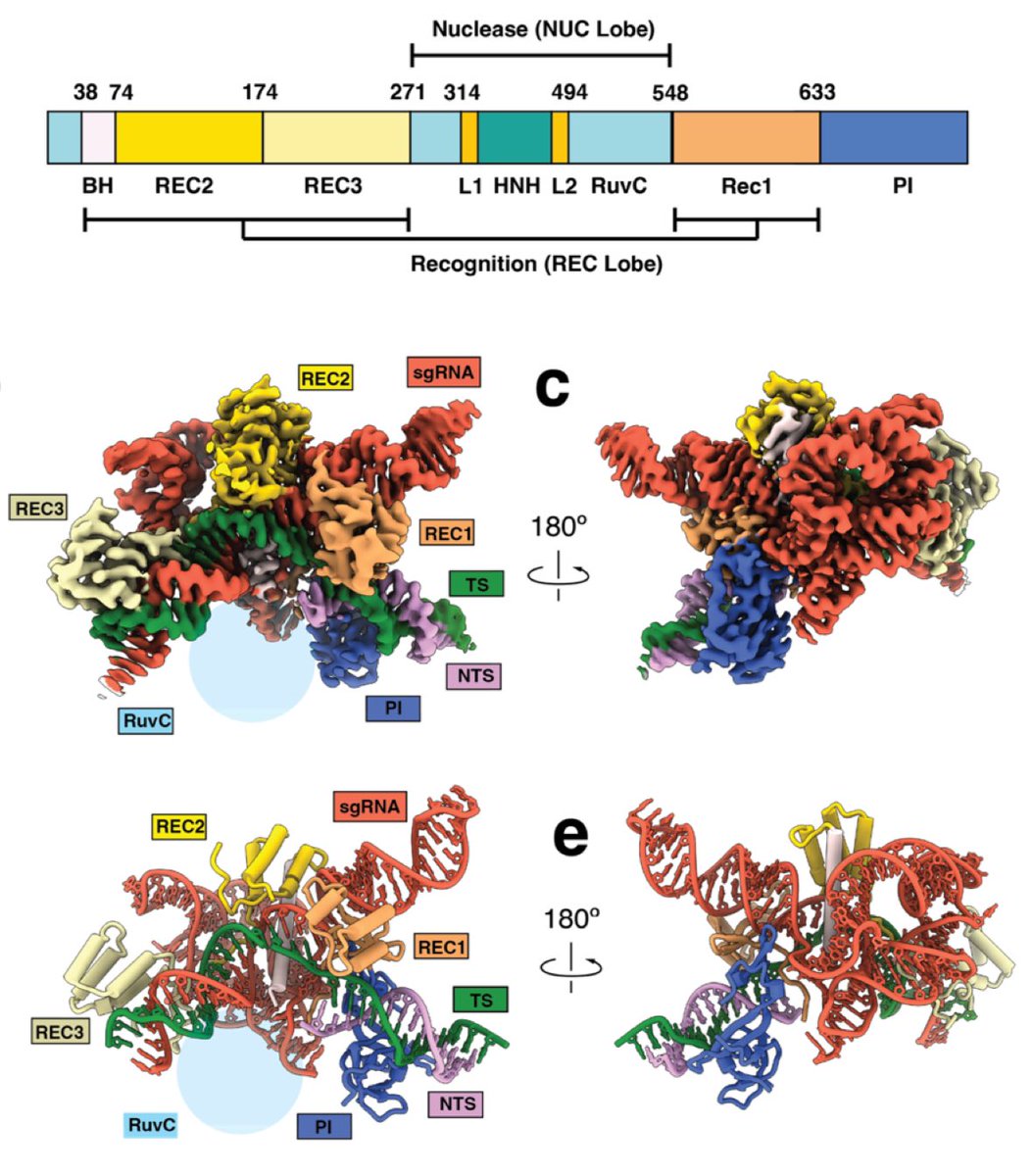
Check out our new work by fabulous grad student Rodrigo @TexasScience@ut_mbs! Guide RNA folds into gnarly geometry to tether tiny protein domains together. Fun collaboration with @metagenomi! DNA targeting by compact Cas9d and its resurrected ancestor https://t.co/1g0xsWZag7
Update on our kinase domain side project (37 kDa with a ligand): Previous sample had severe preferred orientation issues, pausing the project. Now back at it with new 2D classification results. Still preferred orientation persists, but we're optimistic about getting a map. #TGIF
This fantastic story is out on structural analysis of NLRP3 inflammasome activation. Happy to be part of it! Please check it out!
https://t.co/Oke4KQsJXi
Didn't think I would ever post ApoF, but here we go. First couple hours of test data collection on our new Tundra. How easy was that! And the best part: it's not hidden in a basement, but on the 3rd floor, one flight of stairs away from the office :D
Kicking off the year with key clinical updates: first patient dosed with GB-0895 for mild-to-moderate asthma and advancement in our GB-0669 study for SARS-CoV-2. We’ve also expanded our relationship with @Amgen to push the boundaries of drug development. https://t.co/T5ALVgGGeW
Excited to share our preprint: “Structural and mechanistic insights into Streptococcus pneumoniae NADPH oxidase” in which we obtained a structure of a 46-kDa membrane protein to 2.2 Å resolution without fiducials.
https://t.co/Cu2RxdxyZq
My indispensable right hand Natalya Dudkina is hiring, join our exciting R&D group at Thermo Fisher Scientific as Application Engineer, Cryo-EM.
RT please!
https://t.co/N60h1RJ7CM
Our structure biology and protein design team embedded within the vibrant scientific environment of Large Molecules Research at Sanofi in Cambridge Crossing, MA has an exciting postdoc opportunity to accelerate the development of next generation biologics.
#postdocjobs#postdoc
Please check our posters at #IMC20 today (9/13, Wed.) : Cryo-EM structure determination of sub-50-kDa protein : a case study on maltose binding protein - Kunwoong Park (LS 05.P, #2087).
See you at the poster session.
“This is really about re-imagining structural biology at scale,” Grigoryan said. “What could we do if it was just as easy to get the structure of a protein you’re working with as sequencing a piece of DNA?” #cryoEM#drugdiscovery#biotech
#AI is only as good as the data behind it, so de novo protein design startup @generate_biomed opened a lab with 4 #cryoEM microscopes to capture how well its AI-generated antibodies work to feed the data to its algorithms. My exclusive story for @endpts
https://t.co/Ph6tiHrwsu