What's a Kitchen Hood?..it's importance?
I believe by now you must have seen a device hanging above the cooker, cooktop or stove right?, yes that is a Kitchen Hood. It contains a mechanical fan and uses power.
The main use of a hood is to remove smoke, but what we don’t know is how important it can be to keep the atmosphere fresh while we cook. There are many grease particles and other particles from food in the air while we heat it, for instance, when we fry it. Your hood absorbs all those fumes and particles up to 98% if we talk about grease and filters them to prevent toxic air from circulating further from the cooker. They are usually made from stainless steel or plastic. There are some that are made from porcelain or ceramic as well.
Kitchen vent hoods are a great way to keep your kitchen clean and fresh. They are designed in different shapes and sizes that make it easier for you to find the right one for your kitchen.
You can choose from different types of kitchen vents such as a hood, extractor fan, or range hood. The size of the ventilation system depends on the size of your kitchen and ofcourse depth of your pockets.
ይህንን ስንት ኢትዮጵያዊ ያውቃል?
የቅርብ ጊዜ ዘገባዎች ኢትዮጵያ፣ ግብፅ እና ሱዳን ከኢትዮጵያ ምርጫ በኋላ ወደ ዋሽንግተን ድርድር ሊመለሱ እንደሚችሉ ይናገራሉ።
አደጋው ደግሞ።፡ድርድሩ ከባዶ ወረቀት አይጀምርም።
የድሮው የዋሽንግተን ሰነድ በተወሰነ ማሻሻያ መልኩ እንደሚያንሰራራ አል-አራቢ ዘግቧል። ያ ማለት ያው መርዛማው የ2020 ረቂቅ፣ ያ የቅኝ ግዛት ወጥመድ በአዲስ የቃላት አገባብ ለብሶ ወደ ጠረጴዛው ይመለሳል ማለት ነው።
ስለዚህ ራስህን ጠይቅ፦
በዚያ ሰነድ ውስጥ ምን እንደነበር ታውቃለህ? አንቀጾቹን አንብበሃል?
ወጥመዱን ተረድተሃል?
ትናንት የለጠፍኩትን Part One አንብቡ።
ከዚያም ከታች ያለውን Part Two አንብብ።
ይህን እንደ ፖለቲካ አታንብ። ልክ እንደ የሀገርህ የወደፊት ዕጣ ፈንታ በፊትህ እየተጻፈ እንዳለ አንብብ።
Before you read Part Two, one thing. Some people ask why we should worry about a draft from February 2020. That is the past, they say. It is not.
DW Amharic reported last week that negotiations between Ethiopia, Egypt, and Sudan in Washington would reportedly start after Ethiopia’s election.
Around two weeks ago, Al-Araby also reported that, according to an Egyptian source, Cairo is waiting for a new U.S. track that would revive the old Washington document in amended form, with the GERD file reportedly returning from the State Department to the Treasury Department.
So this is not history for its own sake. If an old document can come back wearing new wording, every Ethiopian must understand what was inside the old one before anyone repackages it in our name.
Read. Understand. Question. Do not leave this only to politicians, because officials often react after the trap is already written. Protect your country, and do not pass a colonial water burden to the next Ethiopian generation.
Part One showed the empty box. Part Two shows the lock.
How Egypt Tried to Fool Ethiopia: Article 10.1, the Beautiful Sentence in the 2020 Draft That Was Just an Empty Box (Part Two)
The lock on the box. How a single disclaimer could have been turned into a cage Ethiopia could not open without downstream agreement.
Welcome back.
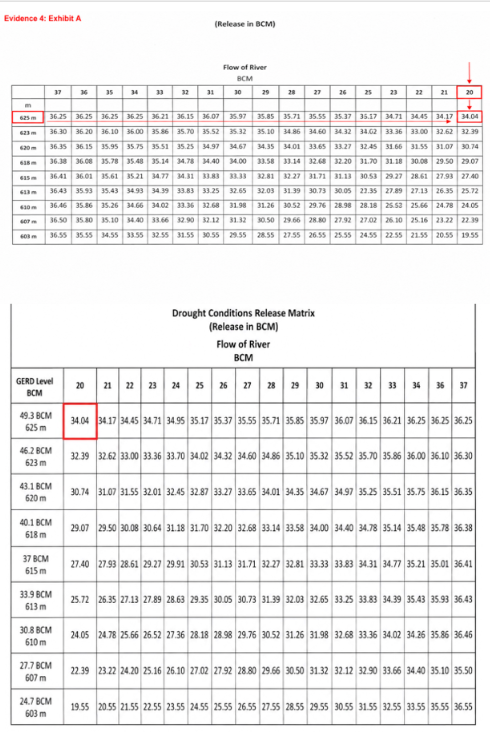
In Part One, I showed you the empty box. I showed you the candy. I showed you Exhibit A and its terrible little number, 34.04, the release the draft would require at the high GERD level of 625 meters / 49.3 BCM when the river flow is only 20 BCM. I showed you Annex A requiring release of 100% of storage above 603 meters over mitigation years, and that cruel line saying the releases are not dependent on future drought. I showed you Exhibit B turning one dry year into a chain, Article 2 turning your own success into the reason you must pay, and Article 10.2 promising a future it had already mortgaged.
If Part One made you uneasy, good. Because now I have to show you the worse half.
In Part One, the draft was merely dangerous. It told you how much water to give away. But a dangerous rule is only dangerous if it can reach you. A snake behind glass cannot bite. So the real question is the one I left you with: once these release rules exist, what makes them bite? What turns a bad table into a binding obligation, a bad obligation into a permanent one, and a permanent one into a door that locks from the outside?
That is Part Two. This is the lock on the box. And I warn you now, this is the part that should make you angry, because this is the part that was built so that, if Ethiopia had signed it as written, Ethiopia could not easily have changed course without downstream agreement.
The evidence for this Part Two is Article 4.5, Article 9, Article 12, Article 14, and Article 15 of the February 2020 Washington draft. Every quote below is lifted straight from that text.
Let me show you the five bolts, one by one.
Bolt one. Article 4.5: they took the key to your own house.
Go back to the house I described in Part One, the one you built with your own hands, stone by stone, while your children carried water up the hill. Imagine you finally move in. Then imagine you reach for the light switch in your own home, and a stranger grabs your wrist and says: not without our permission.
That is Article 4.5. And I am not exaggerating. Here is what it says, word for word:
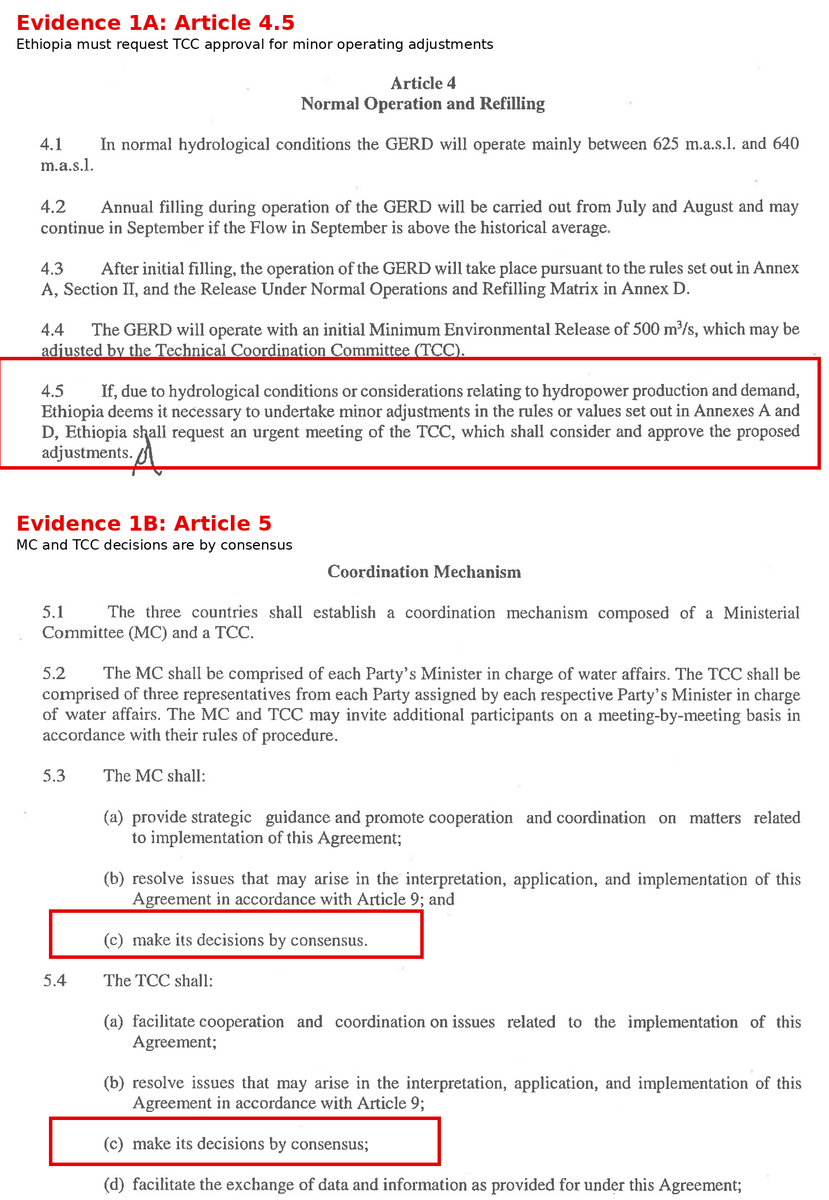
“If, due to hydrological conditions or considerations relating to hydropower production and demand, Ethiopia deems it necessary to undertake minor adjustments in the rules or values set out in Annexes A and D, Ethiopia shall request an urgent meeting of the TCC, which shall consider and approve the proposed adjustments.”
Read those words slowly, because they are quietly outrageous. Minor adjustments. For your own hydropower. For your own demand. For your own people who need electricity tonight. And what would Ethiopia have to do? Not decide. Not act. Ethiopia “shall request.” If Ethiopia had signed this as written, it would have had to go, hat in hand, and ask a committee for approval before making even minor adjustments to the agreed operating rules for its own dam.
And who sits on that committee? Egypt. And how does that committee decide? By consensus, under Article 5. Now, consensus is a beautiful word at a wedding. At this table, consensus means something uglier: it means one “no” can end the conversation. It means Egypt could fold its arms, refuse, and the answer would be no. It means the country downstream, the country that has at times spoken openly of military action against this very dam, would get to sit in judgment over whether Ethiopia may turn a dial on Ethiopian soil.
Think about what this does to the word ownership. They let Ethiopia keep the deed. They let Ethiopia keep the concrete, the turbines, the photographs, the ribbon-cutting, the national pride. And then they took the one thing that actually matters: the right to decide. A dam is not the concrete. A dam is the decisions. Who fills it, when, how fast, how much it holds, when it releases, and for whose benefit. Article 4.5 reaches past the concrete and takes the decisions.
So when someone tells you, “but Article 10.1 says it is not an allocation, Ethiopia keeps its sovereignty,” show them Article 4.5 and ask the only question that matters: what is sovereignty over a dam you would not be allowed to adjust without your rival’s approval?
The deed is yours. The key is in Cairo’s pocket. Put more carefully, so no one can wave it away: the deed would still be yours, but the key to ordinary, everyday adjustment would no longer be fully in your own hand.
And here, in one breath, is the whole Ethiopian position, so no one can twist it. Technical cooperation, yes; downstream command, no. Data exchange, yes; operational veto, no. Drought consultation, yes; water debt, no. Binding procedure, yes; binding surrender of our water, no. That line is not extremism. It is the most ordinary thing a sovereign country can say about its own river.
Bolt two. Article 9: this is where the trap grows teeth.
Here is something I want burned into your memory, because it is the single most important legal fact in the entire draft, and almost nobody talks about it.
Article 10.1, the beautiful sentence, has interpretive value, but it has no supremacy teeth. It does not say “notwithstanding Annex A.” It does not override Exhibit A. It does not cancel Article 4.5. It does not limit Article 9. There is no specific punishment written for violating 10.1, no supremacy clause that makes it override Annex A or Exhibit A, and no remedy that turns it into a master shield. It can be read in argument, but it was not written to overpower the operational machinery. If, years from now, Egypt behaved as though the agreement were an allocation, Ethiopia could not easily lean on 10.1 alone to undo the specific obligations in the annexes, because 10.1 was written to be read aloud, not to overrule the machinery beneath it.
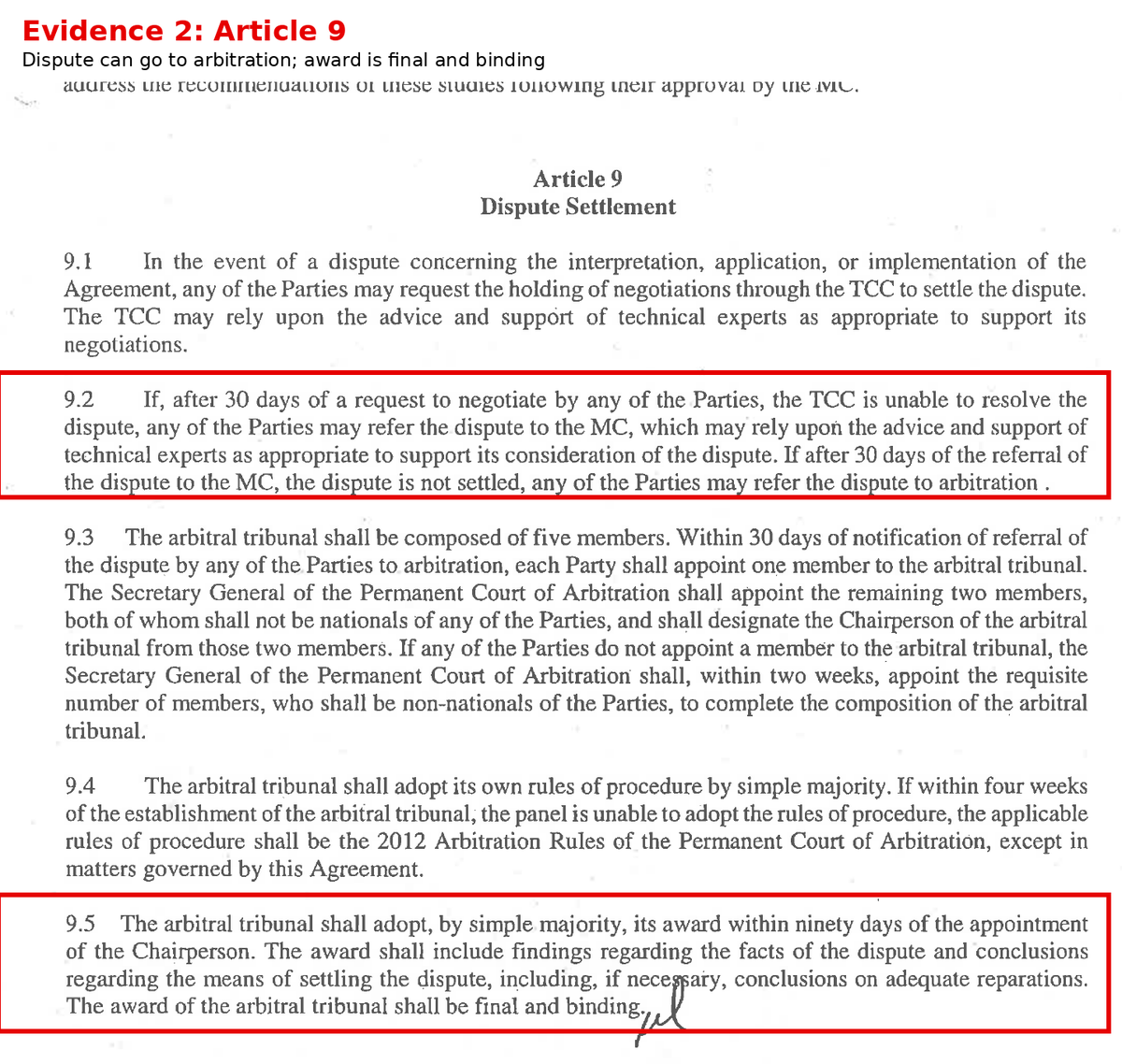
But the release machinery? Exhibit A, Annex A, the drought matrix, the 100 percent drawdown? Those would have teeth, and the teeth are called Article 9. Here is the line that matters:
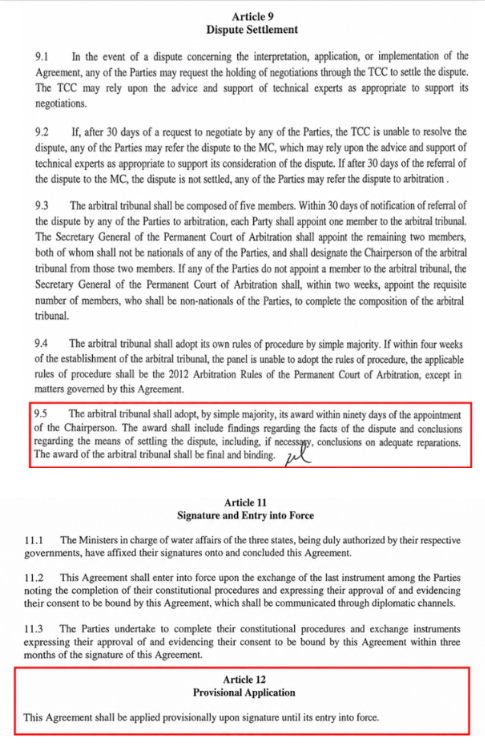
“The award of the arbitral tribunal shall be final and binding.”
Final. Binding. Sit with those two words.
Now let me paint you the fight this clause would make possible, the one that could come ten or twenty years after a signature. A drought arrives. Ethiopia, to keep its own people alive and its own grid breathing, holds back some of the water the matrix demands. Egypt does not send a protest letter. Egypt does not complain in a newspaper. Egypt walks calmly to the arbitral tribunal. And here is the key: Egypt would not need to win the big philosophical argument about whether the Nile is “allocated.” Egypt would only need to ask the tribunal to enforce the specific operational obligations, the exact ones, the number in the box: you agreed to release this, and you did not.
What would Ethiopia bring to that room to defend itself? Article 10.1. A general disclaimer. And a tribunal could treat the specific operational obligations as controlling unless Article 10.1 clearly overrides them. And Article 10.1 does not clearly override them. So Ethiopia would walk into that tribunal holding a poem, and Egypt would walk in holding a contract.
That is the asymmetry I need you to see, and to be angry about. The clause that would help Ethiopia cannot really be enforced. The clauses that would bind Ethiopia could be enforced, finally and permanently, by outsiders. They put the teeth on the trap, never on the promise. That is not an accident. That is design.
Bolt three. Article 12: the trap closes the moment the pen touches paper.
You might think: surely there would be a safety gap. Surely Ethiopia would sign, then go home, let Parliament study it, let the people weigh in, and only then would the dangerous machinery come alive. Surely there would be time to wake up.
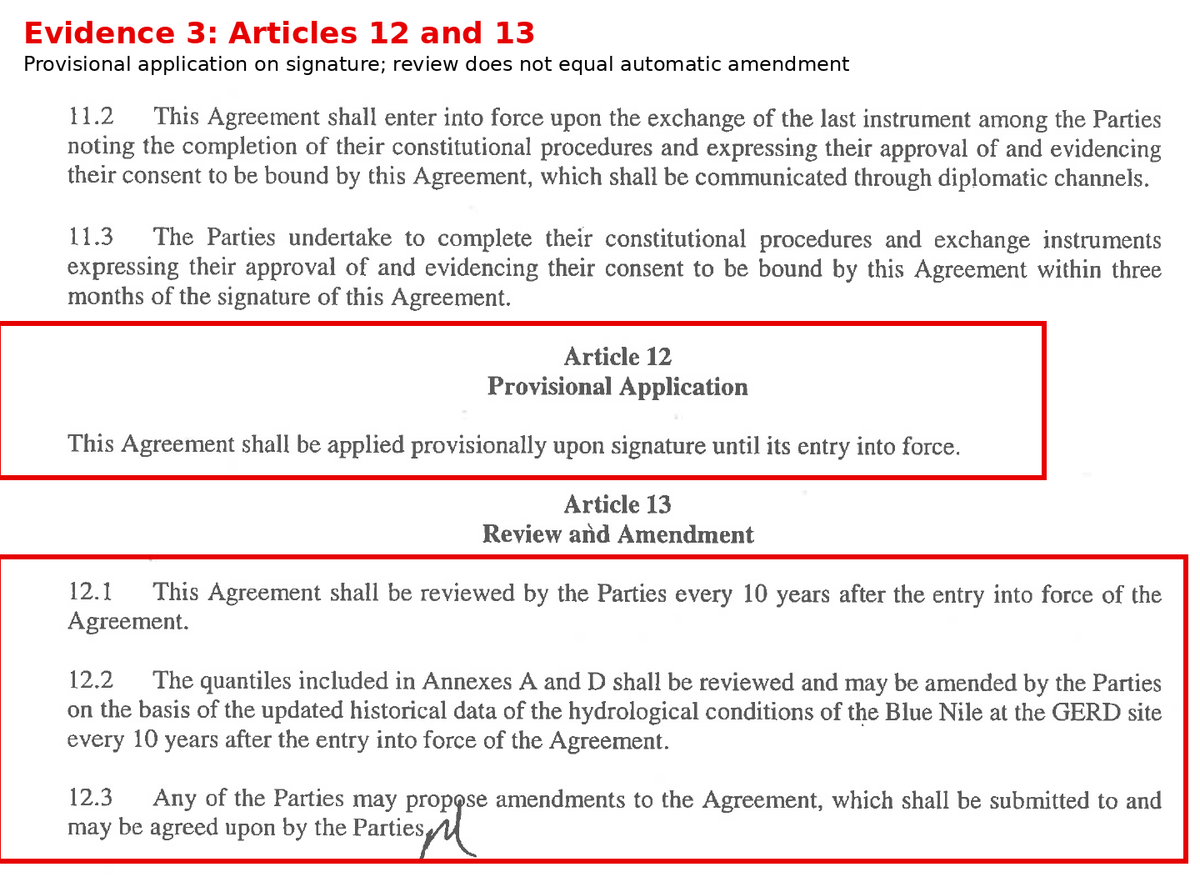
There would not. Read Article 12, the whole of it:
“This Agreement shall be applied provisionally upon signature until its entry into force.”
Provisionally. Upon signature. That means that if Ethiopia had signed this as written, the machine would have started running the instant the pen lifted off the page, before ratification, before Parliament, before the people, before any of the normal protections a sovereign country builds around a decision this enormous. The drought matrix, the drawdown, the approval requirement, all of it could have bound Ethiopia in practice from day one, while the ink was still wet, while the country was still arguing about whether it agreed.
This is the clause that would have removed the morning after. It is the clause that says: no second thoughts, no cooling off, no waking up. You would be living inside the cage before you had finished reading the lease.
Bolt four. Article 14: you cannot keep the candy and refuse the chain.
By now a clever person is thinking the obvious thought: fine, then Ethiopia signs the good sentence, Article 10.1, and simply refuses the dangerous annexes. Take the candy, leave the poison. Sign 10.1, reserve against Annex A.
The draft saw that thought coming and killed it in advance. Article 14:
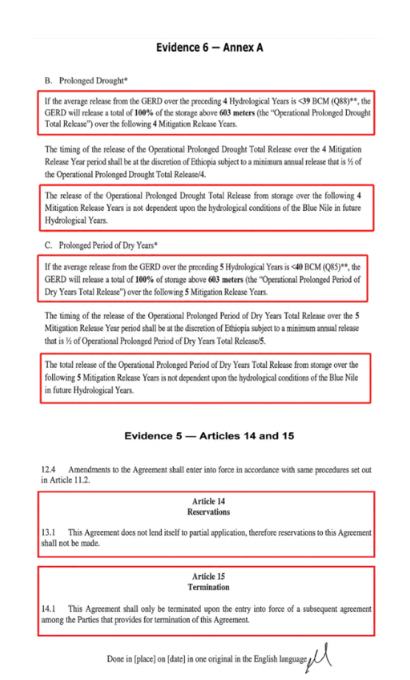
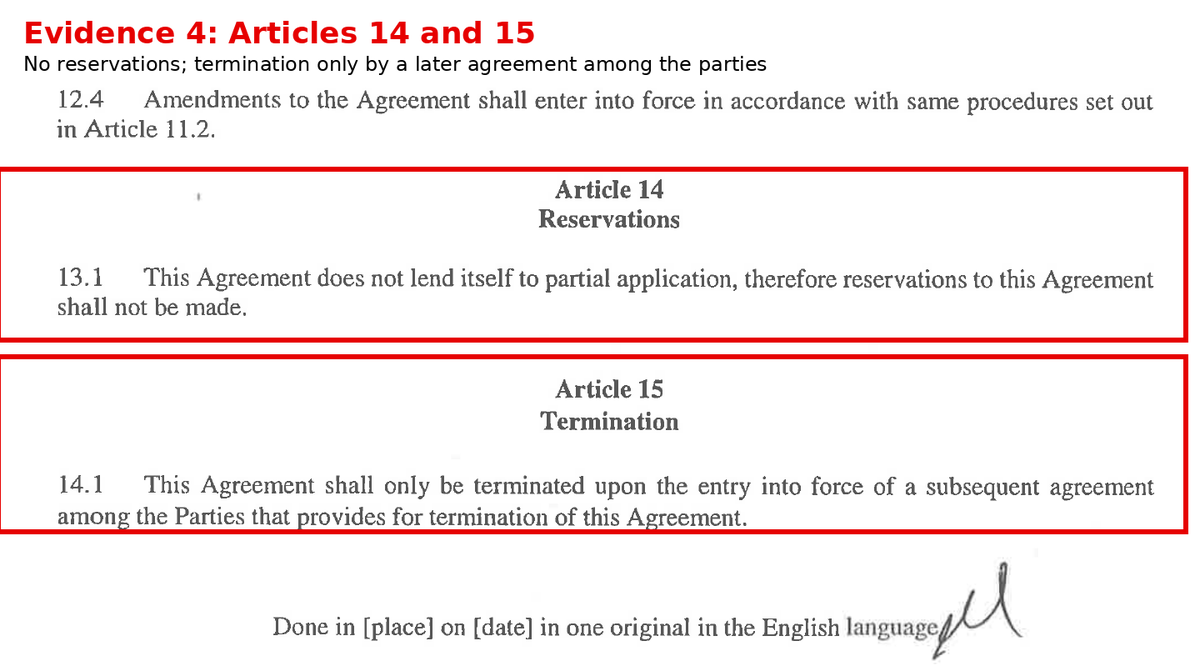
“This Agreement does not lend itself to partial application, therefore reservations to this Agreement shall not be made.”
No reservations. None. It is all or nothing. You cannot accept the beautiful sentence and decline the matrix. You cannot keep the deed and refuse the leash. The shield and the sword come welded into one object, and you must swallow the whole thing or walk away.
And this is the quiet proof of the entire trick. If Article 10.1 had truly overridden the machinery, it would have been far more costly for Egypt to accept. But because Article 14 welds the friendly sentence to the unfriendly machinery, the wording cost Egypt nothing. They could let Ethiopia have the candy, precisely because Article 14 makes sure the candy can never be unwrapped from the chain.
Bolt five. Article 15: the door that locks from the outside.
And now the last bolt, the heaviest one, the one that turns a bad deal into a life sentence. Suppose Ethiopia signs. Suppose five years pass, ten years, and the country sees clearly what it has done, sees the reservoir being drained for someone else’s fields, sees its turbines starving in a drought. Surely a sovereign nation can walk away from a deal that is strangling it?
Read Article 15 and weep:
“This Agreement shall only be terminated upon the entry into force of a subsequent agreement among the Parties that provides for termination of this Agreement.”
Read it again. Ethiopia could only leave if everyone agreed to let Ethiopia leave. Which means Egypt would have to agree. And ask yourself, with a clear and honest mind: why would Egypt ever agree to release Ethiopia from a structure this favorable to downstream control? It would have little reason to. So the arrangement, for all practical purposes, could become indefinite.
Not a treaty for ten years. Not a treaty you could exit when it began to choke you. A door with the handle on the other side. A cage you would have walked into yourself, carrying a piece of candy, and the lock would have clicked shut behind you, and the only party with a real reason to hold the key would be the one who built the cage.
That is the lock on the box. Five bolts. Approval pressure, binding arbitration, provisional application, no reservations, no exit. Each one alone is dangerous. Together they form a machine designed for one purpose: to make sure that once Ethiopia stepped inside, Ethiopia could never step out.
Someone will say, “but Article 13 allows a review every ten years.” Yes, and I want you to see why that is a comfort made of paper. A review is not freedom. A review date does not amend a single word by itself; any amendment still requires the agreement of all parties, which means Egypt’s agreement, which means no. Article 13 gives Ethiopia a calendar, not a key. Ten years later you are standing in the same room, asking the same neighbor for the same permission, and getting the same answer.
What a real Article 10.1 would have looked like.
Now let me show you, in one stroke, the proof that Article 10.1 was decoration and not protection. Just compare it to what a clause written to actually defend Ethiopia would have said.
A real shield does not whisper “this is not an allocation” and then go silent while the annexes do the opposite. A real shield is a master clause, what lawyers call a supremacy clause, and it overrides everything beneath it. It would have read something like this:
“Notwithstanding any article, annex, exhibit, table, matrix, committee procedure, or dispute mechanism in this Agreement, nothing herein shall create a fixed downstream volumetric entitlement, a water debt, a release obligation independent of future hydrological conditions, an obligation to deplete GERD storage for downstream benefit, a pass-through delivery duty, a committee power to approve or veto ordinary GERD operation, an arbitration-imposed release obligation, or any restriction on Ethiopia’s future development of its own waters.”
Read that, then read the real Article 10.1 again, and feel the difference in your chest. The real one says “not allocation” and stops. It never says no water debt. It never says no storage mining. It never says no forced release above the year’s inflow. It never says no veto over how I run my own dam. It never says Ethiopia may walk away if this regime begins to strangle her.
A sentence that names none of the real dangers is not a shield. It is a souvenir. The draft handed Ethiopia the souvenir and kept every danger. They gave us the word “sovereignty” to frame and hang on the wall, and they wrote the machinery that empties the reservoir into the small print underneath.
Why I am angry, and why the anger points at the right people.
Let me say the hard part plainly, because you have read this far and you deserve directness.
This was not an accident. A document does not arrive this elegant by mistake. Someone designed it so the one Ethiopian-friendly sentence would be loud and the Egypt-friendly machinery would be quiet. Someone understood that a tired delegation needs something to carry home, and that a nation’s pride can be satisfied with a name while its water is quietly taken. That is not the work of fools. That is the work of people who have studied this river for generations and studied us for just as long.
And the setting helped them. The United States Treasury facilitated the process, and the World Bank provided technical input. That institutional weight matters. But institutional weight does not make a dangerous clause safe. A clause does not become balanced because it walks into the room wearing a World Bank suit. And remember what the Treasury said when the talks broke down: it stated publicly that final testing and filling of the dam should not take place without an agreement, while Egypt had already initialed the text and Ethiopia was still consulting its own people at home. A finance ministry, helping broker a river it does not share, signaling that the upstream nation should not move on its own water until a deal was done. From an Ethiopian seat, that did not look like neutral refereeing. It looked like pressure, and the pressure leaned downstream.
So when people say Ethiopia “refused to cooperate” by walking away in February 2020, remember what was actually on that table. Ethiopia did not walk away from cooperation. Ethiopia walked away from a cage with a candy in it. And refusing to sign your own imprisonment is not stubbornness. It is the most basic act of a free people.
And let me be clear about what cooperation is, so no one can twist my words. Ethiopia should share its data. Ethiopia should coordinate with Sudan on Roseires and on dam safety. Ethiopia should give honest drought notice and sit at every serious table, with an open hand. Cooperation is a bridge, and Ethiopia should build it. But a bridge is crossed from both sides. What was offered in Washington was a one-way road: our water flowing down it, and a single piece of candy flowing back up. That is not a bridge. That is a drain with good manners.
The whole story, in one breath.
If you remember nothing else from these two parts, remember the chain, because this is the entire trap in a single line:
Article 2 defines the triggers. Annex A creates the water debt. Exhibit A gives the number. Exhibit B makes the debt follow you. Article 4.5 forbids you to adjust it freely. Article 9 makes it final and binding. Article 12 starts it on signature. Article 14 blocks you from keeping only the good part. Article 15 blocks easy unilateral exit.
And Article 10.1, the beautiful sentence, the headline gift, the thing they wanted you to carry home and wave at your people? It stands off to the side, smiling, with no power to stop a single link in that chain.
So now you have seen the whole thing. Part One showed you the empty box, the beautiful ribbon and the air inside. Part Two showed you the lock, the five bolts that could have made the trap, for all practical purposes, indefinite, with no unilateral exit.
And here is where I leave you, with the same question that started all of this, because after everything we have read together, it lands differently now:
We built that dam with our own hands. With our own birr. With the savings of teachers and farmers and taxi drivers who bought bonds they could barely afford, because the dam was ours, a national lifeline, a promise to our grandchildren that the Nile would finally light Ethiopian homes. And we were asked to hand over the operating manual in exchange for one beautiful sentence.
A dam is meant to be a lamp, not a leash. A reservoir is meant to be a shield, not a ransom note.
So if you must build the house with your own hands, carry every stone yourself, go hungry to pay for it, and then sign a paper that says you may not lock your own door, may not adjust your own lights, may not ever move out, then tell me, my friends: whose house is it, really?
I think you already know the answer. I think Egypt knew it too. That is exactly why they could afford to give us Article 10.1.
It cost them nothing. It was an empty box all along.
The end.
#Egypt #Sudan #SouthSudan #Ethiopia #Uganda #Kenya #Tanzania #Rwanda #Burundi #DRC @AbiyAhmedAli #NileRiver #BlueNile #NileDam #AfricanWaters #NoToColonialism @MFAEthiopia #Sovereignty #GERD #WaterRights #Sovereignty #ReadTheDraft #AfricanWaters #NoToColonialism #Abbay #NileNegotiations
How Egypt Tried to Fool Ethiopia: Article 10.1, the Beautiful Sentence in the 2020 Draft That Was Just an Empty Box (Part One)
A close reading of Article 10.1 of the 2020 Washington draft, and why the only “gift” Ethiopia received was wrapped in ribbon and filled with air.
Let me start with a confession.
The last time I sat down and read the 2020 draft, the one Egypt initialed in Washington on February 28, 2020, the one Ethiopia walked away from, I missed something. Not a small thing. A big thing. I was so busy hunting for the poison in the document that I walked right past the one place where the document smiles at you.
There is one sentence in that whole draft that looks like the clear, headline gift for Ethiopia, the one that can make an Ethiopian reader breathe for a moment. Out of fifteen articles, four annexes, and a stack of exhibits, this is the sentence everyone points to first.
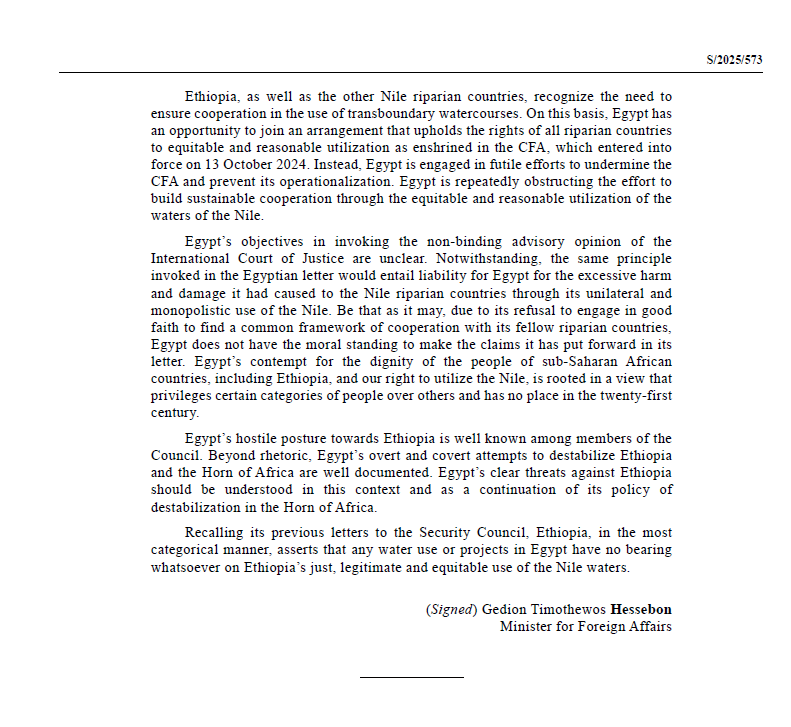
It is Article 10.1. And here is what it says, word for word: “This Agreement is not intended to be and shall not be interpreted or applied as an allocation of the waters of the Blue Nile among the Parties.”
Read that again slowly. Not an allocation of the waters of the Blue Nile. For a country that has spent a century being told by colonial-era papers it never signed that its own rain already belongs to someone downstream(Egypt), that sentence is oxygen. It says, in plain legal language, that this document does not divide the Nile. It does not hand Egypt a written quota. It does not bless the old “historical rights.” On its face, it protects the one principle Ethiopia has bled to defend: the Blue Nile is not already spoken for.
But here is the first problem, and you need to see it before you let your shoulders drop. The draft does not leave Article 10.1 standing alone. The opening of the agreement says it consists of the articles, annexes, and associated exhibits, and that these constitute an integral part of it. In plain language: Exhibit A is not decoration. Annex A is not a footnote. They are bolts in the same machine as Article 10.1. So that beautiful sentence must be read together with the very annexes that quietly do the opposite of what it promises.
So I want to be honest with you, my friends, before I get angry, because I am going to get angry. That sentence is real, and it is good. If I tell you it is worth nothing at all, I am lying to you, and a man who lies to his own people to win an argument is no better than the people he is arguing against.
But here is the question that has been burning in me since I reread it:
What is the use of one good sentence in a house built entirely to trap you?
That is what this whole article is about. So pour your coffee, settle in. Let me take you somewhere first.
Let us drive back to February 2020, into a room I was never in.
I want to be completely clear with you. I was not in that negotiation room in Washington. I have no idea what was actually said. What I am about to tell you is my imagination, a story, a picture in my head, and I am telling you it is imagination so that no one can later say Asrat made up facts. I made up nothing. I am painting a scene. Bear with me.
Picture it. February 2020. A cold Washington conference room. A long polished table. On one side, Egypt’s delegation, calm, prepared, lawyers who have studied this river for generations. Beside them, helpfully, the United States Treasury, facilitating. And in the corner, the World Bank, lending its “technical input” like a respectable witness at a wedding nobody asked for.
And the draft on the table? In my imagination, it already leaned heavily toward egypt control. I am not going to hand you a precise percentage and pretend I measured it. I didn’t, and neither did anyone who tells you a number. I am describing the shape of the text: Annex A, Exhibit A, Article 4.5, Article 9, Article 12, Article 14, and Article 15 all lean the same way, like trees bent by one strong wind. They never need to say the word “allocation” to take the water.
Now imagine, in that room, one tired Ethiopian negotiator looks up from the pages, feels his stomach drop, and says, almost begs:
“Wait. Wait. There has to be at least ONE article in here that is good for Ethiopia. One. Give us something we can carry home.”
And imagine Egypt, patient, unbothered, the way a chess player is unbothered when you finally move a pawn, leaning back, thinking for one second, and saying:
“Of course. Here. Write this down: ‘This is not an allocation of the Blue Nile.’ There. Now you have your good article. Article 10.1. Happy?”
And the pen moves, and the sentence goes in, and somewhere a shoulder relaxes.
Again, Don’t take my word for any of that. It is theater in my head. But ask yourself why the theater feels so true. Why does it fit the document so perfectly? Because when you finally read what the rest of the draft actually does, you realize that Egypt could afford to give away that sentence. It cost them nothing. They were never going to need the word “allocation.” They had already written the allocation into the machinery. They just left the name off.
The candy and the toys
Let me use an analogy, so let me give you the one every Ethiopian parent already understands.
A clever uncle visits a child. He crouches down, smiling, and holds out one bright piece of candy. “This is for you,” he says. “It’s all yours. Nobody can ever take this candy from you. I promise.”
The child’s eyes light up. Mine. He said it’s mine.
And while the child is busy unwrapping that one candy, happy, distracted, grateful, the uncle quietly gathers up every toy in the room. The blocks. The ball. The little wooden truck the child’s father carved with his own hands. All of it. Into his bag.
Then the uncle stands up, pats the child on the head, and says, “See? I kept my promise. The candy is still yours.”
That is Article 10.1.
The candy is the word. The toys are the water.
But let me give you a second picture, because the candy story is too gentle, and what was attempted in Washington was not gentle.
Imagine a man builds a house with his own hands. He carries every stone himself. He goes hungry to pay for the cement. His children carry water up the hill for the mortar. For years. And when the house is finally standing, strong, his, earned, a neighbor arrives with a contract. The contract has a beautiful first line: “This document does not say we own your house.” The neighbor smiles. “You see? We respect that it’s your house.”
And then, in the small print, the contract says: you may not lock your own door without our permission. You must leave the windows open on the nights we choose. When the well runs dry, you must give us your stored water first, even if your own children are thirsty. And you may never tear up this contract unless we agree to let you.
Whose house is that, really?
The deed says it’s yours. The operation of it belongs to the neighbor. And a house you cannot lock, cannot run, and cannot leave is not your house. It is your prison that you happen to have built yourself.
That is the genius and the cruelty of what was put on that table. Egypt did not try to take the deed to GERD. Taking the deed would have been too obvious; it would have caused an open fight. Egypt did something quieter and far more dangerous. It reached for the operating manual while letting Ethiopia keep the deed, and then it offered Article 10.1 as proof of its good manners.
Now let us leave my imagination and walk into the real document.
Here is where I stop telling stories and start showing receipts. Everything from here is in the text. I will quote it. You decide.
The whole trick of Article 10.1 rests on a distinction that sounds boring but decides everything: the difference between what a clause says it is and what a clause makes you do.
In law, this is not a small point. It is the whole point. Lawyers have a saying about it that goes back centuries: substance over form. It does not matter what you call the animal. If it has four legs, a mane, and hooves, and it carries a rider, it is a horse. You can write “this is not a horse” on a sign and hang it around its neck. It is still a horse.
Article 10.1 is the sign that says “this is not a horse.”
The annexes are the horse.
So let me walk you through the animal, piece by piece, strongest evidence first, because you asked me to start from the top of the mountain and come down, and the view from the top is brutal.
Exhibit A: the receipt that ends the argument
If I could show an Ethiopian only one page of this draft, it would be Exhibit A, the Drought Conditions Release Matrix. It is a grid of numbers, dry and bureaucratic, and inside that grid sits the single most damning fact in the entire document.
Find the row where the GERD reservoir is at its highest listed level: 625 meters above sea level, holding 49.3 billion cubic meters. Now follow it across to the column where the river’s flow for the year is only 20 BCM. A drought year. A hungry year. A year when the rain failed.
The number in that box is 34.04.
Stop and feel what that means. The river brought you 20. If signed as written, the document would require you to release 34.04 BCM. That is about 170 percent of everything nature gave you that year. Where do the missing 14.04 billion cubic meters come from? Not from the sky; the river brought only 20, not 34.04. The missing 14.04 must come from your storage, from the water you saved, from the water your country went into debt to hold back. In the dry year, when your own people most need that reserve, the rule would reach into your reservoir, pull out roughly 14 billion cubic meters of stored Ethiopian water, and send it downstream.
Now turn back to Article 10.1 and read it one more time: “not… an allocation of the waters of the Blue Nile.”
My friends, what do you call a rule that tells you exactly how much water to deliver downstream under specified drought conditions, enforceable through the agreement, and drawn from your own stored water? There is only one honest description for it: functional allocation. Allocation without the name. Egypt did not need the word, because Egypt had the number: 34.04.
That single box cancels most of the comfort of 10.1 by itself. I would put it roughly ninety percent of the way toward making 10.1 meaningless. The sign says “not a horse.” The horse just kicked you.
Annex A: the water debt that follows you into the dark
It gets worse, and I need you to follow me carefully here, because this is the part a downstream legal strategy would love and the Ethiopian public never understood.
Look at the long-term operation rules in Annex A. They say that if the average GERD release over the preceding four hydrological years falls below 39 BCM, GERD must release 100% of the storage above 603 meters over the following four mitigation years. And if the average over the preceding five years falls below 40 BCM, GERD must release 100% of the storage above 603 meters over five mitigation years.
One hundred percent. Not a share. Not a portion. All of the storage above 603 meters.
And then comes the sentence that should make every Ethiopian’s blood run cold. The draft says these releases are: “not dependent upon the hydrological conditions of the Blue Nile in future Hydrological Years.”
Read that slowly, because it is the cruelest line in the document. Not dependent on the future. It means this: suppose a drought hits, and the rule triggers a multi-year obligation to drain your storage. Now suppose the next years are also dry, God forbid, a real drought, the kind the Horn of Africa knows too well. Under any sane, humane rule, your obligation would shrink, because there is no water and your own people are suffering.
But this draft says no. The debt was calculated from the past. You must pay it regardless of the present. Even if your children are thirsty. Even if your turbines are starving. The water debt does not care about the future, because it was never designed to protect you. It was designed to guarantee Egypt’s supply no matter what the sky does to Ethiopia.
This is not cooperation. Cooperation shares the pain of a drought. This exports the pain of drought out of Egypt and pushes it upstream onto us. It turns GERD, the dam we built to protect ourselves from drought, into an insurance policy for someone else’s drought. We pay the premiums. They collect the claim.
And here is the engineering knife hidden inside the legal one. Draining your reservoir down to 603 meters does not only cost you water. It costs you power. A hydropower dam generates electricity from the pressure of the water stacked above the turbines, the “head.” Drop the level, and you drop the pressure, and you drop the megawatts. So in the very years when drought makes electricity most precious, this clause would put GERD under forced drawdown: less stored water, less hydraulic head, exactly when reliability matters most, so that Egypt’s fields stay green. We built the largest dam in Africa, and the draft would have us run it under drawdown to water someone else’s harvest.
What does Article 10.1 do about any of this? Nothing. It cannot. It is a sentence about a name. Annex A is a machine about water. When a name fights a machine, the machine wins every time.
Exhibit B: how one dry year becomes a chain that drags you for years
Now, someone might say: “Fine, one bad drought, one big release. We survive it and move on.” I wish that were true. Read Exhibit B, and you find out it is not a single bad year. It is a system.
Exhibit B does one small kindness. It says overlapping drought and dry-year measures should not be double-counted, and the higher value applies. Good. But it does not make this a single-year problem. It builds a stacking-risk architecture. It shows that a release obligation created in a drought period reduces the water GERD is allowed to keep in later years. And it shows that ordinary drought-matrix releases can operate during the very periods when prolonged-drought or dry-year mechanisms are already in effect.
So watch the chain form. A dry year triggers the matrix. A prolonged dry stretch creates a multi-year release duty. That duty then eats into your retention in the following years, years that may be perfectly normal. And on top of that, the drought matrix can still be firing at the same time. One bad season does not simply pass. It can attach itself to your dam and walk beside you for years, draining a little more along the way.
Article 10.1 has nothing to say to this system. It cannot, because it was never written as a master switch. It does not say “no annex may create water debt.” It does not say “no rule may force release above the year’s inflow.” It is a polite sentence sitting in the corner while the machine runs.
The definitions: how they made your success the reason you must pay
You would never look twice at Article 2. It is the “Definitions” section, the part everyone skips. That is exactly why it is dangerous. The most important traps are always set in the boring rooms.
The draft defines “Flow” like this: “‘Flow’ means the total volume of water entering the GERD reservoir in any given Hydrological Year.”
And it defines “GERD Level” as the level of your reservoir at the start of the year.
Why does this matter? Because these two boring definitions are the trigger for the whole release machine. The matrix doesn’t look at the water crossing into Sudan. It looks at the water inside your dam and at how full your reservoir is. And the fuller your reservoir, the more the matrix demands that you release.
Think about the madness of that. You worked hard. You saved water. You filled your dam, the dam you built to secure your own future. And the document treats your full reservoir not as your achievement but as the evidence that you can afford to give more away. Your savings account becomes the proof that you owe. Your success becomes the trigger of your obligation.
And there is a second blade here, aimed straight at the future, and this is the part I beg you not to skip. Because “Flow” is measured at the dam, any future Ethiopian project upstream of GERD could be argued to reduce GERD inflow and trip the same drought machinery, unless the agreement clearly protects future development from being converted into a release obligation. An irrigation scheme to feed Ethiopian children. A small dam for a thirsty highland town. A watershed to hold back the rains. Each one could lower the flow arriving at GERD, and a lower flow at GERD could be read as a drought under these very definitions. So Ethiopia developing its own land could, on paper, be made to look like the sky failing. Someone downstream could point at your new canal and argue that a drought was triggered, and the matrix would obey. The trap is not only set for today. It is set for your grandchildren, and it risks punishing them for the crime of building.
So when Article 10.1 says “not an allocation,” ask it: then why does my own water level decide how much I must surrender, and why might feeding my own people count against me? The article has no answer.
Article 10.2: the second beautiful sentence, also not enough
To be fair, there is a second sentence that looks friendly to Ethiopia, and an honest writer must deal with it. Article 10.2 says future developments upstream of GERD may be undertaken, but “without prejudice to this Agreement,” and in line with international-law principles like equitable use, no significant harm, and cooperation. That sounds good. Ethiopia should want that sentence.
But look carefully at four words: without prejudice to this Agreement. And what does this Agreement already do? It defines “Flow” at GERD. It ties release rules to GERD flow and GERD level. It pulls Annex A and Exhibit A into operation. So if future Ethiopian development reduces the inflow into GERD, the downstream argument writes itself: you have affected the trigger system inside the draft.
That is why Article 10.2 is not enough either. Future development should not merely be “allowed” in a sentence. It needs a real safe harbor, a line that says lawful Ethiopian development shall never automatically become drought, breach, shortage, compensation, water debt, or a release obligation. Without that protection, the future is allowed on paper but still forced to walk through the cage the rest of the draft has already built.
My Conclusion for part One
So let me close Part One with the simplest truth.
Article 10.1 looks good. If you read it alone, it looks like the most beautiful sentence Ethiopia received in the 2020 Washington draft. It says the agreement is not an allocation of the waters of the Blue Nile. It sounds like sovereignty. It sounds like protection. It sounds like Ethiopia finally got one sentence in its favor.
But once you read the rest of the draft, that beautiful sentence begins to collapse.
Because a sentence does not protect a dam if the annexes control the releases. A sentence does not protect sovereignty if the tables control the storage. A sentence does not protect Ethiopia if the operating machinery turns GERD into a downstream drought buffer.
That is why I call Article 10.1 an empty box.
The ribbon is beautiful. The words are beautiful. The promise sounds beautiful. But when you open the box, the real power is not inside Article 10.1. The real power is buried in Annex A, Exhibit A, Exhibit B, Article 2, and the legal machinery that comes after them.
In Part One, I showed the empty box. I showed the candy. I showed Exhibit A, Annex A, Exhibit B, Article 2, and Article 10.2.
In Part Two, I will show the lock on the box: Article 4.5, Article 9, Article 12, Article 14, and Article 15. That is where the draft moves from dangerous operation into legal trap: approval pressure, arbitration, provisional application, no reservations, and no easy exit.
Part One showed why the beautiful sentence is weak.
Part Two will show why the trap could have become enforceable.
To be continued..
#Egypt #Sudan #SouthSudan #Ethiopia #Eritrea #Uganda #Kenya #Tanzania #Rwanda #Burundi #DRC #UAE @AbiyAhmedAli #NileRiver #WaterRights #Sovereignty #BlueNile #NileDam #AfricanWaters #NoToColonialism #GERD #NileRiver #Kechene @MFAEthiopia #Sovereignty
Egypt’s Eritrea Miracle? Look Closer.
Behind the multi-billion-dollar rhetoric lies a tiny maritime pact, a collapsing transit route, and single-digit trade numbers.
Egypt frequently presents its regional maneuvers around Ethiopia as a masterclass in grand strategy. However, a closer look reveals a predictable, deeply entrenched pattern: a grand ceremony, a massive headline, and a historic promise, followed by a widening implementation gap and predictable implementation failure.
Whenever Ethiopia makes a strategic move, Cairo reflexively scrambles to a neighboring state, be it Sudan, Somalia, Uganda, South Sudan, or now Eritrea. The rhetorical framing is always magnificent, spinning politically inflated tales of "strategic partnerships" and sweeping "continental corridors." Yet, the tangible results consistently evaporate the moment the cameras turn off. This is Egypt’s familiar corridor theater: announce a regional future, deliver a symbolic project dressed as regional power, then let the media call it strategy. Cairo is not building durable infrastructure; it is trading in geopolitical vaporware born out of deep regional anxiety.
A Track Record of Headline Diplomacy
Egypt’s history of regional project development in East Africa is defined by unfunded ambition and repeated delivery failure. Across the region, major diplomatic announcements routinely fail to survive the transition from paper to reality:
• Sudan (The Recycled Rail Link): Promises of an Egypt-Sudan railway and land link have been aggressively promoted by Cairo’s PR machine since 2008 and were breathlessly revived around 2021. Decades later, the project remains completely paralyzed by differing rail gauges, financial shortfalls, and systemic instability, remaining an operationally hollow promise rather than functioning logistics.
• Uganda (The Symbolic Delivery): Egypt heavily promoted its involvement in Uganda's energy sector through the Busitema Solar Power Station, portraying it as a massive milestone in regional transformation. Yet, after years of MoUs and high-level delegations, the project yielded a mere 4 MW. To put this minimal scale into perspective, Uganda recently commissioned a 600 MW hydropower plant financed heavily by China. Cairo's contribution remains a small, symbolic delivery.
• South Sudan (The Stalled Initiative): The highly touted 20 MW Juba Solar Power Station has followed a near-identical trajectory of strategic overreach. Slated for commissioning years ago, public project listings still relegate it to the status of a "paper corridor" initiative, labeled as "proposed" or "under development."
• Somalia (The Reactive Front): Following Ethiopia’s Somaliland sea-access MoU in January 2024, Cairo rushed to supply weapons and commit troops to the African Union mission in Mogadishu. This rapid, highly publicized military footprint was a direct regional reaction to turn Somalia into a pressure front, rather than a slow, organic blueprint for long-term regional stability.
Now comes the "Eritrea Corridor," the newest headline in Egypt’s aging playbook of unproven promises.
Deconstructing the Egypt-Eritrea Project
Egyptian state media has built a towering, fictional narrative around a massive logistics axis stretching from Alexandria and Suez, straight through Sudan, down to Eritrea, and deep into East Africa. In reality, the project's logic is flawed from the ground up across six key dimensions.
1. A Shipping Line Pretending to Be a Continent
There is a striking mismatch between the media narrative and official records. While pro-Cairo headlines claim a groundbreaking land corridor, the official document signed in Asmara is strictly a maritime transport agreement to establish a simple shipping line. A shipping line can be announced quickly with a political signature. A true land corridor demands billions of dollars in liquid capital, synchronized border customs, extensive highway networks, and robust cargo guarantees. The media has artificially inflated a basic maritime route into an imaginary continental axis.
2. The Project's Own Warning Label
Critiques of this project do not just come from outside observers. The pro-Egyptian Al-Araby article itself openly admits that the initiative faces severe structural risks, explicitly listing Sudan’s ongoing crisis, asset-security risks, high implementation costs, and deep doubts regarding economic viability. When a project's own promotional literature reads like a defensive risk assessment, political urgency has clearly outrun commercial design.
3. The War-Exposed Sudan Bottleneck and Logistical Inversion
Any viable land route connecting Egypt to Eritrea must physically bisect Sudan, a country currently engulfed in a devastating civil war. Even Sudan’s eastern hub, Port Sudan, has seen critical infrastructure like fuel depots and electricity substations exposed to conflict.
Relying on this route introduces a fundamental logistical absurdity. Both Egypt and Eritrea possess direct coastlines on the exact same body of water: the Red Sea. Maritime freight is generally far cheaper per ton-mile than overland desert trucking. Bypassing an open, direct maritime route to offload cargo, truck it thousands of kilometers through a violent conflict zone, and reload it at another port is commercially very difficult to justify.
4. The Isolated Eritrean Anchor
Eritrea is uniquely unsuited to anchor an international, open-market trade corridor. According to UNCTAD profiles, Eritrea possesses a tiny maritime footprint: a national-flag fleet of only 9 ships, totaling roughly 14,000 DWT, and exactly 0 container ships. Furthermore, Eritrea remains the only African country that has not joined the African Continental Free Trade Area (AfCFTA), has completely withdrawn from the regional bloc IGAD, and operates a highly state-controlled economy with heavy sanctions compliance risks. Lenders, insurers, and global logistics firms will not tolerate this level of legal and reputational uncertainty.
5. Fatal Cargo Logic and the Suez Comparison
Corridors live and die by freight volume, but the commercial base between these two nations is practically nonexistent. Public trackers show Egypt’s exports to Eritrea sit at a tiny $7.53 million, while imports from Eritrea crawl at a negligible $2.47 thousand.
Some Egyptian commentators claim this corridor can compensate for the geopolitical disruptions in the Red Sea. However, Egypt recently lost roughly $7 billion in Suez Canal revenue due to regional instability, with monthly losses hitting $800 million. A trade route with a total commercial baseline measured in the single-digit millions cannot plausibly substitute for multi-billion-dollar Suez losses.
6. Unfunded Ambitions and Established Competition
Egypt's economy is currently navigating intense macroeconomic headwinds, marked by heavy debt pressure and foreign-currency vulnerabilities. Funding multi-state infrastructure networks requires billions of dollars that Cairo simply does not possess, and key Gulf allies have little commercial reason to finance a volatile, anti-Ethiopian transit line through a collapsing Sudanese state.
Even if Cairo could solve the funding, the corridor faces an impossible competitive landscape. The imagined route aims to eventually reach East African markets, including Ethiopia. However, over 95% of Ethiopia’s import-export trade already moves seamlessly through the deeply entrenched Addis-Djibouti corridor, which is currently backed by a $730 million World Bank upgrade. Egypt’s concept simply cannot compete with an already functioning, financed, and dominant regional artery.
Conclusion: Loud Promises, Thin Delivery
The timing and scale of the Egypt-Eritrea announcement betray its true nature. It is driven not by commercial breakthrough, but by intense geopolitical anxiety surrounding Ethiopia's Renaissance Dam and Addis Ababa's strategic maritime ambitions.
The small, realistic version of this project may happen: a basic shipping line, minor port contact, and limited bilateral trade. The grand version is pure political theater: a propaganda corridor sold to the public before the financing, route, cargo, and security even exist.
Egypt’s Eritrea initiative is not a trade revolution. It is a limited maritime pact inflated into a continental mirage by a state that repeatedly confuses announcements with achievement. It repeats the familiar, reactive pattern around Ethiopia: panic, announce, exaggerate, delay. The headline is loud, the delivery is thin, and the implementation failure is already visible before the corridor even exists.
#GERD #Abbay #BlueNile #NileRiver #NileBasin #WaterSecurity #EquitableUtilization #Ethiopia #Egypt #Sudan #SouthSudan #Uganda #Kenya #Tanzania #Rwanda #Burundi #DRC #Eritrea #HornOfAfrica #EastAfrica #Africa #Geopolitics
High blood pressure doesn't start with salt and getting old...
It starts with inflammation, insulin resistance and low nitric oxide.
Here are 10 science-backed methods to lower your blood pressure naturally (bookmark this): 🧵
1. Eat more garlic
Title: @abbas_sharaky’s GERD post, checked against the data
When unsupported technical claims go unanswered, they do not stay small. They get repeated, enlarged, and recycled as fact. That is exactly why I am answering Abbas Sharaky today, with the files, the product limits, and the engineering logic his post tries to hide behind rhetoric.
I checked the DAHITI files I downloaded from my DAHITI account, HydroWeb, the SWOT LakeSP observation and prior files I downloaded from my NASA Earthdata account, and other public inland-water records.
The first weakness in @abbas_sharaky’s post appears before the engineering even begins: he does not transparently identify which database he is using, which date he is using, which satellite track he is relying on, or how he converted water level into BCM. That is not a small omission. Once someone publishes exact numbers like 629 m and 47 BCM, vague sourcing is not good enough. It has to be auditable. His is not.
Once the actual record is checked, that vagueness becomes a serious problem. The DAHITI GERD target summary itself shows that the water-level record ends on March 24, 2026, at 629.732 m ± 0.180 m, while the surface-area record ends on June 6, 2025, at 1548.230 km² ± 136.840 km². Just as importantly, the same GERD target summary shows that volume-variation data are not available there. In plain English, the DAHITI GERD record I checked does not directly give the kind of BCM storage series @abbas_sharaky’s wording implies, and it does not directly contain April 2026 water-level and surface-area rows in the way his precise claims would require. So before I even start dismantling his conclusions, the record already shows that his certainty is running far ahead of the evidence.
1.Quote: “The reservoir was about 629 m and about 47 BCM.”
My response: This is the weakest numerical claim in the entire post.
The DAHITI GERD record I checked does not directly provide absolute storage in BCM. It provides water level from satellite altimetry and surface area from optical imagery, and the GERD target summary explicitly says that volume-variation data are not available for this target. So 47 BCM is not a direct DAHITI number from the GERD record I checked.
Then the storage math collapses.
In the records and operating references I checked, 625 m corresponds to about 49.3 to 49.5 BCM, and 640 m corresponds to 74 BCM. That means 625 m is already about two-thirds of full storage, while 47 BCM is only about 63.5 percent of full storage. So Sharaky is asking people to believe something mathematically backwards: a reservoir at 629 m, four meters higher than 625 m, somehow holds less water than the documented 625 m benchmark.
That is not a tiny slip. That is a storage-math failure.
If you compare 47 BCM to the 625 m benchmark, his number is lower by about 2.3 to 2.5 BCM. In percentage terms, he makes a reservoir that is four meters higher hold about 5 percent less water than the lower benchmark. And if you do even a crude interpolation between 625 m and 640 m, 629 m lands around the mid-50s BCM, not 47 BCM.
So no, this is not a rounding issue. It is a serious technical miss.
And one more thing: 625 m is not some vague number. In the Ethiopia-Sudan 2022 technical rules, first filling is completed when the reservoir reaches 625 m or above, and GERD is supposed to operate mainly between 625 m and 640 m. In other words, 625 m is already a documented operating reference point. So claiming 629 m and only 47 BCM is not just weak. It is backwards.
2. Quote: “The reservoir stayed almost unchanged since April 10.”
My response: That may be a visual impression from screenshots. But a visual impression is not the same thing as a reproducible data row.
The DAHITI water-level file I checked stops on March 24, 2026, not in April 2026. The DAHITI surface-area file I checked stops in June 2025, not April 2026.
So the record I checked does not directly contain:
April 10, 2026 water level
April 18, 2026 water level
April 23, 2026 water level
April 28, 2026 water level
any April 2026 surface-area row at all
So my careful statement is this: he may have a visual shoreline impression from browser imagery, but he does not have April 2026 DAHITI row support from the file record I checked. That distinction matters. A visual impression is not the same thing as a reproducible measurement row.
3. Quote: “Satellite images show that the upper turbines stopped during the past two weeks.”
My response: No. Not in the way he wants the reader to believe.
The documentation is clear that this class of evidence comes from optical imagery, mainly Landsat and Sentinel-2. That makes it useful for shoreline comparison, visible plume or turbulence patterns, and broad surface conditions. But it is not unit-by-unit turbine telemetry.
This is where Sharaky stops sounding like an operator and starts sounding like a commentator.
A storage hydropower plant on a highly seasonal river like the Blue Nile is not supposed to run every unit at the same load all year. Unit commitment changes with inflow, head, grid demand, maintenance, outages, and dispatch strategy. In the heavy-flow months, more units may run. Outside them, fewer units may run. That is normal plant operation, not automatic evidence of failure.
Optical screenshots cannot, by themselves, reliably prove: which exact turbines are on or off, whether all upper turbines stopped, whether the lower pair has been out since a particular month, exact unit-by-unit dispatch. So a few visible surface cues do not prove the story Sharaky wants them to prove. They do not prove turbine shutdown. They do not prove malfunction. They do not prove bad engineering.
Screenshots are not control-room data. They are not turbine-status evidence.
4. Quote: “The two lower turbines have been stopped since last June.”
My response: That is even weaker.
The file record contains water-level estimates, surface-area estimates, product documentation, and remote-sensing method papers. It does not contain a month-by-month plant operating record. It does not contain a unit-status log. It does not contain a dispatch sheet.
So this claim is not being demonstrated from the evidence base. It is being asserted.
If @abbas_sharaky wants to claim that specific lower units have been offline since a particular month, the burden is on him to produce plant-status evidence, not screenshots and not DAHITI level-area products.
5. Quote: “Under good operation, the reservoir should have been about 20 BCM, not 47 BCM.”
My response: This is another major overreach.
The DAHITI files do not say that. They cannot say that. They are not operating-rule documents.
And the broader GERD literature cuts against him. Published GERD work places normal or optimal operation in a much higher band, around 625 to 640 m, not near some universal early-May target of 20 BCM. The Ethiopia-Sudan 2022 technical rules also say first filling is completed when the reservoir reaches 625 m or above, GERD operates mainly between 625 m and 640 m, and replenishment usually happens in July, August, September, and October.
So this 20 BCM by early May line does not read like a neutral engineering benchmark. It reads like @abbas_sharaky’s personal operating assumption being presented as if it were settled dam law.
It is not.
6. Quote: “The rainy season in the Blue Nile Basin begins specifically on May 1.”
My response: Here wording matters.
He did not say around May 1.
He did not say roughly early May.
He said it specifically.
That is false precision.
A basin does not switch on like a machine on one date. The Upper Blue Nile has the shorter Belg season and the main Kiremt rainy season, and onset varies. The broad wet-season transition is real. But specifically May 1 is not serious operations language. It is rhetoric dressed up as precision.
So yes, I challenge him directly on the wording.
7.Quote: “Weak operation or shutdown of the 13 turbines is due to technical installation problems and lack of readiness.”
My response: That is not demonstrated by the evidence.
The data products are about water level, surface area, optical water masks, and remote-sensing methodology. They are not commissioning records, not contractor defect logs, and not plant-readiness reports. So moving from weak visible surface release to installation problems is not an engineering conclusion here. It is speculation.
And again, he skips the real engineering variables:
head, available flow, unit commitment, maintenance
grid absorption, dispatch strategy, Without those, this is not a diagnosis. It is a guess.
A serious mechanical-readiness diagnosis would require plant records, commissioning updates, or credible engineering reporting. Screenshots do not do that work for him.
8. Quote: “The dam needs wise management and coordination with Egypt and Sudan.”
My response: This is where wording matters again.
@abbas_sharaky does not literally write, “This proves poor dam management.” So I will not misquote him.
But he clearly uses the imagery, the 20 BCM assumption, the technical-problems story, and the release narrative to push the reader toward that conclusion. He is framing the situation as evidence of weak operation and a need for wiser management.
That is the fair way to describe what he is doing.
And the fair rebuttal is this: even if high releases occurred at some point, that alone does not automatically prove turbine trouble, installation failure, or poor management. It proves a release event occurred. The leap from large release to therefore bad management is his argument, not a direct product output from the evidence base.
9. The April SWOT files make his April case weaker, not stronger
This is the new point that sharpens the whole rebuttal.
A satellite track is just one strip of ground the satellite flew over on that day. The GERD DAHITI page lists GERD SWOT tracks as 012, 318, and 499. That means April 23 track 165 is not even a GERD track.
And the only GERD-relevant April track in the NASA files I checked, April 18 track 012, still does not rescue his claim. In the observation files, I did not get a GERD-consistent record. In the prior files, the nearby entries are no_data placeholders, not valid observed water-level or area values.
So my statement is this: I checked both the April SWOT LakeSP observation files and the April SWOT LakeSP prior files downloaded from NASA Earthdata. April 23 track 165 is not even a GERD track, and for the only GERD-relevant April track in the set, April 18 track 012, the files still do not produce a valid GERD observation.
What actually survives after the bluff
Once the exaggeration is stripped away, what survives is much smaller: yes, the Blue Nile is highly seasonal
yes, the basin transitions toward higher inflows as the wet season approaches. yes, Ethiopia’s grid constraints are real. yes, the screenshots may support a visual impression of limited shoreline change over a short interval.
But that is not the same thing as a sound dam-operations diagnosis.
The real story is: Abbas Sharaky takes some plausible hydrology, wraps it in screenshots, and then stretches it into engineering conclusions that the data record does not actually prove.
His strongest-sounding claims are actually his weakest: 629 m = 47 BCM, screenshots prove turbine shutdown, good operation should have been 20 BCM
specifically May 1.
So no, this is not a clean technical reading of GERD operations. It is a political argument leaning hard on data that cannot carry the weight he puts on it.
#GERD #BlueNile #Abbay #NileBasin #Hydrology #DamEngineering #WaterSecurity #TransboundaryWater #DataNotNoise #Ethiopia #Egypt #Sudan #SouthSudan #Uganda #Kenya #Tanzania #Rwanda #Burundi #DRC #Eritrea
Title: Cairo Screams “Life or Death” While Pumping the Nile Into the Desert
President @AlsisiOfficial keeps telling the world that the Nile is a “life and death” issue for Egypt, that the river supplies more than 98 percent of Egypt’s water, and that Cairo will not compromise on its “vital water interests.” That is the line Egypt wants the world to hear. But Egypt’s own official numbers tell a much uglier story.
Egypt’s own 2026 figures say annual water demand is 88.55 bcm: 68.1 bcm for agriculture, 12.45 bcm for drinking water, 5.5 bcm for industry, and 2.5 bcm for other uses. Another official 2026 frame gives 65.35 bcm/year of renewable resources and 23.2 bcm/year reused. A separate official strategy frame gives 59.25 bcm/year of conventional resources, a 20.75 bcm gap, 20 bcm/year of virtual-water imports, and 21 bcm/year of reuse, with a resource mix of 55.5 bcm Nile water, 2.1 bcm deep groundwater, 1.3 bcm rainfall and flash floods, and 0.35 bcm desalinated water. Cairo is not surviving on raw Nile flow alone. Cairo is already surviving through storage, reuse, groundwater, desalination, and imported virtual water.
Now do the arithmetic Cairo prefers not to say out loud. Out of 88.55 bcm, agriculture takes about 76.9%. Drinking water takes about 14.1%. So when Cairo performs this dispute as if it is only about a thirsty child with an empty cup, its own numbers say something else: this is overwhelmingly an agriculture-heavy state allocation problem. The slogan hides a giant irrigation economy behind the image of household survival. That is the first deception.
The famous “98% Nile” line is another deception. It is political shorthand, not a stable engineering ratio across Egypt’s own official accounting frames. Take Egypt’s own 55.5 bcm Nile figure. Against the 65.35 bcm frame, that is about 84.9%. Against the 59.25 bcm conventional-resource frame, that is about 93.7%. Against the full 88.55 bcm annual-demand frame, it covers only about 62.7%. So which Egypt is Cairo asking the world to believe, the Egypt of official accounting, or the Egypt of slogans?
Then comes the part Cairo most wants hidden: storage. Egypt’s own Ministry of Water Resources and Irrigation says the High Dam and Lake Nasser system was designed for a maximum water level of 183 m and a storage capacity of 169 bcm, divided into 31.6 bcm dead storage, 89.7 bcm to guarantee average annual discharge, and 47.7 bcm for flood protection. The same official page says the spillway can discharge 200 million m3/day. This is not a country standing with one cup of water in its hand. This is a state operating one of the largest hydraulic buffers on Earth.
And Cairo forgets its own history whenever it acts helpless. Official public records say that during the low-flow sequence from 1979 to 1987, Egypt drew down nearly 70 bcm from Lake Nasser storage to cover natural deficits. Read that again. Seventy bcm. A state that can withdraw nearly seventy bcm from strategic storage cannot honestly act as if every upstream fluctuation means instant national collapse.
Then comes the evaporation hypocrisy. Cairo lectures Ethiopia about “lost water,” while one of Egypt’s biggest losses is Lake Nasser evaporation. Peer-reviewed studies place Lake Nasser evaporation broadly in the 10 to 16 bcm/year range, with some estimates around 12.3 to 12.9 bcm/year over 2001 to 2013. By contrast, the widely cited Nile operations study in Nature Communications estimates GERD net evaporation at about 1.7 bcm/year, partly offset by about 1.1 bcm/year of reduced evaporation in the High Aswan reservoir once the system reaches a new equilibrium. So when Cairo screams about upstream “waste,” it conveniently forgets that it stores massive volumes in a desert reservoir where huge amounts vanish into the air every year.
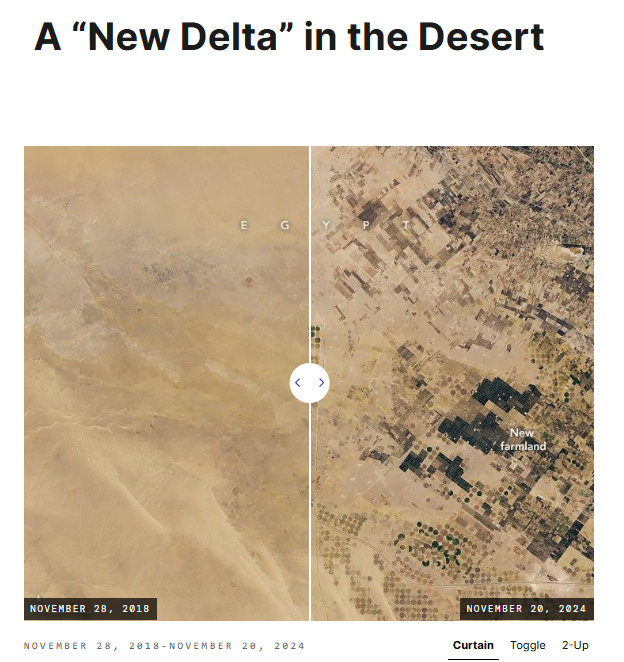
And then there is the desert-expansion story, the part that blows up the entire morality play. Cairo says every drop is life and death. Then Cairo’s own official project pages show that New Delta is not a treated-wastewater-only story. The Egyptian Presidency says treated wastewater is moved through a 170 km canal and 17 lifting stations to a treatment plant with capacity of 7.5 million m3/day, while a 41 km canal extension carrying 10 million m3/day is meant to cultivate about 700,000 additional feddans. The same page says 350,000 feddans are already reclaimed using 2,600 pivots, and ties the “Future of Egypt” component to 1.05 million feddans within a broader 2.2 million feddan New Delta target. NASA independently describes the New Delta as a 2.2 million feddan desert expansion supplied by treated wastewater, pumped groundwater, and a canal connected to the Rosetta branch of the Nile. That point matters. Cairo cannot hide behind the claim that this is only recycled water and therefore outside the Nile argument. It is not only recycled water. It is a multi-source desert-expansion scheme.
The arithmetic makes that even clearer. 7.5 million m3/day is about 2.74 bcm/year. Spread across 2.2 million feddans, that alone is nowhere near enough to explain the whole project. That is exactly why Egypt’s own public descriptions add other sources: groundwater and Nile-linked conveyance. So no, the morality problem does not disappear just because Cairo says “treatment plants.” Egypt’s own public record shows a broader reality: treated water is part of the system, but so are groundwater extraction and direct Nile-linked supply. That is not mere survival. That is strategic expansion.
The most politically explosive number in the whole record is still the Reuters Jirian figure. Reuters reported that Egypt plans to route about 10 million m3/day of Nile water, roughly 3.65 bcm/year, about 7% of Egypt’s self-claimed annual Nile quota, to the Jirian desert city corridor while helping irrigate the adjacent 2.28 million-acre New Delta agricultural project. Let that sink in. Cairo tells the world the Nile is “life and death,” then moves about 7% of its annual quota into a desert-city and frontier-agriculture corridor designed to raise land values and expand development. That is not emergency drinking water. That is regime-priority water.
Sinai tells the same story. The Egyptian Presidency says the Bahr El-Baqar wastewater-treatment plant has a daily capacity of 5.6 million m3/day and supports the reclamation of 456,000 feddans, with treated water sent under the Suez Canal into Sheikh Jaber Canal. That is about 2.04 bcm/year of treated water going into frontier development. Again, this is not a country behaving as if every contested cubic metre is reserved only for existing subsistence needs. This is a state making deliberate choices about where water goes.
Toshka and export agriculture deepen the contradiction again. The Egyptian Presidency says Toshka farm covers about 60,000 feddans, irrigated through a pumping station with 7 pumps supplying about 7,000 m3/hour, including 40,000 acres of date palms and about 2.5 million palm trees. At the same time, Egypt’s own official reporting says agricultural exports hit a record 9.5 million tons worth $11.5 billion in 2025, with citrus at about 2 million tons and potatoes at about 1.3 million tons. Cairo cannot honestly tell the world that all Nile water is simply household survival water while also using water to support large export-oriented agricultural systems. If this is truly “life and death,” then why is so much of it leaving the country as dates, citrus, and potatoes?
And since Cairo loves saying “we have no alternative,” let us talk about alternatives. Egypt’s own 2026 public record says it has 129 operational desalination plants with a combined capacity of 1.411 million m3/day, plus 19 more under construction. The long-term strategy targets around 9 million m3/day by 2050. Egypt Today also reported in April 2026 that Sisi had directed priority attention to the seawater-desalination sector in Sinai. So when Ethiopians ask why Egypt does not lean harder on the Mediterranean, the Red Sea, reuse, and desalination, the honest answer is not “there is no alternative.” The honest answer is that alternatives exist, but Cairo prefers to present them as secondary while turning Ethiopia into the villain.
Then there is the transparency hypocrisy. Egypt is very generous with numbers when those numbers advertise state projects: 88.55 bcm demand, 23.2 bcm reuse, 170 km canals, 17lifting stations, 7.5 million m3/day treatment, 10 million m3/day desert conveyance, 5.6 million m3/day Sinai reuse, 129 desalination plants. But on 5 April 2026, when Egypt’s own ministry said it reviewed Nile inflows, volumes reaching Lake Nasser, High Dam procedures, water levels, discharge rates, and allocations, the accessible public statement still did not publish the actual current Lake Nasser level, live storage, inflow, High Dam release, or turbine-dispatch numbers. So Cairo demands upstream transparency from Ethiopia while withholding a clean weekly operating dashboard for the High Dam and Lake Nasser. That is not principled hydropolitics. That is selective disclosure.
And here is the legal point Cairo never wants to face. International water law is not a doctrine of downstream monopoly. The UN Watercourses Convention makes equitable and reasonable utilization the core principle and states plainly that, absent agreement or custom to the contrary, no use of an international watercourse enjoys inherent priority over other uses. Vital human needs matter, yes, but they do not turn one downstream state’s entire agriculture-heavy, evaporation-heavy, export-oriented, desert-expansion water economy into a permanent veto over an upstream country’s development. Scarcity is real. Scarcity is not a title deed. Dependence is real. Dependence is not ownership.
So let us say it clearly. Nobody denies that Egypt’s water stress is real as most countrie in the world. What is false is the moral theater that turns that stress into a permanent claim over Ethiopia’s future. Cairo is not just a passive victim. Cairo is also an allocator, a diverter, a pumper, a recycler, a desalination builder, a desert-expansion state, and an agricultural exporter. Cairo’s own numbers expose that truth. That is why the phrase “the Nile is life and death” is not an engineering description. It is a downstream-veto narrative dressed up as survival language. The real question is not whether Egypt needs water. Of course it does. The real question is this: for which use, under which priorities, and at whose expense? For drinking water and basic survival, there is one argument. For export agriculture, desert megaprojects, elite city corridors, and frontier expansion, there is another. Cairo wraps all of them into one sacred bucket and then demands that Ethiopia freeze its development under the weight of that emotional packaging. That is not necessity. That is power wrapped in victim language.
#GERD #BlueNile #NileBasin #Hydrology #WaterPolicy #WaterSecurity #Hydropower #DamEngineering #LakeNasser #NewDelta #Jirian #BahrElBaqar #Toshka #DataNotNoise #Ethiopia #Egypt #Sudan #SouthSudan #Uganda #Kenya #Tanzania #Rwanda #Burundi #DRC #Eritrea @AlsisiOfficial@EGPresidency_AR@MwriEgypt@MfaEgypt@MFAEgOfficial@EgyptCabinet@nbiweb
The President of the United States is threatening to commit war crimes and wipe out a "whole civilization" — all because he started a disastrous war of his own making and had no plan and no strategy for how to end it.
This is abhorrent, and the American people do not support this.
Trump's recklessness is needlessly putting our brave service members in harm's way, destroying America's global standing, and making life even more unaffordable for the American people.
We must all stand against this and oppose funding this illegal war of choice.
My note today:
In my opinion, Ethiopian leaders do not see the future clearly, especially when it comes to Nile politics. They do not predict. They do not think two moves ahead. It feels like they live day to day, meeting to meeting, speech to speech. They manage the moment, but they do not build the next decade.
And that is exactly why we keep landing in the same Egyptian trap.
Egypt does not live in the moment. Egypt plays the long game. They think in timelines, also headlines. They prepare the legal language early even though it’s weak, they shape the narrative early, they build alliances early, and when the pressure comes, it is not random. It is scheduled.
So every time Ethiopia shows up late , unprepared, and reactive, it looks like Egypt is “strong” and Ethiopia is “weak.” Not because Egypt is morally or legally right. Not because they own the river or have any legitimacy for “historical rights,” but because they planned, and ethiopia didn’t.
I will say it plainly, even if it hurts your feelings.
Egyptians are good at this game. Great at it. They are not disciplined, but they are consistent and strategic.
And Ethiopia? We keep wasting the easiest wins. We keep whispering when we should be building law. We keep taking photos when we should be collecting signatures and deposits. We keep reacting after the trap is already built.
Let me give just one example. I asked myself this question, and now it is your turn.
Why is Kenya still not ratifying and depositing the CFA?
President William Ruto came to Addis Ababa in 2025 at least four times, mainly tied to Kenyan interests and investment. So why didn’t Ethiopia use those visits to push for Ethiopia’s biggest legal win by pressing Kenya to ratify and deposit the CFA?
Ratify. Deposit.
Kenya already signed the CFA. The remaining step is for Kenya’s Parliament to complete ratification and for Kenya to deposit its instrument with the African Union.
Do you understand how powerful that would be?
Because legality is stronger than politics. Politics makes noise. Legality builds the structure. And in the long run, the structure wins.
That’s why the same pressure comes back again and again. Not because Ethiopia has no options, but because our leaders keep acting like tomorrow will take care of itself.
Tomorrow doesn’t take care of itself.
If you don’t build the future, somebody else will build it for you. And they will build it against you.
🧠 Things to teach your kids
♟️ Chess
🩹 First aid
💪 Resilience
🌌 Astronomy
🗣️ Persuasion
🔄 Adaptability
🪞 Self-respect
🥋 Self-defence
🍳 Cooking skills
📢 Assertiveness
⏰ Managing time
🙂 A good attitude
🎤 Public speaking
🧩 Problem solving
🔍 Self-awareness
🌱 Gardening skills
🤝 How to volunteer
🤝 How to negotiate
🏕️ Living off the land
🛠️ Basic home repair
🚀 Starting a business
💰 Money management
💬 Good communication
📵 Don’t watch the news
❤️ Emotional intelligence
🧘 How to manage stress
🚗 Basic car maintenance
⚖️ How to make a decision
🎯 How to influence people
👩👧 How to be a great mother
💭 It’s okay to feel your emotions
🧠 Mental frameworks for thinking
💞 Understanding healthy relationships
🌟 Building others up, not tearing them down
🧩 Problem-solving over memorization
🧭 Exploration over conformity
🎨 Creativity over rote learning
🏋️ The value of hard work
🤍 How to be kind to everyone
🚧 Why failure is the path to success
🧠 How to think, not what to think
🔄 How to adapt, not conform
🦁 How to lead, not follow
🛠️ How to create, not consume
🐾 Taking care of animals
🗣️ Good use of language
👫 Opposite sex relationships
🥗 Healthy food choices
🎵 Music, listening and performing
🌍 General culture
🗺️ Foreign languages
👑 Leadership
🗿 Stoicism
🌙 Fasting
🏃 Sports
🎮 Video games
🕉️ Spirituality
✈️ Travelling
✍️ Copywriting
🎨 Drawing
💖 Self-love
🧾 Digital literacy
🔐 Online safety & privacy
🤖 AI basics
📚 Reading habits
🧠 Critical thinking
📊 Financial discipline
🌍 Environmental responsibility
🧑🤝🧑 Empathy
🛌 Sleep hygiene
⚖️ Ethics & integrity
What more would you add?
My most fervent prayers for 2026 (no priority order): national reconciliation in Ethiopia; Democracy in Eritrea; recognition for Somaliland; justice for Ambazonians; security in Nigeria and safety for Nigeria's Christians; peace in Eastern DRC; end to Sudan's suffering. Amen!
BAKING SODA FOR PEST CONTROL 🌿
Baking soda is cheap, safe, and handy. With a few simple tricks, it can help keep pests away without using strong chemicals.
1️⃣ Cockroaches
Mix equal parts baking soda and sugar. Sprinkle behind fridges, stoves, and in dark corners.
2️⃣ Fleas
Blend baking soda with fine salt. Spread on carpets, rugs, and pet bedding. Leave for hours, then vacuum well.
3️⃣ Ants
Combine baking soda with powdered sugar. Place near ant trails, doorways, and nest spots.
4️⃣ Clothes Moths
Keep an open bowl of baking soda in wardrobes or storage boxes to reduce smells and discourage moths.
5️⃣ Mice & Rats
Mix baking soda with flour. Put small amounts along walls, holes, or places where rodents roam.
6️⃣ Spiders
Dissolve baking soda in water. Spray lightly into corners, behind furniture, and cracks.
7️⃣ Slugs, Snails & Centipedes
Sprinkle baking soda directly on paths or problem areas—avoid sprinkling on plants.
💡 Extra Tip
This method is gentler than chemical sprays and safer for homes with kids or pets.
Why Many People Are Poor
Nobody needs an iPhone 17. They may want it. But they don't need it. You don't even need a phone. Until you understand what a need is, you will always go broke because you are using your scarce resources to fulfil your wants. A need is something that is an absolute requirement.
You need food, water, shelter, clothing, love, education, security, respect and the opportunity to pursue your own happiness. Outside of these, almost everything else is a want.
And there are some needs, such as sexual intercourse, that you control, in that you do not start having them unless and until you open the door. Which is why people, like me, have taught sexual abstinence until you marry. Once you start, your body will find it difficult to stop, which is why the Creator designed it for the institution of marriage.
When you understand this discipline, you will have better clarity on how to manage people, time and money.
Sadly, most people in our society do not understand the difference between their needs and their wants. Which is why you see people with expensive wigs, iPhones, designer clothes, and who went to a club or lounge the previous night, begging for loans to pay their house rent, buy food or settle their children's school fees.
If you live by discipline, you will not need to pray to meet your necessities.
Many people living in multi-dimensional poverty are right now thinking of how to raise money, not to start a business, or to meet their needs, but to catch fun this Christmas.
Our desire for immediate pleasure is often why we do not have an eventual treasure.
Capital is not the problem with many of our people. We can always raise capital, even if it is small. The challenge is what we do with it.
For example, look at how many Nigerians were victims of loan apps before the Federal Competition and Consumer Protection Commission intervened.
But here is the issue with that: All those people accessed the loan apps via their smartphones. That means they already had enough capital to start a small business in the first place.
How much did Mohammed Yunus, through his Grameen Bank, give as capital to help people in Bangladesh escape poverty? As little as $5!
Nature will provide you with enough to meet your need, but not your greed. But if you try to satisfy your wants before your needs, the same nature will humble you because you are not mature.
Look at it this way: If you cannot manage your need, why would God and man give you wealth and power?
You see that in society, where people breed and have children when they don't have an income and accuse their relatives of being wicked if they refuse to help them raise their family.
You do not need an immediate family if you have no income. You need a job or business. And it does not matter if time is going by and you are ageing. Let time go. Let age come. Those are not criteria for expansion. Growth in your family should ONLY come with a rise in your income.
If the Black Race can understand and implement this, we will end poverty in one generation. And with poverty gone, its evil twin, insecurity, will also go.
Focus on developing a strong sense of self-esteem and self-respect so that your purchase decisions are driven by your needs rather than societal pressure.
I go back to what I started with-an iPhone 17. You don't need it.
Recently, I spent time with Alhaji Aliko Dangote, the wealthiest Black person on Earth. He does not have an iPhone 17. Instead, he uses a regular Samsung Android phone.
A phone is a communication device, not a status symbol.
As we end the year, if the most expensive thing you bought was a phone, especially one that you do not need, your 2026, should God spare your life till then, should be devoted to acquiring the discipline of prioritising your needs over your wants.
Surely, some people will call you stingy. But guess what? Only a beggar is an expert at identifying stingy people!
frica, 2024.
Ethiopia Punches Back at Egypt in the UN Security Council (Sept 2025)
Sources: Egypt S/2025/562 (9 Sep 2025). Ethiopia S/2025/573 (10 Sep 2025). DoP details from Ethiopia’s earlier UNSC letters.
1) Legality and the 2015 DoP
Egypt says: GERD’s inauguration and operation are “unilateral,” breaching the 2015 Declaration of Principles and the Council’s 2021 statement.
Ethiopia responds: Ethiopia “took exhaustive steps” under the DoP and negotiated for years. The DoP itself says the parties agree rules “in parallel with the construction of the GERD.” Ethiopia did exactly that under the AU. Egypt’s real issue is its “unbridled desire to monopolize the waters of the Nile.”
2) “Existential threat” vs equitable use
Egypt says: GERD threatens 150 million downstream.
Ethiopia responds: Egypt lacks the “moral standing” to make these claims while showing “contempt for the dignity of the people of sub Saharan African countries” and their right to use the Nile. Ethiopia “asserts that any water use or projects in Egypt have no bearing whatsoever on Ethiopia’s just, legitimate and equitable use of the Nile waters.”
3) Aridity story and alternatives
Egypt says: It is ultra arid, below the water poverty line, and already recycles water.
Ethiopia responds: It is “disconcerting” to hear Egypt’s “absurd claim” that others cannot use the river because of Egypt’s aridity. The claim is “baseless and counterproductive.” Egypt has ample groundwater, should curb wasteful use, stop unlawful out of basin transfers, and invest more in desalination. Over 70 percent of Ethiopia’s surface water is Abbay and Ethiopia lacks Egypt’s groundwater and desalination options.
4) ICJ “no harm” and future risk
Egypt says: The ICJ advisory confirms no harm covers foreseeable future harm, so GERD is illegal on risk grounds.
Ethiopia responds: The opinion is non binding and symmetrical. By the same logic, Egypt’s unilateral and monopolistic use “would entail liability for Egypt.”
5) “Unlawful dam” vs African legality
Egypt says: Completion never confers legality.
Ethiopia responds: Modern basin rules apply. Egypt can join an arrangement that upholds equitable and reasonable utilization for all riparians under the Cooperative Framework Agreement, which entered into force on 13 Oct 2024.
6) Sovereignty, arbitration, and the CFA/NBI record
Egypt says: Ethiopia rejects arbitration, advances “unfounded legal arguments,” and clings to “absolute sovereignty.”
Ethiopia responds: After more than a decade negotiating the CFA, “Egypt started to attack the CFA, and suspended its membership in the Nile Basin Initiative.” Egypt’s fixation on a “supposed ‘historic right’” and claims of supremacy and hegemony reflect a “colonial mindset.”
7) Threats and destabilization
Egypt says: It will take all appropriate measures to defend its interests.
Ethiopia responds: “Egypt’s hostile posture” is well known, including overt and covert attempts to destabilize Ethiopia and the Horn of Africa, and “clear threats” against Ethiopia.
8) Downstream variability and drought risk
Egypt says: Uncoordinated filling and operation create uncertain flows, especially in prolonged drought.
Ethiopia responds: Ethiopia recognizes the need for cooperation and points Egypt to an equitable use framework rather than veto politics. Earlier filings show the practical safeguards: first stage filling in two phases (4.9 bcm then 13.5 bcm) and a 31 bcm dry inflow trigger. The DoP allows the operator to adjust rules as hydrology changes. These are standard dam practices that reduce risk by smoothing floods and supporting low flows.
9) Bottom line
Egypt frames GERD as unlawful and existential. Ethiopia answers with law, equity, African cooperation, and development, and rejects colonial entitlement while asserting its “just, legitimate and equitable use of the Nile waters.”
#GERD #Abbay #BlueNile #Nile #Ethiopia #Egypt #Sudan #SouthSudan #Uganda #Kenya #Tanzania #Rwanda #Burundi #CFA #NBI #UNSC #Africa