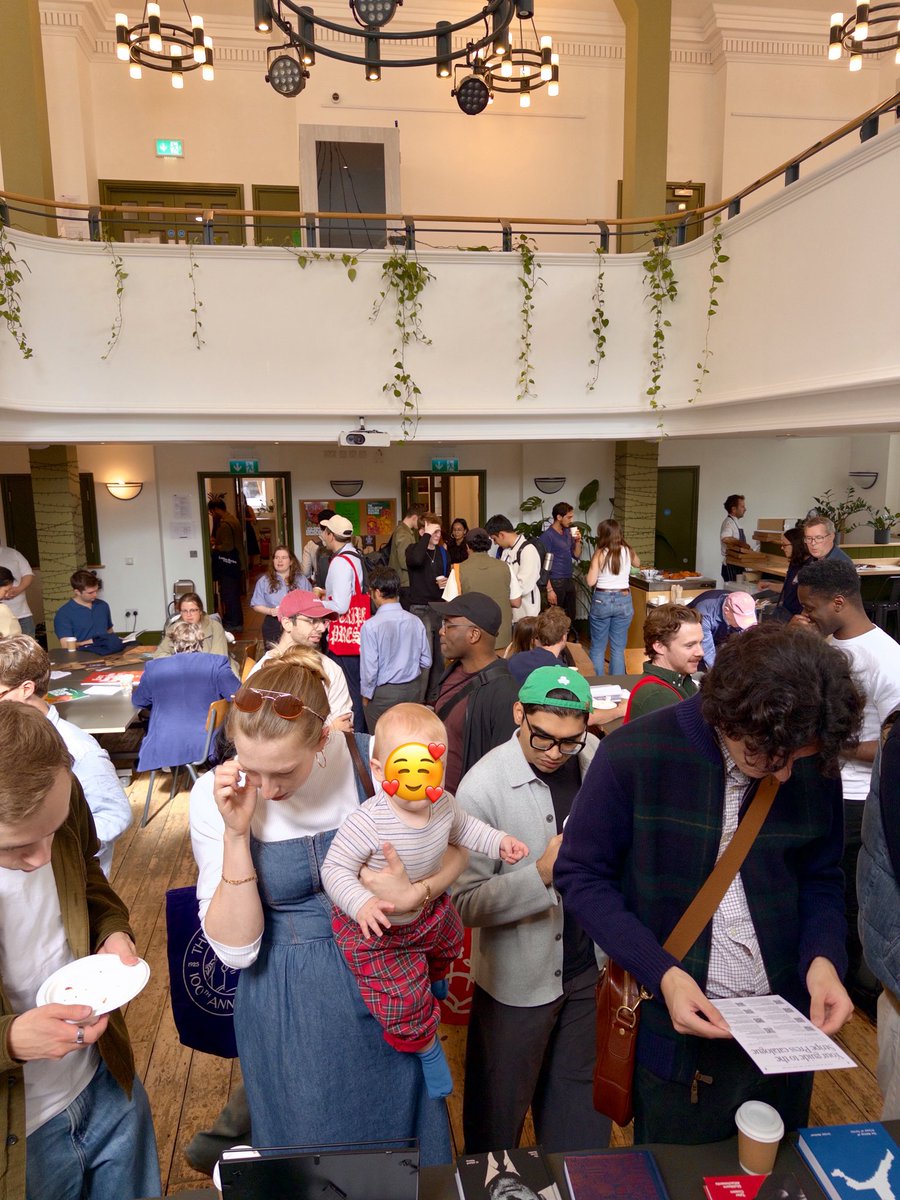
I think London pop-ups are just going to have to be a yearly occurrence from now on. Amazing day—thank you to the hundreds of you who came to hang out!
(Particularly to the gaggle of babies in the corner who came dangerously close to unionizing)❣️🤭📚
keeping up with the otel spec is way harder than it should be and sometimes it's just lacking, so over the years a lot of vendors decided to create their own otel flavor making it often a pain to work with auto instrumentation, framework, lib or even platform instrumentation.
additionally the otel spec moves quite quickly, often deprecating things, renaming, updating etc. making it really hard to track
built https://t.co/3vYd3Zg9wW to fix that.
- every release automatically diffed, so you can see what changed since the version you're on and stay up to date
- has both an MCP and agent friendly public api to search for specific spec conventions or helping you update to a newer spec
- tracks experimental specs like GenAI conventions to make building with those easier
I have alwyas been obsessed with Observability and really believe in otel, especially now with agents
I'm committed trying to make otel less of a pain, and push the ecosystem into a better place
Sociologist Richard Sennett wrote a wonderful book about the value of hand craftsmanship in his 2008 book The Craftsman. He traces the long history of why people have valued handmade goods for hundreds of years, even through periods of major technological or industrial advancement, and weaves together an engaging intellectual history involving figures like Aristotle and John Ruskin.
One of the book’s recurring themes is the value of imperfection. Sennett notes that the authors of the Encyclopédie praised the “character” of handmade goods, such as the slightly irregular bubbles in hand-blown glass bottles. He connects this idea to Voltaire, who warned us of the relentless pursuit of perfection. If we learned to embrace these imperfections, Sennett suggests, perhaps we would develop more realistic expectations about life.
This creates an interesting tension at the heart of craftsmanship. A good craftsperson strives to make something as well as they possibly can, yet must ultimately accept that perfection is unattainable because they are imperfect, like all human creatures. Toward the end of the book, Sennett discusses craftsmanship in religious terms. In the Judeo-Christian tradition, he notes, excessive pride is a sin because it risks putting the self in God's place. In this sense, the craftsperson embodies both aspiration and humility.
In Sennett's framing, craftsmanship is not necessarily about whether a machine can replicate the results, but about a human's role in production and what that process can teach us about ourselves. It's not just about materiality, but also spirituality.
How do I say this...
You don't want to use AI when you can reduce something to a deterministic solution.
What do I mean?
You don't want to use AI to fill in fields in loan documents or operating agreements.
Instead you want to use AI to build the software that does it for you. And then you don't need the AI tool again for that task.
It's a subtle difference, but a really important one.
As the price of software drops to zero, it's interesting to reconsider 70's-era ideas about this.
That is: the "computer liberation" necessarily comes from fully understanding the "dream machine". We'll create universal literacy for this new medium, and that will mean everyone learning to code. The challenge, then, is to create languages and representations which are learnable enough.
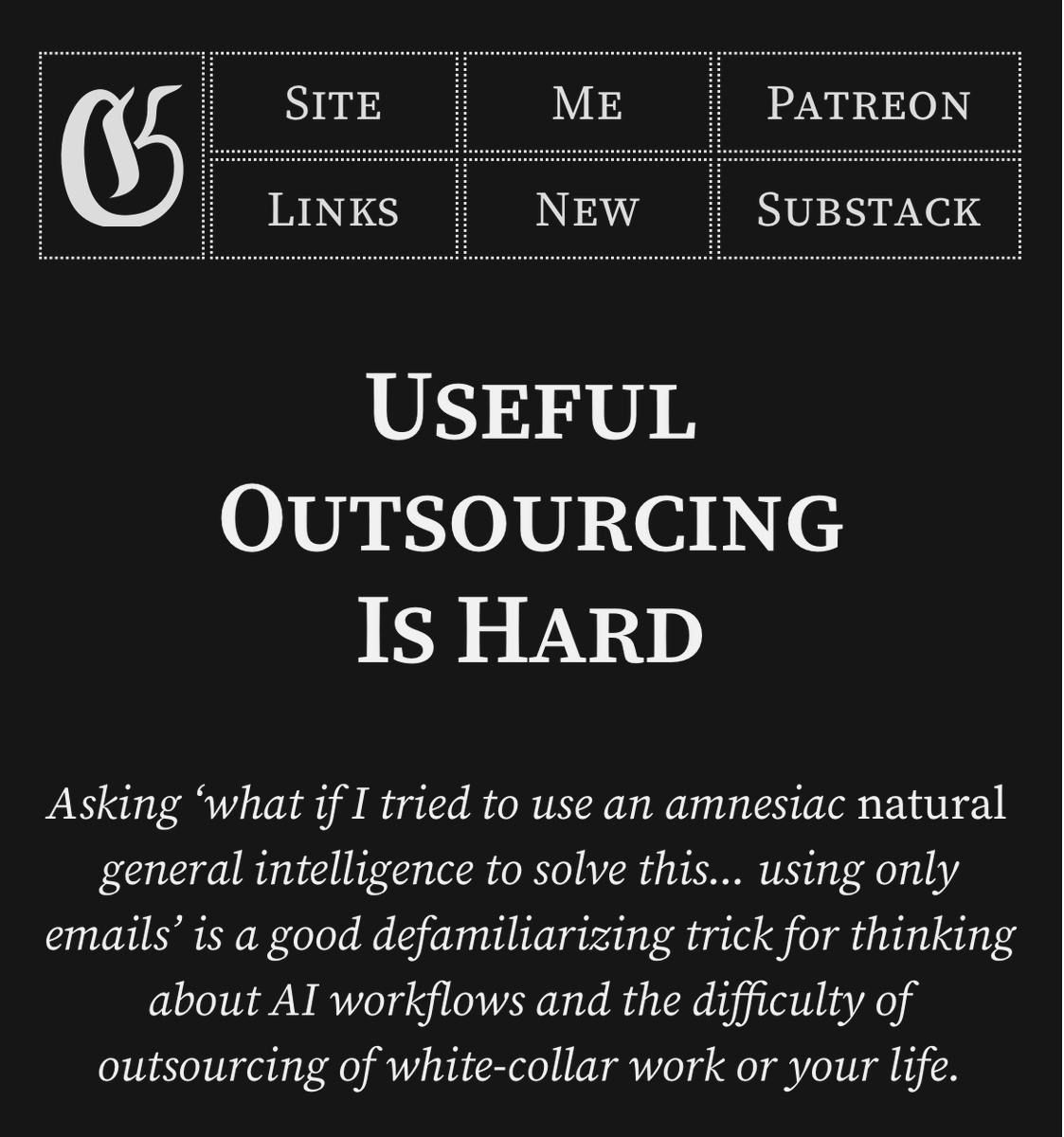
Now we've got a lot of the dream machine with little understanding. I think this is… broadly pretty great? If I want some idiosyncratic custom behaviors in my email app, would I really benefit so much from expressing that in code myself? I want it to work and to get on with my day!
Consider a status quo bias test: suppose we live in a world where genies can improvise dynamic media through natural language. It's often imperfect, or comes with surprising behavior, but it mostly works most of the time. How would we feel about the proposal that everyone should be able to specify these media through some systematic/deterministic representation? I think it's a hard sell!
Custom email clients are pretty benign, I think, but I wonder where the line is. Would I have learned to program as a kid if these kinds of tools existed? A technical society does require people who can read and write technical media. They're already a minority, and "computer lib" argues that political participation in a technical society with complex systems requires that widespread literacy. I wonder where it will come from?
OpenClaw deleted around 400k LOC of its own tests without much change in code coverage. Modern models just love writing tests for every tiny change, even if they aren't useful. This skill helped. https://t.co/a1jSBpfpns
i feel like people do not grok how important celld is.
it's scalable applications of arbitrary complexity. the only dependency is s3.
once you see it, you'll realize there's no point to traditional javascript runtimes in serving applications - only for build processes (eg bundling) and scripting.
the networking and scaleability are deeply rooted not only in the distributed runtime (celld), but in the programming model itself (largely kenton's design)
I wasn't quite sure when I started celld how well this could be made to work, but we've been running it in bigger capacities and getting user reports over the last months. Actually handles load surprisingly well. (any experience in the comments to share?)
because the programming model does not expose the underlying linux system, you can actually think of celld as a distributed operating system - running in user space of linux. it only runs one program / doesn't support multi-tenant, but it has system services like an operating system. it's all about networking - i like to think of it as the practical modern version of plan9 or even erlang beam.
Many are familiar with the Stockdale Paradox from Good to Great, which combines unwavering faith that you will prevail (fire) with the discipline to confront the brutal facts of present reality (ice).
Admiral Jim Stockdale was imprisoned for eight years, without any rights or promise of when or if he may ever leave. He is famous for saying those that didn’t make it out were “the optimists” because they weren’t able to confront the brutal truth of their reality.
Viktor Frankl had a similar analogue in Man’s Search for Meaning, where he said “The prisoner who had lost faith in the future–his future–was doomed.”
Our day to day experiences are far less severe than anything Admiral Stockdale or Viktor Frankl experienced, but we should heed the lessons well.
there are so many everyday demos that could make ai, personal agents, & agents in general feel insanely powerful to normal ppl & yet ai companies keep choosing things like booking flights, planning travel, or god forbid planning a god damn wedding.
these are not everyday problems. they’re relatively rare events & worse for a lot of ppl they’re actually part of the joys of life. the best demo should make someone feel pain they already are familiar with disappearing. almost every company gets this wrong. they optimize for spectacle instead of relief which is fine in some cases but it doesn’t last.
one of my favorite historical examples is a product called head on.
the ad showed someone with a headache, then showed them applying the product directly to their forehead while repeating:
“head on. apply directly to the forehead.”
beautifully simple. you instantly understood the product, the problem, & the value. ai companies should be doing the same thing.
show me the annoying thing i deal with every single day then make it disappear. it’s not sexy, i guarantee it will work. when jobs demo’ed the iphone he picked universal simple problems that the iphone did better than anything else on the fucking planet.
anyway, thanks for coming to my ted talk.
We'll be spending a lot more time trying to understand the outputs of language models. A few thoughts, tips & tricks:
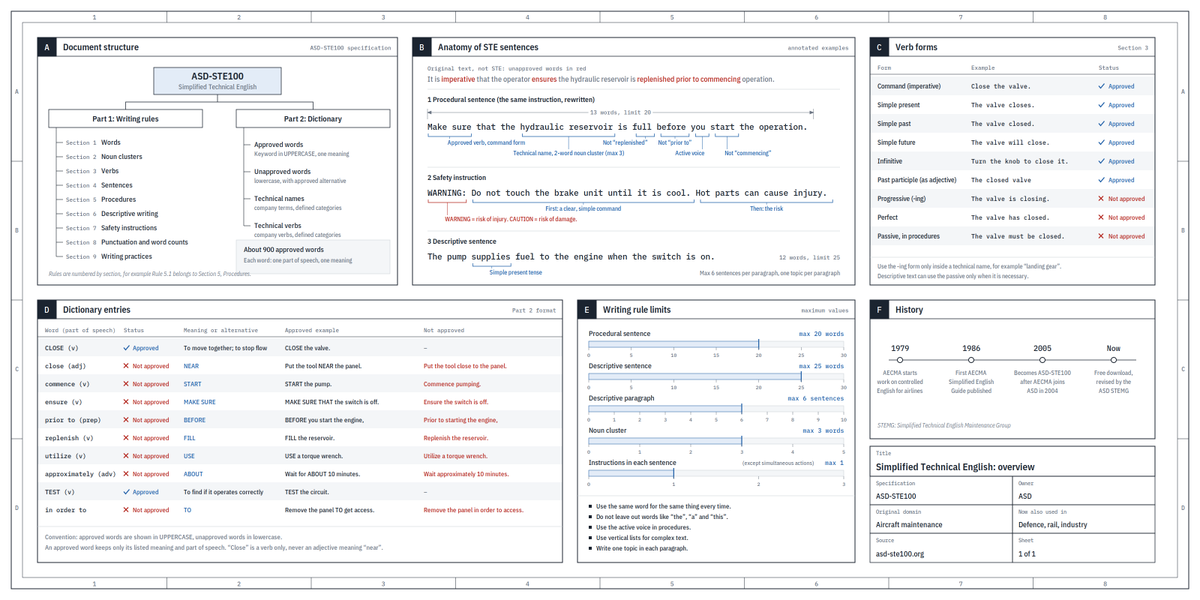
Writing. Something I've had success with: Ask your LLM to explain something in ASD-STE100, it's a controlled language specification originally developed for aerospace maintenance documentation. LLMs well-versed in this language and it comes with heavy constraints on clean writing style that I often find a lot more readable. Sometimes I've tried to soften it a bit e.g. ask for "80% of the way to ASD-STE100" because the spec is quite stringent. But even better:
Diagrams / images. Instead of writing, ask your LLM to create a diagram. These can be a lot easier to process, parse, and understand. But even better:
Web pages. Ask for output "in HTML" to get a beautiful, interactive webpage. LLMs are getting really good at frontend and can create beautiful experiences, animations, etc. But even better:
Explainer videos. The output format I am most bullish on is fully custom / bespoke explainer videos generated on any arbitrary topic. Experiment with things like "Create a 3b1b style video explainer on X. Use my ElevenLabs API key for audio narration". (you'd need an API key for the latter or you can ask your LLM to find you decent free alternatives that use your local compute). This is actually starting to work!
In summary:
- As LLMs get better, they will do more and more of the legwork autonomously, and a lot more of our work will rise up the abstractions into oversight and understanding.
- Luckily, LLMs can help here too because as intelligence and code are increasingly abundant, you can ask for large, custom, discardable software artifacts (e.g. web apps, video explainers) that would have never made sense to create before. Push the boundaries here and you'll be surprised.
@rohanpaul_ai Being an artist in 2030. Building your own model on top of open models and turn it into a unique tool that allows you to express yourself in a way that no existing tool or model was ever capable of. Maybe a unique musical instrument, a custom brush, or a cinematic editing style.
Went to "Software As Content" by the @getdiffer team and now I have a bunch of fun/weird little chorded musical toys: https://t.co/hNmB3xKh5O as well as the feeling that we're not post-literacy but emerging into a world of new literacies and software may become media.
During covid I played Go reasonably seriously for about a year (had a teacher, studied puzzles, etc.) I didn't get especially good at Go, but here's what I learned about competence in general:
1/ Go teachers are adamant about forcing you *not* to say to yourself "ah that was dumb" and move on. Sometimes a move really is just dumb and it's good to vent. Usually though you can spend an hour studying your seemingly dumb move because (a) there is smtg very maladaptive about your instincts that needs to be beaten out of you, or (b) you don't understand something deep about the game, or (c) you have a wrong attitude that needs to be adjusted. So long as you don't face this you don't get better, and so it's absolutely essential to approach "insignificant" aspects of the game with due reverence
2/ this has also been my experience teaching programming. Ppl hit some problem they don't understand and blindly tweak things until the program works (or ask an agent to do it), then go "ah that was annoying!" and move on. As long as they hold this attitude they don't get better, so they keep failing interviews then go on X and complain about leetcode. To get better it's essential to slow down and think very carefully, or better yet ask a good performer how they would have handled it in order to improve. (Today you can ask an agent "this is what I did to solve this problem and I think my approach keeps me from improving, how would a great programmer like person_i_respect likely handle it?" and get a pretty good answer!)
3/ in general your rate of improvement in Go is a function of your ability to notice your tiniest impulses and retrain yourself to convert them into productive action. These impulses are your boring run-of-the-mill cognitive distortions. For example, people will make instinctive moves because thinking is hard [effort aversion], hope the move works despite having no logical reason to expect that [magical thinking], then blame themselves when it doesn't work [learned helplessness]
4/ if you interview enough programmers or talk with enough startup founders you notice that poor performance is often a consequence of these same errors. Talking to users is hard so people stick with their ideas and hope for the best. When the product keeps not working they think "eh, maybe I'm bad at this startup thing", and so on. CFAR workshops were supposed to train you to notice these distortions and do the right thing, but I'm not sure how well they worked. (My guess is not well, since it seems unlikely these kinds of changes can happen over a weekend)
5/ there is a lot of research on this stuff and the data shows that getting good at a game like Go or chess doesn't give you an edge in other domains (i.e. "far transfer" doesn't work). This mirrors my subjective experience. In about a year I improved at Go considerably, but it did not make me any better at e.g. debugging or solving programming problems. But I do think that's not the whole story
6/ I have no hard evidence for this but I subjectively feel I got better at learning itself, and I can now get better in other domains quicker than I otherwise would have. For example it *really* sunk in that I have to disqualify my ideas. So when at work I started talking to customers to plan product roadmaps, while I wasn't instantly better at talking to them, my PM game improved enormously over the next few months because I finally learned not to be easily seduced by my own ideas or delude myself with wishful thinking
7/ to give another example, novice Go players tend to be very embarrassed of their games (the rules are simple but operationalizing them is hard, so early games are a disaster). Go ppl have a proverb for this-- "lose your first 50 games quickly". Meaning since early games don't matter and nobody will ever remember them, you should just get them out of the way. It didn't permanently cure me of embarrassment or anything, but it really sunk in how silly it is to worry about being a beginner in public and that I shouldn't worry about that at all
8/ if you're hard-optimizing your time you probably should work on improving the skills you care about directly. But otherwise I'd recommend spending a year trying hard to get good at a competitive intellectual game. Chess or Go are good, but really anything turn-based with an objective ranking you can't lie to yourself about. Pick whatever you're attracted to, try hard to get better, and keep mental notes about the process of learning that you can maybe apply to other domains later. At the very least it'll be loads of fun
9/ you will be humbled. No matter how smart you are or how hard you work you will discover the ceiling is infinitely high and there is an endless supply of people better than you. Getting that kind of humility has always been good, and it'll be especially good as AIs surpass us in basically everything. The sooner you get that out of the way, the sooner you can focus on a creative niche where you have no competition (since nobody can be a better you than you)
10/ you should probably stop after a year or two. Competitive games with an infinite skill ceiling can take over your life, don't forget to keep things in perspective
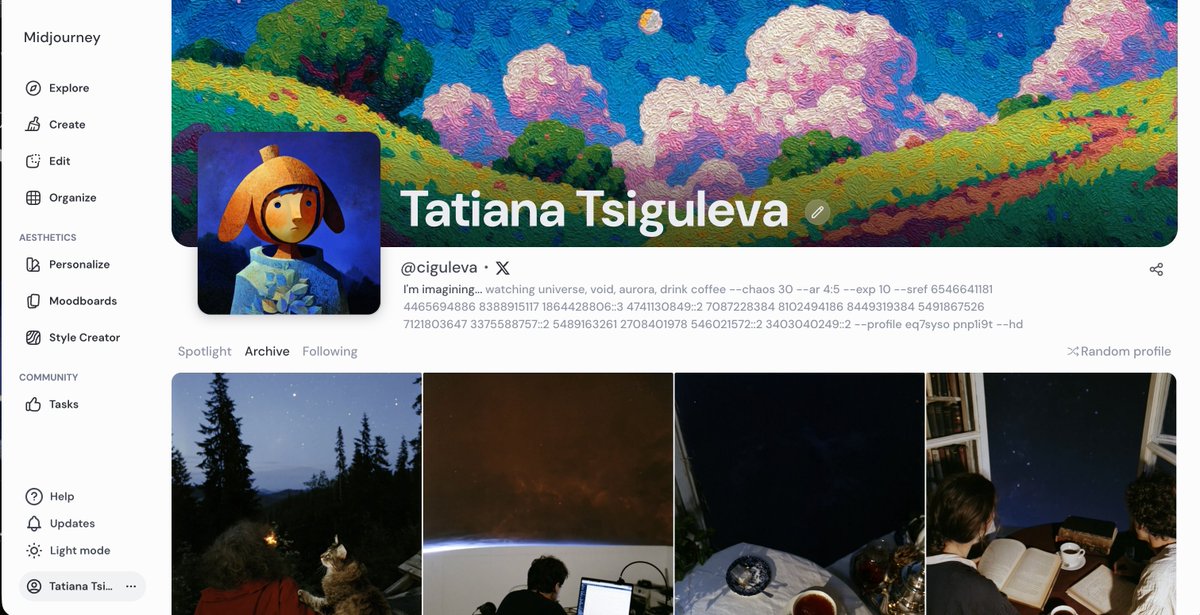
I've decided to make my Midjourney account public. 🖤
https://t.co/YeQM1zkkNB
Wander through the archive, borrow any style that speaks to you, and use the images freely. Midjourney has given me so much joy and taught me more than I ever expected. If my work can spark something in you or help you on your own creative path, that would truly make my day.
I'm also opening up mjpro(dot)ai completely, for free.
To my early subscribers: thank you! You believed in this from the very beginning, and you won't be charged again. If you ever have questions, have concernes or just want to say hi, my inbox is always open.
Happy creating ✨
recommended reading by our friendos at @exedev
100% agree that we need new modes of interaction with agents. transcripts scrolling by is not all that useful, especially if you have high tok/s.
https://t.co/UL0cDjatQV
I thought that most of us were driven by the feeling of finding the 20 lines that replace 200 convoluted lines, finally directly representing the solution instead of gesturing at it vaguely through a cloud of indirection. But the zeitgeist suggests it's weird to care about that?
Britain has an infrastructure costs problem. But what's causing this and how can we fix it?
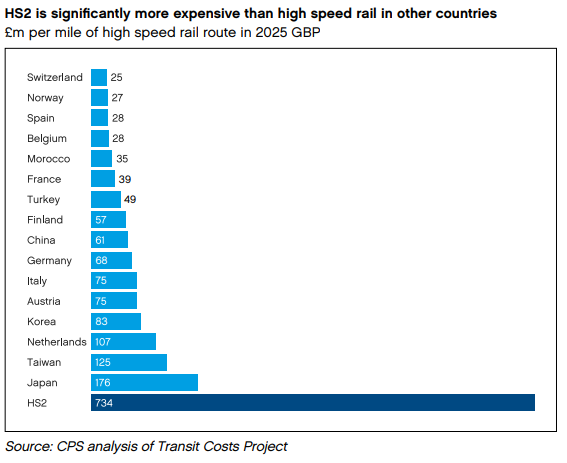
HS2 will cost up to £102.7bn for 140 miles. Spain built the second longest high speed network in the world, 2,500 miles, for less.
It isn't just HS2 though.
Underground extensions cost twice the per-mile average of France or Italy, and six times Spain's.
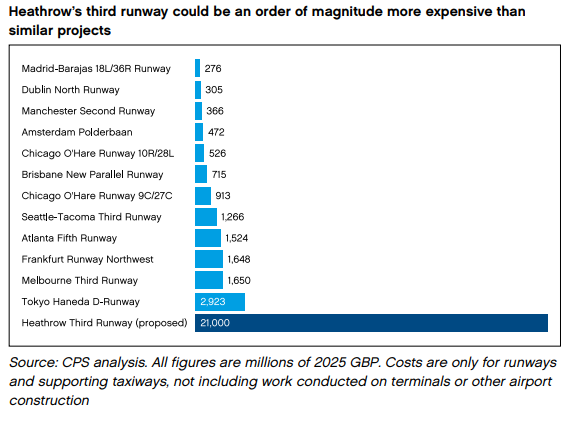
Heathrow's third runway, excluding new terminals, is expected to cost 10 to 70 times more than other runways.
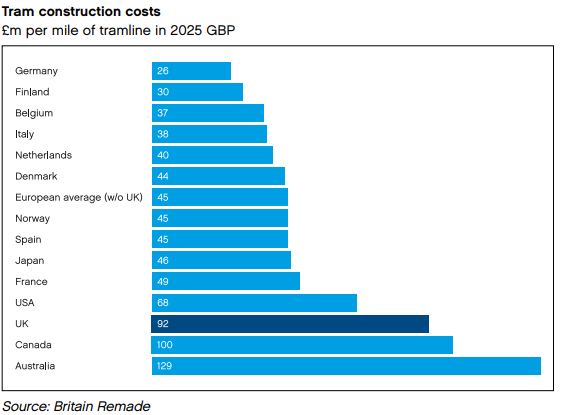
British trams cost more than double the European average.
Why are these projects so expensive? There are eight key reasons:
1. Planning: it took 14 years, £300m, and 360,000 pages for the Lower Thames Crossing to go from being designated a national priority to receiving permission.
2. Environmental and Habitats Regulations: these gave us the £216m bat tunnel and the fish disco, as well as an 18,000 page environmental statement to re-open just 3.3 miles of railway on an existing alignment.
3. Judicial review: of 36 legal challenges to approved major projects, only four forced a re-decision. All four were approved again, but fighting a legal challenge can add £120m+ to a project's cost and mountains of paperwork.
4. Funding: the Treasury pays, but cannot directly control a project's spend, so it instead requires long business cases. Once given funding, promoters don't have the incentive to build more cheaply.
5. Procurement: currently generalist teams rely on consultants and are more focused on social value than past performance and value for money.
6. Regulation: quangos and departments create regulation that they don't bear the costs of. E.g. new tram projects must pay for 92.5% of the cost of moving utilities, which means utility companies demand a completely new set of pipes and wires.
7. Lack of state capacity: Madrid trebled its metro at a tenth of London's cost led by nine in-house engineers. The DfT has the second highest staff turnover of any department and cannot effectively oversee a project from design through construction.
8. Centralisation: Mayors cannot fund and approve their own infrastructure. If they could, they'd have strong electoral incentives to build quickly and cheaply, as seen in France and Spain.
The good news is that every one of these is a policy choice, which can be reversed. Some fixes need only a letter from the right minister and none require significantly more spending.
My new @CPSThinkTank report lays out these fixes and how to lower infrastructure costs. If we implement them, Britain could once again build the infrastructure it desperately needs. https://t.co/GumxPETBEc
Aside from creating strong images, I often write stories to accompany the collections. The story of Amur centred around a fictional character who lived through the collapse of the Qing Dynasty.
In a post-literacy world, it can seem rather futile to be penning words while most fashion consumers are pivoting towards short-form video. But this is my way of giving an audience a deeper glimpse into the work I do, without resorting to methods that I feel diminish either the work or the audience.
Talking to the camera or writing on Substack are now established ways of communicating with an audience, but there are others to consider when reaching out to those who seek less mainstream approaches.