Excellent Read - Manufacturing Crises: A Response to Coercive Diplomacy; by David Yeh
*"...The revisionist nature of Ethiopia’s foreign policy is most acutely revealed in its rhetoric concerning sovereign access to the Red Sea and its persistent questioning of Eritrean statehood. Under the guise of seeking pragmatic cooperation or commercial dialogue, official statements and state sanctioned commentary from Addis Ababa have repeatedly challenged the legality of Eritrea’s independence and asserted existential entitlements over sovereign Eritrean maritime space and port infrastructure".
*"...International law and the United Nations Charter do not grant any landlocked state an inherent, existential right to claim, coerce, or seize sovereign coastal territory from a neighboring nation. Commercial access to maritime routes and port services is routinely established through voluntary bilateral agreements between sovereign equals, not through existential demands, historical revisionism, or military posturing".
*"...To suggest that a sovereign state’s territorial integrity is subject to negotiation under the threat of regional instability is a direct violation of the foundational tenets that govern international relations; and specifically, the UN Charter, the AU Constitutive Act as well as the OAU 1964 Resolution in the sanctity of the Colonial Boundaries".
*"...Demanding that Eritrea perpetually re-engage in dialogue on its inviolable sovereign boundaries under the threat of conflict subverts the sanctity of international treaties and international law".
https://t.co/7HvPH7uOF2
It is Friday, and what a week it has been for the folks at FANA and the PP cadres. I am accustomed to receiving from Member States their priorities for UNGA 81, but this week’s output from the PP has been something of an overload.
Eight years after Prime Minister Abiy Ahmed came to power, 2026 may well be the year in which the rhetoric, acronyms and strategic formulations finally lay bare what has long been hiding in plain sight: the ambitions of his government for #Ethiopia, the implications for its neighbors, and the formidable challenge this presents to an international community seeking to build lasting peace and stability in the #Horn of #Africa.
In a region where strategic doctrines come and go with remarkable speed, one might reasonably hope that Ethiopia’s foreign policy could survive a Thursday without acquiring another acronym. Perhaps the PP might give its audience a little time to digest its growing collection of increasingly elaborate formulations before unveiling the next one.
Otherwise, in the rush to introduce yet another strategic concept, it may risk another strategic miscalculation, and deepen the very self-created quagmire it is now working so hard to explain. But before we get to this week’s latest formulations, let us go back a little bit.
Prime Minister Abiy Ahmed introduced Ethiopia, and at times the region, to መደመር, Medemer, in its first and second iterations, presenting it as a new political philosophy and, ultimately, as the only viable path for Ethiopia and the region: addition, convergence, cooperation and the pooling of strengths. But the Ethiopian experience has increasingly produced a rather different vocabulary.
Instead of መደመር (Medemer), there has been far too much መደናገር (Medenager): confusion, disorientation and a country struggling to find its way through one crisis after another. And instead of adding to the lives and security of its citizens, there has been መቀነስ (Mequenes): a grim process of subtraction, as Ethiopian lives have been lost in violence across different parts of the country.
People have been killed in cold blood. Communities have been devastated. Families have disappeared into grief. And much of the international community has watched with a silence that has sometimes been difficult to distinguish from indifference. One is left wondering whether Ethiopian lives have been valued differently depending on where those lives were lost.
The irony is difficult to miss. A philosophy premised on adding together was supposed to strengthen the Ethiopian state and bring its peoples closer together. Yet the country has repeatedly experienced fragmentation, violence, displacement and deepening mistrust.
Perhaps the real test of any political philosophy is not how elegantly it is written in books, nor how compellingly it is presented from podiums. It is whether ordinary people are safer, whether their children are alive, whether communities can live without fear, and whether a citizen’s life is treated as having equal value regardless of ethnicity, region or political affiliation.
Last month, we were introduced to the 3Ms: Mequaquam, Metekem and Megrat. This week, the PP brought us the 4As of Ethiopia’s diplomatic doctrine: Active, Alternative, Adaptive and Agenda-Setting. And now we have the latest PP-created concept: “compound pressure.” One almost wonders when the PowerPoint will run out of letters, or whether every familiar principle of statecraft will eventually acquire its own acronym.
As Prime Minister Abiy put it:
“...ለዚህ ምንከተለው መንገድ፣ በኛ ሳይድ ሶስት መ ብለን አስቀምጠናቸዋል። አንደኛው መቋቋም ነው... ሁለተኛ መጠቀም ነው። ፈተናን ወደ እድል መቀየር። ሶስተኛው መግራት ነው። በሰው አጀንዳ መገራት ሳይሆን አሁን የራስ አጀንዳ ፈጥሮ መግራት ነው...”
Translated by @HOAAffairs as:
“…The path we follow on our side we have set as the ‘Three Ms’. The first is Mequaquam (to withstand): building resilient institutions and a nation. The second is Metekem (to exploit): turning challenges into opportunities. The third is Megrat (to tame): rather than being tamed by others’ agendas, creating our own agenda and taming [the region] …”
There is, of course, nothing inherently objectionable about a state developing strategic doctrines or giving familiar ideas new terminology. States are entitled to think strategically. They are entitled to develop doctrines. They are even entitled to create acronyms. But beneath the acronyms remain a few rather unfashionable concepts that PP cadres continue to ignore: sovereignty, territorial integrity, sovereign equality and international law. Strategies evolve. Acronyms come and go. Sovereignty is not a passing trend.
And this is where the latest formulation, “compound pressure”, deserves closer attention. The PP presents Ethiopia’s security environment in terms of multiple pressures: the unresolved political and security challenges surrounding the Tigray transition, the Nile Basin and GERD dispute, and wider questions concerning Red Sea access and frontier security. These developments may indeed impose a cumulative strategic burden on Ethiopia.
There is also nothing inherently wrong with analyzing a country’s security environment in terms of cumulative pressure. Strategic planners do this all the time. But such an analysis must be accompanied by accountability, honesty and a clear distinction between perception and fact.
The problem begins when strategic analysis is transformed into a legal argument. Several developments may have a cumulative effect on #Ethiopia. That does not establish that they are coordinated. It does not establish that they have a single author. It does not establish that they constitute one dispute. And, most importantly, it does not give Ethiopia additional legal rights.
Each issue has its own history, its own actors, its own facts and its own applicable law. Strategic accumulation is not legal aggregation. Or, as I would describe it, a self-created quagmire compounded by arrogance and hubris is still a quagmire. It is reassuring, at least, to know that the PP understands the predicament it has created for itself.
But a quagmire is a predicament, not a title deed. A difficult strategic environment does not give Ethiopia a legal right to resolve it by imposing costs on its neighbors. Feeling being constrained does not confer the right to constrain others. The PP may feel strategically constrained by several separate developments. It cannot convert that cumulative constraint into a legal basis for overriding the sovereign rights of its neighbors.
PM Abiy cannot convert cumulative strategic pressure into cumulative sovereign rights. Strategic pressure may explain behavior; it does not legalize it. #Eritrea|s decisions regarding foreign military bases, maritime policy, relations with other states and territorial integrity may be inconvenient to Ethiopian strategy. But, inconvenience is not illegality.
On the issue of establishing a naval base on the Red Sea, the presence of foreign military facilities in the region does not change the equation. They exist because a sovereign state, permits them. #Eritrea has chosen otherwise. Presence by consent is not entitlement by proximity. International law does not operate on a “me too” principle.
The same applies to claims involving proxies, conspiracies and regional alignments. Tigrayan politics have their own history and agency. Egypt, Sudan and the Gulf states have their own interests and calculations. #Eritrea has its sovereign interests. #Ethiopia has its own. There is a word for states pursuing overlapping interests: international relations.
And if “compound pressure” simply means that Ethiopia is surrounded by sovereign states whose independent decisions sometimes constrain Ethiopian choices, Eritrea can offer a modest reminder: that is what having neighbors means.
Eritrea does not oppose Ethiopia’s aspirations. It does not oppose peaceful access to international markets or mutually beneficial regional trade. What it rejects is the progression from access to entitlement, entitlement to control, and control to historical or security necessity. That progression is not inevitable. It is a political choice.
Eritrea also understands perfectly well the economic value of Massawa, Assab, the Dahlak Islands and its Red Sea coastline. Thank you for the business advice. Eritrea will decide how to manage its sovereign assets.
There is also a certain irony in Ethiopia’s invocation of “sovereignty of decision.” Ethiopia has sovereignty of decision. So does Eritrea. Ethiopia deserves strategic freedom. So does Eritrea. Ethiopia deserves security. So does Eritrea. Freedom from the agendas of others cannot mean the subordination of neighbors to one’s own agenda. That is not strategic freedom. What the PP is seeking is strategic privilege.
The #Horn of #Africa does not need another war to establish this rather obvious proposition. A stable, prosperous Ethiopia is in Eritrea’s interest. A stable, prosperous Eritrea is in Ethiopia’s interest. The sensible path is reciprocity: equal sovereignty, negotiated access, lawful commerce and respect for established borders. If #Ethiopia wants trade, it should build partnerships. If it wants regional influence, it should exercise diplomacy. If it wants access, it should negotiate access. But if access becomes a demand that Eritrea surrender its sovereign discretion, then the issue is no longer maritime access. It is hierarchy.
And hierarchy is not the same thing as regional cooperation.
The #Horn has suffered enough from attempts to resolve political and strategic problems through force, coercion and unilateral calculations of entitlement. There is another path. It begins with accepting a rather simple proposition: #Ethiopia can pursue its interests without denying the interests of its neighbors. It can seek access without claiming ownership. It can pursue security without making insecurity for others the price of its own. It can exercise influence without demanding hierarchy.
The PP can develop as many strategic doctrines and invent as many acronyms as it wishes. But none of them changes the underlying rules. Acronyms can describe a strategy; they cannot amend international law. And there remains one inconvenient constraint that no PP acronym can overcome: international law applies to #Eritrea too. But it also applies to #Ethiopia.
Have a great weekend, folks. Hopefully, the PP cadres will take a break too, if only to give us all a chance to catch up with the latest acronym on Monday…
I listened to PM Abiy’s latest bid to hoodwink the Ethiopian public and present himself as Ethiopia’s premier historian. He appears to confuse linguistic resemblance with historical evidence. Similar-sounding place names do not, by themselves, establish common origin, migration, conquest, or occupation.
Across the Horn of Africa, toponyms are repeated, transformed across languages, and can derive from entirely different linguistic roots. Turning phonetic resemblance into evidence of conquest or occupation is therefore a rather remarkable, and desperate, leap from etymology to history, and from historical speculation to “incontrovertible proof.”
#Ethiopia|s woes continue, and sadly, so does the embarrassment. We could chalk it up to inexperience and laugh it off if the consequences were not so serious, and potentially so deadly. When historical fiction is used to inform contemporary geopolitical claims, it ceases to be merely amusing; it can have very real and dangerous consequences. History and law should not be selectively reconstructed to manufacture justification for present-day territorial ambitions.
The #Horn of #Africa has already paid an enormous price for wars driven by expansionism and miscalculation. PM Abiy is in no position to rewrite history, erode established legal principles, or manufacture grievances against neighboring states. The region needs sober diplomacy, respect for sovereignty and territorial integrity, and adherence to international law, not historical fiction in the service of geopolitical designs.
I recall an earlier commentary that, by precisely this sort of linguistic alchemy, sought to suggest that the Tigris in #Iraq was somehow “Tigrean.” Perhaps the PP leader and that commentator attended the same school of historical methodology, where words that sound alike become evidence of common ancestry, and etymology quietly graduates into territorial history. One would hope the lesson has since been learned: the Tigris is in Iraq, Tigray is in #Ethiopia, and phonetic resemblance does not redraw maps.
By the same logic, my name is Sophia, and Sofia happens to be the capital of Bulgaria. That does not make me Bulgarian. Names can resemble one another without establishing ancestry, identity, historical connection, sovereignty, or ownership. A name may be a starting point for historical inquiry; it is certainly not the conclusion.
A serious claim that Oromo-speaking populations once mounted an expedition resulting in the full occupation of Midri Bahri would require evidence specific to that proposition: contemporary chronicles, inscriptions, administrative records, archaeology, independently verifiable genealogical traditions, or other documentary evidence. Demonstrating historical movements, contacts, migrations, or conflicts involving Oromo-speaking populations in the wider #Horn is one thing. Transforming such movements into proof of the conquest and occupation of a historical #Eritrean polity is quite another.
The place-name argument is particularly revealing. Barentu and Borana sounding alike does not establish that one derives from the other, just as similarities involving Soira, Debra, or other Eritrean names cannot, by themselves, establish territorial control. To make such an argument responsibly, one would have to establish the actual linguistic etymology, demonstrate a credible historical pathway for the alleged transfer of the name, date it, and corroborate the conclusion with independent evidence.
There is, after all, a rather simple principle at work here: a phonetic coincidence is not a title deed, and a speculative etymology is not a historical record. Ancient history cannot be reconstructed backwards to validate a contemporary geopolitical narrative. If ancient history is invoked to support present-day territorial claims, the evidence must be historical, not semantic, speculative, or constructed after the fact. “Incontrovertible proof” requires considerably more than words that happen to sound alike.
One would hope that, before history is enlisted to prepare the ground for another war, someone might remind the architects of this narrative that maps are not redrawn by wordplay, borders are not established by phonetics, and nations are not built, or conquered, through etymology.
Wither #Ethiopia...
The Potemkin Party’s propaganda machinery is increasingly edgy and seems to spin out of control to miss the whole plot these days.
The telltale signs of this desperate mindset and quagmire are better accentuated by:
- the marathon interviews of its leader in the past ten days with Amhara Media Corporation (AMECO) and Oromo Broadcasting Network (OBN) principally on domestic issues but with frequent provocative digressions on Eritrea;
- the flurry of articles/Tv programmes on Eritrea by the Potemkin Party’s official/affiliated media outlets – Ethiopian News Agency (ENA), Ethiopian Broadcasting Corporation (EBC), Fana Broadcasting Corporate (FBC), FDRE Institute of Foreign Affairs, Horn Review, etc.
PP’s new narrative on domestic issues peddled in the Interviews is naturally an internal matter that has no pertinence to Eritrea. As such, we shall not delve into their substance though we may allude, in passing, to the overwhelming consensus/verdict by most Ethiopian analysts on its dangerously myopic tactical approaches – and double-speak. That the Interviews are maliciously aimed at stigmatizing as well as inciting cleavages and polarization between certain, and especially the Amhara and Tigrayan, ethnic nationalities and intended as desperate appeals for sectarian support from the Oromo ethnic constituency.
In reference to Eritrea, the PP’s manufactured narratives venture into “creative” fantasies and fictious constructs that are grossly at variance with historical facts and events.
In a nutshell, the new “PP linen”, touted for the market, consists of:
1. Preposterous claims of Oromo “expedition” into Eritrea in the distant past to include full occupation of Midri Bahri (Medieval and independent Kingdom in the Highlands and eastern lowlands of present-day Eritrea). For “incontrovertible proof”, the pretentious PP leader invokes a phony conjecture of semantics to speculate “same origins” between Barentu (Eritrea’s capital city of the Gash Barka Region) and Borona in present-day Oromia Region; as well as Soira (the highest mountain in Eritrea), Debra and other numerous names (not explicitly listed in the Interview) in Eritrea with similar sounding places in Oromia etc.
2. These fantasies could have been routinely dismissed as hollow and risible if they were not fraught with tragic consequences.
3. Indeed, what the newly minted narrative signifies is that the malaise/quest for “sovereign port ownership” by invading Eritrean sovereign territory that the PP leader enunciated in October 2023; his previous and outrageous claims that “he could not find legal documents on Eritrean independence in Ethiopian official archives (Cabinet, Parliament etc.)”; subsequent claims on Eritrea’s Dahlak Islands and the southern coastline for reasons of “strategic depth” to “project Ethiopia’s maritime power” etc. have degenerated further towards terminal metastasis.
4. In effect, the Potemkin Party’s revisionist history and toxic agenda have now morphed into full-scale denial of Eritrea’s inalienable status as a sovereign nation. This recent chorus of aggression and war is of course antithetical to the 2018 Eritrea-Ethiopia Friendship Agreement which was anchored on Ethiopia’s full adherence to international law (and EEBC Award) and for which he was awarded the Nobel Peace Prize!
5. Duplicitous and ironic as it is, the Potemkin Party’s agenda of aggression and war are increasingly couched in self-defense terms these days. To this end, Eritrea is constantly portrayed, by the PP’s media outlets, as “innately insecure whose survival depends on perpetual destabilization of Ethiopia”. Eritrea’s independence struggle is denigrated as an “external conspiratorial agenda that was concocted to weaken Ethiopia”.
6. All these transparent ruses are willfully peddled to prepare “historical and legal rationale” for a destructive war. The truth is Eritrea has never had the interest or political design and will to destabilize Ethiopia. The costly and long war of liberation was imposed on Eritrea due to Ethiopia’s expansionist ambitions and annexation in flagrant breach of international law. The border war from 1998-2000 essentially erupted due to the willful desire of the incumbent regime to change the sacrosanct colonial borders in violation of international law, the UN Charter and the AU’s Constitutive Act. The climate of tension and conflict that looms in the Horn of Africa region today is, again, largely a product of the Potemkin Party’s misguided policies of irredentism and hegemony. The illicit MOU that the Potemkin Party signed with Somaliland in 2024; its hosting of military base in southwestern Ethiopia to provide support to the RSF under the bidding of the UAE; and its constant threats and saber-rattling against Eritrea complete the picture of the reckless policies of destabilization to which the Potemkin Party seems wedded to for reasons known to itself.
7. Finally, Eritrea had indeed cultivated networks of support with various Ethiopian liberation movements, including the Oromo Liberation Front, during the armed struggle in 1980s. These were based on common denominators and platforms of opposition to oppression by the incumbent regimes in Ethiopia and recognition of Eritrea’s legitimate rights of decolonization. Even in those times, Eritrea’s principled position on Ethiopia’s unity and territorial integrity were crystal clear and explicitly pronounced; including in its 1984 seminal paper on EPLF ties with Ethiopian Opposition Movements.
In these tumultuous times, charting out synergetic and complementary architecture of collective regional security, and more broadly, modalities and mechanisms of wider cooperation has become more vital and urgent than ever before.
The overarching political considerations and operational calculus behind this conviction are the imperatives of ownership and agency; the need to avoid a polarized climate of global rivalry; and the rationale for enhancing local capacity building and mutual cooperation between the main stakeholders to secure and enhance enduring regional peace and stability.
In the Red Sea, this broad framework translates and is better summed up in the following 12 points that Eritrea submitted to the Council of Red Sea and Gulf of Aden Littoral States few years ago.
Eritrea maintains that these parameters can indeed serve as substantive inputs that can be enriched through continuous and rigorous consultation against the backdrop of fluid and changing realities.
1. Comprehensive and unbiased assessment of the current realities of the Red Sea and associated matters, in all their dimensions and perspectives in a realistic manner;
2. Full clarity on the desired objectives and goals;
3. Detailed mapping of the threats to the peace and security of the Red Sea; and, categorization and specification of these parameters;
4. Formulation of a viable strategy that will ensure achievement of constructive objectives and goals;
5. Formulation of strategies to contain and eliminate the threats in tandem with the positive policies of cooperation;
6. Mapping out detailed schemes and plans that will ensure holistic implementation of the twin strategies;
7. Stipulation of the implementation mechanisms, associated structures and mobilization of the requisite resources;
8. Ensuring that all the organizational configurations and frameworks that are developed are anchored on respect of sovereignty and international law;
9. Ensuring that all littoral States build and possess their own effective defense capabilities and naval forces (without delegation to others);
10. Supplementing, through collective efforts and synergy, those specific tasks that cannot be met through individual domestic capabilities and resources;
11. All relevant States will create appropriate modalities of cooperation with “external forces” for tasks or missions that are beyond their collective capability on the basis of a consensual framework;
12. Creation of competent committees to address all these issues in a comprehensive and professional manner.
Potemkin Party's official media outlets - Ethiopian News Agency (ENA), EBC, and FANA among others - are yet again on overdrive mode this week to churn out, particularly in their domestic broadcasts, fallacious and incendiary vitriol against Eritrea on a daily basis.
The stale and obsolete themes, the inflammatory and provocative packaging, remain the same; i.e.
1. Denigration and denial of Eritrea's hard-won independence that was achieved through precious sacrifices in Africa's longest liberation struggle when its right to decolonization was suppressed in the 1940s on the altar of "overarching" geopolitical interests of some global powers;
2. Repeated and bellicose pronouncements, accompanied by incessant saber-rattling, on the Potemkin Party's inexorable quest for "sovereign access to the sea... through negotiations if possible and force if necessary";
3. Rationalization of a "wider war that would expand to Eritrea's Dahlak Islands for reasons of strategic depth", in order to project and guarantee, in its convoluted views, "viable maritime power";
4. Banal and spurious "economic arguments" for rationalizing war and invasion in order to avoid exorbitant "port fees"; etc.
These are red lines and political blasphemies that should not be countenanced by any normal country.
The sad fact is these are normative for a callous and reckless Potemkin Party that seems to specialize in incubating endless conflicts both at home and in the wider Horn of Africa region (illicit MoU with Somaliland; active and surrogate role in the exacerbation of the conflict in Sudan etc.).
https://t.co/GkuVblIueE
In characteristic fashion, the Potemkin Party's erratic political pendulum is yet again swinging between two extreme positions:
i) A provocative and aggressive posturing that has been accompanied, for over two years now, by incessant saber-rattling to "acquire sovereign access to the sea", on the one hand;
ii) Simultaneous portrayal of itself as the "aggrieved party" and a "hapless victim of internal and external conspiracies", on the other.
This was indeed the gist of the PM's rambling at the House of Peoples Representatives earlier today.
Hyperbole and associated drama aside, the stubborn facts remain the same.
The sad truth is: the unnecessary and avoidable tensions in the region have and continue to be stoked by the very reckless policies of the Potemkin Party. For brief illustrations:
1. The palpable friction with the Sudan squarely emanates from the Potemkin Party's dangerous involvement in the conflict in the Sudan by hosting, under the bidding of certain extraneous forces, a secret military camp and base for the RSF in the Benishangul-Gumuz region of Ethiopia. The evidence, which is overwhelming, is already in the public domain.
2. The Potemkin Party's stealthily signed MOU with Somaliland a couple of years ago was another illicit and reckless misstep that aroused consternation in the region as a whole. This act remains in flagrant violation of the AU and IGAD Constitutive Acts as well as fundamental tenets of international law on sovereignty and territorial integrity of States.
3. The Potemkin Party has pursued, for over two and half years now, a toxic and revisionist policy against Eritrea by openly threatening to invade/acquire by any means, its Assab port and coastal areas for what it terms as "sovereign access to the sea".
4. In the event, its frequent reference to "conspiratorial forces disappointed by, and bent on, scuttling the Pretoria Agreement" is as disingenuous as it is untenable. In as far as Eritrea is concerned, the Pretoria Agreement is a purely Ethiopian affair. Let us also recall - the beans have been spilled now by Getachew Redda's multiple confessions - that the Potemkin Party was scheming against Eritrea (Djibouti and Seychelles events) months before the negotiations and signature of the Pretoria Agreement.
In a nutshell, the quest for enduring regional peace and stability that the peoples of the Horn of Africa deeply cherish and deserve has been, and continues to be, jeopardized by the Potemkin Party's delusional policies.
https://t.co/2MuR9MZUna
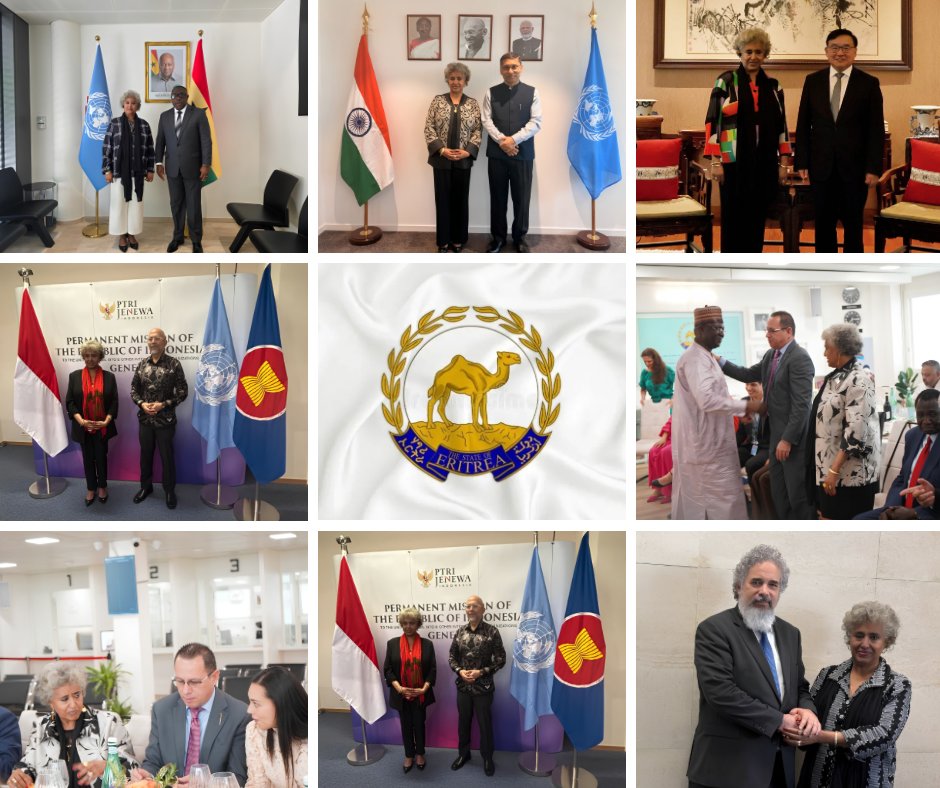
On the margins of the 62nd Session of the UNHRC, Eritrea's delegation has held a series of bilateral meetings with Permanent Representatives of several countries and also addressed the Africa Group.
The delegation further participated in the meeting of the Group of Friends in Defense of the Charter of the United Nations.
The critical issue is of course whether the penholders (essentially the EU under the prodding of some Member States) will again persist in their unwarranted campaign of harassment against Eritrea for the defunct geopolitical motives that we all know.
Equally important is whether other members of the Council will shed diplomatic inertia, and/or, discard narrow political horse-trading to reject the obsolete draft resolution without equivocation.
Eritrea's National Service seems to be on the spotlight again by certain quarters.
The "new interest" does not stem from some "benevolent concern" for Eritrea. On the contrary, it is floated, purely and simply, in order to weaponize it as a "convenient" whiplash or cudgel for their unwarranted and malicious policies of perennial witch-hunting and harassment.
Indeed, the logic is simple and straight forward.
Countries and international institutions that were complicit in, or that kept mum, at critical junctures of Eritrea's modern history; when its decolonization rights were compromised to mollify the overriding geopolitical interests of major powers; when they left it to its own devices during the three decades of its long and arduous liberation struggle; who relapsed to their traditional position of hostility or apathy even after independence when successive Ethiopian regimes waged illicit wars, and are still contemplating reckless agendas, of territorial irredentism.. etc. have no legal or moral authority to comment on Eritrea's defense architecture.
Truth is international partnership is, and must be, a two-way street. Those who have traditionally abandoned Eritrea during its cyclical ordeals cannot pose as "good-faith" partners to offer unsolicited "advice" on its defense architecture.
The facts are otherwise unambivalent and crystal clear:
1. First off, demobilization is not a new or novel concept to Eritrea. The GOE embarked, on its own volition, on a demobilization programme in 1992, immediately after independence, to reduce the size of the 100,000-strong army of freedom fighters by 65%. The military doctrine at the time was to maintain a small professional army of 35,000 that would be supplemented by a reserve army (National Service) for reasons of contingency in the event of some grave external threat to the nation.
2. In this perspective, National Service was introduced in the context of this military doctrine. It was and remains limited to 18 months by law. And this was the operational modality until the war of aggression that was unleashed by Ethiopia in 1998 under the false pretext of a border dispute.
3. The GOE again embarked on a much more expansive Demobilization Programme in 2001 pursuant to the signing of the Algiers Agreement. The second Demobilization Programme had various training and reinsertion components as it was also funded by Eritrea's international partners including the World Bank, the European Union and bilateral funds. More than 105,000 National Service members were demobilized in this programme that continued until 2007. But it was ultimately shelved as the Ethiopian regime continued to renege on its treaty obligations; occupy, with impunity, sovereign Eritrean territories including Badme; and further pursued a hostile policy of perpetual confrontation.
4. The mindset of the current Ethiopian regime remains, in many respects, a continuation and aggravation of the misguided and deplorable policies of aggression of its predecessors.
4. But even during these trying and difficult times, the GOE has, and continues to take, various measures to mitigate the shared burden of the National Service. The measures adopted range from introduction of new and much higher Civil Service Salary Scale to deployment of the overwhelming majority of NS members to the public sector.
5. In the event, the new smear campaign on the National Service peddled by certain quarters, and its timing, only amplify a malicious ulterior agenda that has nothing to do with the welfare of the Eritrean people and/or the pursuit of regional peace and security.
#Eritrea: Statement by Ambassador Sophia Tesfamariam at the Enhanced Interactive Dialogue; Geneva 15 June 2026
*"...Eritrea rejects the report before the Council as fundamentally flawed in its methodology, unsupported by independently verified information, and disconnected from realities on the ground. Its findings and conclusions therefore lack credibility and cannot serve as a reliable basis for informed deliberation or action by this Council".
*"...The Special Rapporteur argues that his mandate is indispensable as the only international mechanism responsible for monitoring Eritrea. This assertion disregards the existence of multiple United Nations mechanisms, including the Universal Periodic Review, treaty bodies, specialized agencies, and other intergovernmental processes through which all Member States, including Eritrea, are regularly assessed".
*"...Eritrea has maintained its sovereignty, preserved social stability, sustained public administration, and continued the delivery of essential services despite decades of conflict, sanctions, and external pressures. While acknowledging the need for continued progress, this reality is fundamentally inconsistent with the picture repeatedly presented through this mandate".
*:...When a country-specific mechanism persists despite sustained questions regarding its selectivity, methodology, and balance, it risks shifting from a tool of engagement into one of entrenchment. Rather than promoting constructive dialogue, it perpetuates a divisive process that has failed to command broad confidence among Member States.... Eritrea therefore rejects both the report and the resolution before the Council and reiterates its call for the termination of this mandate".
https://t.co/0R9QOvqST1
The Economist article on Eritrea, (11 June 2026), is again replete with the usual condescending attitude and mindset; and inevitably, presumptive and utterly erroneous portrayal of unfolding events and trends.
The Editor does not only insult a people and nation that he has no inkling about, but even dubs the envisaged lifting of unwarranted sanctions as "sweeteners" to the GOE.
In general terms, the malaise of biased and irresponsible news reporting is not confined to one or two mainstream media outlets or odd articles here and there. It is indeed common in, and visceral to, many, "prestigious", media platforms who have long abandoned their pronounced ethical standards of "objectivity, impartiality and neutrality" to cater for higher financial and geopolitical interests.
In the event, the panacea is crystal clear: the Global South and particularly targeted countries have no option but to focus on their own networks to rectify falsified narratives.
EDF: Admirable Ethos Rooted on Rich Heritage https://t.co/puvnhpL76t
Potemkin Party's signature trademark has been aptly described by the formula: PP Propaganda = Lies + Deception + Delusion + Disinformation + "Dazzling" Optics.
Indeed, the article (Al Jazeera, 11 June 2026) by mercurial Getachew Reda (PP's Advisor for East African Affairs); and Redwan Hussein, (PP's Director General for National Intelligence and Security Services) accentuates, in more graphic terms, this poignant reality.
Let us revert to the facts:
1. The tragic war that ravaged Ethiopia for two years from 4 November 2020 until 2 November 2022 with devastating consequences stemmed from, and has its roots in, Ethiopia's internal and perennial ethnic cleavages. Eritrea was dragged into the imposed conflict at the behest of the Federal Government, and more importantly, due to the broad objectives of the war agenda that explicitly included and targeted Eritrea itself. This is on the public record. As one of the principal architects and fervent advocates of the war, Getachew Redda is intimately aware of all these facts; a matter that is easily validated by his numerous posts under his X handle in those tragic times.
2. At the end of the war, PP political and military leaders from the Prime Minister downwards, profusely expressed their profound gratitude to Eritrea. Again, this is on the public record.
2. Getachew Reda and Redwan Hussein weave a theatrical and fictitious story about the consternation of their South African Hosts in Pretoria as the "negotiating team from the two warring parties would get into a fist fight in the middle of the Conference Hall if not shepherded to steer clear of one another".
3. Problem with this fictitious and romanticized story is the Parties had, in fact, held secret meetings in Djibouti and Seychelles months back under the sponsorship of US and EU "Peace Facilitators". And as it was later divulged by Getachew Redda himself, the two Teams had contemplated prompt reconciliation, reportedly under the prodding of the PP Party, to join forces and wage a war of aggression against Eritrea that they both agreed was, in their contorted views, "the ultimate threat to them". These meetings took place in August 2022; when the war was still raging ferociously. A Confidential EU Report issued in September 2022 further corroborated this "imminent trend".
4. The Pretoria Agreement is essentially a peace-pact between warring sides in Ethiopia. It is, and remains, an Ethiopian affair; purely and exclusively. Eritrea's stance and support to the Pretoria Agreement stems from its principled desire and commitment to promote regional peace and stability. In this sense, Eritrea has neither the political appetite nor the interest to scuttle an agreement between Ethiopian political forces if all the parties indeed implement the provisions of the agreement in good faith.
5. In this perspective, PP's current propaganda and transparent disinformation campaigns, as epitomized by the article in question, are designed to re-package the unprovoked agenda of conflict and hostility that it has unleashed against Eritrea since December 2023 in the quest of what it calls "sovereign access to the sea", in "self-defense" terms.
6. The unfortunate fact is: it is PP's delusional agendas (illicit MOU with Somali-land; logistical and other military support to RSF under the bidding of other external forces; and provocative pronouncement, accompanied by unremitting saber-rattling, for acquiring Assab and other Eritrean coastal lands "through negotiations if possible and force if necessary" ) that are stoking unnecessary and avoidable tensions in the Horn. "ጭጉራፍ'ሲ ሃሪማ ተእዊ" ፥ ከም ዝበሃል።
https://t.co/2MuR9MZUna
President Isaias Afwerki and his host, President Abdel Fattah el-Sisi, held extensive talks in Cairo today on bilateral, regional and international issues of mutual importance.
The two leaders agreed to deepen and elevate the historical and brotherly ties of friendship and cooperation that exist between the two countries to a higher level.
In this respect, President Isaias Afwerki and President Abdel Fattah el-Sisi agreed on the launching of concrete programmes in the sectors of marine resources, development of port infrastructure, and maritime transport within the overall economic, political and diplomatic frameworks and agreements reached in the past.
The two leaders also discussed, in greater detail, the economic, political, diplomatic and security dimensions of developments and trends in the Red Sea, the Middle East, the Horn of Africa and other international matters of mutual interest.
Foreign Minister Osman Saleh and his Egyptian counterpart, Dr. Badr Abdelatty, subsequently discussed implementation details of the agendas outlined in the extensive consultations between the two Heads of State.
Defamatory narrative on Eritrea, peddled for many decades now, was never a simple case of sloppy journalism or paucity of authentic/verifiable information.
In its recent manifestations, the demonization campaign stems from and is driven by the consortium, the unholy alliance so to speak, of forces bent on reversing and rolling back Eritrea's hard-won and inviolable independence.
In this perspective, https://t.co/512O7pb8z2's timely initiative to expose the toxic campaign on the basis of fact-based, well-researched, and nuanced analyses is laudable indeed. It will also substantially enrich and complement previous and foundational documents (Responses to UNHCR Eligibility Guidelines etc.) that are already in the public domain.
Myths About #Eritrea: A Fact-Based Examination https://t.co/NcEkFjouOJ via @RedSeaBeacon
#Eritrea: Statement by Ambassador Beyene Russom at the 13th World Urban Forum; Baku, Azerbaijan
"In Eritrea, our approach is based on integrated urban-rural development....As we move toward the midpoint of the New Urban Agenda, let us be clear: the future of urbanization in Africa and many nations globally depends on how we treat the link between cities and villages. Eritrea commits to advancing this integrated approach. We call on partners to support investments that connect rural and urban areas through infrastructure, services, and markets. Let us ensure that no community is left behind, whether in a megacity or a mountain village".
https://t.co/QauNW7BqVU
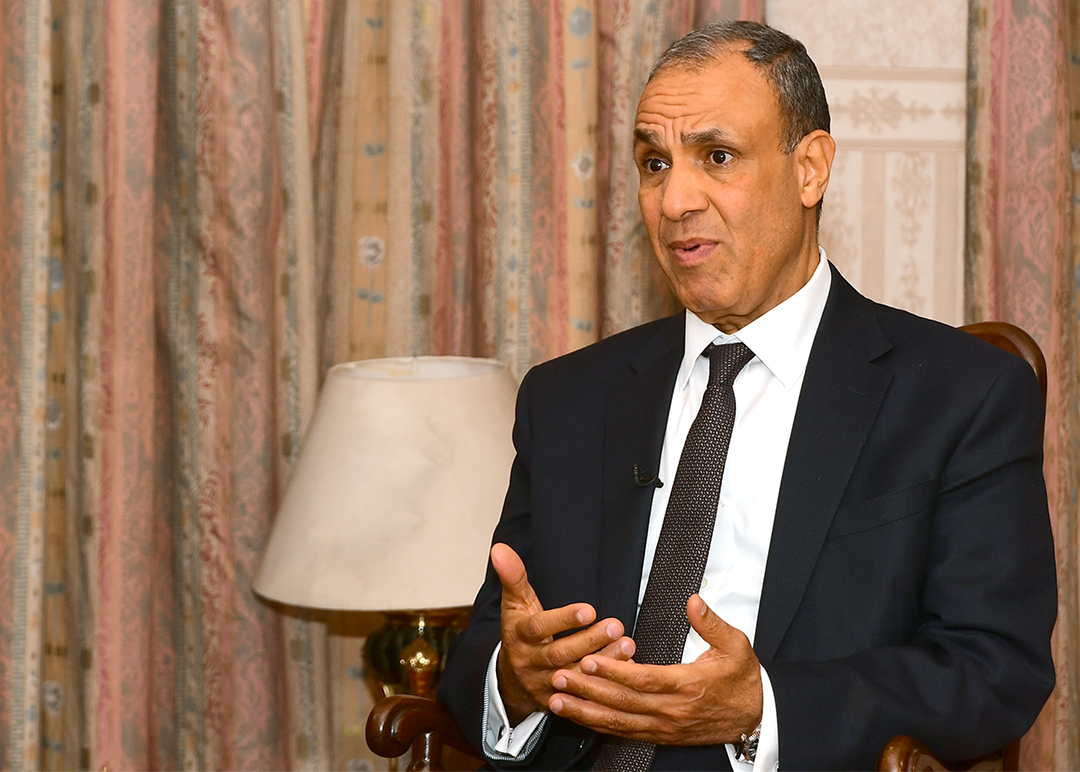
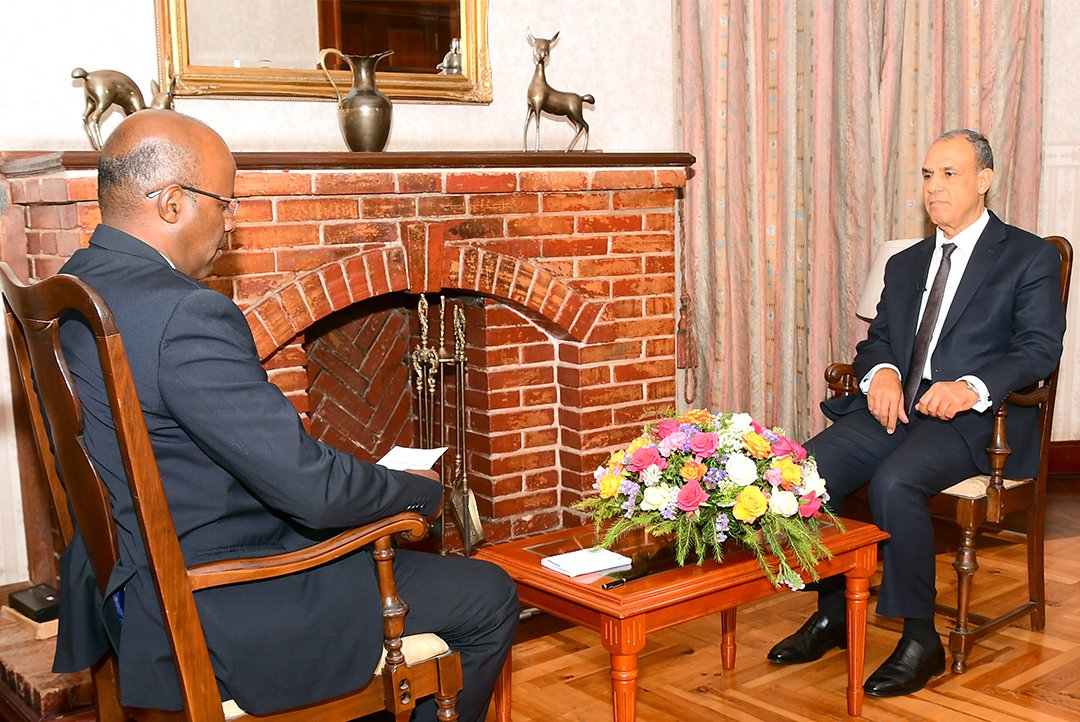
Exclusive Q &A: 'We Consider Eritrea a Pillar of Stability'; Egypt's Foreign Minister, Dr. Badr Abdellaty
*"...This visit comes amidst several important occasions, most notably the approaching celebration of the 35th Anniversary of Eritrea’s Independence. Heartfelt congratulations on this auspicious occasion. I am carrying a message from President El-Sisi to his brother President Isaias – a message of empathy, brotherhood, friendship, support, and solidarity".
*"...Firstly, we view Eritrea as a fundamental pillar of stability in this troubled region, the Horn of Africa. We admire President Isaias’s wisdom in managing relations with a high degree of tact, balance, and de-escalation. Secondly, there is a shared vision between the two Presidents regarding managing relations in the Red Sea and Horn of Africa. We manage these relations based on dialogue, focusing on improving living standards, enhancing economic and technical cooperation, and avoiding military escalation or rash adventures with unpredictable consequences. We cannot afford such situations; we already have more than enough problems".
*"...There is a strong alignment between Egyptian and Eritrean viewpoints that all matters related to the governance and security of the Red Sea and the Gulf of Aden are solely the responsibility of the littoral states. This is crystal clear and non-negotiable. Discussions are currently underway among the littoral states – particularly with Saudi Arabia, Eritrea, Egypt, Jordan, Yemen, and Somalia – to activate the Council of Arab and African States Bordering the Red Sea and the Gulf of Aden. The focus is on activating this council as quickly as possible to ensure that governance and security of the Red Sea are a reality, not just rhetoric. This necessitates activating the council’s mechanisms, which will be headquartered in Saudi Arabia. There are clear visions for linking ports and fostering logistical cooperation among Red Sea ports of the littoral states. Security, too, must be the sole responsibility of the littoral states and no other parties. This is a clear and non-negotiable point".
https://t.co/MzLeWmOVU4


![AmbStesfamariam's tweet photo. It is Friday, and what a week it has been for the folks at FANA and the PP cadres. I am accustomed to receiving from Member States their priorities for UNGA 81, but this week’s output from the PP has been something of an overload.
Eight years after Prime Minister Abiy Ahmed came to power, 2026 may well be the year in which the rhetoric, acronyms and strategic formulations finally lay bare what has long been hiding in plain sight: the ambitions of his government for #Ethiopia, the implications for its neighbors, and the formidable challenge this presents to an international community seeking to build lasting peace and stability in the #Horn of #Africa.
In a region where strategic doctrines come and go with remarkable speed, one might reasonably hope that Ethiopia’s foreign policy could survive a Thursday without acquiring another acronym. Perhaps the PP might give its audience a little time to digest its growing collection of increasingly elaborate formulations before unveiling the next one.
Otherwise, in the rush to introduce yet another strategic concept, it may risk another strategic miscalculation, and deepen the very self-created quagmire it is now working so hard to explain. But before we get to this week’s latest formulations, let us go back a little bit.
Prime Minister Abiy Ahmed introduced Ethiopia, and at times the region, to መደመር, Medemer, in its first and second iterations, presenting it as a new political philosophy and, ultimately, as the only viable path for Ethiopia and the region: addition, convergence, cooperation and the pooling of strengths. But the Ethiopian experience has increasingly produced a rather different vocabulary.
Instead of መደመር (Medemer), there has been far too much መደናገር (Medenager): confusion, disorientation and a country struggling to find its way through one crisis after another. And instead of adding to the lives and security of its citizens, there has been መቀነስ (Mequenes): a grim process of subtraction, as Ethiopian lives have been lost in violence across different parts of the country.
People have been killed in cold blood. Communities have been devastated. Families have disappeared into grief. And much of the international community has watched with a silence that has sometimes been difficult to distinguish from indifference. One is left wondering whether Ethiopian lives have been valued differently depending on where those lives were lost.
The irony is difficult to miss. A philosophy premised on adding together was supposed to strengthen the Ethiopian state and bring its peoples closer together. Yet the country has repeatedly experienced fragmentation, violence, displacement and deepening mistrust.
Perhaps the real test of any political philosophy is not how elegantly it is written in books, nor how compellingly it is presented from podiums. It is whether ordinary people are safer, whether their children are alive, whether communities can live without fear, and whether a citizen’s life is treated as having equal value regardless of ethnicity, region or political affiliation.
Last month, we were introduced to the 3Ms: Mequaquam, Metekem and Megrat. This week, the PP brought us the 4As of Ethiopia’s diplomatic doctrine: Active, Alternative, Adaptive and Agenda-Setting. And now we have the latest PP-created concept: “compound pressure.” One almost wonders when the PowerPoint will run out of letters, or whether every familiar principle of statecraft will eventually acquire its own acronym.
As Prime Minister Abiy put it:
“...ለዚህ ምንከተለው መንገድ፣ በኛ ሳይድ ሶስት መ ብለን አስቀምጠናቸዋል። አንደኛው መቋቋም ነው... ሁለተኛ መጠቀም ነው። ፈተናን ወደ እድል መቀየር። ሶስተኛው መግራት ነው። በሰው አጀንዳ መገራት ሳይሆን አሁን የራስ አጀንዳ ፈጥሮ መግራት ነው...”
Translated by @HOAAffairs as:
“…The path we follow on our side we have set as the ‘Three Ms’. The first is Mequaquam (to withstand): building resilient institutions and a nation. The second is Metekem (to exploit): turning challenges into opportunities. The third is Megrat (to tame): rather than being tamed by others’ agendas, creating our own agenda and taming [the region] …”
There is, of course, nothing inherently objectionable about a state developing strategic doctrines or giving familiar ideas new terminology. States are entitled to think strategically. They are entitled to develop doctrines. They are even entitled to create acronyms. But beneath the acronyms remain a few rather unfashionable concepts that PP cadres continue to ignore: sovereignty, territorial integrity, sovereign equality and international law. Strategies evolve. Acronyms come and go. Sovereignty is not a passing trend.
And this is where the latest formulation, “compound pressure”, deserves closer attention. The PP presents Ethiopia’s security environment in terms of multiple pressures: the unresolved political and security challenges surrounding the Tigray transition, the Nile Basin and GERD dispute, and wider questions concerning Red Sea access and frontier security. These developments may indeed impose a cumulative strategic burden on Ethiopia.
There is also nothing inherently wrong with analyzing a country’s security environment in terms of cumulative pressure. Strategic planners do this all the time. But such an analysis must be accompanied by accountability, honesty and a clear distinction between perception and fact.
The problem begins when strategic analysis is transformed into a legal argument. Several developments may have a cumulative effect on #Ethiopia. That does not establish that they are coordinated. It does not establish that they have a single author. It does not establish that they constitute one dispute. And, most importantly, it does not give Ethiopia additional legal rights.
Each issue has its own history, its own actors, its own facts and its own applicable law. Strategic accumulation is not legal aggregation. Or, as I would describe it, a self-created quagmire compounded by arrogance and hubris is still a quagmire. It is reassuring, at least, to know that the PP understands the predicament it has created for itself.
But a quagmire is a predicament, not a title deed. A difficult strategic environment does not give Ethiopia a legal right to resolve it by imposing costs on its neighbors. Feeling being constrained does not confer the right to constrain others. The PP may feel strategically constrained by several separate developments. It cannot convert that cumulative constraint into a legal basis for overriding the sovereign rights of its neighbors.
PM Abiy cannot convert cumulative strategic pressure into cumulative sovereign rights. Strategic pressure may explain behavior; it does not legalize it. #Eritrea|s decisions regarding foreign military bases, maritime policy, relations with other states and territorial integrity may be inconvenient to Ethiopian strategy. But, inconvenience is not illegality.
On the issue of establishing a naval base on the Red Sea, the presence of foreign military facilities in the region does not change the equation. They exist because a sovereign state, permits them. #Eritrea has chosen otherwise. Presence by consent is not entitlement by proximity. International law does not operate on a “me too” principle.
The same applies to claims involving proxies, conspiracies and regional alignments. Tigrayan politics have their own history and agency. Egypt, Sudan and the Gulf states have their own interests and calculations. #Eritrea has its sovereign interests. #Ethiopia has its own. There is a word for states pursuing overlapping interests: international relations.
And if “compound pressure” simply means that Ethiopia is surrounded by sovereign states whose independent decisions sometimes constrain Ethiopian choices, Eritrea can offer a modest reminder: that is what having neighbors means.
Eritrea does not oppose Ethiopia’s aspirations. It does not oppose peaceful access to international markets or mutually beneficial regional trade. What it rejects is the progression from access to entitlement, entitlement to control, and control to historical or security necessity. That progression is not inevitable. It is a political choice.
Eritrea also understands perfectly well the economic value of Massawa, Assab, the Dahlak Islands and its Red Sea coastline. Thank you for the business advice. Eritrea will decide how to manage its sovereign assets.
There is also a certain irony in Ethiopia’s invocation of “sovereignty of decision.” Ethiopia has sovereignty of decision. So does Eritrea. Ethiopia deserves strategic freedom. So does Eritrea. Ethiopia deserves security. So does Eritrea. Freedom from the agendas of others cannot mean the subordination of neighbors to one’s own agenda. That is not strategic freedom. What the PP is seeking is strategic privilege.
The #Horn of #Africa does not need another war to establish this rather obvious proposition. A stable, prosperous Ethiopia is in Eritrea’s interest. A stable, prosperous Eritrea is in Ethiopia’s interest. The sensible path is reciprocity: equal sovereignty, negotiated access, lawful commerce and respect for established borders. If #Ethiopia wants trade, it should build partnerships. If it wants regional influence, it should exercise diplomacy. If it wants access, it should negotiate access. But if access becomes a demand that Eritrea surrender its sovereign discretion, then the issue is no longer maritime access. It is hierarchy.
And hierarchy is not the same thing as regional cooperation.
The #Horn has suffered enough from attempts to resolve political and strategic problems through force, coercion and unilateral calculations of entitlement. There is another path. It begins with accepting a rather simple proposition: #Ethiopia can pursue its interests without denying the interests of its neighbors. It can seek access without claiming ownership. It can pursue security without making insecurity for others the price of its own. It can exercise influence without demanding hierarchy.
The PP can develop as many strategic doctrines and invent as many acronyms as it wishes. But none of them changes the underlying rules. Acronyms can describe a strategy; they cannot amend international law. And there remains one inconvenient constraint that no PP acronym can overcome: international law applies to #Eritrea too. But it also applies to #Ethiopia.
Have a great weekend, folks. Hopefully, the PP cadres will take a break too, if only to give us all a chance to catch up with the latest acronym on Monday…](https://pbs.twimg.com/media/HPtVWIxXsAA5l_n.jpg)
![AmbStesfamariam's tweet photo. It is Friday, and what a week it has been for the folks at FANA and the PP cadres. I am accustomed to receiving from Member States their priorities for UNGA 81, but this week’s output from the PP has been something of an overload.
Eight years after Prime Minister Abiy Ahmed came to power, 2026 may well be the year in which the rhetoric, acronyms and strategic formulations finally lay bare what has long been hiding in plain sight: the ambitions of his government for #Ethiopia, the implications for its neighbors, and the formidable challenge this presents to an international community seeking to build lasting peace and stability in the #Horn of #Africa.
In a region where strategic doctrines come and go with remarkable speed, one might reasonably hope that Ethiopia’s foreign policy could survive a Thursday without acquiring another acronym. Perhaps the PP might give its audience a little time to digest its growing collection of increasingly elaborate formulations before unveiling the next one.
Otherwise, in the rush to introduce yet another strategic concept, it may risk another strategic miscalculation, and deepen the very self-created quagmire it is now working so hard to explain. But before we get to this week’s latest formulations, let us go back a little bit.
Prime Minister Abiy Ahmed introduced Ethiopia, and at times the region, to መደመር, Medemer, in its first and second iterations, presenting it as a new political philosophy and, ultimately, as the only viable path for Ethiopia and the region: addition, convergence, cooperation and the pooling of strengths. But the Ethiopian experience has increasingly produced a rather different vocabulary.
Instead of መደመር (Medemer), there has been far too much መደናገር (Medenager): confusion, disorientation and a country struggling to find its way through one crisis after another. And instead of adding to the lives and security of its citizens, there has been መቀነስ (Mequenes): a grim process of subtraction, as Ethiopian lives have been lost in violence across different parts of the country.
People have been killed in cold blood. Communities have been devastated. Families have disappeared into grief. And much of the international community has watched with a silence that has sometimes been difficult to distinguish from indifference. One is left wondering whether Ethiopian lives have been valued differently depending on where those lives were lost.
The irony is difficult to miss. A philosophy premised on adding together was supposed to strengthen the Ethiopian state and bring its peoples closer together. Yet the country has repeatedly experienced fragmentation, violence, displacement and deepening mistrust.
Perhaps the real test of any political philosophy is not how elegantly it is written in books, nor how compellingly it is presented from podiums. It is whether ordinary people are safer, whether their children are alive, whether communities can live without fear, and whether a citizen’s life is treated as having equal value regardless of ethnicity, region or political affiliation.
Last month, we were introduced to the 3Ms: Mequaquam, Metekem and Megrat. This week, the PP brought us the 4As of Ethiopia’s diplomatic doctrine: Active, Alternative, Adaptive and Agenda-Setting. And now we have the latest PP-created concept: “compound pressure.” One almost wonders when the PowerPoint will run out of letters, or whether every familiar principle of statecraft will eventually acquire its own acronym.
As Prime Minister Abiy put it:
“...ለዚህ ምንከተለው መንገድ፣ በኛ ሳይድ ሶስት መ ብለን አስቀምጠናቸዋል። አንደኛው መቋቋም ነው... ሁለተኛ መጠቀም ነው። ፈተናን ወደ እድል መቀየር። ሶስተኛው መግራት ነው። በሰው አጀንዳ መገራት ሳይሆን አሁን የራስ አጀንዳ ፈጥሮ መግራት ነው...”
Translated by @HOAAffairs as:
“…The path we follow on our side we have set as the ‘Three Ms’. The first is Mequaquam (to withstand): building resilient institutions and a nation. The second is Metekem (to exploit): turning challenges into opportunities. The third is Megrat (to tame): rather than being tamed by others’ agendas, creating our own agenda and taming [the region] …”
There is, of course, nothing inherently objectionable about a state developing strategic doctrines or giving familiar ideas new terminology. States are entitled to think strategically. They are entitled to develop doctrines. They are even entitled to create acronyms. But beneath the acronyms remain a few rather unfashionable concepts that PP cadres continue to ignore: sovereignty, territorial integrity, sovereign equality and international law. Strategies evolve. Acronyms come and go. Sovereignty is not a passing trend.
And this is where the latest formulation, “compound pressure”, deserves closer attention. The PP presents Ethiopia’s security environment in terms of multiple pressures: the unresolved political and security challenges surrounding the Tigray transition, the Nile Basin and GERD dispute, and wider questions concerning Red Sea access and frontier security. These developments may indeed impose a cumulative strategic burden on Ethiopia.
There is also nothing inherently wrong with analyzing a country’s security environment in terms of cumulative pressure. Strategic planners do this all the time. But such an analysis must be accompanied by accountability, honesty and a clear distinction between perception and fact.
The problem begins when strategic analysis is transformed into a legal argument. Several developments may have a cumulative effect on #Ethiopia. That does not establish that they are coordinated. It does not establish that they have a single author. It does not establish that they constitute one dispute. And, most importantly, it does not give Ethiopia additional legal rights.
Each issue has its own history, its own actors, its own facts and its own applicable law. Strategic accumulation is not legal aggregation. Or, as I would describe it, a self-created quagmire compounded by arrogance and hubris is still a quagmire. It is reassuring, at least, to know that the PP understands the predicament it has created for itself.
But a quagmire is a predicament, not a title deed. A difficult strategic environment does not give Ethiopia a legal right to resolve it by imposing costs on its neighbors. Feeling being constrained does not confer the right to constrain others. The PP may feel strategically constrained by several separate developments. It cannot convert that cumulative constraint into a legal basis for overriding the sovereign rights of its neighbors.
PM Abiy cannot convert cumulative strategic pressure into cumulative sovereign rights. Strategic pressure may explain behavior; it does not legalize it. #Eritrea|s decisions regarding foreign military bases, maritime policy, relations with other states and territorial integrity may be inconvenient to Ethiopian strategy. But, inconvenience is not illegality.
On the issue of establishing a naval base on the Red Sea, the presence of foreign military facilities in the region does not change the equation. They exist because a sovereign state, permits them. #Eritrea has chosen otherwise. Presence by consent is not entitlement by proximity. International law does not operate on a “me too” principle.
The same applies to claims involving proxies, conspiracies and regional alignments. Tigrayan politics have their own history and agency. Egypt, Sudan and the Gulf states have their own interests and calculations. #Eritrea has its sovereign interests. #Ethiopia has its own. There is a word for states pursuing overlapping interests: international relations.
And if “compound pressure” simply means that Ethiopia is surrounded by sovereign states whose independent decisions sometimes constrain Ethiopian choices, Eritrea can offer a modest reminder: that is what having neighbors means.
Eritrea does not oppose Ethiopia’s aspirations. It does not oppose peaceful access to international markets or mutually beneficial regional trade. What it rejects is the progression from access to entitlement, entitlement to control, and control to historical or security necessity. That progression is not inevitable. It is a political choice.
Eritrea also understands perfectly well the economic value of Massawa, Assab, the Dahlak Islands and its Red Sea coastline. Thank you for the business advice. Eritrea will decide how to manage its sovereign assets.
There is also a certain irony in Ethiopia’s invocation of “sovereignty of decision.” Ethiopia has sovereignty of decision. So does Eritrea. Ethiopia deserves strategic freedom. So does Eritrea. Ethiopia deserves security. So does Eritrea. Freedom from the agendas of others cannot mean the subordination of neighbors to one’s own agenda. That is not strategic freedom. What the PP is seeking is strategic privilege.
The #Horn of #Africa does not need another war to establish this rather obvious proposition. A stable, prosperous Ethiopia is in Eritrea’s interest. A stable, prosperous Eritrea is in Ethiopia’s interest. The sensible path is reciprocity: equal sovereignty, negotiated access, lawful commerce and respect for established borders. If #Ethiopia wants trade, it should build partnerships. If it wants regional influence, it should exercise diplomacy. If it wants access, it should negotiate access. But if access becomes a demand that Eritrea surrender its sovereign discretion, then the issue is no longer maritime access. It is hierarchy.
And hierarchy is not the same thing as regional cooperation.
The #Horn has suffered enough from attempts to resolve political and strategic problems through force, coercion and unilateral calculations of entitlement. There is another path. It begins with accepting a rather simple proposition: #Ethiopia can pursue its interests without denying the interests of its neighbors. It can seek access without claiming ownership. It can pursue security without making insecurity for others the price of its own. It can exercise influence without demanding hierarchy.
The PP can develop as many strategic doctrines and invent as many acronyms as it wishes. But none of them changes the underlying rules. Acronyms can describe a strategy; they cannot amend international law. And there remains one inconvenient constraint that no PP acronym can overcome: international law applies to #Eritrea too. But it also applies to #Ethiopia.
Have a great weekend, folks. Hopefully, the PP cadres will take a break too, if only to give us all a chance to catch up with the latest acronym on Monday…](https://pbs.twimg.com/media/HPtVWIiXYAEB_RW.jpg)
![AmbStesfamariam's tweet photo. It is Friday, and what a week it has been for the folks at FANA and the PP cadres. I am accustomed to receiving from Member States their priorities for UNGA 81, but this week’s output from the PP has been something of an overload.
Eight years after Prime Minister Abiy Ahmed came to power, 2026 may well be the year in which the rhetoric, acronyms and strategic formulations finally lay bare what has long been hiding in plain sight: the ambitions of his government for #Ethiopia, the implications for its neighbors, and the formidable challenge this presents to an international community seeking to build lasting peace and stability in the #Horn of #Africa.
In a region where strategic doctrines come and go with remarkable speed, one might reasonably hope that Ethiopia’s foreign policy could survive a Thursday without acquiring another acronym. Perhaps the PP might give its audience a little time to digest its growing collection of increasingly elaborate formulations before unveiling the next one.
Otherwise, in the rush to introduce yet another strategic concept, it may risk another strategic miscalculation, and deepen the very self-created quagmire it is now working so hard to explain. But before we get to this week’s latest formulations, let us go back a little bit.
Prime Minister Abiy Ahmed introduced Ethiopia, and at times the region, to መደመር, Medemer, in its first and second iterations, presenting it as a new political philosophy and, ultimately, as the only viable path for Ethiopia and the region: addition, convergence, cooperation and the pooling of strengths. But the Ethiopian experience has increasingly produced a rather different vocabulary.
Instead of መደመር (Medemer), there has been far too much መደናገር (Medenager): confusion, disorientation and a country struggling to find its way through one crisis after another. And instead of adding to the lives and security of its citizens, there has been መቀነስ (Mequenes): a grim process of subtraction, as Ethiopian lives have been lost in violence across different parts of the country.
People have been killed in cold blood. Communities have been devastated. Families have disappeared into grief. And much of the international community has watched with a silence that has sometimes been difficult to distinguish from indifference. One is left wondering whether Ethiopian lives have been valued differently depending on where those lives were lost.
The irony is difficult to miss. A philosophy premised on adding together was supposed to strengthen the Ethiopian state and bring its peoples closer together. Yet the country has repeatedly experienced fragmentation, violence, displacement and deepening mistrust.
Perhaps the real test of any political philosophy is not how elegantly it is written in books, nor how compellingly it is presented from podiums. It is whether ordinary people are safer, whether their children are alive, whether communities can live without fear, and whether a citizen’s life is treated as having equal value regardless of ethnicity, region or political affiliation.
Last month, we were introduced to the 3Ms: Mequaquam, Metekem and Megrat. This week, the PP brought us the 4As of Ethiopia’s diplomatic doctrine: Active, Alternative, Adaptive and Agenda-Setting. And now we have the latest PP-created concept: “compound pressure.” One almost wonders when the PowerPoint will run out of letters, or whether every familiar principle of statecraft will eventually acquire its own acronym.
As Prime Minister Abiy put it:
“...ለዚህ ምንከተለው መንገድ፣ በኛ ሳይድ ሶስት መ ብለን አስቀምጠናቸዋል። አንደኛው መቋቋም ነው... ሁለተኛ መጠቀም ነው። ፈተናን ወደ እድል መቀየር። ሶስተኛው መግራት ነው። በሰው አጀንዳ መገራት ሳይሆን አሁን የራስ አጀንዳ ፈጥሮ መግራት ነው...”
Translated by @HOAAffairs as:
“…The path we follow on our side we have set as the ‘Three Ms’. The first is Mequaquam (to withstand): building resilient institutions and a nation. The second is Metekem (to exploit): turning challenges into opportunities. The third is Megrat (to tame): rather than being tamed by others’ agendas, creating our own agenda and taming [the region] …”
There is, of course, nothing inherently objectionable about a state developing strategic doctrines or giving familiar ideas new terminology. States are entitled to think strategically. They are entitled to develop doctrines. They are even entitled to create acronyms. But beneath the acronyms remain a few rather unfashionable concepts that PP cadres continue to ignore: sovereignty, territorial integrity, sovereign equality and international law. Strategies evolve. Acronyms come and go. Sovereignty is not a passing trend.
And this is where the latest formulation, “compound pressure”, deserves closer attention. The PP presents Ethiopia’s security environment in terms of multiple pressures: the unresolved political and security challenges surrounding the Tigray transition, the Nile Basin and GERD dispute, and wider questions concerning Red Sea access and frontier security. These developments may indeed impose a cumulative strategic burden on Ethiopia.
There is also nothing inherently wrong with analyzing a country’s security environment in terms of cumulative pressure. Strategic planners do this all the time. But such an analysis must be accompanied by accountability, honesty and a clear distinction between perception and fact.
The problem begins when strategic analysis is transformed into a legal argument. Several developments may have a cumulative effect on #Ethiopia. That does not establish that they are coordinated. It does not establish that they have a single author. It does not establish that they constitute one dispute. And, most importantly, it does not give Ethiopia additional legal rights.
Each issue has its own history, its own actors, its own facts and its own applicable law. Strategic accumulation is not legal aggregation. Or, as I would describe it, a self-created quagmire compounded by arrogance and hubris is still a quagmire. It is reassuring, at least, to know that the PP understands the predicament it has created for itself.
But a quagmire is a predicament, not a title deed. A difficult strategic environment does not give Ethiopia a legal right to resolve it by imposing costs on its neighbors. Feeling being constrained does not confer the right to constrain others. The PP may feel strategically constrained by several separate developments. It cannot convert that cumulative constraint into a legal basis for overriding the sovereign rights of its neighbors.
PM Abiy cannot convert cumulative strategic pressure into cumulative sovereign rights. Strategic pressure may explain behavior; it does not legalize it. #Eritrea|s decisions regarding foreign military bases, maritime policy, relations with other states and territorial integrity may be inconvenient to Ethiopian strategy. But, inconvenience is not illegality.
On the issue of establishing a naval base on the Red Sea, the presence of foreign military facilities in the region does not change the equation. They exist because a sovereign state, permits them. #Eritrea has chosen otherwise. Presence by consent is not entitlement by proximity. International law does not operate on a “me too” principle.
The same applies to claims involving proxies, conspiracies and regional alignments. Tigrayan politics have their own history and agency. Egypt, Sudan and the Gulf states have their own interests and calculations. #Eritrea has its sovereign interests. #Ethiopia has its own. There is a word for states pursuing overlapping interests: international relations.
And if “compound pressure” simply means that Ethiopia is surrounded by sovereign states whose independent decisions sometimes constrain Ethiopian choices, Eritrea can offer a modest reminder: that is what having neighbors means.
Eritrea does not oppose Ethiopia’s aspirations. It does not oppose peaceful access to international markets or mutually beneficial regional trade. What it rejects is the progression from access to entitlement, entitlement to control, and control to historical or security necessity. That progression is not inevitable. It is a political choice.
Eritrea also understands perfectly well the economic value of Massawa, Assab, the Dahlak Islands and its Red Sea coastline. Thank you for the business advice. Eritrea will decide how to manage its sovereign assets.
There is also a certain irony in Ethiopia’s invocation of “sovereignty of decision.” Ethiopia has sovereignty of decision. So does Eritrea. Ethiopia deserves strategic freedom. So does Eritrea. Ethiopia deserves security. So does Eritrea. Freedom from the agendas of others cannot mean the subordination of neighbors to one’s own agenda. That is not strategic freedom. What the PP is seeking is strategic privilege.
The #Horn of #Africa does not need another war to establish this rather obvious proposition. A stable, prosperous Ethiopia is in Eritrea’s interest. A stable, prosperous Eritrea is in Ethiopia’s interest. The sensible path is reciprocity: equal sovereignty, negotiated access, lawful commerce and respect for established borders. If #Ethiopia wants trade, it should build partnerships. If it wants regional influence, it should exercise diplomacy. If it wants access, it should negotiate access. But if access becomes a demand that Eritrea surrender its sovereign discretion, then the issue is no longer maritime access. It is hierarchy.
And hierarchy is not the same thing as regional cooperation.
The #Horn has suffered enough from attempts to resolve political and strategic problems through force, coercion and unilateral calculations of entitlement. There is another path. It begins with accepting a rather simple proposition: #Ethiopia can pursue its interests without denying the interests of its neighbors. It can seek access without claiming ownership. It can pursue security without making insecurity for others the price of its own. It can exercise influence without demanding hierarchy.
The PP can develop as many strategic doctrines and invent as many acronyms as it wishes. But none of them changes the underlying rules. Acronyms can describe a strategy; they cannot amend international law. And there remains one inconvenient constraint that no PP acronym can overcome: international law applies to #Eritrea too. But it also applies to #Ethiopia.
Have a great weekend, folks. Hopefully, the PP cadres will take a break too, if only to give us all a chance to catch up with the latest acronym on Monday…](https://pbs.twimg.com/media/HPtVTxWXoAA3ULg.jpg)







![AmbStesfamariam's tweet photo. It is Friday, and what a week it has been for the folks at FANA and the PP cadres. I am accustomed to receiving from Member States their priorities for UNGA 81, but this week’s output from the PP has been something of an overload.
Eight years after Prime Minister Abiy Ahmed came to power, 2026 may well be the year in which the rhetoric, acronyms and strategic formulations finally lay bare what has long been hiding in plain sight: the ambitions of his government for #Ethiopia, the implications for its neighbors, and the formidable challenge this presents to an international community seeking to build lasting peace and stability in the #Horn of #Africa.
In a region where strategic doctrines come and go with remarkable speed, one might reasonably hope that Ethiopia’s foreign policy could survive a Thursday without acquiring another acronym. Perhaps the PP might give its audience a little time to digest its growing collection of increasingly elaborate formulations before unveiling the next one.
Otherwise, in the rush to introduce yet another strategic concept, it may risk another strategic miscalculation, and deepen the very self-created quagmire it is now working so hard to explain. But before we get to this week’s latest formulations, let us go back a little bit.
Prime Minister Abiy Ahmed introduced Ethiopia, and at times the region, to መደመር, Medemer, in its first and second iterations, presenting it as a new political philosophy and, ultimately, as the only viable path for Ethiopia and the region: addition, convergence, cooperation and the pooling of strengths. But the Ethiopian experience has increasingly produced a rather different vocabulary.
Instead of መደመር (Medemer), there has been far too much መደናገር (Medenager): confusion, disorientation and a country struggling to find its way through one crisis after another. And instead of adding to the lives and security of its citizens, there has been መቀነስ (Mequenes): a grim process of subtraction, as Ethiopian lives have been lost in violence across different parts of the country.
People have been killed in cold blood. Communities have been devastated. Families have disappeared into grief. And much of the international community has watched with a silence that has sometimes been difficult to distinguish from indifference. One is left wondering whether Ethiopian lives have been valued differently depending on where those lives were lost.
The irony is difficult to miss. A philosophy premised on adding together was supposed to strengthen the Ethiopian state and bring its peoples closer together. Yet the country has repeatedly experienced fragmentation, violence, displacement and deepening mistrust.
Perhaps the real test of any political philosophy is not how elegantly it is written in books, nor how compellingly it is presented from podiums. It is whether ordinary people are safer, whether their children are alive, whether communities can live without fear, and whether a citizen’s life is treated as having equal value regardless of ethnicity, region or political affiliation.
Last month, we were introduced to the 3Ms: Mequaquam, Metekem and Megrat. This week, the PP brought us the 4As of Ethiopia’s diplomatic doctrine: Active, Alternative, Adaptive and Agenda-Setting. And now we have the latest PP-created concept: “compound pressure.” One almost wonders when the PowerPoint will run out of letters, or whether every familiar principle of statecraft will eventually acquire its own acronym.
As Prime Minister Abiy put it:
“...ለዚህ ምንከተለው መንገድ፣ በኛ ሳይድ ሶስት መ ብለን አስቀምጠናቸዋል። አንደኛው መቋቋም ነው... ሁለተኛ መጠቀም ነው። ፈተናን ወደ እድል መቀየር። ሶስተኛው መግራት ነው። በሰው አጀንዳ መገራት ሳይሆን አሁን የራስ አጀንዳ ፈጥሮ መግራት ነው...”
Translated by @HOAAffairs as:
“…The path we follow on our side we have set as the ‘Three Ms’. The first is Mequaquam (to withstand): building resilient institutions and a nation. The second is Metekem (to exploit): turning challenges into opportunities. The third is Megrat (to tame): rather than being tamed by others’ agendas, creating our own agenda and taming [the region] …”
There is, of course, nothing inherently objectionable about a state developing strategic doctrines or giving familiar ideas new terminology. States are entitled to think strategically. They are entitled to develop doctrines. They are even entitled to create acronyms. But beneath the acronyms remain a few rather unfashionable concepts that PP cadres continue to ignore: sovereignty, territorial integrity, sovereign equality and international law. Strategies evolve. Acronyms come and go. Sovereignty is not a passing trend.
And this is where the latest formulation, “compound pressure”, deserves closer attention. The PP presents Ethiopia’s security environment in terms of multiple pressures: the unresolved political and security challenges surrounding the Tigray transition, the Nile Basin and GERD dispute, and wider questions concerning Red Sea access and frontier security. These developments may indeed impose a cumulative strategic burden on Ethiopia.
There is also nothing inherently wrong with analyzing a country’s security environment in terms of cumulative pressure. Strategic planners do this all the time. But such an analysis must be accompanied by accountability, honesty and a clear distinction between perception and fact.
The problem begins when strategic analysis is transformed into a legal argument. Several developments may have a cumulative effect on #Ethiopia. That does not establish that they are coordinated. It does not establish that they have a single author. It does not establish that they constitute one dispute. And, most importantly, it does not give Ethiopia additional legal rights.
Each issue has its own history, its own actors, its own facts and its own applicable law. Strategic accumulation is not legal aggregation. Or, as I would describe it, a self-created quagmire compounded by arrogance and hubris is still a quagmire. It is reassuring, at least, to know that the PP understands the predicament it has created for itself.
But a quagmire is a predicament, not a title deed. A difficult strategic environment does not give Ethiopia a legal right to resolve it by imposing costs on its neighbors. Feeling being constrained does not confer the right to constrain others. The PP may feel strategically constrained by several separate developments. It cannot convert that cumulative constraint into a legal basis for overriding the sovereign rights of its neighbors.
PM Abiy cannot convert cumulative strategic pressure into cumulative sovereign rights. Strategic pressure may explain behavior; it does not legalize it. #Eritrea|s decisions regarding foreign military bases, maritime policy, relations with other states and territorial integrity may be inconvenient to Ethiopian strategy. But, inconvenience is not illegality.
On the issue of establishing a naval base on the Red Sea, the presence of foreign military facilities in the region does not change the equation. They exist because a sovereign state, permits them. #Eritrea has chosen otherwise. Presence by consent is not entitlement by proximity. International law does not operate on a “me too” principle.
The same applies to claims involving proxies, conspiracies and regional alignments. Tigrayan politics have their own history and agency. Egypt, Sudan and the Gulf states have their own interests and calculations. #Eritrea has its sovereign interests. #Ethiopia has its own. There is a word for states pursuing overlapping interests: international relations.
And if “compound pressure” simply means that Ethiopia is surrounded by sovereign states whose independent decisions sometimes constrain Ethiopian choices, Eritrea can offer a modest reminder: that is what having neighbors means.
Eritrea does not oppose Ethiopia’s aspirations. It does not oppose peaceful access to international markets or mutually beneficial regional trade. What it rejects is the progression from access to entitlement, entitlement to control, and control to historical or security necessity. That progression is not inevitable. It is a political choice.
Eritrea also understands perfectly well the economic value of Massawa, Assab, the Dahlak Islands and its Red Sea coastline. Thank you for the business advice. Eritrea will decide how to manage its sovereign assets.
There is also a certain irony in Ethiopia’s invocation of “sovereignty of decision.” Ethiopia has sovereignty of decision. So does Eritrea. Ethiopia deserves strategic freedom. So does Eritrea. Ethiopia deserves security. So does Eritrea. Freedom from the agendas of others cannot mean the subordination of neighbors to one’s own agenda. That is not strategic freedom. What the PP is seeking is strategic privilege.
The #Horn of #Africa does not need another war to establish this rather obvious proposition. A stable, prosperous Ethiopia is in Eritrea’s interest. A stable, prosperous Eritrea is in Ethiopia’s interest. The sensible path is reciprocity: equal sovereignty, negotiated access, lawful commerce and respect for established borders. If #Ethiopia wants trade, it should build partnerships. If it wants regional influence, it should exercise diplomacy. If it wants access, it should negotiate access. But if access becomes a demand that Eritrea surrender its sovereign discretion, then the issue is no longer maritime access. It is hierarchy.
And hierarchy is not the same thing as regional cooperation.
The #Horn has suffered enough from attempts to resolve political and strategic problems through force, coercion and unilateral calculations of entitlement. There is another path. It begins with accepting a rather simple proposition: #Ethiopia can pursue its interests without denying the interests of its neighbors. It can seek access without claiming ownership. It can pursue security without making insecurity for others the price of its own. It can exercise influence without demanding hierarchy.
The PP can develop as many strategic doctrines and invent as many acronyms as it wishes. But none of them changes the underlying rules. Acronyms can describe a strategy; they cannot amend international law. And there remains one inconvenient constraint that no PP acronym can overcome: international law applies to #Eritrea too. But it also applies to #Ethiopia.
Have a great weekend, folks. Hopefully, the PP cadres will take a break too, if only to give us all a chance to catch up with the latest acronym on Monday…](https://pbs.twimg.com/media/HPtVWMDXoAAvh5p.jpg)