Prompt:
Professional luxury birthday poster, 3:4 ratio. Entire frame filled with a premium off white luxury paper textured wall. Large number “6” precisely carved in the wall with visible depth and realistic inner shadows. Inside the number: soft blue and blue balloons, subtle white flowers, elegant bouquet arrangement, premium celebration styling. A happy 6 year old child with preserved reference facial features, wearing a milky white T shirt and dark denim overalls, laughing naturally. Face, shoulder, one hand and one foot extend outside the number creating a realistic 3D effect. Warm cinematic sunlight from one side, soft rim light, photorealistic skin, premium studio photography, ultra realistic, sharp focus. Typography on wall: SKY LOU, CHAPTER 6, 365 MORE DAYS OF WONDER. Clean minimalist layout, luxury magazine cover aesthetic, high end art direction, realistic shadows, natural colors, no tree shadows, no fake lighting, no AI artifacts.
Claude Code creator:
"I don't prompt Claude anymore. I write loops - and the loops do the work. My job is to write loops."
in 30 minutes Boris reveals his actual daily Claude Code setup.
Claude Code + loops + dynamic workflow
Worth more than a $500 vibe-coding course
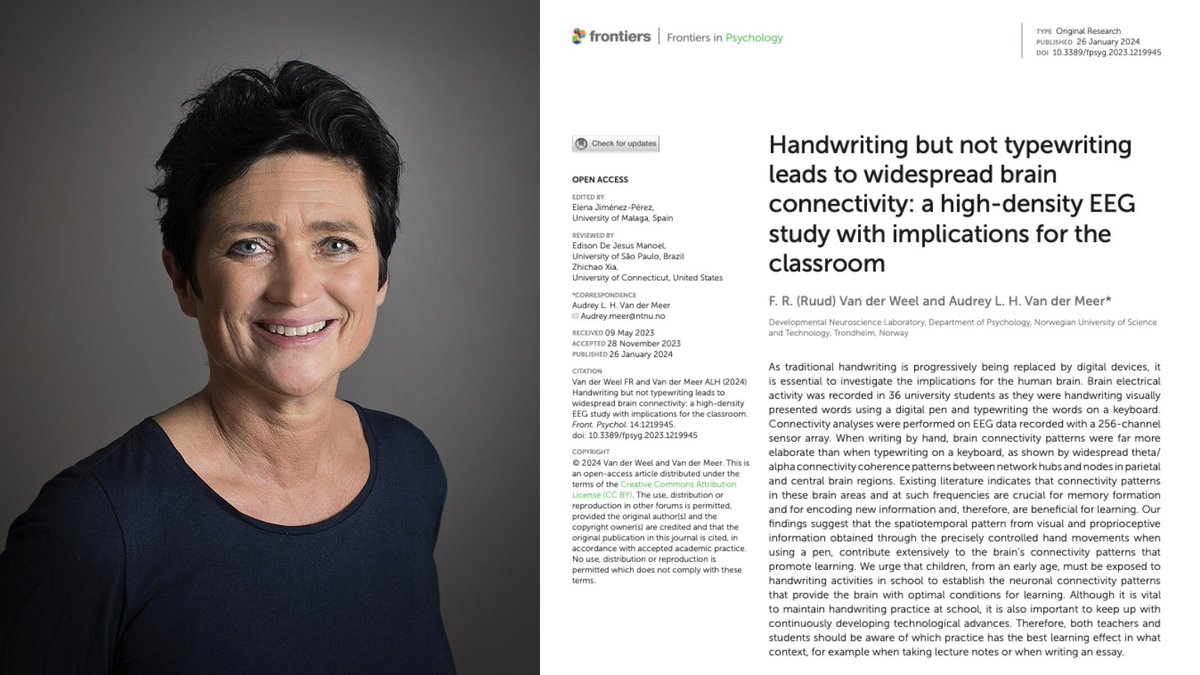
A Norwegian neuroscientist spent 20 years proving that the act of writing by hand changes the human brain in ways typing physically cannot, and almost nobody outside her field has read the paper.
Her name is Audrey van der Meer.
She runs a brain research lab in Trondheim, and the paper that closed the argument was published in 2024 in a journal called Frontiers in Psychology. The finding is brutal enough that it should have changed every classroom on Earth.
The experiment was simple. She recruited 36 university students and put each one in a cap with 256 sensors pressed against their scalp to record brain activity. Words flashed on a screen one at a time.
Sometimes the students wrote the word by hand on a touchscreen using a digital pen, and sometimes they typed the same word on a keyboard. Every neural response was recorded for the full five seconds the word stayed on screen.
Then her team looked at the part of the data most researchers had ignored for years, which is how different parts of the brain were communicating with each other during the task.
When the students wrote by hand, the brain lit up everywhere at once.
The regions responsible for memory, sensory integration, and the encoding of new information were all firing together in a coordinated pattern that spread across the entire cortex. The whole network was awake and connected.
When the same students typed the same word, that pattern collapsed almost completely.
Most of the brain went quiet, and the connections between regions that had been alive seconds earlier were nowhere to be found on the EEG.
Same word, same brain, same person, and two completely different neurological events.
The reason turned out to be something nobody had really paid attention to before her work. Writing by hand is not one motion but a sequence of thousands of tiny micro-movements coordinated with your eyes in real time, where each letter is a different shape that requires the brain to solve a slightly different spatial problem.
Your fingers, wrist, vision, and the parts of your brain that track position in space are all working together to produce one letter, then the next, then the next.
Typing throws all of that away. Every key on a keyboard requires the exact same finger motion regardless of which letter you are pressing, which means the brain has almost nothing to integrate and almost no problem to solve.
Van der Meer said it plainly in her interviews.
Pressing the same key with the same finger over and over does not stimulate the brain in any meaningful way, and she pointed out something that should scare every parent who handed their kid an iPad.
Children who learn to read and write on tablets often cannot tell letters like b and d apart, because they have never physically felt with their bodies what it takes to actually produce those letters on a page.
A decade before her, two researchers at Princeton ran the same fight using a completely different method and ended up at the same answer. Pam Mueller and Daniel Oppenheimer tested 327 students across three experiments, where half took notes on laptops with the internet disabled and half took notes by hand, before testing everyone on what they actually understood from the lectures they had watched.
The handwriting group won by a wide margin on every question that required real understanding rather than surface recall.
The reason was hiding in the transcripts of what the two groups had actually written down.
The laptop students typed almost word for word, capturing more total content but processing almost none of it as they went, while the handwriting students physically could not write fast enough to transcribe a lecture in real time, which forced them to listen carefully, decide what actually mattered, and put it in their own words on the page.
That single act of choosing what to keep was the learning itself, and the keyboard had quietly skipped the choosing and skipped the learning along with it.
Two studies. Two countries. Same answer.
Handwriting makes the brain work. Typing lets it coast.
Every note you have ever typed instead of written went into your brain through a thinner pipe. Every meeting, every book highlight, every idea you captured on your phone instead of on paper was processed at half depth.
You did not forget those things because your memory is bad. You forgot them because typing never woke the part of the brain that would have made them stick.
The fix is the thing your grandmother already knew.
Pick up a pen. Write the thing down. The slower road is the faster one.
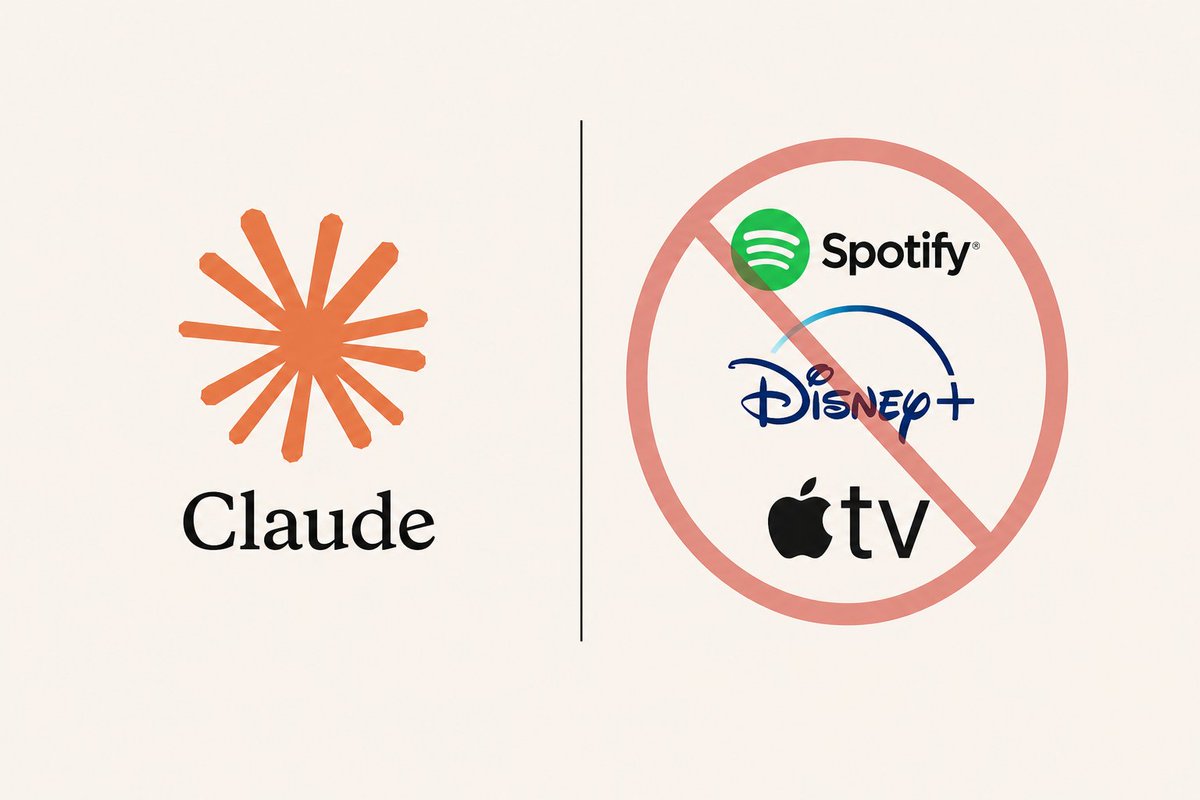
I canceled Spotify.
I canceled Disney+.
I canceled Apple TV+.
No more monthly payments.
Claude turned my laptop into a free entertainment hub that’s better than all of them *combined*.
Here are 9 prompts that rebuild the whole system for free (Save this).
For XPENG IRON, we developed a general-purpose framework that mimics human skeletal geometry and utilized a muscle-like lattice structure to replicate actual muscular movement.
🚨BREAKING: Anthropic just published a study mapping exactly which jobs its own AI is replacing right now.
The workers most at risk are not who anyone expected. They are older. They are more educated. They earn 47% more than average. And they are nearly four times more likely to hold a graduate degree than the workers AI is not touching.
The argument is straightforward. Anthropic built a new metric called "observed exposure." Not what AI could theoretically do. What it is actually doing right now in professional settings, measured against millions of real Claude conversations from enterprise users.
For computer and math workers, AI is theoretically capable of handling 94% of their tasks. It is currently handling 33% of them. For office and administrative roles, theoretical capability is 90%. Current observed usage is 40%. The gap between what AI can do and what it is already doing is enormous. The researchers are explicit about what comes next. As capabilities improve and adoption deepens, the red area grows to fill the blue.
The demographic finding is what makes the paper uncomfortable. The most AI-exposed workers earn 47% more on average than the least exposed group. They are more likely to be female. They are more likely to be college educated. This is not a story about warehouse workers or truck drivers. It is a story about lawyers, financial analysts, market researchers, and software developers. The exact group whose education was supposed to insulate them.
Computer programmers showed the highest observed AI exposure at 74.5%. Customer service representatives at 70.1%. Data entry keyers at 67.1%. Medical record specialists at 66.7%. Market research analysts and marketing specialists at 64.8%. These are not predictions. These are measurements of work that is already happening on AI platforms right now.
Then there is the pipeline finding nobody is talking about loudly enough.
Anthropic's researchers found a 14% decline in the job-finding rate for workers aged 22 to 25 in highly exposed occupations since ChatGPT launched. No comparable effect for workers over 25. Entry-level roles were never just jobs. They were the training ground where junior analysts became senior analysts, where junior lawyers learned how arguments hold together. If that layer disappears, nobody has answered the question of where the next generation of senior professionals comes from.
The detail buried in the paper that most coverage missed: 30% of American workers have zero AI exposure at all. Cooks. Mechanics. Bartenders. Dishwashers. The technology reshaping professional careers is completely irrelevant to roughly a third of the workforce. The divide is no longer between high skill and low skill. It is between presence and absence.
The company publishing this study is the same company selling the AI doing the replacing. Anthropic had every commercial incentive to soften these findings. They published them anyway.
If you spent four years and $200,000 on a degree to land a white collar career, the company that builds Claude just confirmed your job is more exposed than the bartender pouring drinks at your graduation party.
Source: Anthropic, "Labor market impacts of AI: A new measure and early evidence"
PDF: https://t.co/taYgsIfiTj
🚨 Anthropic's own team just showed how to actually use Claude Code properly.
30 minutes. free. the person who created Claude Code.
watch the workshop. bookmark it.
worth more than every $500 course you almost bought.
you've been using Claude without knowing 40 of its commands.
Then read the guide below.
The hottest job for the next five years is going to be the agent operator.
They don't need to be an engineer. They can walk into marketing, legal, or life sciences research and actually make agents work for that function.
Required skills:
> MCPs
> CLIs
> Writing skills (the file kind)
> agents.md fluency
> Business acumen
None of this is in any CS curriculum today.
Soon, enterprises will be pressured to redesign their workflows for agents, not for people. And when that happens, agent operators will be in massive demand.
🚨 BREAKING: Someone just open-sourced a full offline survival computer with AI, Wikipedia, and maps built in.
Project N.O.M.A.D. is an open-source offline survival computer.
Self-contained.
Zero internet required after install.
Zero telemetry. Everything runs locally on your hardware.
What it includes:
→ Full Wikipedia archives via Kiwix
→ Offline maps via OpenStreetMap
→ Local AI models via Ollama + Open WebUI
→ Calculators, reference tools, resource libraries
→ A management UI to control
everything from a browser
One curl command installs the entire system on any Debian-based machine.
Runs headless as a server so any device on your local network can access it.
Minimum specs to run the base system: dual-core processor, 4GB RAM, 5GB storage.
To run local LLMs offline, you want 32GB RAM and an NVIDIA RTX 3060 or better.
No accounts.
No authentication by default.
No cloud dependency.
No phone-home behavior.
Built to function when nothing else does.
The grid, the cloud, the API you depend on. None of it is guaranteed.
The people building local-first systems right now are the ones who won’t be asking for help when access disappears.
BREAKING: AI can now analyze stocks like Wall Street analysts (for free).
Here are 8 insane Claude prompts that replace $5,000/month Bloomberg terminals (Save for later)
Recommend to me your must-have Mac apps.
Here is what I have:
1. Raycast
2. iTerm2 / Warp
3. ChatGPT + Superwhisper
4. Transmit
5. Hey (Email + Calendar)
What are the apps you can't live without?
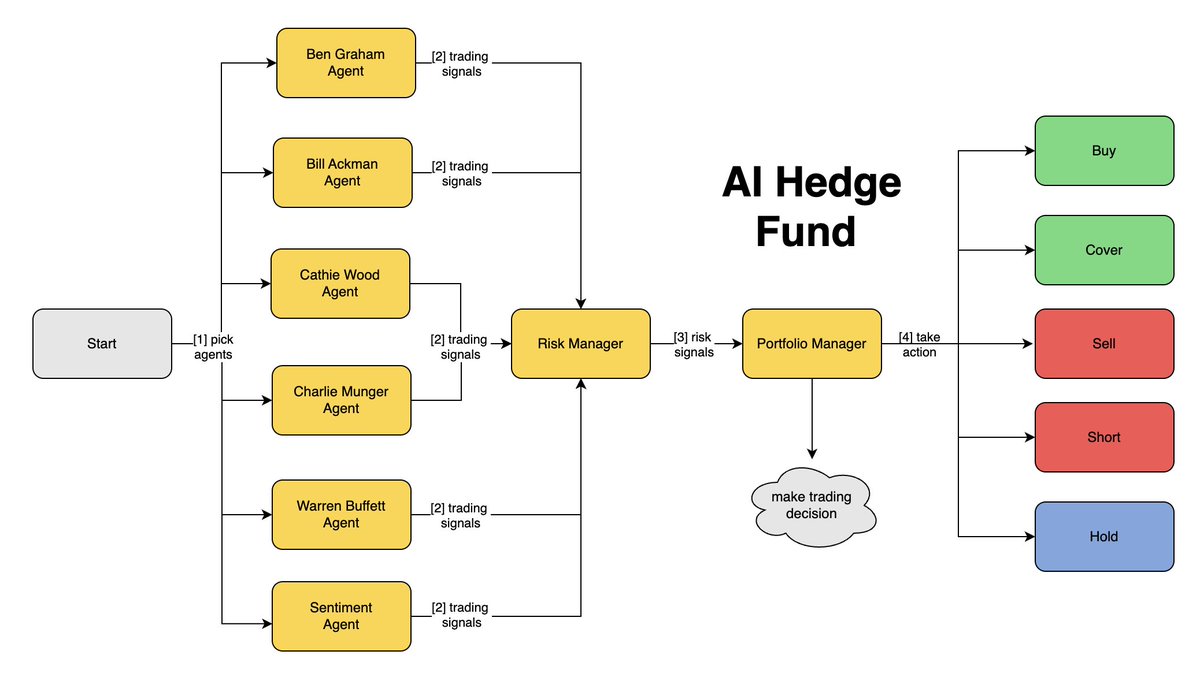
I updated my AI hedge fund system diagram.
We now have 5 investor agents and 8 LLMs.
@langchain powers our agent graph.
Our AI agents:
1 • Ben Graham agent
2 • Bill Ackman agent
3 • Cathie Wood agent
4 • Charlie Munger agent
5 • Warren Buffett agent
You can mix + match these with any LLM.
Our LLM providers:
1 • Anthropic
2 • DeepSeek
3 • Meta
4 • OpenAI
5 • Google (coming soon)
6 • Mistral (coming soon)
No coding is required to run the system.
Everything is open source.
Here is how each investor agent works:
1 • Ben Graham: Uses classic principles like earnings stability, financial strength, and margin of safety with Graham Number calculations.
2 • Bill Ackman: Identifies durable competitive advantages, consistent cash flows, and strong financial discipline at a discount to intrinsic value.
3 • Cathie Wood: Identifies disruptive innovators, focusing on R&D intensity, expanding margins, and breakthrough technologies.
4 • Charlie Munger: Prioritizes business moats, management quality, and predictability while demanding a significant margin of safety.
5 • Warren Buffett: Focuses on owner earnings, consistent growth, and intrinsic value calculations with a long-term perspective on quality businesses.
Goal is to keep adding agents and LLMs.
Let me know what else to add.
"If you're in tech, run in one of these directions."
In this clip, @amasad (CEO @Replit) shares two paths to future-proof your career in the AI era:
1. Get as close to the metal as possible (e.g., NASA won't use GPT-Javascript to run rockets)
OR
2. Become a generalist who can go from idea to end product with AI end to end.
Amjad and I had a great chat covering:
• Why now's the best time to learn to code
• A live demo of building a nutrition tracker app
• The rise of personal apps and the future of work
Some quotes from Amjad:
"The return on learning to code doubles every 6 months. AI automates many of the boring parts. What's left is you and your creativity — the most exciting part of coding."
"The ultimate test for an AI coding agent is if you can make an app faster than you can Google for it. I think we've done it."
"I’ll be honest with you. I think roadmaps are dead. Here's why..."
📌 Watch now: https://t.co/Qn8Zspz0dw