Proud to share our most recent work in @PsychScience :
Cheaters, Liars, or Both? A New Classification of Dishonesty Profiles.
A new innovative paradigm to measure Dishonesty individually
https://t.co/hxPsLWTL6m
Meet the new Stitch, your vibe design partner.
Here are 5 major upgrades to help you create, iterate and collaborate:
🎨 AI-Native Canvas
🧠 Smarter Design Agent
🎙️ Voice
⚡️ Instant Prototypes
📐 Design Systems and DESIGN.md
Rolling out now. Details and product walkthrough video in 🧵
Introducing Gemini Embedding 2! Our first multimodal embedding model for text, images, audio, video, and PDFs.
Here's an app you can try in @GoogleAIStudio where you can see multimodal search in action:
El Servicio Público de Empleo de la Junta de Castilla y León tiene 6,8 millones para formación y está ofertando cursos de:
— Flash
— Dreamweaver
— Borland
— Joomla!
¡Que alguien les quite urgentemente el dinero público, por favor!
Este tío simpático es Guy Goma. En 2013, acudió a la BBC a una entrevista (de trabajo, cabe precisar). Guy, entonces en paro, aspiraba a un puesto de técnico informático. La entrevista tuvo lugar, solo que de la manera más irreal posible. El resto es historia.
HILO.
¡Empieza el Black Friday de Codely! 100 € de Descuento!
Se vienen cursos de:
🌩️ Problemas con DDD
🐳 Diseño de Infraestructura
👁️ Observabilidad para Devs
También vamos a regrabar algunos cursos, entre ellos el de SOLID.
¡Aprovéchala!
⇩⇩⇩
https://t.co/P5xswyZBA6
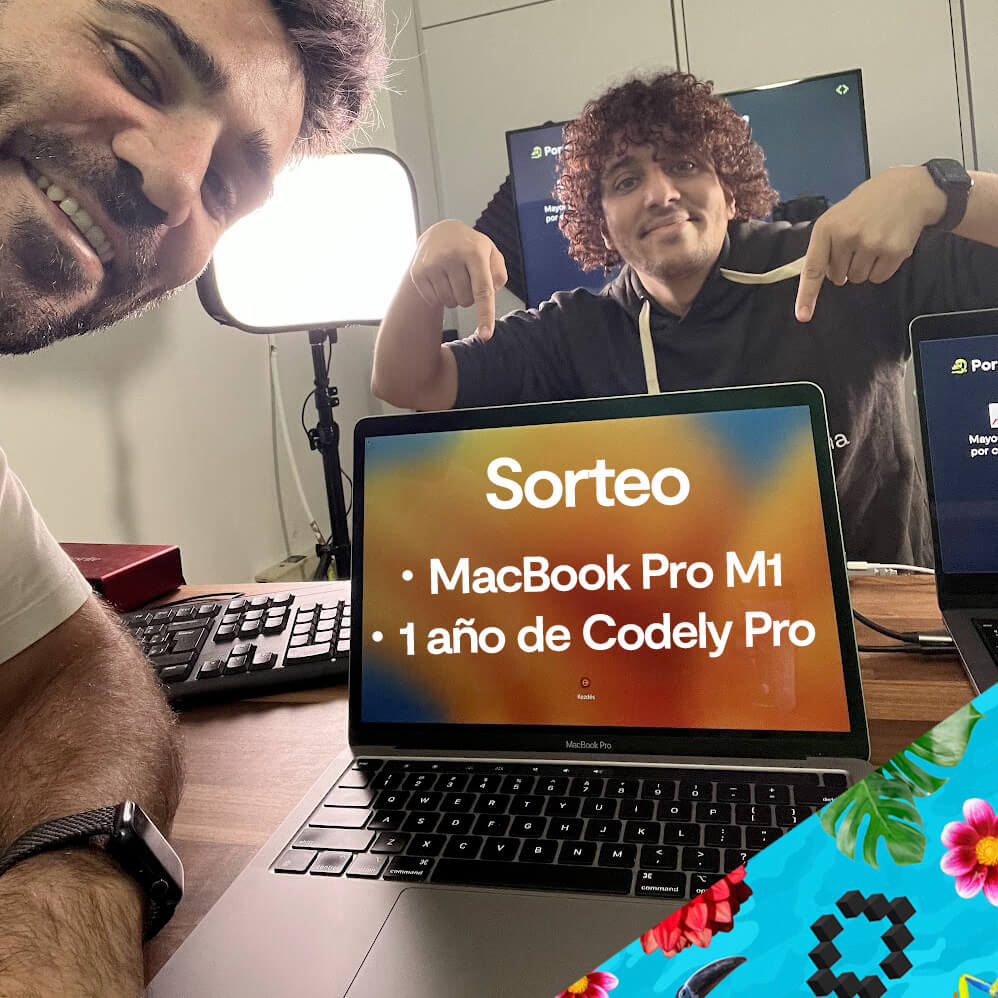
¡Sorteamos un MacBook Pro M1 y una suscripción de un año a Codely Pro por Black Friday!
Puedes participar y es totalmente GRATIS. Envío internacional incluido.
Tienes distintas opciones para participar en el sorteo.
Con cada una de ellas ganas puntos que aumentan las probabilidades de que te toque 😊
Apúntate en 👉 https://t.co/Zb4b9meVxK
Somos honestos: El tema de sortear es por dar a conocer la oferta de BlackFriday. Para gastarnos el dinero en anuncios de Twitter, preferimos que se lo lleve alguien.
Si crees que te pueden interesar cursos de buenas prácticas de programación, OFERTACA de 100€ de ahorro por Black Friday:
https://t.co/aGLLG6Xf25
Este es el nuevo spot de #Andalucía. Una maravillosa tierra que cuando la descubres te rompe y no se olvida.
Estamos orgullosos de lo que somos: andaluces. Y lo queremos compartir con todo el mundo.
#AndalusianCrush
About a year ago, we embarked on a quest to answer one of the most intriguing questions:
If you flip a fair coin and catch it in hand, what's the probability it lands on the same side it started?
Today, we are finally ready to share the results.
Understanding Confidence Intervals
1/ Let’s start with a scenario: Imagine a doctor wants to estimate the average blood pressure of all adults. It's impractical to measure everyone, so she takes a sample of 100 adults and calculates the average blood pressure to be 120 mmHg.
2/ Now, the doctor knows that this is just an estimate, and if she took another sample, she might get a different average. So, how can she express the uncertainty around her estimate?
3/ Enter Confidence Intervals (CIs): A CI is a range of values, derived from the sample data, that is likely to contain the true value of an unknown population parameter.
4/ For example, the doctor might say she is 95% confident that the average blood pressure of all adults is between 115 and 125 mmHg. This is a 95% confidence interval.
5/ How to calculate it? For a 95% CI, you would use the sample mean (average) +/- 1.96 * (standard deviation / sqrt(sample size)). The 1.96 comes from the fact that 95% of the area under a normal distribution curve lies within 1.96 standard deviations of the mean.
6/ So, if our doctor's sample had a standard deviation of 10 mmHg, the 95% CI would be 120 +/- 1.96*(10/sqrt(100)) = 120 +/- 1.96, or 118.04 to 121.96 mmHg.
7/ Interpretation is key: Saying “I am 95% confident that the average blood pressure is between 118.04 and 121.96 mmHg” does NOT mean that there is a 95% chance that the true average falls in this range.
8/ Instead, it means that if you were to take many samples and compute a 95% confidence interval for each one, about 95% of these intervals would contain the true average blood pressure.
9/ It’s important to choose an appropriate confidence level. 95% is common, but in some cases, you might want a higher or lower level. For example, if the consequences of being wrong are very severe, you might choose a higher confidence level, like 99%.
10/ However, higher confidence levels result in wider intervals, and vice versa. So, there is always a trade-off between precision and confidence.
11/ Limitations: CIs assume that your data is normally distributed, which may not always be the case. Also, they can sometimes be misinterpreted or misused, so it’s important to understand them properly and communicate them clearly.
12/ In summary, confidence intervals are a useful tool for expressing the uncertainty around an estimate, but they have their limitations and should be interpreted and communicated carefully.
#Statistics #DataScience
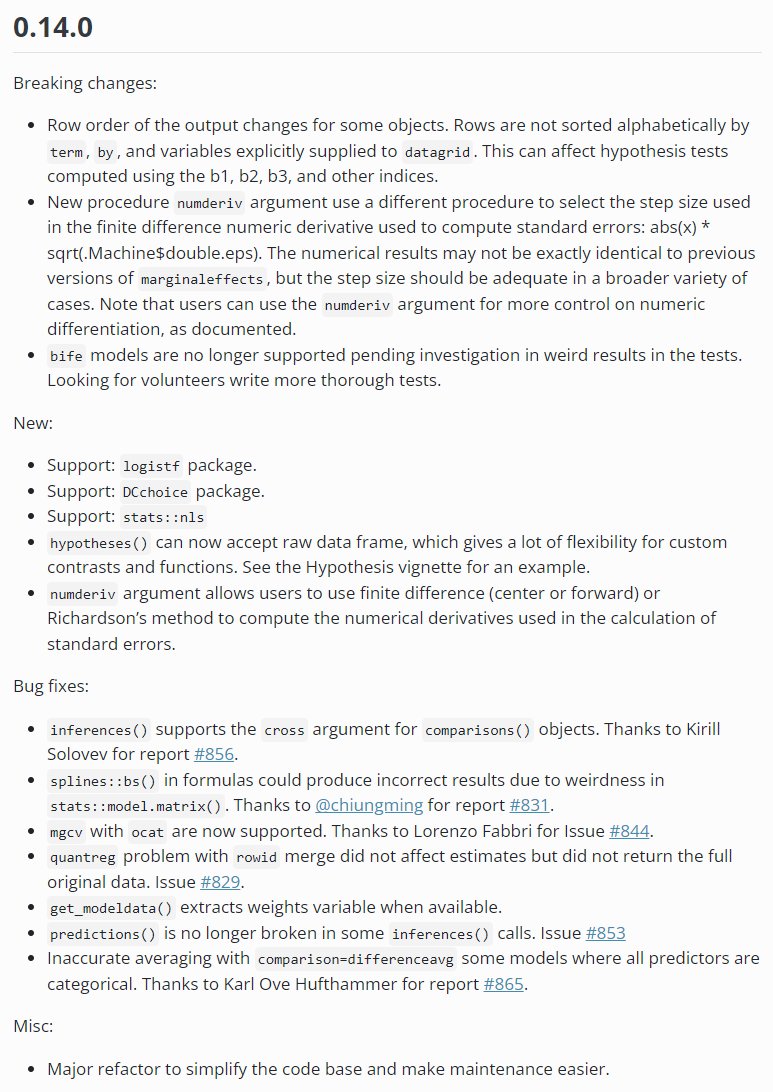
{marginaleffects} 0.14.0 for #RStats offers more reliable estimation of std errors and lots of cool features. Everyone should upgrade now. BTW, we just got a fancy new domain: https://t.co/VGkGBtJTdA While you're there check out the revamped bilingual (R/Python) Get Started page
I used to teach game theory, both undergrad & phd levels. One game I would do at start is version of Keynesian beauty contest: everyone picks a number 0-100, person closest to 2/3 of average wins. Nash is 0. But anyone choosing 0 loses, bc the class aren't (yet) game theorists. >