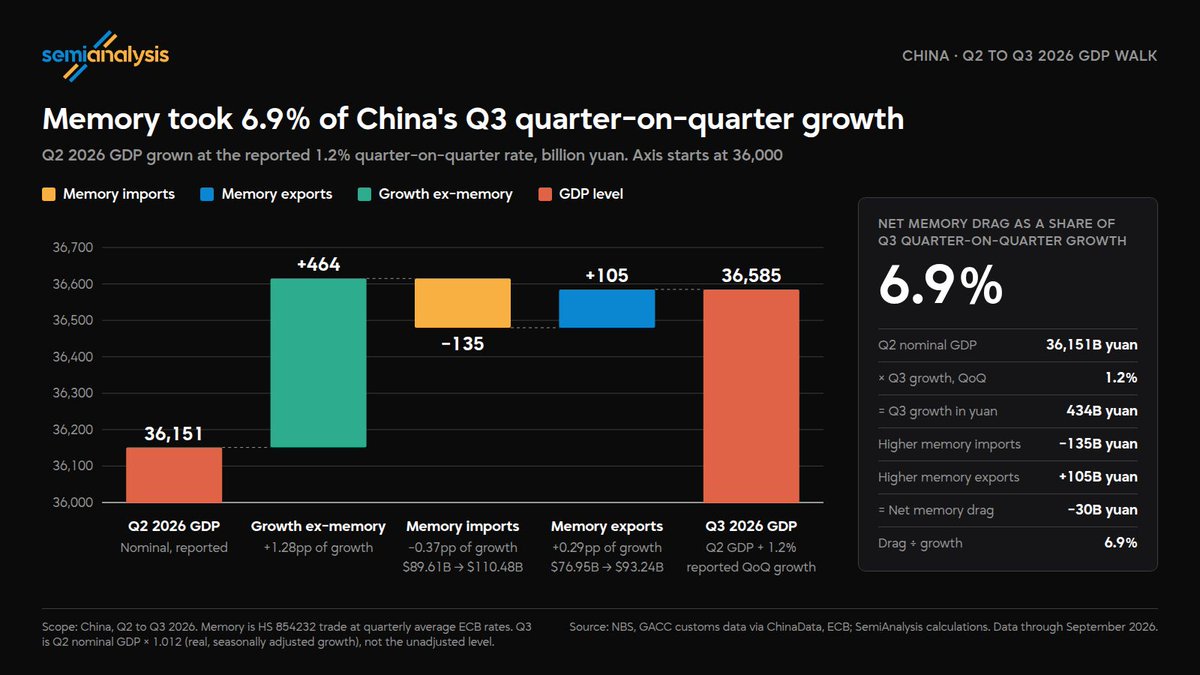
Memory chips ate 6.9% [nice] of China's Q3 GDP growth
China imported $110 BILLION of memory last quarter vs $30B a year ago
Exports only cover $93B. That $17B gap was $13B last quarter and $5B a year ago
Every memory price hike is a tax on China now. Korea collects 58% of it
BREAKING: Retail investors sold -$250 million worth of technology ETFs last week, their largest weekly sale in at least 2 years.
This follows 4 consecutive weekly purchases, totaling +$1.2 billion.
Retail investors have sold technology ETFs in 9 of the last 20 weeks, a frequency not seen in at least 2 years.
Overall, retail purchases of equity ETFs fell to +$2.5 billion last week, near the lowest level since late 2023.
By comparison, retail's weekly purchases averaged +$8.0 billion in the first few weeks of 2026.
Many retail investors were shaken out last week.
LMAO, just saw this from Chinese social network:
A few things Jensen Huang will be announcing after his return:
1. Colette Kress will be appointed general manager of NVIDIA’s Antarctica branch or Mars branch.
2. A dedicated reception room is set up for NYT journalists, located on the north slope of Mount Everest.
3. GPU deliveries for Anthropic’s orders are scheduled out to 2047.
We are VERY EARLY in the AI cycle. 这一点我完全同意
从长期来看,我甚至觉得 AI 最终会催生一轮极其疯狂的泡沫。如果 AGI 真正实现突破的那一天,整个世界会有多 FOMO?大规模失业的恐惧、生产力革命的预期、资本疯狂涌入 AI 相关股票,可能会创造出远超今天想象的估值
那个时候 Semi 和 AI 硬件最终也会受益。但在那一天到来之前,中间会发生多少次大规模出清,恐怕没人能准确预测。
这让我想到 2017 年的 Crypto, 当年 BTC 从 $1,000 涨到 $20,000,随后一路暴跌到 $3,200 ,多年以后,经历几个周期 BTC 突破了 $100,000.
AI 可能也一样。长期前景是光明的,但中间的道路可能比绝大多数人想象得更加曲折. 现在的AI是不是当年BTC $8,000-10,000的阶段没人知道, 很可能还有调整空间.
所以现阶段,我觉得最重要的还是三件事:
1.不要用杠杆去赌长期叙事
2.始终保留一部分 Cash,给自己留下犯错和抄底的空间。
3.乐观的时候不要太乐观,悲观的时候也不要太悲观,尤其不要在市场最绝望的时候交出所有筹码
十年前很多人可能知道央行持续放水是个很大的确定性事件,但是真的能把 BTC 这个周期玩好的人是极少数的。
今天也是一样的,AGI 在未来10年是个非常确定的事件,但是怎么把AI周期玩好,是一个很值得思考的问题。谁能把这个问题想明白,未来十年就能做新时代的AI土豪阶级.
时间会证明,懒得跟二极管辩论
小丑张嘴就喷。记得当初炒山寨、对我群起而攻之的人吗
AI时代multiple变化很大,我这次确实低估了流动性和负面情绪的影响
但即使今天,仍坚信:
we r VERY EARLY in the AI cycle
现在AI 定价,仿佛应用天花板就只有 300B coding?
ps 看多应用,却不看好 Semi,逻辑上说不通
@ShanghaoJin 吉米戴蒙说它们太反商业,太缺乏常识了,很多媒体都是文科小仙男小仙女进去,对社会生产的了解最多限于大学校园“社会实践”,然后开始搞这种弱智文章,misleading已经算最好了,再次就是propaganda,再次是utter garbage& fabricated info
Tim Cook inherited Steve Jobs’ legacy, but NV board will have to dismantle Jensen’s to stay in power.
By turning a leadership transition into a power struggle, they are inevitably changing NV’s culture
Jobs was a legend in AAPL, and Cook’s job was just to preserve this legacy.
But NV’s board, having rejected Jensen’s return, must now prove it can succeed without him, and do things differently. You can expect more compliance, tighter controls, consensus driven decisions, and bureaucracy.
Short term financial earnings will likely become the way to justify itself, at the expense of the aggressive risk taking that made NV extraordinary.
The result? You will see a more bureaucratic, risk averse, politically correct NV. It may remain profitable for a few more years, but it won’t be the one Jensen built.
That’s why Kress the CFO, or any board-appointed successor, may be doomed to fail
I believe the @nvidia board is not acting in the best interest of shareholders nor in a manner consistent with their fiduciary duties.
What we know is that the board fired Jensen or forced his resignation for violating company policy and/or in response to the accusation of an affair with a spy.
They did so without careful consideration of the impact on the company, its customers, its shareholders or other stakeholders.
They rushed to judgment without the benefit of careful due diligence or even with a basic understanding of the facts.
How do we know this?
We know this by how quickly Jensen was fired and how little was known at the time of his firing.
It takes time to convene a board meeting. There was time, maybe, for one Zoom.
And this is a decision that should have been made by a board sitting in person and carefully deliberating the facts once they are known.
And they should have slept on the decision and met again the day after to discuss the facts, the risks and the other implications of their decision.
The timing and lack of information did not allow for careful board deliberation.
While boards can fire a CEO for an inappropriate relationship with a subordinate, it should not be an automatic decision. That is why we have boards comprised of humans and not agents.
A board should consider whether or not such a relationship was consensual or whether it was an abuse of power dynamics. And a board has to consider what the impact of the firing is on all stakeholders.
If I were in this board, I would not have rushed to judgment based on articles in the media. I would have made sure the board had all of the facts so it could make a careful and informed decision.
Boards of Delaware companies have a duty of care which means they must make informed, prudent and good faith decisions. This clearly did not happen here.
What law firm is advising this board?
Or is the board even taken good legal advice?
It doesn’t look like it.
And now the board is compounding its failures by insisting that there is no possibility for Jensen’s return as CEO.
Why is it in the best interest of the company to foreclose the possibility of Jensen’s return and to do so before all of the facts are known? This is yet another breach of their duty of care.
Furthermore, the board has launched an investigation whose scope is unknown. Investigations can be extremely damaging to a company and should be carefully targeted to address whatever facts need to be known rather than be overly broad in scope.
In short, this looks like a series of major governance failures by directors that panicked due to headlines in the media. They likely felt compelled to do something because they were afraid of looking bad in the media, not because it was the right thing for them company.
They couldn’t stand the heat.
The board’s conduct here is shocking for a company of this scale and importance to our country and the world at large, particularly at this moment in history.