I think this doc is a great step forward. Lots of focus on RSI, lots of support for CAISI, and just hopefully more clarity in terms of where we stand. Would love for the other big labs to also make their frontier safety positions clear.
There’s real momentum right now for AI safety policy. Yesterday’s EO on cyber was an important step forward.
We’re proposing a set of ideas for policymakers to consider next and to put the US out in front on frontier safety.
https://t.co/2RlMqd0hLw
There’s real momentum right now for AI safety policy. Yesterday’s EO on cyber was an important step forward.
We’re proposing a set of ideas for policymakers to consider next and to put the US out in front on frontier safety.
https://t.co/2RlMqd0hLw
The OpenAI national security policy team is hiring for my old job!
As the AI stakes get stratospheric, the technical nuances of policy become extremely important. This can be an incredibly positively impactful role for the right person. If you might be excellent at this, I’d love to answer your Qs.
someone i know just donated 10% of their net worth to oppose save our bacon act and has been extremely private about it because it’s still easier to start a conversation about someone’s bottega bag than about charities you’re passionate about
theUSshould lead on AI by continuing to develop the very best models, making sure they're safe, and getting cyber tools into the hands of trusted defenders.
the new EO gets the balance right.
AI is advancing quickly. Society’s ability to manage its risks must advance just as fast.
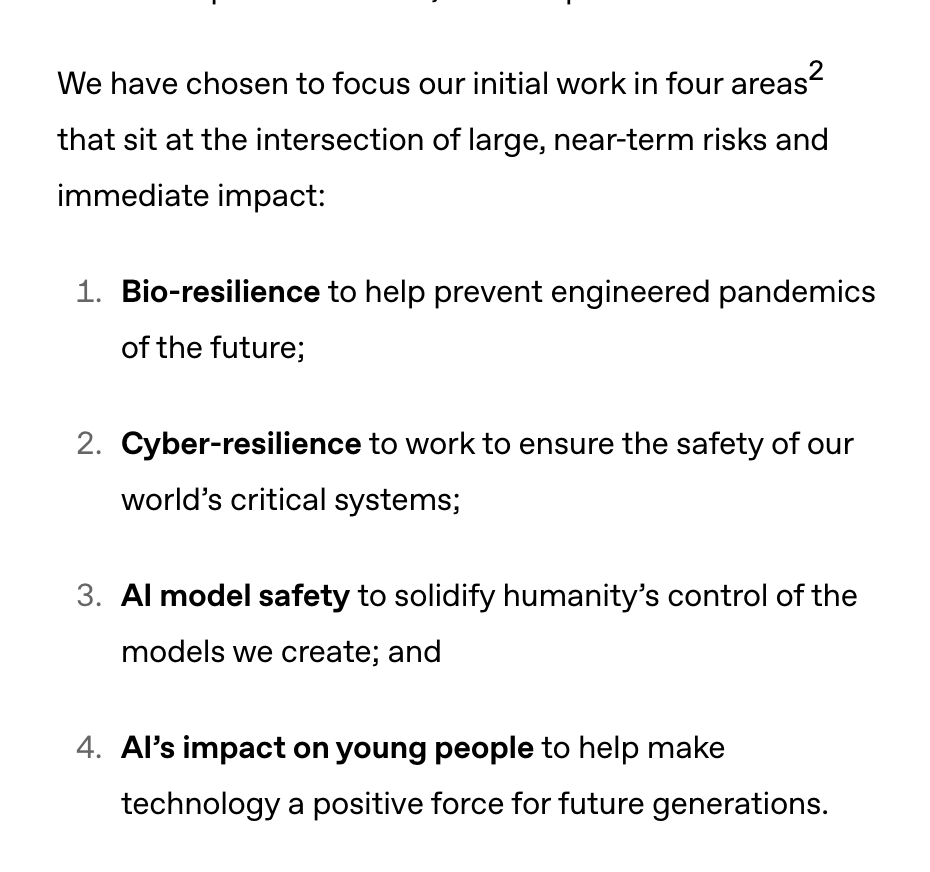
Today we’re sharing our vision for AI Resilience, with more than $130M in initial grants underway across bio-resilience, cyber-resilience, AI model safety, and AI’s impact on young people: https://t.co/mXwqzIYAPm
the frontier labs don’t have “comms problems”. reality right now has a comms problem. what is happening is a little scary and there’s no nice words anyone could say, especially not those profiting from it, that’ll make it feel that much better
I’m happy OpenAI put out this statement. Personally I really dislike a lot of things I’ve heard about LTF, and I’ve donated in personal capacity to Bores.
This is just a small step and people may still rightly be skeptical, but I hope we can earn trust through our actions going forward. One thing I’ve learned through being more engaged in our policy work lately is that there are so many people at OpenAI both inside and outside Global Affairs who care deeply about how the right policies could help ensure that AGI benefits all of humanity.
Anthropic has confidentially submitted a draft S-1 registration statement to the Securities and Exchange Commission.
Pending completion of SEC review, this gives us the option to pursue an initial public offering.
Read more: https://t.co/onGZAhRLvD
It’s a bit tough for me to cash out how the current SB315-level of regulation applies to issues of internal deployment, scheming, and RSI. A little bit for sure, but I’m not convinced it addresses them enough (and to be clear part of the problem here is that there isn’t a good solution I know of to address them, but that could be figured out in the future). These are huge issues and probably merit congressional or executive action, but can we really count on these things happening? Congress is notoriously constipated, and the executive is currently strongly influenced by strong anti regulatory forces.
Solutions here if one really wants preemption might be, alternatively 1/ articulating how these issues are well covered by current laws, if i am wrong in my assessment that they aren’t, 2/ partial preemption limited to the types of solutions contemplated by the federal laws, but allowing states to pass laws related to substantially different solutions, or 3/ a sufficiently flexible federal framework proposal, eg that delegates regulatory power to an appropriately equipped federal agency that has the ability to move fast.
I’m sure the anti preemption crowd wouldn’t like some of these solutions, but they at least seem like a step towards a rejoinder.
@deanwball Or more precisely, seemingly all the discussion I see seems to reach “and therefore we can’t have preemption” as a conclusion, but seemingly ignores the problems you highlighted with that
I agree, but AI is a very fast moving technology where best practices might evolve at a pace that way exceeds congress’ ability to act, and this is what worries me about preemption. There are potential solutions but I’m not seeing a lot of serious discussion of this problem right now.