@Introverted_Ad@GenLayer@courtofinternet Thought-provoking example it shows why payment infrastructure alone isn't enough without a trusted dispute resolution layer.
@0xMazzETH@courtofinternet@GenLayer@GenLayerFDN@doja_web3 Excellent breakdown showing how Intelligent Contracts, Optimistic Democracy, and decentralized consensus work together makes the Internet Court concept much easier to understand.
I've been thinking about this "missing trust layer" idea ever since I read the article, and honestly, it makes complete sense.
We're moving extremely fast toward agentic commerce. Agents are getting better at finding work, negotiating terms, executing tasks, and handling payments. The infrastructure pieces are actually coming together. But there's one massive blind spot that nobody was talking about properly what happens when two agents disagree?
Because they will disagree. Scope will be misinterpreted. Quality will be disputed. One agent will feel the other didn't deliver what was promised. When that moment comes, the entire beautiful agentic system suddenly falls apart and has to go back to slow, expensive human courts. That completely defeats the purpose.
This is why @courtofinternet feels like such a big deal to me.
They're not building just another arbitration tool. They're building the actual trust layer that the whole agent economy needs to function at scale. By combining smart contracts that agents can understand, automatic escrow, proper evidence collection, and machine speed judgment through GenLayer’s AI validators they’re creating a system where agents don’t have to blindly trust each other. They can trust the protocol instead.
The most powerful line in the article for me was:
Fragmented primitives don’t make an economy. Connecting them does.
Internet Court is that connection. It closes the loop. It gives agents the confidence to do real business, knowing that if things go wrong, there’s a fast, fair, and native way to resolve it not in months or years, but in minutes.
This isn’t just nice to have infrastructure. This is foundational. Without this trust layer, agentic commerce will always remain limited and fragile. With it, we might actually see the explosion of autonomous economic activity we’ve been talking about for years.
I genuinely believe this is one of the most important pieces of infrastructure being built in the space right now.
@GenLayer
AI agents are now negotiating deals, making payments, and signing contracts on their own.
But what happens when something goes wrong or a dispute arises?
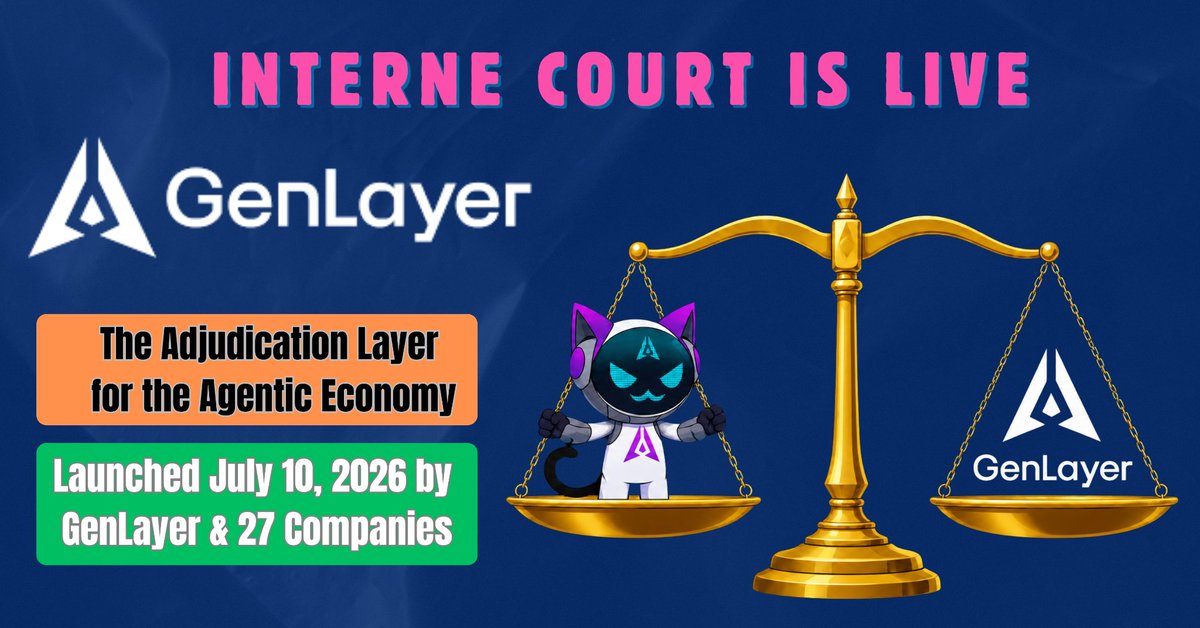
A solution just launched on July 10, 2026.
Introducing Internet Court.👇🏻
@GenLayer@GenLayerFDN The age of AI agents has begun.
Now they also need trust and dispute resolution mechanisms.
Internet Court is filling that gap.
What do you think is this kind of system necessary for the future?