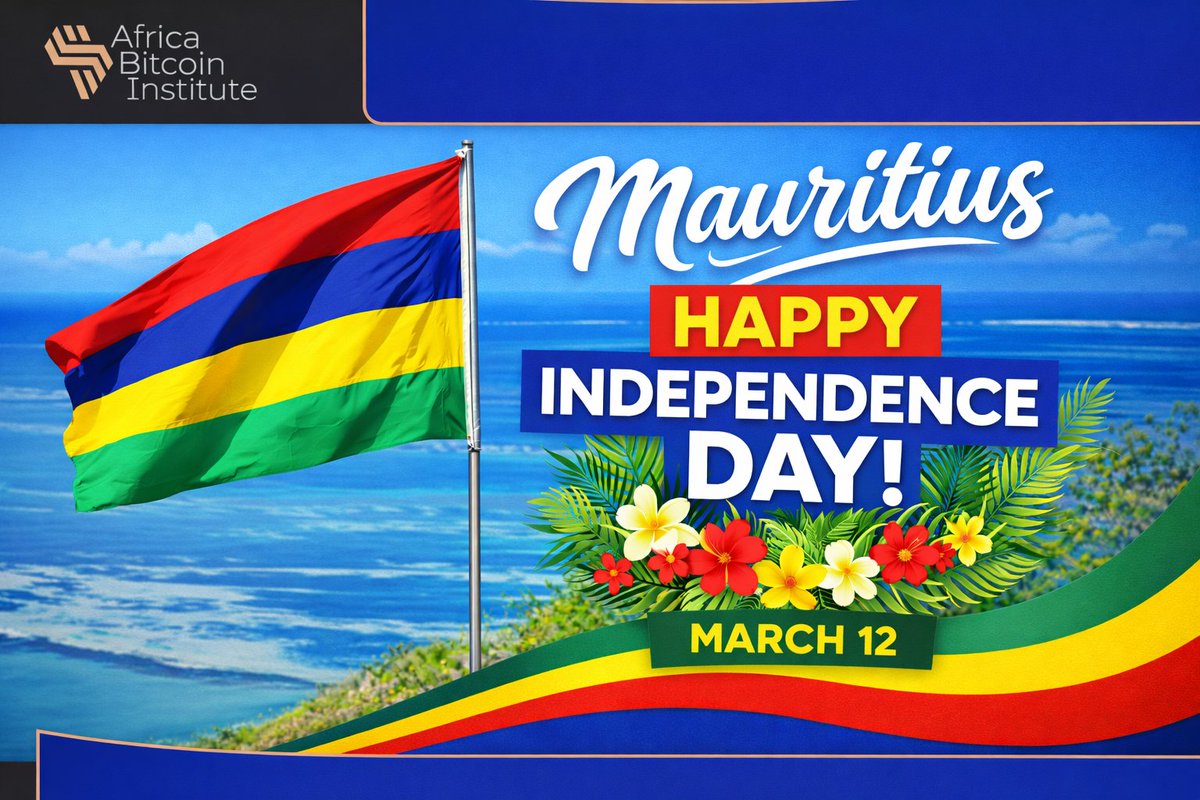
Independence represents more than political autonomy in a country it reflects the power of self-determination and the ability of people to shape their own future.
In today’s digital age, conversations about independence increasingly include financial sovereignty.
Innovations like Bitcoin highlight new possibilities for individuals and businesses to participate in a global, open financial system built on transparency and accessibility.
As Mauritius continues to grow as a dynamic financial and technology hub, the values of independence, innovation, and resilience remain central to its journey.
Happy Independence Day, Mauritius.
#Mauritius #IndependenceDay #Bitcoin #FinancialFreedom #AfricaBitcoinInstitute
Today marks 69 years of Ghana’s independence (1957–2026) 🇬🇭🇬🇭
To commemorate the occasion, we spotlight Ghana as part of our ongoing effort to track and analyze emerging digital asset policies across Africa.
This week’s policy watch looks at recent regulatory signals in Ghana, what they point to, and what they may mean for Bitcoin.
Across Africa, much of the regulatory oversight tends to focus on financial activities, while protocol-level distinctions are largely overlooked. As a result, Bitcoin is often grouped with the broader “crypto” universe, despite its distinct design and monetary architecture.
One notable development is the establishment of the National Virtual Asset Literacy Initiative (NaVALI) by the Bank of Ghana to educate the public on virtual assets, their risks, and broader economic implications as Ghana positions itself to build a more informed digital asset ecosystem.
For Bitcoin advocates willing to engage, NaVALI creates a window to engage policymakers and clarify how emerging regulatory structures distinguish Bitcoin from the broader crypto field.
Read the full publication here: https://t.co/xAEgnuR1eu
@BankofGhana @DrJPA_Siama #GhanaIndependenceDay #DigitalAssets
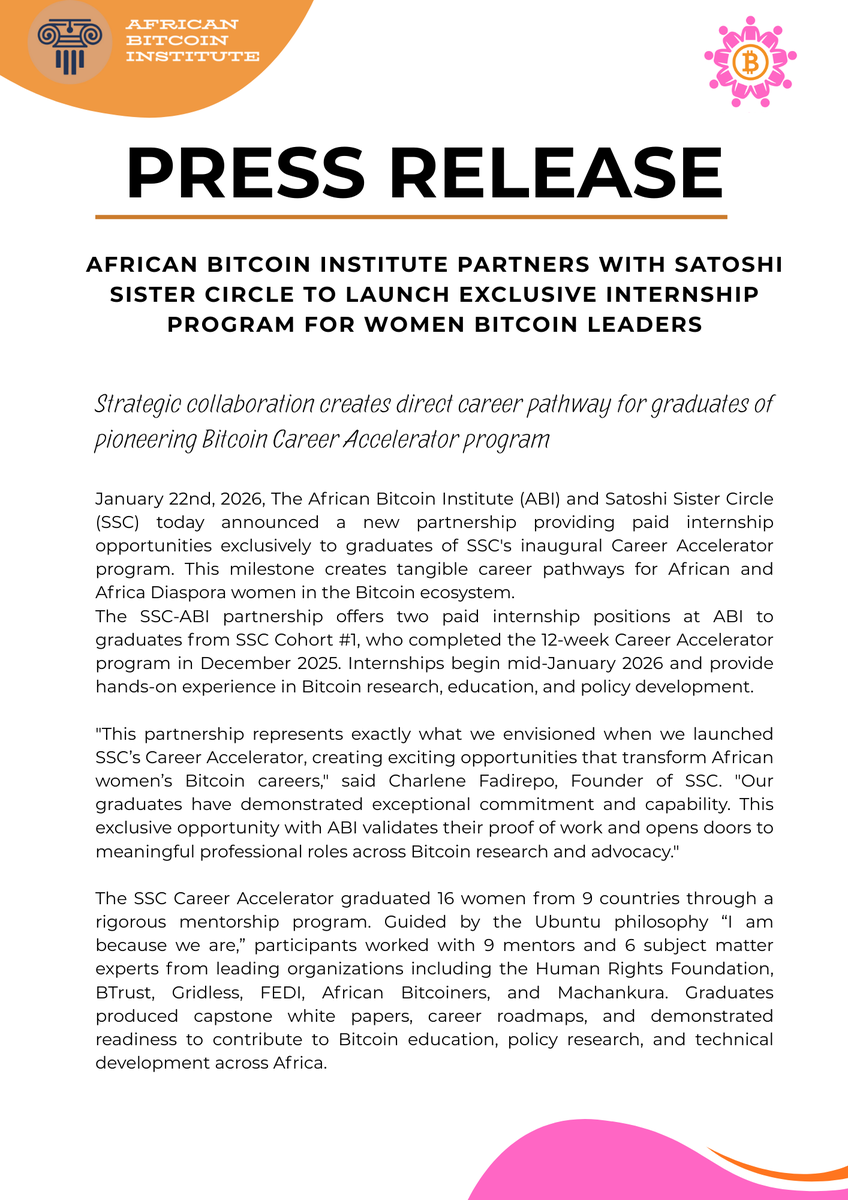
We’re incredibly excited to partner with @SatoshiSisters to launch a paid internship program for women Bitcoin leaders 🌍✨
This collaboration is about building real career pathways while advancing African-centric research, scholarship, and authorship and ensuring African women are shaping Bitcoin policy, research, and leadership across the continent.
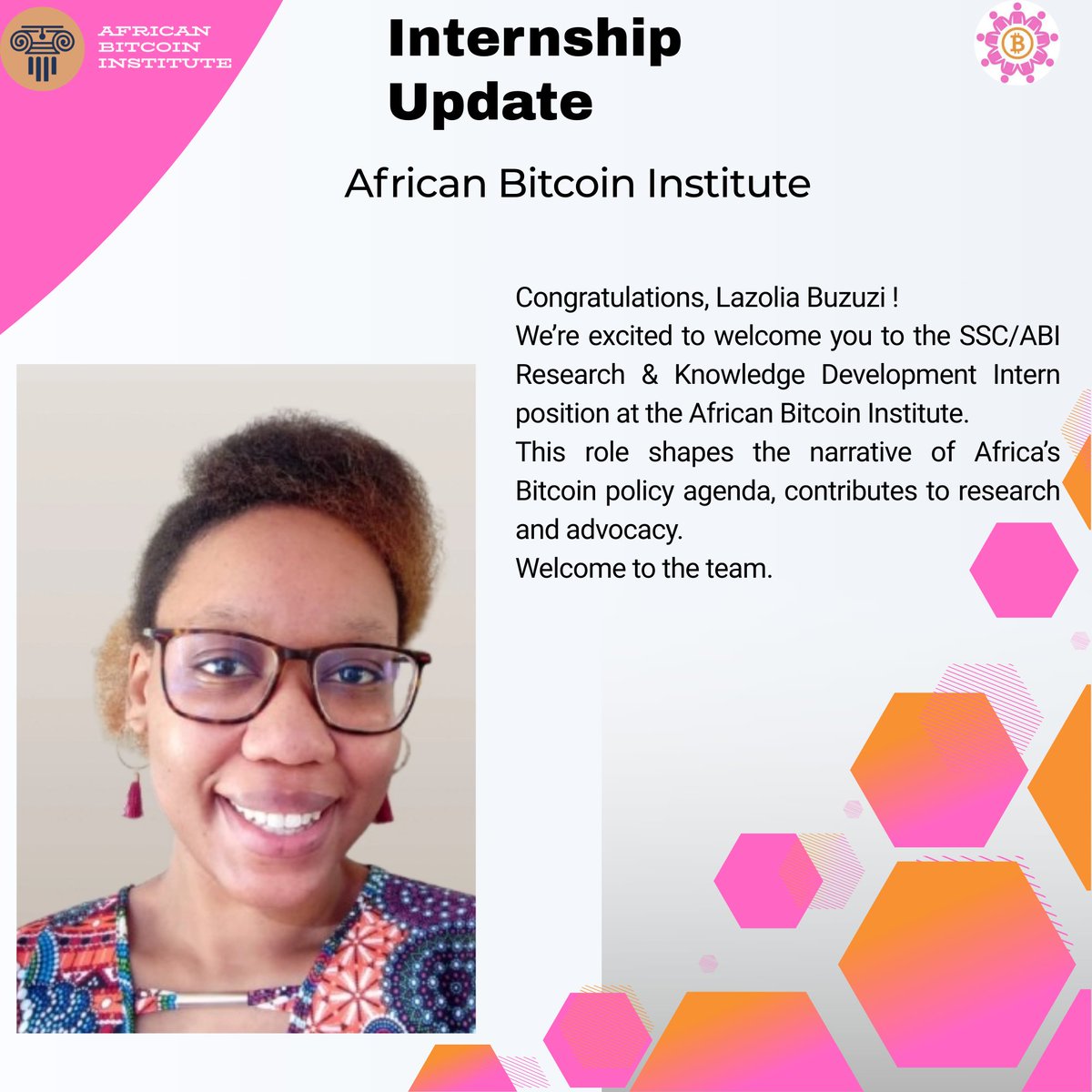
We're especially proud to welcome @LazoliaB in this first cohort.
Big news for women building in Bitcoin ⚡
We’re thrilled to announce a powerful new partnership 👇
@AfriBitInst × @SatSisterCircle
Launching an exclusive paid internship program for the next generation of women Bitcoin leaders. 🚀
8/8 Congrats, Lazolia Buzuzi! 🎉
She’s the first @SatSisterCircle × @AfriBitInst intern, chosen from Cohort 1 Applicants for her skills, passion & leadership. She joins as Research & Knowledge Development Intern (Q1 2026). Wishing her success! @CharFadirepo@AnaiseKanimba
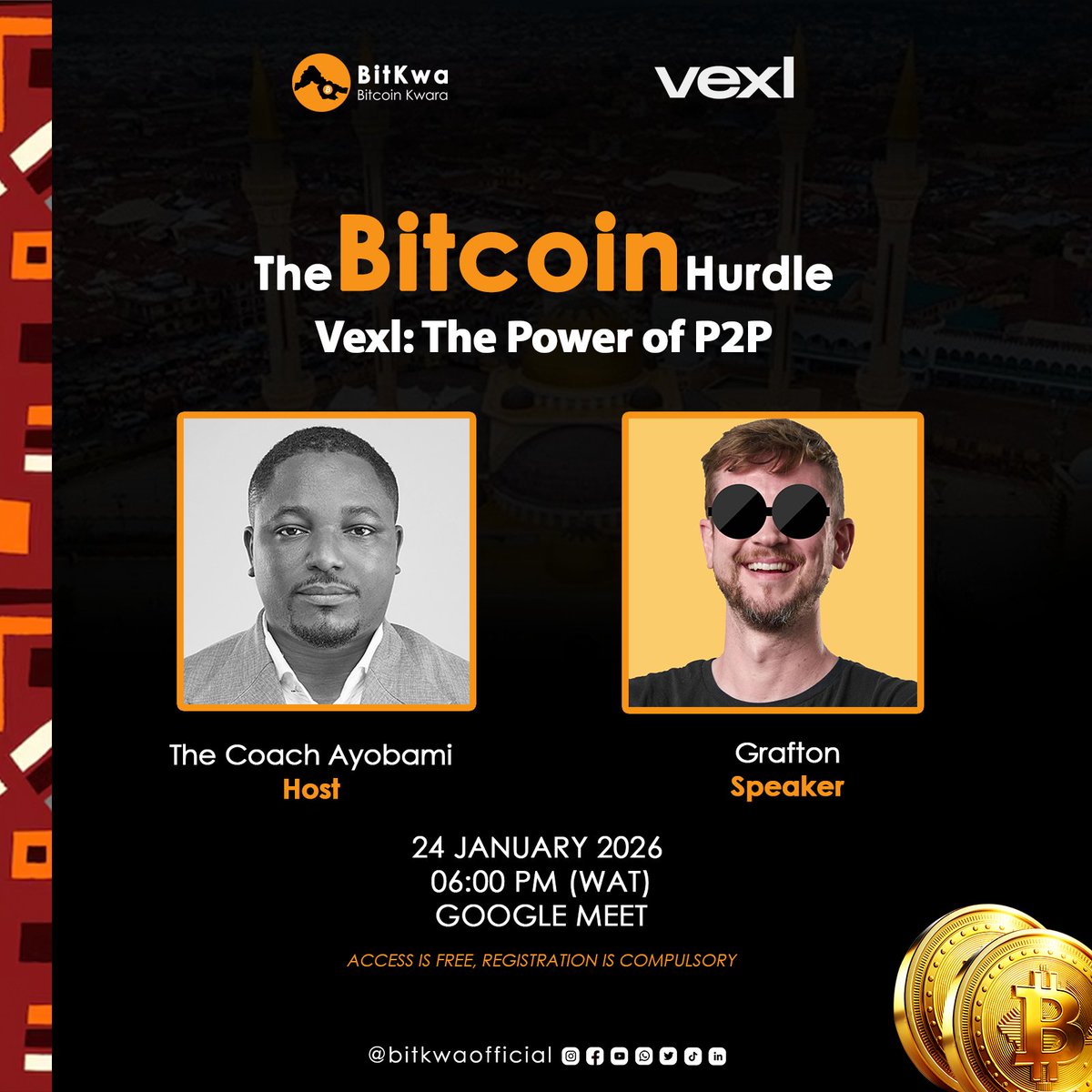
BitKwa x @vexl : The Power of P2P
If you care about self-custody, censorship resistance, and real Bitcoin adoption, this session is for you.
Join the host @thecoachayobami & speaker @satsdisco
Secure your spot: https://t.co/eIpkrQVp0o
#nokyc#p2p#Bitcoin#bitkwa#Africa
On The State of Bitcoin Literature in Africa, we examine Tlhokomelo Monethi’s study, Is Africa Ready to Join the Blockchain Revolution?
The study finds that Africa’s constraint on blockchain-based financial adoption is not technology but political economy. Governments recognize the potential, yet favor CBDCs and regulatory sandboxes that preserve institutional control.
Crucially, decentralized adoption has emerged from use, not policy endorsement. This reframes the challenge: not how states control blockchain-based finance, but how political frameworks can accommodate systems like Bitcoin that function without state intervention.
#Bitcoin #BitcoinResearch #Africa #PoliticalEconomy
https://t.co/JIt5aGFm8T
🎙️ Join us for a landmark X Space: Celebrating incredible women driving Bitcoin adoption across the continent!
We’re gathering pioneering women from around Africa to share their journeys, insights, and visions for how Bitcoin is shaping Africa’s economic landscape.
Amazing Speakers like:
1. Janet Maingi @nduku_jay
2. Sabina Gitau @waithiraah
3. Tebo Makgakga @tebogo_makgakga
4. Mary Imasuen @mary_imasuen
🗓️ Date: Thursday, Dec. 18, 2025.
⏱️ Time: 4 PM UTC [5 PM WAT | 6 PM CAT | 7 PM EAT]
This is a conversation you need to hear.
👇 Set a Reminder!!!
https://t.co/nY7vEHbyqy
Nigeria’s payment rails are modernising, but access is shrinking. Banks are closing low-balance accounts in a country where only 52% are banked and poverty is rising. And despite ~93% mobile penetration, mobile-money use remains weak compared to elsewhere in Africa, citing regulatory concerns and low integration of digital payments to small businesses.
Bitcoin in Nigeria is already practical. With tools like @MavaPay and @iPayBTC — supported by local circular economies (@BitKwaofficial, @BitcoinAnambra, @BitcoinCalabar), educators and advocates such as @story_bitcoin — people are buying, saving and settling in sats, even with ₦1,000 (≈$0.69 USD)
💡Full insight: https://t.co/jSTgcwD9py
On the State of Bitcoin Literature in Africa:
📊 Evidence from Budree et al. (2023) shows blockchain can lower costs, improve recordkeeping and support digital IDs for wider financial access in South Africa.
Key stats:
🔹 54% account ownership in developing countries vs 94% in OECD
🔹 27% of South Africans remain unbanked
🔹 <30% of low-income adults hold formal accounts
Low-tech tools such as Machankura show how practical access can emerge in low-connectivity environments.
🔗 Full review: https://t.co/uKQXKkTW4w
Yesterday, @jeremyalmond of @paystand made the case for Bitcoin circular economies as a catalyst for change at an event held during the United Nations' General Assembly week.
He called to bitcoin "freedom money" and "savings technology for the world."
https://t.co/v5qmxszavm
Insightful report by @afribitcoiners ->
While global Bitcoin mining is measured in hash rates, in Africa, it’s about cheap energy, electrification, and inclusion.
🇪🇹 Ethiopia mines 1 BTC for $1,986 vs $107k in the U.S.
🇲🇼 Malawi’s mini-grids have lit 1,800 homes.
🌍 Yet 600M Africans still lack electricity — even though it’s the cheapest place on earth to mine Bitcoin.
This is the Bitcoin Energy Paradox.
We are proud to announce the release of our landmark report, "Bitcoin Mining in Africa: Powering a New Era (2025–2030)". This is your essential guide to understanding how Africa is charting a more responsible, sustainable, and profoundly renewable path for Bitcoin mining.
A special and heartfelt thank you to @DSBatten for his invaluable contributions to this report and his tireless work across the Bitcoin mining sector.
A special thankyou too to @nduku_jay and @nemozen for their invaluable contributions to this report and the overall African Bitcoin Mining sector.
"Africa is a place where people are ACTUALLY using Bitcoin peer-to-peer."
That’s why there’s a need for institutions like @AfriBitInst: native-driven policy that’s NOT just “copy-pasting” from Washington D.C.
🚨Just a few more days left to apply for the Research Fellow position at the Africa Bitcoin Institute! Applications close soon.
Don’t miss the chance to contribute to Bitcoin policy research for Africa.
Apply now 👉 https://t.co/dmCQhtgecl
🚨 The Africa Bitcoin Institute is hiring Research Fellows!
Explore how Bitcoin can advance financial inclusion, cross-border trade, energy investment, innovation, and regulatory development in Africa.
💼 Paid | 🌍 Remote | 📅 Apply by June 30
🔗 https://t.co/L9Lp5vUNvs
#Bitcoin #Africa #PolicyResearch #Hiring #ABI






![afribitcoiners's tweet photo. 🎙️ Join us for a landmark X Space: Celebrating incredible women driving Bitcoin adoption across the continent!
We’re gathering pioneering women from around Africa to share their journeys, insights, and visions for how Bitcoin is shaping Africa’s economic landscape.
Amazing Speakers like:
1. Janet Maingi @nduku_jay
2. Sabina Gitau @waithiraah
3. Tebo Makgakga @tebogo_makgakga
4. Mary Imasuen @mary_imasuen
🗓️ Date: Thursday, Dec. 18, 2025.
⏱️ Time: 4 PM UTC [5 PM WAT | 6 PM CAT | 7 PM EAT]
This is a conversation you need to hear.
👇 Set a Reminder!!!
https://t.co/nY7vEHbyqy](https://pbs.twimg.com/media/G70C-1VXcAAFavl.jpg)





