Big tech’s betrayal of America — unveiled.
Inside the untold story of how big tech giant Qualcomm ripped-off one of the most important patented innovations in American history and shipped it off to China with the help from the US government.
Did the Obama Admin provide cover?
“. . . this shouldn’t be tried to a jury, in my opinion.”
That’s what the judge said.
Then ruled that our patents require capacitors to down-convert radio signals.
- They can’t.
- Our patents don’t claim that.
- Science doesn’t support it.
Appeal filed for the second time.
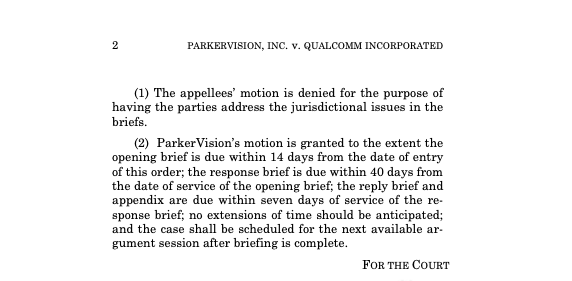
Procedural win: the Federal Circuit denied Qualcomm’s motion to dismiss our appeal, ordered jurisdiction to be briefed with the merits, and put our appeal on an expedited track.
We file the first brief in 14 days. Then a fast briefing cycle. Last brief due March 23.
We’re anxious to put the facts on the record. More to come. Thank you for the support and for following our story, Against The Giants.
@anduriltech@DeptofWar Agree. We can’t win with blueprints alone. Some of that funding needs to go to real IP protection and enforcement, so our adversaries can’t just copy our tech without repercussions.
America loves a David vs. Goliath story.
But we don't talk about what happens when Goliath controls the rules, the courts, and the system itself.
Here we are.
@CommerceGov Restoring manufacturing (our capabilities, not just jobs) also means keeping the IP and technical know here so we don't offshore the future again.
@CommerceGov Agree, and it’s not just manufacturing jobs. We’ve been exporting IP and technical know-how too. If we want real resilience, we need to keep the high value engineering, process knowledge , and proprietary tech here, not just the final assembly.
The patent system wasn't built to protect corporations.
It was built to protect inventors.
So what happens when it stops working as intended and the biggest players learn to exploit it?
That's exactly what we're up against.
@howardlutnick@MicronTech Absolutely, bringing semiconductor manufacturing home is a huge win for jobs and national security. The other half is ensuring American innovators' IP is strongly protected so we don't just build it here, but own and defend the breakthroughs too. Great step forward!
Some innovations don’t fail because they’re wrong.
They fail because they challenge what everyone else has already accepted as “impossible.”
More often, it's small innovators who disrupt the market - not big tech.
This is what must be protected in America.
America was built by people who couldn’t stop tinkering.
Before billion-dollar monopolies.
Before Big Tech capture.
Before innovation became something you had to ask permission for.
This is how real inventors start. 🇺🇸
Agree, supporting domestic semiconductor manufacturing is important. We also need to deal with U.S. tech giants setting up shop in China and transferring critical IP, which is the cost for market access. Tighten outbound tech controls, enforce US IP, and rebuild a patent system that defends innovators.
It’s bad enough having to endure years of litigation while the infringer keeps profiting off your invention and uses those profits to bankroll the fight against you. Without access to outside capital, smaller innovators get bled dry, forced into lowball settlements or pressured to walk away. This bill wouldn’t have curbed abuse; it would’ve handed Big Tech another tool to choke off startups and bury legitimate claims.
You’re right to raise alarms. And we should be honest about the full pipeline: it’s not just infiltration. U.S. tech giants set up shop in China and effectively teach critical IP and know-how to do business there. That outcome was shaped by years of policy and business choices. Secure the labs and rebuild the patent system so innovators can actually defend what they create.
We keep saying speed wins. So, let’s remove the biggest brake on speed: a hostile patent system that encourages IP theft - which, surprise, surprise, often ends up in China. The patent system didn’t degrade in a vacuum; those guardrails were dismantled under pressure from Big Tech lobbying, leaving small inventors and American national security to pay the price.
.@SECWAR "In modern warfare, the fastest innovator will be the winner – and no one can out-innovate an American entrepreneur who has been liberated from the constraints of a stifling bureaucracy.
The old era ends today: We’re done running a peacetime science fair while our adversaries are running a wartime arms race."
We should prioritize American values, yet the corporate pursuit of short term profits often undermines them. By transferring critical intellectual property to China, we expose ourselves to long term strategic risks. It is increasingly difficult to uphold our values and counter the Chinese Communist Party’s influence while simultaneously training and equipping them with the technologies that strengthen their supply chains.
SENATOR CRUZ: “We don’t want China’s values of surveillance and centralized control by the communist government governing AI. We want American values of free speech, of individual liberty, of respecting the individual.”
We’re not just losing to China. We’re handing them the trophy.
When American companies give away our most advanced technologies, the ultimate loser isn’t business - it’s America.
Innovation built here is being taken overseas, copied, and used against us.
This isn’t competition.
It’s surrender.
It’s not just universities. It’s the same playbook everywhere: Corporations export the know-how, then China beats us with it. America can’t lead if we do not defend our own innovation. China does not let their companies set up shop in the United States to teach us their IP.
Nearly $6 billion from China and Hong Kong has flowed into U.S. universities. This isn’t philanthropy—it’s a strategic effort by the CCP to access sensitive research and recruit talent.
The Select Committee will continue to expose how the CCP uses U.S. campuses to steal research, influence academic discourse, and undermine American interests.
https://t.co/1iWiDzco6G