Asiko ntoo bo fun ijagbara wa sile lowo oko amunisin awon eeyan wa. kin ni kati wi, pe awon ti a gbe oju okun le, ase won o jo aniagbaja. RT is an endorsement.
We both left home at 18.
You cleared JAMB
I got recommended.
You got UNIVERSITY,
I got NDA.
You pursued your degree,
I had the toughest training.
Your day started at 7 and ended at 5,
Mine started at 4 till 9 and
Some nights also included.
You had your convocation ceremony,
I had my POP.
Best company took you and
Best package was awarded,
I was ordered to join my platoon
With 2 stars piped on my shoulders.
You got a job,
I got a way of life.
Every eve you got to see your family,
I just wished i got to see my parents soon.
You celebrated festivals with lights and music,
I celebrated with my comrade in bunkers.
We both married,
Your wife got to see you everyday,
My wife just wished i was alive.
You were sent to business trips,
I was sent on line of control.
We both returned,
Both wives couldn't control their tears, but
You wiped her but,
I couldn't.
You hugged her but,
I couldn't.
Because I was lying in the coffin,
With medals on my chest and,
Coffin wrapped with tricolour.
My way of life ended,
Yours continued.
We both left home at 18.
I dedicate this to every soldier and uniform person out there, we don't understand what you do and the sacrifices you make, but know that we are eternally grateful!
In October 2022 during the 2023 election campaigns, Candidate Asiwaju Bola Ahmed Tinubu was asked a question on climate change at the Arewa House and he answered:
"...the climate change is a question of how do you prevent a church rat from eating a poisoned holy communion..."
As expected, hell broke loose that time with many who simply didn't understand the analogy fuming that he insulted Christianity (of course there was already the Muslim Muslim ticket tension) while others claimed he was talking rubbish.
I remember that I wrote epistles trying to educate people but few were interested with many saying that Tinubu simply didn't understand the question.
It was one of those few moments that I really felt bad about the level of ignorance among the so-called educated folks in Nigeria and their rigidity to learning.
I'm sure that even after today, many will still not understand the analogy, but that's expected.
What prompted me to revisit this video was the confirmation that Shell has secured an unprecedented tax credit from the Tinubu administration on the $20 billion Bonga South West deep water project to the tune of $11 per every barrel produced from the offshore platform.
When climate change discussions take place in international fora, the central topic has always been about reducing consumption of fossil fuels (mostly crude oil) so as to reduce CO2 emissions that fuel climate change the most.
Tinubu, a former player in the oil industry knew this relationship between climate change and oil exploration/exploitation. But just like Kemi Badenoch and leader of the UK Conservative Party, Candidate Bola Tinubu was of the firm opinion that countries especially poor developing countries like Nigeria who have natural deposits like crude oil must not be made to sacrifice exploiting their fossil fuel on the alter of mitigating climate change.
For the "church rat", it is always a metaphor used to describe poverty because there is usually no food in the church and a rat you see in the church will likely be impoverished. One of the foods a church rat is most likely to come across is the holy communion.
Now imagine, you keep a poisoned holy communion (unleavened bread) in the church, the church rat will still eat it nonetheless since it has very few choices outside the holy communion.
So, Tinubu knew that for Nigeria, it's not even an option to scale back crude oil exploitation because it is the major revenue earner for the country and if it was a poisoned chalice, Nigeria being a church rat has few options other than to consume it.
He was instead talking about how to even encourage the exploration of more of this poisoned holy communion (oil and gas), telling the world that he would even give incentives to companies to invest in oil and gas exploration in Nigeria so that we can compete with Russia. He was not going to commit to scaling back Nigeria's oil production in the name of climate change action. Clarity.
As President, he has not looked back on this commitment. In fact his argument in climate change events has literally been, "if you want us to scale back on exploring our oil and gas deposits, will you provide us with free money to finance our expenditures? Would you finance our transition to alternative energy sources?"
At the Arewa House in Kaduna in 2022, Tinubu was being diplomatic in his response. He didn't want to outrightly commit to sacrifices he knows Nigeria cannot make, but also, he didn't want to dismiss the climate change challenge as a non-issue or live in denial of it (as Trump did and probably does) because Nigeria's savanna belt is actually feeling the impact of climate change and Arewa elites see it as an existential problem.
President Bola Tinubu is really underrated by many people. Fashola said it before that his placid look makes his opponents to underestimate him, often at their own peril.
In a country where economic policy is often shaped as much by politics as by principle, the rise of Taiwo Oyedele signals more than a career transition. It reflects a deeper shift in Nigeria’s governance instinct: a growing reliance on technocrats to fix problems that are fundamentally political.
For years, Oyedele operated in the background of Nigeria’s economic architecture. As a fiscal policy partner at PricewaterhouseCoopers, he advised governments on tax systems, revenue mobilisation, and fiscal reform. His work focused on a persistent structural weakness: how to build a tax system capable of funding a modern state in an economy where compliance is low and informality is high...
Read more: https://t.co/kuZVJdaJVY
A man was filmed during the heat of the 2023 elections shouting, “Lagos is not negotiable, even if we lose the presidency, we must not lose Lagos.” This was at a meeting held in Abia State.
They then transferred over 500,000 voter cards to Lagos in a bid to take control of a Yoruba land.
And the liberals are telling us we are doing too much… it will not be well with you all.
For correction sake: This information is FALSE, Asiwaju Bola Tinubu was the first to release a very detailed Manifesto, issues on Student loans which birthed NELFUND Student loan scheme and other policies came from it .
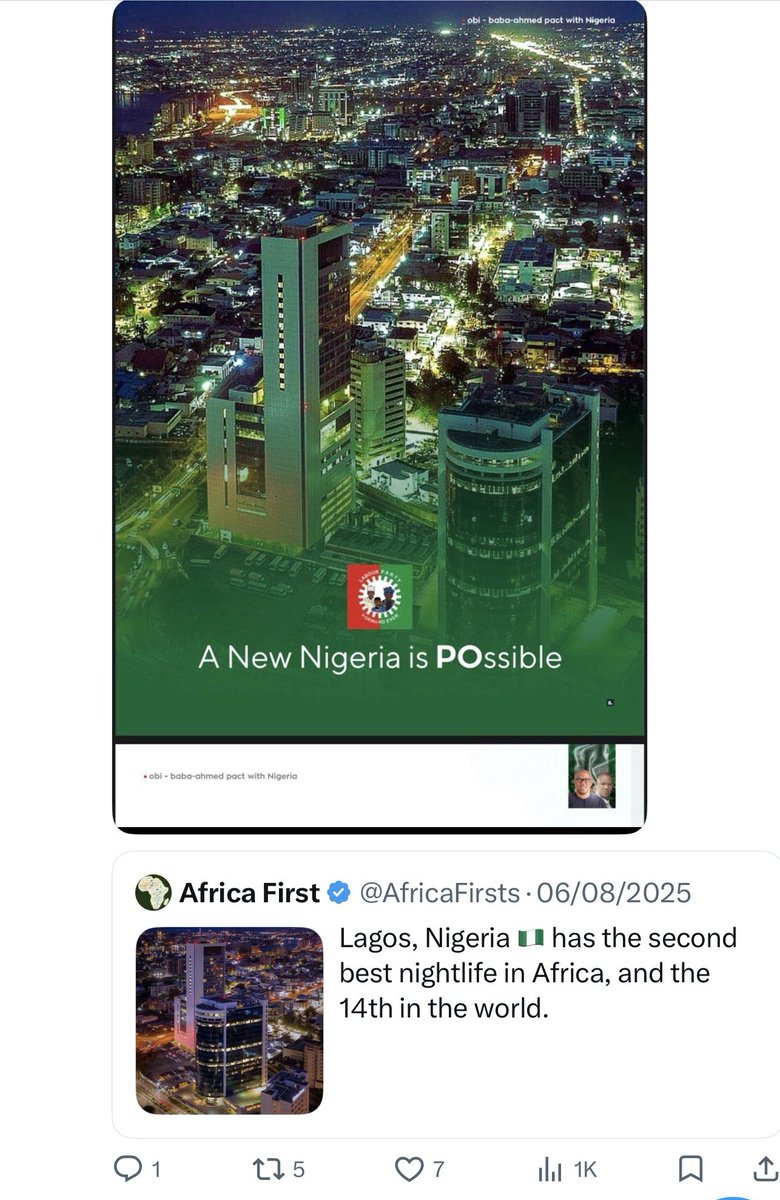
As at that time, Peter Obi said clearly that he does NOT need a manifesto (video evidence attached). After much pressure, his team quickly put something together, they later used a picture from Ikoyi/VI as his cover page which was heavily criticized (picture evidence attached), people said he should have used a picture from Anambra which he governed.
Please feel free to support your candidate BUT Say No to FAKE NEWS.
Kayode Oloko, co-founder of Yetunde - The Yoruba dating App, reveals that the feedback has been amazing — and it’s not just from Nigeria! Yoruba singles in the UK and across the diaspora are already using the app to meet meaningful connections and find someone who truly understands their culture and values.
Yetunde App is safe, trusted, and built to bridge the gap for Yoruba singles everywhere. Keep downloading, keep sharing, and join the community that’s connecting hearts globally ❤️
The new Electoral Act 2026 has more weight to cut the wings of all politicians to size. Good that NASS saw all of that and still went ahead to pass it into law....
It means we are growing in our political space.....
The unnecessary noise about LIVE TRANSMISSION overshadowed major aspects that ought to be the force of deliberation in the public space...OAPs were using their ignorance to push LIVE TRANSMISSION instead of looking more closely into weightier matters in the Acts ..
In case you missed it, in this essay I write about the loss of Hausa names in Northern Nigeria in favour of Islamic (and Christian) names. I look particularly at Arabic and Qur’anic names, carried into Hausa life through Islam and naturalised so thoroughly that they now wear the mask of indigeneity.
Where, oh where, have the Hausa names gone?, by @elnathan_john https://t.co/1Fk9r1wzVm
Yes you are right!
Decentralisation/ Restructuring has started and he is taking them one by one....final lap will be some form of resource control...
Key Laws that has enabled decentralisation to States:
1) New Electricity Act
2) VAT Act ( Revenue allocation)
3) LG Autonomy
New one on pipe through Constitutional amendment...
1) State Police
Any other that have missed ?
This is a great article and Nigeria is a good case study for it.
Nigeria's development failure is inseparable from its oil boom. The discovery and expansion of oil revenues in the 1970s shifted the economy away from production toward rent extraction.
Easy foreign exchange weakened incentives to build manufacturing, hollowed out agriculture(The Western region alone in Nigeria used to be the world's leading exporter of cocoa), and made imports cheaper than making things locally. An Oil boom that should've financed industrialization instead ended up crowding it out.
Our public institutions became oriented around distribution rather than discipline neglecting active productivity.Manufacturing never had the stable policy environment needed to learn, scale, and compete(An issue we are still battling with today).
We have created an economy that consumes without producing and imports what it could have learned to make(& sometimes, forgot it used to make).
The Federal Government must come clean with Nigerians.
The quiet appointment of Xpress Payments Solutions Limited as a new TSA collecting agent is not an administrative decision, it is a dangerous resurrection of the Alpha Beta revenue cartel that dominated Lagos State during and after the Tinubu years. That model created a private toll gate around public revenue and funnelled state funds into the hands of a politically connected monopoly.
What we are witnessing now is the attempt to nationalise that same template, moving Nigeria from a republic to a private holding company controlled by a small circle of vested interests.
To introduce such a policy in the middle of a national tragedy, while Nigerians are mourning loved ones lost to the deepening insecurity crisis, is not only insensitive, it is a deliberate act of governance by stealth. When a nation is grieving, leadership should show empathy and focus on securing lives, not on expanding private revenue pipelines.
This latest move raises fundamental questions:
Why was this appointment rushed and smuggled into the public space without consultation, stakeholder engagement, or National Assembly oversight?
What value does Xpress Payments add that existing TSA channels do not already provide?
Who truly benefits from this? Nigeria or an entrenched political network?
This is not reform. This is state capture masquerading as digital innovation.
Let me be clear:
Nigeria does not need more middlemen between citizens and their government revenue. What we need is greater transparency, stronger institutions, and a tax system free from political capture.
I therefore call for the following:
1. Immediate suspension of the Xpress Payments appointment pending a public inquiry;
2. Full disclosure of the contractual terms, beneficiaries, fee structures, and selection criteria;
3. A comprehensive audit of TSA operations to prevent the creeping privatisation of revenue collection;
4. A legal framework, not executive shortcuts, that prohibits the insertion of private proxies into core government revenue systems;
5. A national security priority shift, recognising that a country under assault cannot afford economic governance conducted in the shadows.
Nigeria’s revenues are not political spoils. They are the lifeblood of our national survival, especially at a time when insecurity is tearing communities apart.
The government must abandon this Lagos-style revenue cartelisation and return to the path of transparency, constitutionalism, and public accountability. -AA
https://t.co/619AWoQtKZ
Ordinarily, I would let such ahistorical claims pass, but given their capacity to mislead, a correction is unavoidable. The tweet below is not just inaccurate; it is a deliberate inversion of historical cause and effect. What transpired at the Universities of Ibadan and Lagos was not an unprovoked Yoruba assault on Igbo academics, but a corrective response to entrenched Igbo nepotism and institutional capture. Unfortunately, much of Nigerian historiography has relentlessly painted the Yoruba as the primary aggressors in ethnic struggles, a narrative even echoed by some Yoruba intellectuals who neglect these critical antecedent events.
So let’s set the record straight.
First, a factual correction: Richard Akinjide became the Federal Minister of Education in 1965. The claim that he was "pushing against Igbo academia" at the Universities of Ibadan and Ife in 1962 is chronologically impossible and factually incorrect. The central events revolve around Ibadan and Lagos; the inclusion of the University of Ife here is a red herring.
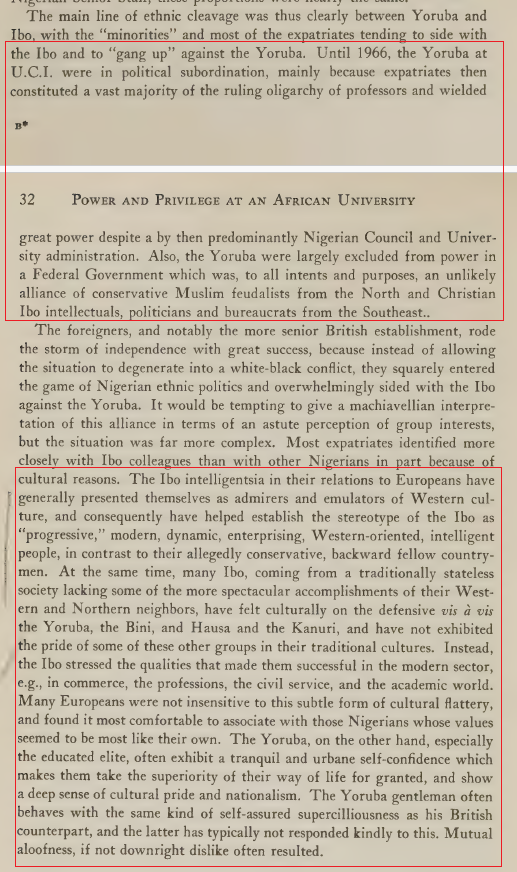
To understand the events at Ibadan, one must turn to the eyewitness account of Pierre van den Berghe (Power and Privilege at an African University), a visiting professor during this turbulent period. He identified the central dynamic: “The main line of ethnic cleavage was clearly between Yoruba and Ibo, with the ‘minorities’ and most of the expatriates siding with the Ibo and ‘ganging up’ against the Yoruba” (pg. 31).
This alliance was rooted in a cultural clash. Van den Berghe observed that the Yoruba, with their centuries-deep intellectual tradition, carried a natural cultural confidence that "makes them take the superiority of their way of life for granted, and show a deep sense of cultural pride and nationalism". The educated Yoruba often displayed a self-assurance that the expatriates found off-putting, seeing themselves as equals with no need to ape European manners (pg. 31).
The Igbo intelligentsia, by contrast, presented themselves as eager emulators of Western culture, measuring progress by proximity to European norms. Van den Berghe notes that this posture ingratiated them deeply with expatriates and helped entrench the stereotype of the Igbo as “progressive, modern, dynamic, enterprising, Western-oriented, intelligent people”, in contrast to their allegedly “conservative, backward” compatriots. This cultural flattery forged a comfortable British–Igbo partnership that became the backbone of campus politics (pg. 31).
This dynamic took on institutional consequence in 1962 when the University College, Ibadan, became an independent university. The Vice-Chancellorship went to Professor Kenneth Dike, an Igbo historian favored by expatriates and the NCNC-led federal government, rather than to an equally qualified Yoruba candidate, Professor Ajose. This appointment was made by Aja Nwachukwu, the Igbo Minister of Education. At the same time, another Igbo academic, Professor Eni Njoku, was appointed Vice-Chancellor of the University of Lagos. In a country with only two federal universities, both were now headed by Igbo men.
Furthermore, the University of Ibadan Act, crafted by Minister Nwachukwu, appointed Dike as VC without specifying any time limit. Thus, barring removal for misconduct, Dike became, in effect, Vice-Chancellor for life.
Yet despite this glaring imbalance, there was not a single Yoruba riot, not a single newspaper meltdown, not a single declaration of persecution. The Yoruba intelligentsia accepted the situation as part of the politics of the time.
But Dike’s tenure quickly revealed a systematic pattern of ethnic preference. Van den Berghe reports that he “systematically favored fellow Ibo,” placing them in strategic positions: the Deanships of Agriculture and Medicine (both held by his relatives), the Headship of the History Department, and other key administrative offices (pg. 37 - 38). Dike’s stated goal was “ethnic balance,” but in practice, it meant prioritizing Igbo candidates even when better-qualified Yoruba candidates were available. Under him, UI increasingly resembled an Igbo fiefdom.
Dike’s methods were subtle but effective. He would promote Yoruba and Igbo candidates to the professorial level to create an appearance of fairness but reserve the real levers of power — the chairmanships, deanships, and strategic administrative roles — for Igbos (pg. 38). When obstructed, he undermined the officeholder. His campaign against the Registrar, Nathaniel Adamolekun, was the most egregious example. Dike saw Adamolekun as the final obstacle to his full consolidation of the university into an ethnic patronage system (pg. 39). His solution was to remove academic affairs from the Registry's jurisdiction by creating an “Academic Office” under an Igbo loyalist and to bypass Adamolekun in major decisions (pg. 40).
The result was a spiraling administrative crisis. By 1966, the feud had descended into a grotesque spectacle - countermanding memos, press leaks, court injunctions, threats, office lockouts, and even police involvement.
The crisis came to a head in June 1966, when a trivial disciplinary action against an Intermediate Staff clerk, most liklely a non-Yoruba, accused of fornication in a university office escalated into a violent strike and demonstration by the non-Yoruba faction of the University Workers’ Union against Adamolekun, demanding his resignation. The University Council, effectively captured by Dike’s faction, obliged by suspending Adamolekun. The injustice was so transparent that Bola Ige, a personal friend of Dike's, represented Adamolekun against him. When Ige later recounted the story, he described Dike’s shock that he would defend a man subjected to such plainly unfair treatment.
The crisis only ended when Dike resigned in late 1966 and returned to the East in the aftermath of the coup. The Gowon administration reinstated Adamolekun, restoring administrative order. Yet in Chinua Achebe’s telling, Dike becomes the victim of Yoruba small-mindedness. It is therefore laughable to read Chinua Achebe’s portrayal of Dike as a victim of "tribal small-mindedness." To Achebe, this blatant nepotism was acceptable, the resistance to it was the sin. (Achebe, There was a Country, pg. 77)
The crisis at the University of Lagos was a direct parallel. The law establishing UNILAG set a four-year term for the Vice-Chancellor. Professor Eni Njoku, appointed by fellow Igbo, Aja Nwachukwu, completed his full term on May 31, 1965. By then, Chief Richard Akinjide had become Minister of Education. Exercising his lawful discretion, he chose not to renew Njoku’s contract and appointed Dr. Saburi Biobaku. Njoku was not fired; he was offered a professorship and allowed to retain his VC salary. But the reaction from Igbo students and certain expatriate staff was immediate, violent, and politically choreographed. Riots broke out. Picketing intensified. Expatriate deans (mostly British) staged a rebellion against the Federal Government. Zik’s West African Pilot flooded the public space with inflammatory editorials about “tribalism” and “Igbo victimization,” weaponizing the press to manufacture outrage.
The Federal Government’s response was unequivocal: accusations of tribalism were baseless. Both federal universities had previously been under Igbo leadership; if anything, the Igbo had been favored. The government described the behavior of the foreign agitators as “a naked form of neo-imperialism" (Vickers & Post, Structure and Conflict in Nigeria 1960-1966, pg. 210). Chief Akinjide, not one to tolerate such interference, terminated the appointments of the expatriates who had fomented the crisis. Despite riots and an attempted murder, Prof. Biobaku eventually assumed his position.
The fundamental flaw in lies such as the one in this tweet is the neglect of antecedents. The story did not begin with Akinjide’s decision; it began with the lopsided appointments engineered by Nwachukwu, the systemic ethnic favoritism of Kenneth Dike, the patronage network built between British academics and Igbo elites, and the entrenched administrative capture at Ibadan and Lagos. But the revisionists skip all this. They begin the story at the point of correction, erase the provocations, cast Akinjide as the villain, and sanctify the architects of the imbalance.
It is therefore a profound historical misrepresentation to claim that “Akinjide’s actions remain central to the Yoruba–Igbo academic struggle.” The truth is the reverse: the ethnic tensions were set in motion long before Akinjide entered the story. The actions of men like Dike and Nwachukwu, who first entangled these institutions in ethnic competition, are the true origins of the conflict. Akinjide’s role, in contrast, was an attempt to recalibrate a balance that had already been severely compromised and to reassert rightful federal oversight over institutions that had drifted into ethnic capture.
Anyone insisting otherwise is not recounting history — they are manufacturing myth.
@ibidunniOodua@patrickanum@naija1babe
We had an incredible experience hosting the E1 Lagos GP this weekend. Watching the world’s first electric powerboat race take place right here on our waters was a proud moment for our city.
Congratulations to Team Brazil for taking the top spot. Their energy and determination truly lit up our waterways.
The E1 Lagos GP was about innovation, sustainability, and showing what’s possible when Lagos embraces new ideas and global partnerships.
To everyone who came out, cheered, and made it a memorable event, thank you. Lagos continues to prove that we’re ready for the future.
#E1LagosGP