Gm anon, are you paying attention yet?
Principal engineer at Google tells us they worked on a distributed agent orchestrator for months.
They then gave the problem to Claude Code, which reproduced their work and got them basically 80% there… in an hour.
When building gets this cheap, what’s the moat?
Ideas? Taste? Distribution? Speed?
There is no better time to start experimenting & learning “vibe” coding.
If you’re skeptical, do what @rakyll suggests and try it in a domain you actually understand, so you can judge the output.
I made a multi agent orchestration app for blog posts last year and it blew my mind.
I'm not joking and this isn't funny. We have been trying to build distributed agent orchestrators at Google since last year. There are various options, not everyone is aligned... I gave Claude Code a description of the problem, it generated what we built last year in an hour.
Colgate had 9,300 human survey responses to check its AI shoppers against.
Most of us asking ChatGPT, Claude or Gemini if our idea will sell have a chat window, sycophantic AI models alongside an idea that we're probs already quite attached to.
In the Colgate study, the AI came quite close to how people ranked 57 personal care concepts in purchase intent surveys... but nobody was buying anything.
The authors thought that the fact the internet is full of people with strong opinions about toothpaste helped. They also tailored the scoring to those human surveys.
If we were to give AI a product in a category that barely exists... with no years of reviews to draw on, and a scoring locked before we see what real customers have to say...
Would it spot the thing that would actually put someone off?
Or would it write a very convincing review of the nearest thing it has read about on the internet?
That's the AI market research paper I'd love to read next.
A toothpaste company didn’t kill market research like this bait ai slop post suggests 💀
But the Colgate paper is worth reading for different reasons... it’s a clear example of when giving AI a role actually helps.
Ask an AI to rate a product from 1 to 5, and it plays it safe with mostly 3s. Real people typically said 4 or 5.
So Colgate gave each AI shopper a real customer profile (age, income, location, etc). It wrote its reaction in its own words, and they turned that text into a score. Across 57 surveys, they ranked products about 90% as reliably as real people do.
The bit the OP missed is what happened when they took the profiles away…
The AI still produced a survey that looked legit with same average score as real humans. But it basically liked everything. Its ability to tell which products people preferred dropped from about 90% to 50%.
Now compare that with a study from December. Researchers told 6 AI models they were experts and tested them with PHD level questions. It made no difference.
So why did one one role matter and not the other?
The customer profile gave the AI info that should change its answer.
A shopper who’s skint should react differently to a premium toothpaste… “you’re an expert” tells it nothing new about the question.
This paper is useful method to shortlisting ideas before real research… but it’s still predicting what people would SAY they’d buy, not what they’d actually get their wallets out for.
@MateenMohammed_@behdadjaa@VALORANT Fair enough if it is a homage, great game fr.
But wondering why u did not credit Valorant in the original post?
As it is exactly the same scene, just a character swap.
50,000,000,000 tokens via OpenAI's Codex ✅
For context, that's roughly 37.5 billion words' worth of text processed... which is about 375,000 books.
And that's just roughly 6 months on Codex alone... doesn't count earlier Codex usage, ChatGPT, Claude, or Replit.
50+ repos on GitHub.
Projects launch? 0 😂
Getting dangerously good at almost launching things. 👀️️️️️️
If switching ChatGPT to Claude means explaining 6 months of decisions again, how model agnostic are you really?
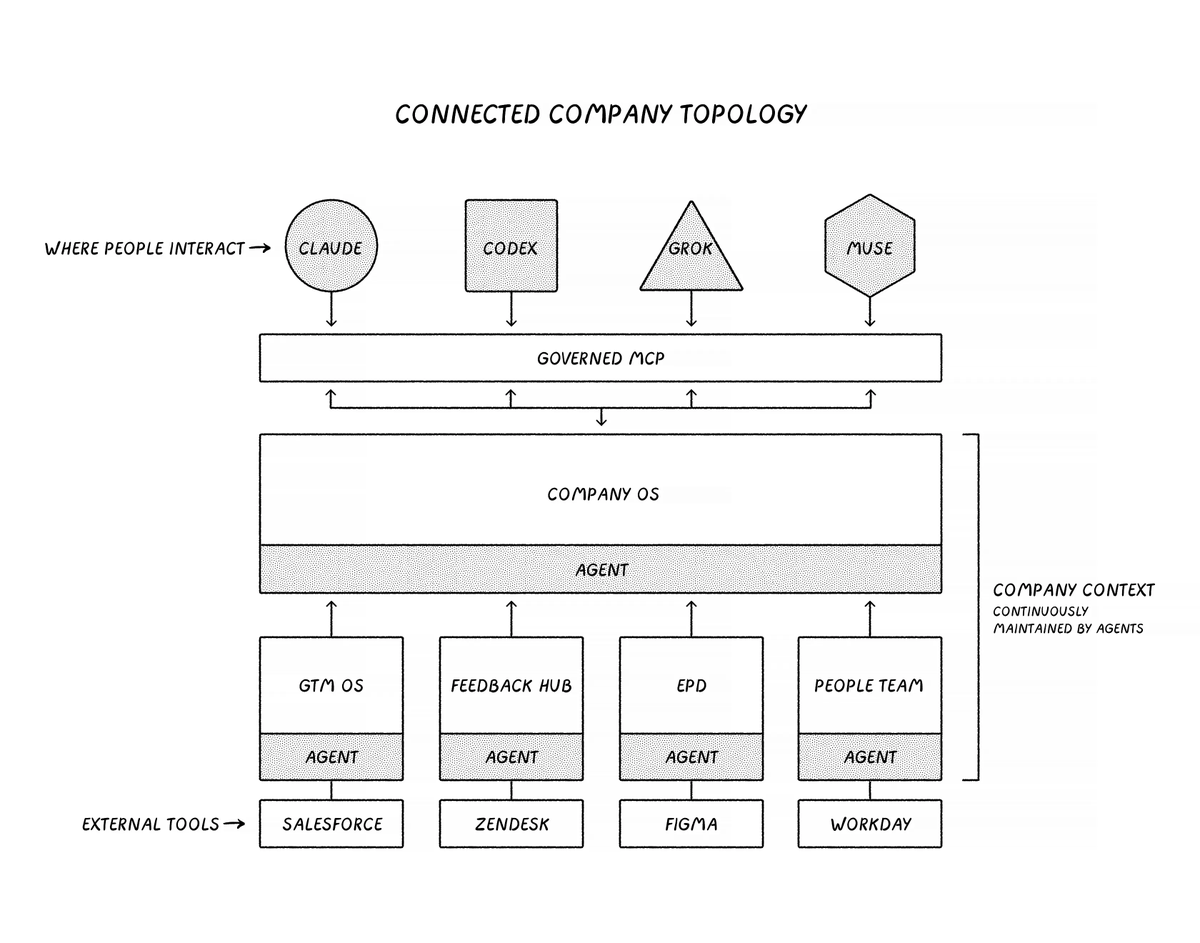
Been banging on about context architecture for a while.
Google, OpenAI and Anthropic can fight to be the best frontier AI lab... but @NotionHQ's big bet is being where AI models find the work.
Loved reading the article shared by @akothari - well worth diving into 👇
A toothpaste company didn’t kill market research like this bait ai slop post suggests 💀
But the Colgate paper is worth reading for different reasons... it’s a clear example of when giving AI a role actually helps.
Ask an AI to rate a product from 1 to 5, and it plays it safe with mostly 3s. Real people typically said 4 or 5.
So Colgate gave each AI shopper a real customer profile (age, income, location, etc). It wrote its reaction in its own words, and they turned that text into a score. Across 57 surveys, they ranked products about 90% as reliably as real people do.
The bit the OP missed is what happened when they took the profiles away…
The AI still produced a survey that looked legit with same average score as real humans. But it basically liked everything. Its ability to tell which products people preferred dropped from about 90% to 50%.
Now compare that with a study from December. Researchers told 6 AI models they were experts and tested them with PHD level questions. It made no difference.
So why did one one role matter and not the other?
The customer profile gave the AI info that should change its answer.
A shopper who’s skint should react differently to a premium toothpaste… “you’re an expert” tells it nothing new about the question.
This paper is useful method to shortlisting ideas before real research… but it’s still predicting what people would SAY they’d buy, not what they’d actually get their wallets out for.
A toothpaste company has quietly killed the entire market research industry and nobody is talking about it.
Colgate published a paper showing you can predict real purchase intent by simply asking LLMs to roleplay customers.
And this is beyond insane.
If you ask an AI, "Rate this product from 1 to 5," it gives safe, middle-of-the-road garbage.
So researchers invented a method called Semantic Similarity Rating (SSR).
Instead of asking the AI for a number, they asked it to roleplay.
They gave the LLM a demographic profile. They showed it a product concept. And they asked it to write down its raw, unfiltered thoughts.
Then, they used a semantic model to translate those written thoughts into a numerical score.
The results are staggering.
Tested against 57 real personal care product surveys and 9,300 human responses, the synthetic consumers hit 90% of human test-retest reliability.
They perfectly mirrored how different age brackets and income levels react to price changes.
And they provided detailed, qualitative feedback that was deeper and more critical than what actual humans wrote.
This destroys the economics of traditional market research.
You don't need to wait a month to see if a product will sell.
You can simulate 1,000 hyper-targeted customer interviews overnight.
You can A/B test pricing across every demographic instantly.
for our friends in europe - we’re working to get dots to you ASAP, but they’re not available just yet. there’s some regulatory stuff we need to work through first
thanks for your patience, hoping we’ll have more to share on this soon🤞