AgentDNA is live now!
The first unified trust layer for multi agent systems, built on ultra scalable DAG of @RubixChain.
https://t.co/qyRB4oj3jV
Why AgentDNA?
1. Auth: Current static auth systems built for humans/static APIs dont work for Agents. AgentDNA introduces dynamic DIDs
@JayaGup10 Identity, KYC, threat detection, observability, immutable audits.. there will be heavy disruption but also the TAM will be far bigger. Nikesh Arora rightly said security will be one of the biggest winners in the AI era.
Security budgets will actually increase sharply.
1. Existing defenses are not sufficient to face AI acclerated threats.
2. Enterprises deploying AI have more savings and ability to spend on security.
3. Agentic AI security is a bigger moat because it includes KYC and management.
@Agent_DNA@EnsurityTech
@cz_binance Post Mythos, access to git accounts should be secured with sandboxed, hardened biometric access. If you have API keys in git repos, better replace with hardened access or decentralized access
@ThinC_AUTH@EnsurityTech@Agent_DNA#github#mythos
@rohan_2502 For cross organisation and ecosystem adjacencies involving agentic reality enterprises will require a new unified,verifiable trust layer which is independent of models,hyper scalers and workflows. @Agent_DNA is the new Compliance ready and ROI friendly accountability guardrail.
The incident in which @cursor_ai and @Railway agent deleted data without authorization is yet another proof that agentic systems without immutable chain of auth and logs are highly risky. Repeat, Agentic security/governance is SO DIFFERENT from current MFA systems. Build first principles.
Significant move for AI adoption, bringing new medicine costs down. Generic drug makers and CRM companies will be negatively affected, unless they adopt AI quickly.
Memory is 40% of AI infra cost. Longer token context makes models powerful, but accentuates memory constraints. Efficient graph based context traversal and retrieval using @RubixChain graph will save billions of costs and also scale agents
https://t.co/B5n1AZBR0V
If your agentic systems allow agents to alter/delete their logs or auth chains, then there is little security or governance. Immutability/non repudiation is vital in agentic security. Without immutability, rest of the zero trust mechanisms become ineffective.
@Agent_DNA
Insanely accurate @RaoulGMI. Economic singularity is almost here.
1. Would prefer Universal Basic Entreprenership can also be added to UBE (owning the substrate + creating the substrate). Everyone can have a shot at it.
2. Proof of human becomes highly valuable. L1s become the only arbiter of UBE.
3. Building p2p graph @RubixChain for 1 bn tps agentic commerce/tokenization and @Agent_DNA for trust resolution.
Generously scoped API permissions - no runtime authorization.
No partitioned backups.
CLI tokens can easily be accessed across.
Your internal agent can be a big threat.
Avoid these pitfalls by building agent lineage, Chain of Custody and immutability with @Agent_DNA for better security. @Railway@cursor_ai
Existing enterprise platforms charging per seat offering different vertical solutions would not deliver productivity to enterprises deploying Agents. Agents do need an implementation and trust layer, agree, but that would more look like a full automated trust layer like @RubixChain and @Agent_DNA
Federated OAuth access (like Google OAuth) carries significsnt risks. This will get worse with AI Agents. Switch to more secure access alternatives like @ThinC_AUTH and @Agent_DNA
@BenBajarin Historically, whenever memory capex ramped hard, cycle peaked. AI super cycle though is keeping the cycle longer. Memory scaling and contrxt optimization through SW tools like @RubixChain and @TrieNetwork will play a key role in easing memory demand growth this time.
The #AGIBarbell.
Open, shared and decentralized software will play a big role on the AI last mile, for security, context and memory. @TrieNetwork and @Agent_DNA layers on Rubix will balance the #barbell.
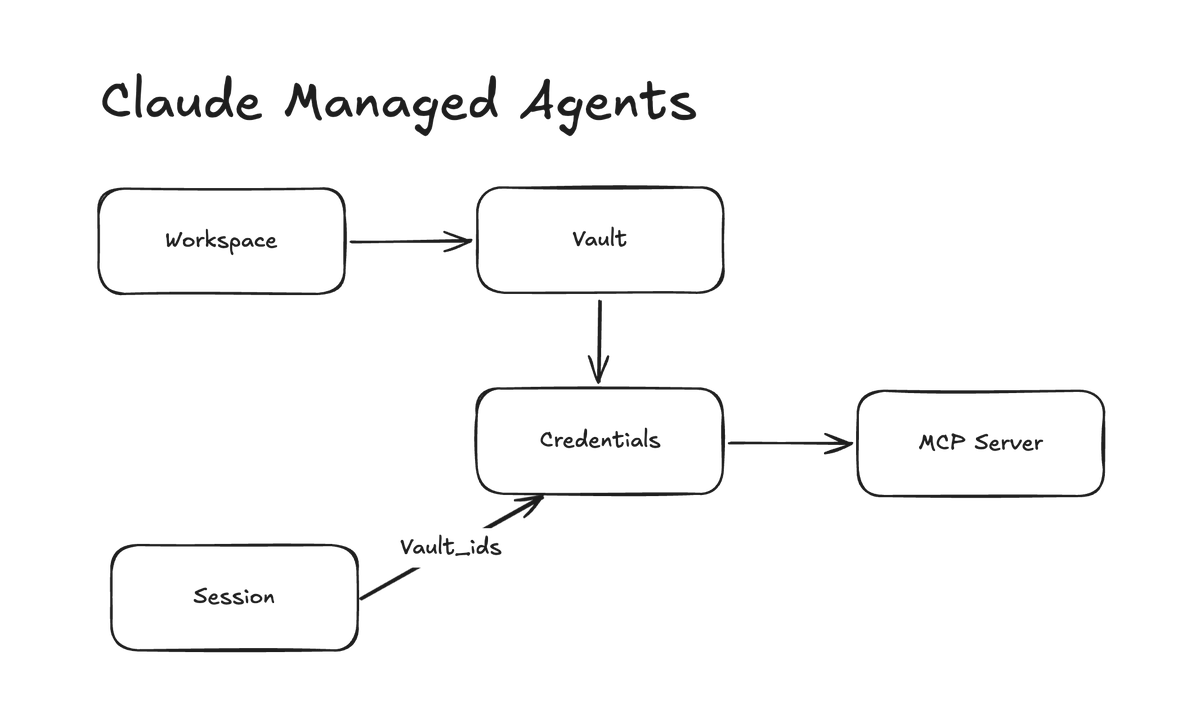
Been testing Claude Managed Agents
Here's my feedback:
Vaults store OAuth tokens outside the sandbox, the agent never handles them directly
The problem, vaults are workspace-scoped
Anyone with workspace access, via API key or the Console, can reference your vaults and use your credentials in their own sessions