🚩The anti-SIR and anti-CEC agitation is now set to become a pro-democracy movement
(Brilliant article by Yogendra Yadav who states that The "Vote Bachao Desh Bachao" rally and the "public impeachment" of Gyanesh Kumar, the day before the rally, expanded the definition of opposition beyond the political parties. A large number of "civil society" organisations and movements that have led the current campaign against the SIR were present both in the "mock parliament" on Saturday and at the podium of the Sunday rally. These included many farmer organisations and all the youth organisations active in the October protests. In an unusual and significant move, the https://t.co/uuxmilv018 issued a call to support the Opposition rally. Influencers like Dhruv Rathee and farmer leaders like Rakesh Tikait also endorsed the rally.
Going forward, the movement is not just about removing Gyanesh Kumar and rolling back the SIR but about reclaiming the democratic space that has been lost over the past 12 years. The anti SIR and anti-CEC agitation is now set to be come a pro-democracy https://t.co/B5xTr3zEEQ of now, a call for free and fair elections encompasses the most widely shared sentiment of the people. This would also entail reclaiming democratic freedoms like freedom of expression, dissent and protest.The regime's decision to brazen it out and block Gyanesh Kumar's resignation could well be a blessing in disguise, not just for the protestors, but for Indian democracy)
NO ONE expected Chief Election Commissioner (CEC) Gyanesh Kumar to resign after the massive INDIA bloc rally this Sunday. Yet, despite the churlish debate over how many attended the rally, the protest has achieved more than anyone expected. At the same time, this suc cess places greater responsibility on every one involved in this month-long struggle.
The run-up to the rally had already seen the entire Opposition, not just the INDIA bloc, come together to question the role of the Election Commission of India (ECI). Although AAP and DMK stayed away from the rally, they are very much with the cause. Non-INDIA bloc opposition parties like the BJD, BRS and YSRCP, which have often sup ported the government, have also come out against the SIR and the ECI. Such a full-spec trum vote of no-confidence by the entire par liamentary Opposition against the election management body would be unprecedented in any democracy. This is like all the non host teams demanding replacement of the tournament referee.
The "Vote Bachao Desh Bachao" rally and the "public impeachment" of Gyanesh Kumar, the day before the rally, expanded the definition of opposition beyond the political parties. A large number of "civil society" organisations and movements that have led the current campaign against the SIR were present both in the "mock parliament" on Saturday and at the podium of the Sunday rally. These included many farmer organisations and all the youth organisations active in the October protests. In an unusual and significant move, the https://t.co/uuxmilv018 issued a call to support the Opposition rally. Influencers like Dhruv Rathee and farmer leaders like Rakesh Tikait also endorsed the rally.
Though the rally participants were overwhelmingly workers and supporters of INDIA bloc parties, mainly Congress, they exuded confidence that they stood for the people at large. While we should not expect all future protests to be under a single umbrella, this week-end has brought in much-needed cohesion in this medley of protests that we witnessed in October. It has also established Rahul Gandhi, the first leader to bring the "vote chori" issue to a disbelieving public, as the moral leader of the wider oppositional space.
The rally was a significant landmark in the popular acceptance of the "vote chori" narrative. The Indian Express exposé has opened the floodgates of media reporting on the multiple scandals of the SIR, besides the unconstitutional functioning of the ECI. The public now knows about the ques tions that surround Form 6, misuse of bulk Form 7 objections, the contentious use of Form 8 to change the final voter list, the weird pattern of voter deletion and bulk filing of anony mous appeals in West Bengal and much more. The ECI is on the back foot. The Supreme Court, too, faces questions. True, many of these grave infringements are too technical for the public to grasp. Yet the cumulative impact of the last six weeks has been a shift in the collective common sense towards "daal mein kuchh kaala hal" -something is rotten out there. The gravi tas of the "public impeachment" pushed this popular narrative further.
As of now, a call for free and fair elections encompasses the most widely shared sentiment of the people. This would also entail reclaiming democratic freedoms like freedom of expression, dissent and protest
This imposes a historic responsibility on all those who have contributed to the success of these protests so far. Going forward, the movement is not just about removing Gyanesh Kumar and rolling back the SIR but about reclaiming the democratic space that has been lost over the past 12 years. The anti SIR and anti-CEC agitation is now set to be come a pro-democracy movement.
At this critical juncture, the call for "regime change" is a distraction best avoided. To be sure, there is nothing wrong or unconstitutional about demanding regime change through the normal democratic route of elec tions. And the onus of keeping that normal route truly open is on the ruling establish ment and independent institutions like the ECI and the Supreme Court. Yet at this stage,this is the demand of the Opposi tion, not necessarily the demand of all the people on the streets. The success of a mass movement dep ends on floating with the sentiment of the organic protesters, on keeping to the lowest common de nominator that ensures the widest
possible support. As of now, a call for free and fair elections encompasses the most widely shared sentiment of the
people. Such a call goes beyond the current demands for the removal of the CEC, the repeal of the 2023 Act and the rollback of the SIR. This would also entail reclaiming democratic freedoms like freedom of expression, dissent and protest all the more relevant in the context of the repressive and intimidatory tactics adopted by the state, like the insistence on a "peace bond".
A demand for neutral functioning of autonomous institu tions like the ECI, the judiciary, investigating agencies and the media would also be a part of the democracy movement. Yet, all this does not amount to a demand for regime change-and certainly not on the streets-until all peaceful, democratic and constitutional means are truly and fully exhausted. And are perceived to be so by the people.
In that context, the coming elections in Uttar Pradesh could be the litmus test. For someone like me who has observed Indian elections closely for the last four decades, the assembly election in UP will be an agnipariksha that will determine whether we can expect anything like fair elections in the minimal sense of the term under the present dispensation. More than a test of Narendra Modi's or Yogi Adityanath's popularity, it will be a test of the electoral system's credibility. That must be the focal point of the pro-democracy movement.
As this stirenters its second phase, it may not look like a mountain river with its mad and unpredictable gush of water. As it descends to the plains, the movement will be slower and more widespread. This is not to be regretted, as the example of the farmers' stir showed us. The river slowing down allows water to percolate. As the rush of energy unleashed by the spontaneously synchronised protests gives way to a loosely coordinated movement spread across the country, the "vote chori" message is likely to seep deeper into popular consciousness. The regime's decision to brazen it out and block Gyanesh Kumar's resignation could well be a blessing in disguise, not just for the protestors, but for Indian democracy.
The writer is member. Swaraj India and national convenor, Bharat Jodo Abhiyaan. Views are personal
🚩Voter ID cards, not Aadhaar, to access panchayati raj benefits now
(Weaponization of SIR : This is no longer just disenfranchisement. It is the creation of a second-class citizenry - denying anyone who opposes the BJP their voice, and their rights and entitlements as citizens)
UNION Minister of Panchayati Raj and Fisheries, Rajiv Ranjan, alias Lalan Singh, announced that a new panchayati raj scheme will render Aadhaar-based payments and benefits outdated. He stated that biometric authentication, along with the voter identification card number or EPIC number, will now be the only valid method for receiving payments and benefits.
How the SIR is being weaponised, the fear everyone expressed? Also, what is the Aadhaar now for - for the sake of having another number?
SIR is being used to illegally delete people unlikely to vote for the BJP from electoral rolls. Those deleted risk being struck off welfare beneficiary lists too.
This is no longer just disenfranchisement.
It is the creation of a second-class citizenry - denying anyone who opposes the BJP their voice, and their rights and entitlements as citizens.
9K-cr PSU assets monetised so far in FY27: NLMC CEO
(NMP(National Monetization pipeline) is a ruse to hand over the right of operating huge infrastructural assets for a period of 30-35 years to the monopolies. This would not only impact the entire economy ,but also result in further worsening of the already alarming situation of job losses and unemployment.CPI(M) has been raising valid concerns that long-term leases of public assets and lands to private conglomerates are done at undervalued rates, effectively creating private monopolies over public utilities.Once land is commercialized, the public lose spaces meant for low-cost public housing, hospitals, or schools, turning them into luxury real estate or private commercial hubs.)
@THE NATIONAL LAND Monetisation Corporation (NLMC) has enabled public sector com-panies monetise assets worth over ₹9,000 crore so far in the current financial year, aggressively e-auctioning premium land parcels belonging to companies like HIL (India) Limited and Rashtriya Ispat Nigam Limited (RINL) in major hubs like Delhi and Visakhapatnam to private developers like Godrej, Omaxe, and M3M
@Assets worth ₹6,000 crore are expected to be monetised in the rest of FY27
🚩Fairfax may use IDBI's funds for acquiring it
(A case of Primitive Accumulation through Privatization : Fairfax Financial Holdings may use IDBI Bank's surplus capital to partially finance its pro-posed acquisition of the lender, according to the transcript of Fairfax's investor conference call held on October 15.This Proposal raises questions over corporate governance, valuation !!)
@The proposed arrangement has raised questions over corporate gover-nance, valuation and minority shareholder rights among banking and market experts.
@This instance reminds us as to how TATA ,after acquiring VSNL,which had massive cash reserves from its international calling monopoly, to bail out or prop up a loss-making Tata Teleservices.This is nothing but Primitive Accumulation through Privatisation: The VSNL Experience !!!
🚩The seven crumbling pillars of India’s democracy
(The structure of democracy in India rests on seven pillars, namely (i) legislature (ii) executive (political and bureaucratic) (iii) political parties (iv) judiciary (v) independent institutions (vi) media and (vii) civil https://t.co/TT3su1mrFB of today, all the pillars appear shaky, threatening the future of democracy, although it could be argued that structural weaknesses in the Indian democratic edifice have existed right from 1947
It is becoming painfully evident that the ailment affecting Indian democracy is not one that a change in government can cure)
@A century has passed since the publication of the autobiography of TE Lawrence, popularly known as Lawrence of Arabia. The title Seven Pillars of Wisdom is drawn from the Book of Proverbs in the Bible: “Wisdom hath builded her house, she hath hewn out her seven pillars.”
How appropriate, then, that in their wisdom, the founders of our Constitution went in for democracy as the form of government that would guide independent India’s destiny.
As it transpires, the structure of democracy in India rests on seven pillars, namely (i) legislature (ii) executive (political and bureaucratic) (iii) political parties (iv) judiciary (v) independent institutions (vi) media and (vii) civil society.
As of today, all the pillars appear shaky, threatening the future of democracy, although it could be argued that structural weaknesses in the Indian democratic edifice have existed right from 1947.
I Legislature
Let us start with the legislatures, both at the union and state levels. Cracks appeared in the post-Nehruvian era. The “aya Ram gaya Ram” phenomenon of politicians switching parties started in 1967, a legacy that continues to the present day. Reminiscent of Indian Premier League auctions, legislators are tempted by the highest bidders, though other pressures such as the fear of investigative agencies can also act as triggers for crossovers.
Disconcertingly, it is no longer just individual bait: shoals of legislators are willing to defect en masse, lured by the attractions of power and patronage and the fear of state action.
The anti-defection provisions in the Constitution have become a dead letter: in no case have presiding officers ruled against defectors. Major legislations are rushed through without adequate public debate and reflection. The quality of discussions in legislatures, especially Parliament, has taken a deep dive.
Presiding officers often give short shrift to Opposition demands for discussion or to notices for legislative intervention, as in the cases of the proposed impeachment of the chief election commissioner and a former High Court judge.
II Executive
At both the political and bureaucratic levels, there is inadequate engagement with public opinion, especially on crucial policy matters. The Citizenship (Amendment) Act, the farm laws and the Special Intensive Revision of the electoral rolls are just some of the glaring instances. Dissent and criticism are brushed off as the handiwork of “urban naxals”, “dimagi naxals” and “anti-nationals”.
The use of civil servants, especially those in the investigative agencies, to lodge cases and subject dissenters and political opponents to harassment has become commonplace. More disturbing is the fact that civil servants, in violation of the oath to the Constitution they take when joining public service, are more than willing and enthusiastic to implement the orders of their political masters, be it the sudden demolition of structures (by a curious coincidence, mostly owned or occupied by the Muslim community), the interference in prayer meetings of the Christian community and the harassment of interfaith couples on the bidding of lumpen vigilante groups.
It seems that the senior bureaucracy of the various services has virtually abdicated its role of pointing out to the political executive the absence of legality in the orders it is asked to carry out.
Infrastructure and mineral resource extraction projects are being given virtually blanket permissions, ignoring the voices of caution from environmental experts and groups and bypassing local consultation with affected stakeholders. The ecological consequences are becoming visible, with repeated hill landslides and flash floods, apart from growing desertification of arable lands.
III Political parties
The initial years after Independence saw many stalwarts from different political parties serve with distinction in Parliament and state legislative assemblies and councils. The watershed year was 1967, when the lure of pelf and patronage led to the mushrooming of political parties, many of them dominated by one family. The Indian National Congress was no exception.
Sycophancy became the path for political advancement, with genuflections to the ruling deities in various parties. The system of hereditary succession took firm root in nearly all parties. With hard work and meritorious performance receiving no returns, the decades from the 1990s saw wannabe politicians jumping ship whenever they felt the reward for switching loyalties was higher.
Loyalty to the ruling coterie in a party was the sole criterion for political survival. Criminals and carpetbaggers freely entered the political arena. Winning elections and deriving the benefits from exercise of power has become the sole preoccupation of politicians. Governance, legislative debate and the quality of enacted legislation have suffered grievously.
Today, India seems to live from election to election: what happens in the five-year interregnum between polls seems to concern neither the politician nor the ordinary citizen.
IV Judiciary
The judiciary, given the constraints of manpower and the burden of litigation, has often been the lumbering elephant in the room. What has been particularly disconcerting in recent years has been its propensity, especially at the highest levels of the Supreme Court and High Courts, to take an agonisingly long time in deciding issues that impact the life and liberty of the individual as also matters that have a crucial bearing on constitutional issues and on the lives of ordinary citizens.
Bail pleas are deferred for months on end, with the draconian provisions in laws like the Unlawful Activities (Prevention) Act and Prevention of Money Laundering Act, ensuring that the process itself becomes the punishment. It took years for the accused in the Bhima-Koregaon and the Delhi riots cases to get bail, with some still in judicial custody after more than six years. Chargesheets are yet to be filed in these cases.Stan Swamy and GN Saibaba were instances where the rigours of incarceration led to their deaths.
And who can forget most of the Aam Aadmi Party leadership in jail before and at the time of the 2025 Delhi elections, denying them the right of participating in election campaigning? The executive has also got away with omnibus clearances of projects that affect the environment, in the absence of meaningful judicial intervention.
V Independent institutions
At the heart of the crisis today is the severe weakening of nearly all independent institutions, meant to serve as the guardians of democracy. We are witnessing the continued unrest arising from the SIR, with the names of 130 million citizens being deleted from the rolls.
The functioning of the Election Commission has come in for scathing criticism. But it is by no means the only institution that has suffered a dent in its reputation. Information Commissions, the Lokpal, the National Green Tribunal, the National Commission for Scheduled Castes, the National Commission for Women and the National Commission for Protection of Child Rights have proved ineffective in acting as a check and balance on executive action/inaction.
VI Media
In a cruel twist of irony, Lal Krishna Advani, one of the founders of the Bharatiya Janata Party, observed about the media after the Emergency: “When they were asked to bend, they crawled.” Today, large sections of the media, both print and electronic, need no such suggestions. They readily genuflect to authority and are more than willing to carry the messages of the government of the day, forgetting their duty of speaking truth to power.
The fear of losing government advertising revenues, the apprehension of coercive action and the outright purchase of independent news channels by powerful corporate interests have silenced the media.
News anchors and editors compete in displaying their loyalty to the powers that be. Responses of opposition leaders and prominent dissenters are given little coverage, if at all. Independent web-based channels face the inquisitions of investigative agencies, while their news reporters have to run the gamut of defamation cases galore.
All this while media channels that actively promote hate speech and incendiary comments get away freely. Little wonder then that a substantial section of thinking citizens have trashed both newspapers and television and rely only on internet-based independent media.
VII Civil society
It is difficult to decide whether civil society is civil anymore. Paraphrasing Mahatma Gandhi on Western civilisation, one must say that civil society in the India of today would be a good idea. Whether on TV channels or on social media, haranguing and shrill accusations are the order of the day. Communities, families and friendships have been split down the middle. Dialogue and discussion have been replaced by partisan postures, with each side retreating into their respective echo chambers.
The polarisation of society, probably dormant before 2014, has come into the open in recent years, with disturbingly large sections of the “educated” majority community “othering” the Muslim community and lumpen groups and the arms of the state harassing the Christian community on the grounds of alleged religious conversion.
Governments may change in the future, but the damage to the ruptured social fabric may take far longer to repair.
Civil society stakeholders – corporate bigwigs, politicians, bureaucrats, academics, media persons, not to mention the large army of WhatsApp uncles and aunties – have enthusiastically espoused the ruling majoritarian ideology.
It might be out of blind adoration, bringing to mind Babasaheb Ambedkar’s warning that in politics, bhakti or hero-worship is a sure road to degradation and to eventual dictatorship. In many cases, ambition dictates obedience, as well as the apprehension of consequences and/or sheer apathy in the garb of self-interest.
What then?
It is becoming painfully evident that the ailment affecting Indian democracy is not one that a simple medicine of change in government is going to cure. We in India have drifted far away from the noble principles of justice, liberty, equality and fraternity enunciated in the Preamble to the Constitution of India, which alone give substance to the seven pillars above.
Unless there is the fullest commitment to these four principles, heart and soul, a just, equitable, free and harmonious society visualised by the framers of the Constitution cannot come into being.
Attaching these pillars firmly to the superstructure of democracy is the cement of trust, a trust that has significantly eroded today – between citizens and the state, citizens and the institutions charged with the protection of their fundamental rights and, indeed, between citizen and citizen. Restoring this trust is the sine qua non for the health of Indian democracy.
V Ramani is a retired IAS officer of the Maharashtra cadre and a member of the Constitutional Conduct Group. This article first appeared on his blog.
🚩Look at the MRP of cancer medicines before and after revision !!
@This loot by hospitals has been going on since 2017
@Why the Government didn't stop this loot ?
@It is only the direction of Supreme Court that put an end to the loot by these hospitals/companies of families of cancer patients like this
@Imagine how much loot must be happening on other medicines/consumables
@Who really owns these Hospitals ?
Our neighborhood corporate hospital isn't run by doctors.
Majority stakes in networks like Manipal, CARE, and HCG are owned by global Private Equity (PE) giants like Temasek, Blackstone, and CVC Capital.
@The Private Equity Trap: These foreign funds demand ruthless quarterly revenue growth and maximum profit margins (EBITDA). To hit these targets, hospitals treat patients like captive consumers.
The "Loss Leader" Trick: They keep doctor consultation fees and general room rents low so the public doesn’t panic. It's a calculated hook to get you through the door.
The Hidden Cash Cow: Once We are trapped in the ICU, they strike. They slap 1,000% markups on consumables, stents, and oncology drugs. We cannot walk out to window shop, and We cannot say no.
@Healthcare in India has been commercialized completely. Our life-or-death crisis is just their ultimate quarterly profit opportunity.
🚩Litmus test of economic resilience
(Thought provoking Article which says
an economy's resilience depends on the strength of its buffers relative to the magnitude of the shocks it faces. Those buffers are beginning to thin. Elevated crude oil prices, El Niño and a weak monsoon warrant close monitoring in the near https://t.co/I5mtxcyJxY buffers thin and inflation broadens, new challenges are arising.Moreover, inflationary pressures are no longer confined to food. Alongside rising fo prices, costs of key indust inputs such as metals and en gy have also increased shary. This is reflected in wholesale price inflation, which rose to 11.4% in September. When input costs rise amid healthy demand, producers tend to pass them on to consumers, broadening inflationary pressures across the economy.
Over the medium term, strengthening energy security, securing supply chains, creating productive employment oppor tunities and advancing structur al reforms will be essential for sustaining higher and more durable economic growth )
R ESILIENCE has been the defining feature of the global economy over the past year. Despite heightened geopolitical tensions and supply-side disruptions, economic activ-ity has consistently outper formed expectations.
Reflecting this strength, the International Monetary Fund (IMF) raised its global growth forecast to 3.1% for 2026 and expects growth to improve to 3.4% in 2027, while cautioning that downside risks remain dominant.
India has mirrored this resilience. Real gross domestic product (GDP) growth was a stronger-than-expected 7.7% in fiscal 2025-26 despite tariff-relat-ed uncertainty and global volatil ity. The economy expanded by 7.8% in the first quarter (April-June) of the current financial year, and high-frequency indica tors point to sustained momen tum in the second quarter.
Not surprisingly, the IMF has revised India's growth forecast upward to 7% from 6.6% for 2026-27.
While growth has remained resilient, inflation is beginning to re-emerge as a concern. Glob al inflation is projected to rise to 4.7% in 2026 from 4.1% in 2025. Inflation is expected to exceed central bank targets in many inflation-targeting economies. In India, we expect inflation to rise to 5.3% this financial year from 2% in the last fiscal, with risks tilted to the upside.
Several factors explain the sur prising resilience of global growth. Foremost among them is the powerful investment cycle driven by artificial intelligence (AI) in the US.
The rapid expansion of Al infrastructure has stimulated investment directly while gener ating spillovers for economies supplying semiconductors, elec tronics and other critical inputs. Al-related investments are expected to account for nearly 3% of US GDP in 2026.
The benefits of this investment boom, however, have notaccrued evenly. India has gained little directly because it is not a significant manufacturer of inputs used in Al infrastructure. Instead, economies such as Tai-wan, South Korea and Vietnam, which are deeply embedded in Al-related supply chains, have emerged as key beneficiaries.
The relatively modest increase in crude oil prices despite severe disruption to energy infrastructure and the temporary closure of the Strait of Hormuz has helped, too.
The energy shock of 2026 is widely regarded as one of the largest on record, yet oil prices have remained well below what doomsayers anticipated.
For India, the impact was mit-igated by the diversification of crude sourcing and timely pol-icy interventions. Households were largely shielded from higher energy costs as the gov ernment and oil companies absorbed a substantial portion of the increase.
Global demand dynamics also helped contain the rise in crude prices. Significant inventory drawdowns, particularly in Chi-na, and rapid electric vehicle adoption moderated crude oil demand and prevented a sharp er increase in prices. This pro-vided important relief for India, which imports more than 85% of
its crude oil requirements. India's downstream refining sector provided an additional buffer. Higher crude prices were accompanied by a sharper rise in refined petroleum product
Sustained food inflation can have a disproportionate impact on household budgets, en
Inflationary pressures are no longer confined to food. Costs of key industrial inputs such as metals and energy have also increased sharply.
prices, partly because refinery disruptions elsewhere curtailed supply. As a result, petroleum exports grew strongly in the first half of this fiscal, easing pres sure on oil companies and nar rowing the oil trade deficit.
That cushion, however, is beginning to weaken. Crude oil prices have moved higher again as supply disruptions have out-paced demand moderation and global inventory buffers have thinned. As a result, crude oil prices may remain elevated for longer, increasing risks.
Global trade has also displayed remarkable adaptability by rerouting supply chains and diversifying export markets, which has kept trade activity
robust, particularly across Asia.
India's merchandise exports saw healthy growth in the first half of this fiscal (April-Sep-tember), supported not only by petroleum products but also by electronics, engineering goods and chemicals. This helped contain the deteriora tion in the trade balance.
Domestic demand has also remained supportive. The impact of goods and services tax (GST) rate cuts in 2025 was particularly visible in the automobile sector, while income tax relief boosted household purchasing power Passenger vehicle and two wheeler sales grew strongly in the first half of this fiscal, and credit growth remained in the high single digits.
Even so, India's growth is likely to moderate in the second half of this fiscal as some of the fac tors that supported activity begin to fade and new domestic headwinds emerge. The boost from the GST cuts would ease as firms increasingly pass through higher input costs to consumers,
Weather-related risks have become a key concern. The mon soon season ended with rainfall 13% below the long-period aver age and significant temporal and spatial imbalances. According to the India Meteorological Depart ment, 40% of India's districts are facing deficient rains, raising concerns about agricultural out put and food prices. The risks extend beyond the kharif season as a weaker monsoon can reduce soil moisture and reservoir levels, affecting rabi production as well. These domestic risks coin-cide with a deteriorating global food outlook. Rising agricultur al input costs and an intensify-ing El Niño are placing upward pressure on food prices world-wide and increasing the likeli hood of weather-related disrup tions to agricultural production across regions.
For India, this can create a dou-ble challenge: weaker domestic farm output and firmer import-ed food prices. The risks are par ticularly acute in edible oils, where high import dependence and rising global prices have already pushed inflation in the category close to double digits.
Since food accounts for a larg er share of expenditure among lower-income households, sus-tained food inflation can have a disproportionate impact on household budgets and com cate inflation management.
Moreover, inflationary pressures are no longer confined to food. Alongside rising fo prices, costs of key indust inputs such as metals and en gy have also increased shary. This is reflected in wholesale price inflation, which rose to 11.4% in September. When input costs rise amid healthy demand, producers tend to pass them on to consumers, broadening inflationary pressures across the economy.
Against this backdrop, the Reserve Bank of India has recal-ibrated its policy stance to pre-serve price stability. Following the 25-basis-point increase in the repo rate in October, we expect another increase of similar mag-nitude in December.
Unlike the last fiscal, when policy rates were reduced and financing conditions remained accommodative, higher interest rates are likely to raise bor rowing costs.
Ultimately, an economy's resilience depends on the strength of its buffers relative to the magnitude of the shocks it faces. Those buffers are beginning to thin. Elevated crude oil prices, El Niño and a weak monsoon warrant close monitoring in the near term.
Over the medium term, strengthening energy security, securing supply chains, creating productive employment oppor tunities and advancing structur al reforms will be essential for sustaining higher and more durable economic growth.
🚩₹11,000 Injection, ₹1,30,000 Bill: Inside the Supreme Court’s War on India’s Hospital Drug Markup
@The Supreme Court questioned the Centre over the stark price difference of a chemotherapy injection allegedly available to a medical distributor for ₹11,000 but charged by a hospital at ₹1,30,000.
@ The distributor shared his experience while seeking treatment for his wife’s cancer. The Court raised concerns over the pricing disparity and asked where the money goes, highlighting the need for transparency in healthcare costs.
🚩Massive AIKS Peasant Rally to Mumbai
(Peasant ,Worker unity Long Live )
@Massive AIKS Peasant Rally on Second Day Marches on Foot down Kasara Ghat, Delegation Proceeds for Talks with CM
@ The massive AIKS-led rally of over 12,000 peasants and 1,000 vehicles from 20 districts of Maharashtra descended Kasara Ghat on foot on the way towards Mumbai, on the second day of the "Vehicle Long March" from Akole to Mumbai.
@AIKS President Ashok Dhawale, General Secretary Vijoo Krishnan and others are leading the rally. The Vehicle Long March has now halted at Shahapur in Thane district.
@ The AIKS state delegation is on its way to the Government's Sahyadri Guest House at Malabar Hill in Mumbai at the CM's invitation, to compel the state government to address the pressing demands of farmers, including adequate relief for drought-hit farmers, immediate payment of crop insurance compensation, ₹2 lakh loan waiver for farmers who have regularly repaid their loans, land titles for those cultivating forest, pasture, temple trust, and homestead land, fair wages and social security for rural workers and scheme workers, and the resumption of financial assistance to Namo Shetkari Mahasanman Nidhi Yojana and Ladli Behna beneficiaries.
🚩The seven crumbling pillars of India’s democracy
(The structure of democracy in India rests on seven pillars, namely (i) legislature (ii) executive (political and bureaucratic) (iii) political parties (iv) judiciary (v) independent institutions (vi) media and (vii) civil https://t.co/TT3su1lTQ3 of today, all the pillars appear shaky, threatening the future of democracy, although it could be argued that structural weaknesses in the Indian democratic edifice have existed right from 1947
It is becoming painfully evident that the ailment affecting Indian democracy is not one that a change in government can cure)
@A century has passed since the publication of the autobiography of TE Lawrence, popularly known as Lawrence of Arabia. The title Seven Pillars of Wisdom is drawn from the Book of Proverbs in the Bible: “Wisdom hath builded her house, she hath hewn out her seven pillars.”
How appropriate, then, that in their wisdom, the founders of our Constitution went in for democracy as the form of government that would guide independent India’s destiny.
As it transpires, the structure of democracy in India rests on seven pillars, namely (i) legislature (ii) executive (political and bureaucratic) (iii) political parties (iv) judiciary (v) independent institutions (vi) media and (vii) civil society.
As of today, all the pillars appear shaky, threatening the future of democracy, although it could be argued that structural weaknesses in the Indian democratic edifice have existed right from 1947.
I Legislature
Let us start with the legislatures, both at the union and state levels. Cracks appeared in the post-Nehruvian era. The “aya Ram gaya Ram” phenomenon of politicians switching parties started in 1967, a legacy that continues to the present day. Reminiscent of Indian Premier League auctions, legislators are tempted by the highest bidders, though other pressures such as the fear of investigative agencies can also act as triggers for crossovers.
Disconcertingly, it is no longer just individual bait: shoals of legislators are willing to defect en masse, lured by the attractions of power and patronage and the fear of state action.
The anti-defection provisions in the Constitution have become a dead letter: in no case have presiding officers ruled against defectors. Major legislations are rushed through without adequate public debate and reflection. The quality of discussions in legislatures, especially Parliament, has taken a deep dive.
Presiding officers often give short shrift to Opposition demands for discussion or to notices for legislative intervention, as in the cases of the proposed impeachment of the chief election commissioner and a former High Court judge.
II Executive
At both the political and bureaucratic levels, there is inadequate engagement with public opinion, especially on crucial policy matters. The Citizenship (Amendment) Act, the farm laws and the Special Intensive Revision of the electoral rolls are just some of the glaring instances. Dissent and criticism are brushed off as the handiwork of “urban naxals”, “dimagi naxals” and “anti-nationals”.
The use of civil servants, especially those in the investigative agencies, to lodge cases and subject dissenters and political opponents to harassment has become commonplace. More disturbing is the fact that civil servants, in violation of the oath to the Constitution they take when joining public service, are more than willing and enthusiastic to implement the orders of their political masters, be it the sudden demolition of structures (by a curious coincidence, mostly owned or occupied by the Muslim community), the interference in prayer meetings of the Christian community and the harassment of interfaith couples on the bidding of lumpen vigilante groups.
It seems that the senior bureaucracy of the various services has virtually abdicated its role of pointing out to the political executive the absence of legality in the orders it is asked to carry out.
Infrastructure and mineral resource extraction projects are being given virtually blanket permissions, ignoring the voices of caution from environmental experts and groups and bypassing local consultation with affected stakeholders. The ecological consequences are becoming visible, with repeated hill landslides and flash floods, apart from growing desertification of arable lands.
III Political parties
The initial years after Independence saw many stalwarts from different political parties serve with distinction in Parliament and state legislative assemblies and councils. The watershed year was 1967, when the lure of pelf and patronage led to the mushrooming of political parties, many of them dominated by one family. The Indian National Congress was no exception.
Sycophancy became the path for political advancement, with genuflections to the ruling deities in various parties. The system of hereditary succession took firm root in nearly all parties. With hard work and meritorious performance receiving no returns, the decades from the 1990s saw wannabe politicians jumping ship whenever they felt the reward for switching loyalties was higher.
Loyalty to the ruling coterie in a party was the sole criterion for political survival. Criminals and carpetbaggers freely entered the political arena. Winning elections and deriving the benefits from exercise of power has become the sole preoccupation of politicians. Governance, legislative debate and the quality of enacted legislation have suffered grievously.
Today, India seems to live from election to election: what happens in the five-year interregnum between polls seems to concern neither the politician nor the ordinary citizen.
IV Judiciary
The judiciary, given the constraints of manpower and the burden of litigation, has often been the lumbering elephant in the room. What has been particularly disconcerting in recent years has been its propensity, especially at the highest levels of the Supreme Court and High Courts, to take an agonisingly long time in deciding issues that impact the life and liberty of the individual as also matters that have a crucial bearing on constitutional issues and on the lives of ordinary citizens.
Bail pleas are deferred for months on end, with the draconian provisions in laws like the Unlawful Activities (Prevention) Act and Prevention of Money Laundering Act, ensuring that the process itself becomes the punishment. It took years for the accused in the Bhima-Koregaon and the Delhi riots cases to get bail, with some still in judicial custody after more than six years. Chargesheets are yet to be filed in these cases.Stan Swamy and GN Saibaba were instances where the rigours of incarceration led to their deaths.
And who can forget most of the Aam Aadmi Party leadership in jail before and at the time of the 2025 Delhi elections, denying them the right of participating in election campaigning? The executive has also got away with omnibus clearances of projects that affect the environment, in the absence of meaningful judicial intervention.
V Independent institutions
At the heart of the crisis today is the severe weakening of nearly all independent institutions, meant to serve as the guardians of democracy. We are witnessing the continued unrest arising from the SIR, with the names of 130 million citizens being deleted from the rolls.
The functioning of the Election Commission has come in for scathing criticism. But it is by no means the only institution that has suffered a dent in its reputation. Information Commissions, the Lokpal, the National Green Tribunal, the National Commission for Scheduled Castes, the National Commission for Women and the National Commission for Protection of Child Rights have proved ineffective in acting as a check and balance on executive action/inaction.
VI Media
In a cruel twist of irony, Lal Krishna Advani, one of the founders of the Bharatiya Janata Party, observed about the media after the Emergency: “When they were asked to bend, they crawled.” Today, large sections of the media, both print and electronic, need no such suggestions. They readily genuflect to authority and are more than willing to carry the messages of the government of the day, forgetting their duty of speaking truth to power.
The fear of losing government advertising revenues, the apprehension of coercive action and the outright purchase of independent news channels by powerful corporate interests have silenced the media.
News anchors and editors compete in displaying their loyalty to the powers that be. Responses of opposition leaders and prominent dissenters are given little coverage, if at all. Independent web-based channels face the inquisitions of investigative agencies, while their news reporters have to run the gamut of defamation cases galore.
All this while media channels that actively promote hate speech and incendiary comments get away freely. Little wonder then that a substantial section of thinking citizens have trashed both newspapers and television and rely only on internet-based independent media.
VII Civil society
It is difficult to decide whether civil society is civil anymore. Paraphrasing Mahatma Gandhi on Western civilisation, one must say that civil society in the India of today would be a good idea. Whether on TV channels or on social media, haranguing and shrill accusations are the order of the day. Communities, families and friendships have been split down the middle. Dialogue and discussion have been replaced by partisan postures, with each side retreating into their respective echo chambers.
The polarisation of society, probably dormant before 2014, has come into the open in recent years, with disturbingly large sections of the “educated” majority community “othering” the Muslim community and lumpen groups and the arms of the state harassing the Christian community on the grounds of alleged religious conversion.
Governments may change in the future, but the damage to the ruptured social fabric may take far longer to repair.
Civil society stakeholders – corporate bigwigs, politicians, bureaucrats, academics, media persons, not to mention the large army of WhatsApp uncles and aunties – have enthusiastically espoused the ruling majoritarian ideology.
It might be out of blind adoration, bringing to mind Babasaheb Ambedkar’s warning that in politics, bhakti or hero-worship is a sure road to degradation and to eventual dictatorship. In many cases, ambition dictates obedience, as well as the apprehension of consequences and/or sheer apathy in the garb of self-interest.
What then?
It is becoming painfully evident that the ailment affecting Indian democracy is not one that a simple medicine of change in government is going to cure. We in India have drifted far away from the noble principles of justice, liberty, equality and fraternity enunciated in the Preamble to the Constitution of India, which alone give substance to the seven pillars above.
Unless there is the fullest commitment to these four principles, heart and soul, a just, equitable, free and harmonious society visualised by the framers of the Constitution cannot come into being.
Attaching these pillars firmly to the superstructure of democracy is the cement of trust, a trust that has significantly eroded today – between citizens and the state, citizens and the institutions charged with the protection of their fundamental rights and, indeed, between citizen and citizen. Restoring this trust is the sine qua non for the health of Indian democracy.
V Ramani is a retired IAS officer of the Maharashtra cadre and a member of the Constitutional Conduct Group. This article first appeared on his blog.
🚩Rising inflation, weak monsoon cloud rural economic outlook
@Rural consumer sentiment has been slowly weakening this year. According to the Reserve Bank of India's (RBI) latest Rural Consumer Confidence Survey (RCCS), households became more pessimistic about the general economic situation, employment scenario, prices, and their own incomes, while they expect spending to continue rising. Th The Current Situation Index under the RBI's bimonthly survey has declined
Higher inflation and higher interest rates don't bode well for consumption.
@Data hint at a moderation in demand.Several indicators areshow ing that things are on a fragile footing for rural demand. Rising inflation, ongoing pass through of higher input costs, and high youthunemployment are likely to have a tempering effect on demand
🚩 *126th Birth Anniversary of Shahid Ashfaqullah Khan* ( *22.10.1900*)
" *Ae shaheed-e-mulko-millat main tery uper nisaar* ....."
*📣Com.Ashfaqullah Khan, the legendary Indian revolutionary, born on 22nd October 1900, hanged along with Ramprasad Bismil, Raushan Singh & Rajinder Nath Lehri on 19 December 1927 in Kakori Conspiracy Case*.
@They belonged to "Hindustan Republican Association" which later Shahid Bhagat Singh & comrades developed into "Hindustan Socialist Republican Association*".
@Comrade Khan belonged to that era of earliest Indian revolutionaries when Indian revolutionary stream was taking definite socialist turn. His courage, determination, sacrificing spirit inspires us to move ahead for reaching the goal he dreamed of*.
*Inquilab Zindabaad*!
Com.Ashfaqullah Khan Red Salute*✊✊
🚩Labour codes & workers
(The Centre of Indian Trade Unions (CITU) has called for a massive "Delhi Chalo" / "Chalo Parliament" protest action scheduled from December 1 to December 3, 2026, in New Delhi,demanding withdrawal of Labour Codes & on other demands.
This insightful article categorically states that the present government has consolidated the existing labour laws into four labour codes in a manner that mainly serves the interests of imperialist forces and large corporate houses.Across the labour codes, provisions intended to protect work ers have been diluted or removed to serve the interests of industrialists and capitalists.The labour codes have weakened workers' right to call a strike.The new labour code has also weakened workers' right to organise.When legal safeguards are weakened, employers may gain greater flexibility in matters such as retrenchment, workplace rules and industrial relations, while workers may find it more difficult to defend their rights through collective action.The central issue is therefore not merely whether labour laws have been consolidated into four codes, but whether the resulting legal framework adequately protects workers' dignity, job security, fair wages, safe working conditions and freedom of association.)
THE four labour codes passed by the Parliament during 2019 and 2020 came into full effect across the country on April 1, 2026. Following the introduction of economic liberalisation in India in the 1990s, international institutions such as the World Bank and the International Monetary Fund, along with imperialist and capitalist forces, repeatedly pressured successive governments to amend existing labour laws in favour of capitalists and employers. These demands were justified in the name of attracting greater investment and accelerating economic growth.
For nearly 35 years, under pressure from industrialists and capitalists, successive Central governments attempted to amend labour laws in ways that undermine workers' rights. The present government has consolidated the existing labour laws into four labour codes in a manner that mainly serves the interests of imperialist forces and large corporate houses.
The Code on Wages Act was passed in August 2019, consolidat-ing the various laws relating to wages, social security and social wel-fare. The amendments were described as pro-worker measures intended to promote their welfare -and resolve their problems. However, the ruling establishment, in collaboration with capitalist interests, cleverly employed language that may appear attractive to workers while introducing these changes.
A careful examination of the amendments suggests that they undermine workers' interests and favour capitalists and corporations. Across the labour codes, provisions intended to protect work ers have been diluted or removed to serve the interests of industrialists and capitalists.
The labour codes have weakened workers' right to call a strike. Earlier, workers could go on strike after giving two weeks' notice. Under the new provisions, however, a 60-day notice period is required. Furthermore, workers cannot strike while a dispute is pending before an industrial tribunal, nor can they strike for 60 days after the tribunal has delivered its decision.
The labour codes have weakened workers' right to call a strike.
Under the Industrial Employ-ment (Standing Orders) Act, 1946, factories and industrial establish ments employing 100 or more work-ers were required to formulate rules governing working conditions and workers' conduct.
Under the new labour code, the employment threshold has been increased from 100 to 300 workers. Consequently, a large number of workers across the country will fall outside the scope of these statutory requirements.
Under the Trade Unions Act, 1926, workers had the right to establish trade unions and organise collective struggles to secure their financial and other demands.
Trade union leaders also enjoyed certain legal immunities under civil and criminal law in connection with legitimate trade union activities, including strikes and collective struggles.
Under the Act, any seven or more workers employed in an industrial establishment could apply to the relevant registrar to register a trade union, subject to the statutory requirements.
The new labour code has also weakened workers' right to organise. Under the revised provisions, registration of a trade union requires the support of at least 10 per cent of the workers employed in the relevant establishment, or 100 workers, whichever is less, sub-ject to the statutory minimum of seven workers.
The new requirement can make union formation more difficult, particularly in workplaces where workers face intimidation, insecure employment or resistance from management. This, in turn, may weaken their capacity to organise collectively and bargain effectively with employers.
When legal safeguards are weakened, employers may gain greater flexibility in matters such as retrenchment, workplace rules and industrial relations, while workers may find it more difficult to defend their rights through col-lective action.
The central issue is therefore not merely whether labour laws have been consolidated into four codes, but whether the resulting legal framework adequately protects workers' dignity, job security, fair wages, safe working conditions and freedom of association.
Economic growth cannot be con-sidered truly inclusive if its benefits accrue disproportionately to corpora-tions while workers bear the burden of insecurity, longer working hours and weakened bargaining power.
For full article, go to https://t.co/iZZ3wSqVqd
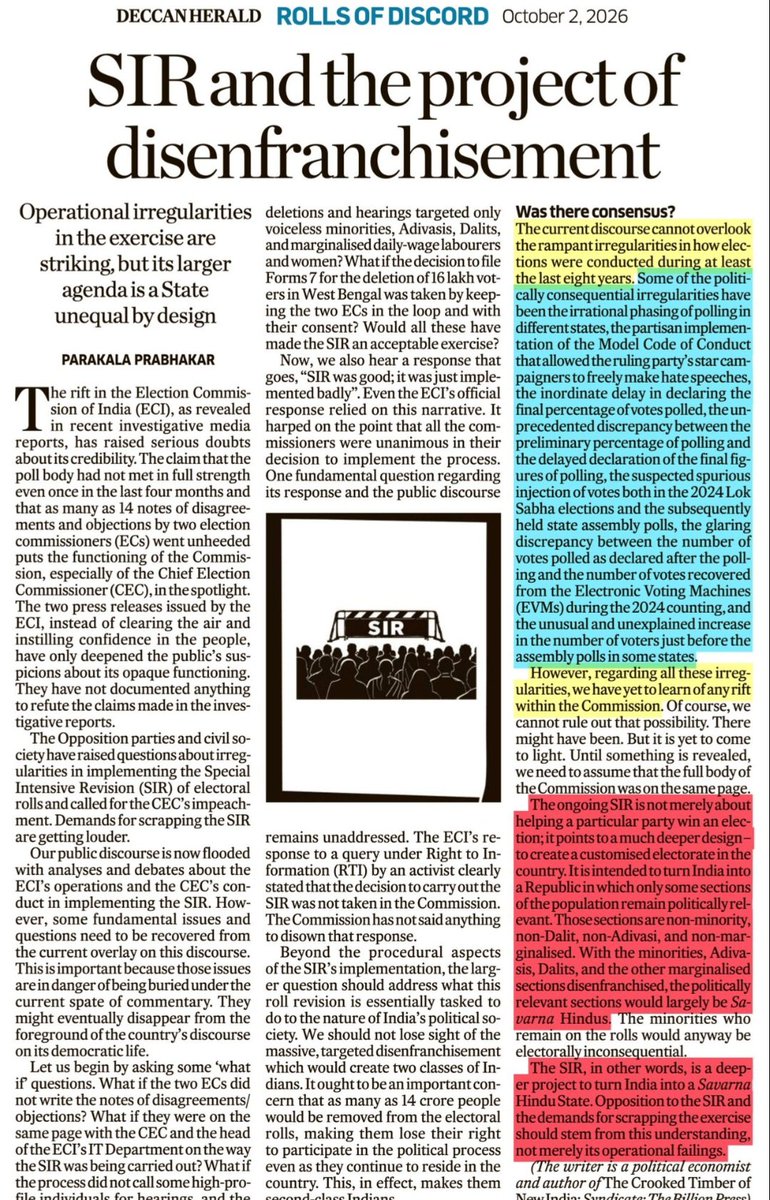
🚩SIR and the project of disenfranchisement
(Valid concerns were raised by Parakala Prabhakar on the Ongoing SIR,Reputed political commentator.He says ongoing SIR is not merely about helping a particular party win an election; it points to a much deeper design-to create a customised electorate in the country. It is intended to turn India into a Republic in which only some sections of the population remain politically relevant. Those sections are non-minority, non-Dalit, non-Adivasi, and non-marginalised. With the minorities, Adivasis, Dalits, and the other marginalised sections disenfranchised, the politically relevant sections would largely be Savarna Hindus. The minorities who remain on the rolls would anyway be electorally inconsequential.
The SIR, in other words, is a deeper project to turn India into a Savarna Hindu State. Opposition to the SIR and the demands for scrapping the exercise should stem from this understanding, not merely its operational failings)
The rift in the Election Commission of India (ECI), as revealed in recent investigative media reports, has raised serious doubts about its credibility. The claim that the poll body had not met in full strength even once in the last four months and that as many as 14 notes of disagreements and objections by two election commissioners (ECs) went unheeded puts the functioning of the Commission, especially of the Chief Election Commissioner (CEC), in the spotlight. The two press releases issued by the ECI, instead of clearing the air and instilling confidence in the people, have only deepened the public's suspicions about its opaque functioning. They have not documented anything to refute the claims made in the investigative reports.
The Opposition parties and civil society have raised questions about irregularities in implementing the Special Intensive Revision (SIR) of electoral rolls and called for the CEC's impeachment. Demands for scrapping the SIR are getting louder.
Our public discourse is now flooded with analyses and debates about the ECI's operations and the CEC's conduct in implementing the SIR. However, some fundamental issues and questions need to be recovered from the current overlay on this discourse. This is important because those issues are in danger of being buried under the current spate of commentary. They might eventually disappear from the foreground of the country's discourse on its democratic life.
Let us begin by asking some 'what if questions. What if the two ECs did not write the notes of disagreements/objections? What if they were on the same page with the CEC and the head of the ECI's IT Department on the way the SIR was being carried out? What if the process did not call some high-profile individuals for bearings and the
deletions and hearings targeted only voiceless minorities, Adivasis, Dalits, and marginalised daily-wage labourers and women? What if the decision to file Forms 7 for the deletion of 16 lakh voters in West Bengal was taken by keeping the two ECs in the loop and with their consent? Would all these have made the SIR an acceptable exercise?
Now, we also hear a response that goes, "SIR was good; it was just implemented badly". Even the ECI's official response relied on this narrative. It harped on the point that all the commissioners were unanimous in their decision to implement the process. One fundamental question regarding its response and the public discourse
remains unaddressed. The ECI's response to a query under Right to Information (RTI) by an activist clearly stated that the decision to carry out the SIR was not taken in the Commission. The Commission has not said anything to disown that response.
Beyond the procedural aspects of the SIR's implementation, the larg er question should address what this roll revision is essentially tasked to do to the nature of India's political society. We should not lose sight of the massive, targeted disenfranchisement which would create two classes of Indians. It ought to be an important concern that as many as 14 crore people would be removed from the electoral rolls, making them lose their right to participate in the political process even as they continue to reside in the country. This, in effect, makes them second clace Indians
Was there consensus?
The current discourse cannot overlook the rampant irregularities in how elections were conducted during at least the last eight years. Some of the politically consequential irregularities have been the irrational phasing of polling in different states, the partisan implementation of the Model Code of Conduct that allowed the ruling party's star campaigners to freely make hate speeches, the inordinate delay in declaring the final percentage of votes polled, the unprecedented discrepancy between the preliminary percentage of polling and the delayed declaration of the final figures of polling, the suspected spurious injection of votes both in the 2024 Lok Sabha elections and the subsequently held state assembly polls, the glaring discrepancy between the number of votes polled as declared after the polling and the number of votes recovered from the Electronic Voting Machines (EVMs) during the 2024 counting, and the unusual and unexplained increase in the number of voters just before the assembly polls in some states.
However, regarding all these irregularities, we have yet to learn of any rift within the Commission. Of course, we cannot rule out that possibility. There might have been. But it is yet to come to light. Until something is revealed, we need to assume that the full body of the Commission was on the same page.
The ongoing SIR is not merely about helping a particular party win an election; it points to a much deeper design-to create a customised electorate in the country. It is intended to turn India into a Republic in which only some sections of the population remain politically relevant. Those sections are non-minority, non-Dalit, non-Adivasi, and non-marginalised. With the minorities, Adivasis, Dalits, and the other marginalised sections disenfranchised, the politically relevant sections would largely be Savarna Hindus. The minorities who remain on the rolls would anyway be electorally inconsequential.
The SIR, in other words, is a deeper project to turn India into a Savarna Hindu State. Opposition to the SIR and the demands for scrapping the exercise should stem from this understanding, not merely its operational failings.
(The writer is a political economist and author of The Crooked Timber of NaurIndia: Sundicata: The Billion Bracel
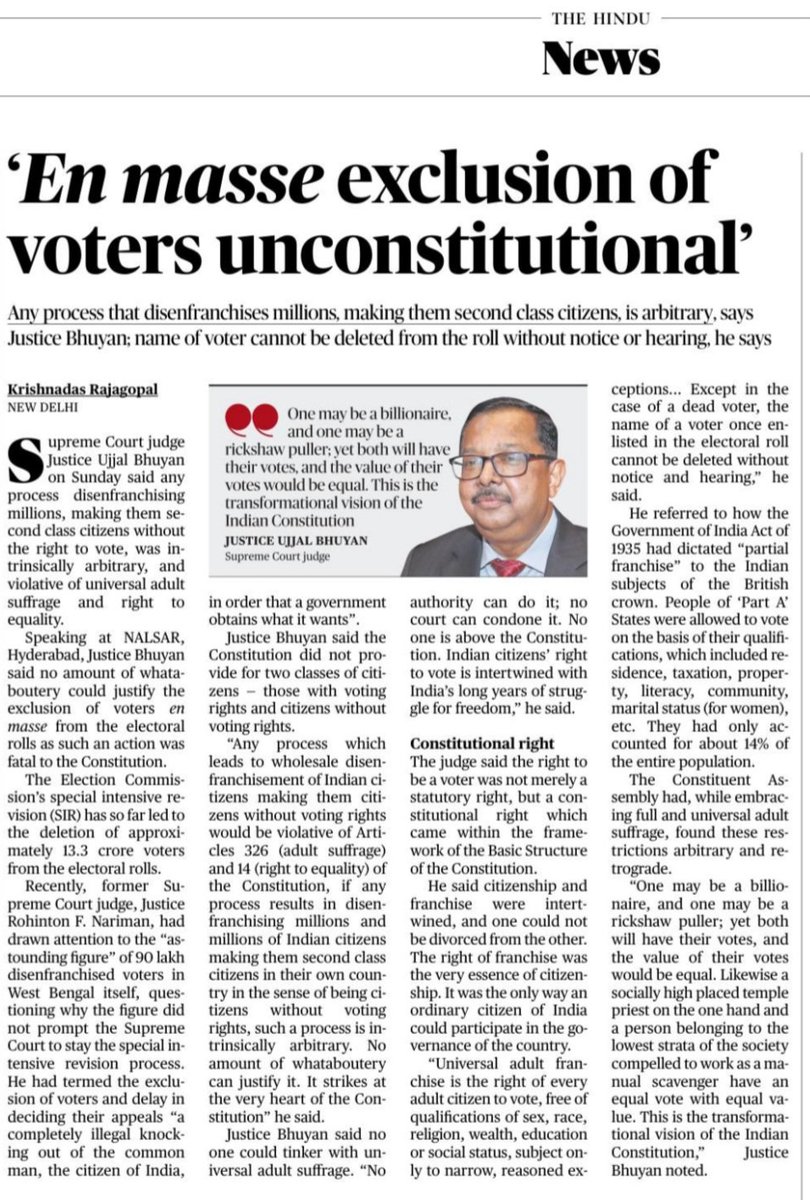
🚩En masse exclusion of voters unconstitutional'
: Scintillating speech by Justice Ujjal Bhuyan in NALSAR
(Any process that disenfranchises millions, making them second class citizens, is arbitrary, says Justice Bhuyan while speaking at NALSAR ,Hyd; name of voter cannot be deleted from the roll without notice or hearing.The Election Commis sion's special intensive revision (SIR) has so far led to the deletion of approximately 13.3 crore voters from the electoral rolls.
@Supreme Court judge Justice Ujjal Bhuyan said any process disenfranchising millions, making them second class citizens without the right to vote, was intrinsically arbitrary, and violative of universal adult suffrage and right to equality.
@Justice Bhuyan said the Constitution did not provide for two classes of citizens those with voting rights and citizens without voting rights.
@"One may be a billionaire, and one may be a rickshaw puller; yet both will have their votes, and the value of their votes would be equal. Likewise a socially high placed temple priest on the one hand and a person belonging to the lowest strata of the society compelled to work as a manual scavenger have an equal vote with equal value. This is the transformational vision of the Indian Constitution," Justice Bhuyan noted.
@Justice Bhuyan said no one could tinker with universal adult suffrage. "No
authority can do it; no court can condone it. No one is above the Constitution. Indian citizens' right to vote is intertwined with India's long years of strug gle for freedom," he said.
@The judge said the right to be a voter was not merely a statutory right, but a constitutional right which came within the frame work of the Basic Structure of the Constitution.He said citizenship and franchise were intertwined, and one could not be divorced from the other. The right of franchise was the very essence of citizen ship. It was the only way an ordinary citizen of India could participate in the governance of the country.Universal adult franchise is the right of every adult citizen to vote, free of qualifications of sex, race, religion, wealth, education or social status, subject only to narrow, reasoned ex-
ceptions... Except in the case of a dead voter, the name of a voter once enlisted in the electoral roll cannot be deleted without notice and hearing," he said.
@He referred to how the Government of India Act of 1935 had dictated "partial franchise" to the Indian subjects of the British crown. People of 'Part A' States were allowed to vote on the basis of their qualifications, which included residence, taxation, property, literacy, community, marital status (for women), etc. They had only accounted for about 14% of the entire population.
@The Constituent Assembly had, while embracing full and universal adult suffrage, found these restrictions arbitrary and retrograde.
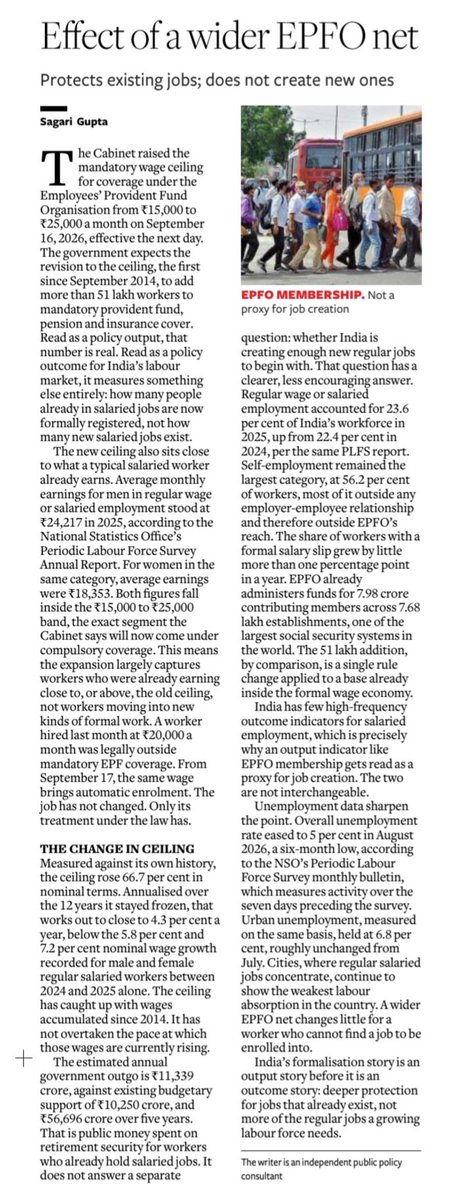
🚩Effect of a wider EPFO net
@The raise in mandatory wage ceiling for coverage under EPFO from 15,000 to 25,000 protects existing jobs; does not create new ones.The government expects the revision to the ceiling, to add more than 51 lakh workers to mandatory provident fund, pension and insurance cover.
@Average monthly earnings for men in regular wage or salaried employment stood at 24,217 in 2025, according to the National Statistics Office's Periodic Labour Force Survey Annual Report. For women in the same category, average earnings were 18,353. Both figures fall inside the ₹15,000 to 25,000 band, the exact segment the Cabinet says will now come under compulsory coverage. This means the expansion largely captures workers who were already earning close to, or above, the old ceiling, not workers moving into new kinds of formal work.
@Measured against its own history, the ceiling rose 66.7 per cent in nominal terms. Annualised over the 12 years it stayed frozen, that works out to close to 4.3 per cent a year, below the 5.8 per cent and 7.2 per cent nominal wage growth recorded for male and female regular salaried workers between 2024 and 2025 alone.
@Regular wage or salaried employment accounted for 23.6 per cent of India's workforce in 2025, up from 22.4 per cent in 2024, per the same PLFS report. Self-employment remained the largest category, at 56.2 per cent of workers, most of it outside any employer-employee relationship and therefore outside EPFO's reach. The share of workers with a formal salary slip grew by little more than one percentage point in a year.
@A wider EPFO net changes little for a worker who cannot find a job to be enrolled into.India's formalisation story is an output story before it is an outcome story: deeper protection for jobs that already exist, not more of the regular jobs a growing labour force needs.
🚩Adani overtakes Ambani as India's richest
(The cumulative wealth of 1810 individuals is equal to 50% of GDP of our country.Primitive accumulation of wealth is taking place in the background of high inflation,job less growth,wage freeze ,massive layoffs )
@The wealth of the Adani family has grown 13 per cent in 2026 (as of August) to 9.23-lakh crore against the 10 per cent decline in Ambanis' wealth to 8.63-lakh crore, according to the M3M Hurun India Rich List 2026
@Gautam Adani and family have reclaimed the top spot as India's richest, overtaking Mukesh Ambani and family
@Ambanis slipped to No. 2 with 8.63-lakh cr, per Hurun Rich List
@The cumulative wealth of 1,810 individuals in the new Rich List was up 13 per cent at 187-lakh crore y-o-y and it was greater than Italy's GDP and nearly half of India's.
@The constituents of the list added wealth at a pace of ₹5,833 crore per day as India created over two new billionaires a month for consecutively three years.
@AI, Aerospace, Defence and Semiconductors together account for 48 individuals worth 4.26-lakh crore and 30 were new to the list this year
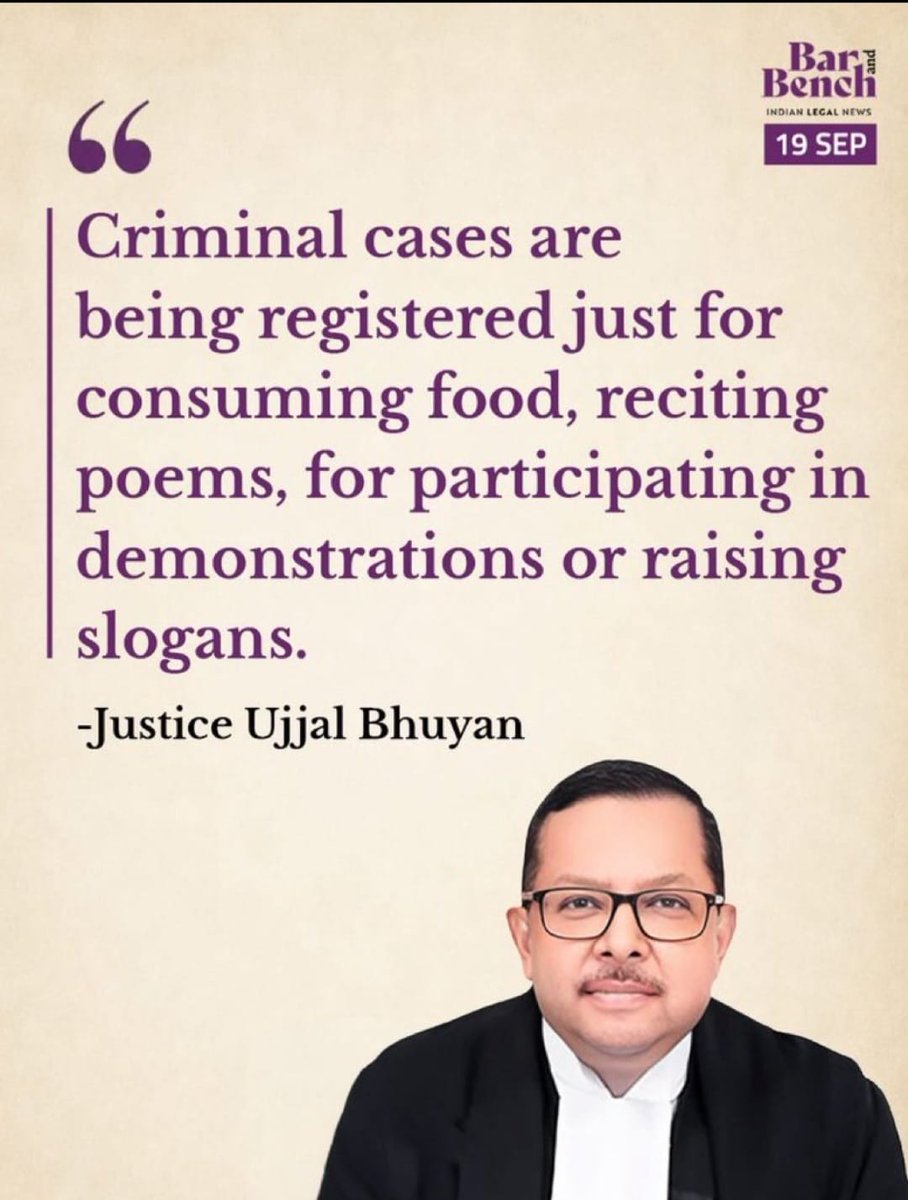
🚩Harsh Reality :
A Supreme Court Judge expressing concern over the happenings in our Country !!
Criminal cases are being registered just for consuming food, reciting poems, for participating in demonstrations or raising slogans.
-Justice Ujjal Bhuyan
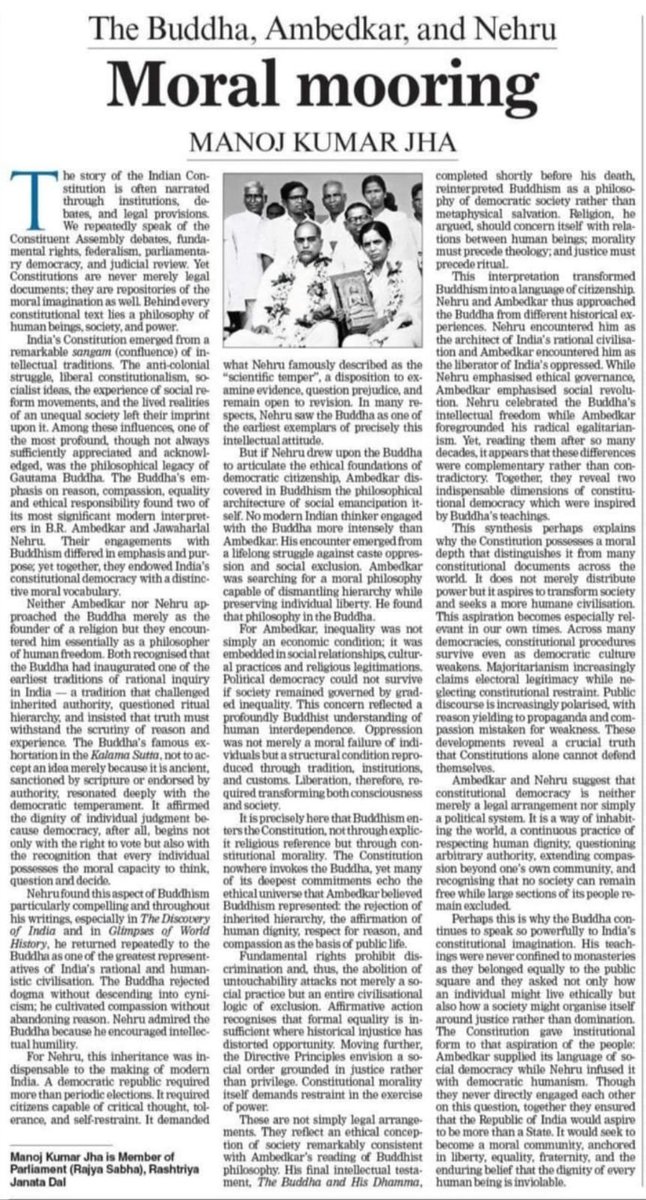
🚩The Buddha, Dr Ambedkar, and Nehru
(Brilliant Article on the influence of Buddha on Dr Ambedkar & Nehru and Buddhism entered the Constitution, not through explicit religious reference but through constitutional morality. Nehru and Dr Ambedkar thus approached the Buddha from different historical experiences. Nehru encountered him as the architect of India's rational civilisation and Dr Ambedkar encountered him as the liberator of India's oppressed. Together, they reveal two indispensable dimensions of constitutional democracy which were inspired by Buddha's teachings.This synthesis perhaps explains why the Constitution possesses a moral depth that distinguishes it from many constitutional documents across the world. It does not merely distribute power but it aspires to transform society and seeks a more humane civilisation. This aspiration becomes especially relevant in our own times. Across many democracies, constitutional procedures survive even as democratic culture weakens. Majoritarianism increasingly claims electoral legitimacy while neglecting constitutional restraint. Public discourse is increasingly polarised, with reason yielding to propaganda and compassion mistaken for weakness. These developments reveal a crucial truth that Constitutions alone cannot defend themselves.
Dr Ambedkar and Nehru suggest that constitutional democracy is neither merely a legal arrangement nor simply a political system. It is a way of inhabiting the world, a continuous practice of respecting human dignity, questioning arbitrary authority, extending compas sion beyond one's own community, and recognising that no society can remain free while large sections of its people remain excluded.Together they ensured that the Republic of India would aspire to be more than a State. It would seek to become a moral community, anchored in liberty, equality, fraternity, and the enduring belief that the dignity of every human being is inviolable )
The story of the Indian Constitution is often narrated through institutions, debates, and legal provisions. We repeatedly speak of the Constituent Assembly debates, fundamental rights, federalism, parliamenta ry democracy, and judicial review. Yet Constitutions are never merely legal documents; they are repositories of the moral imagination as well. Behind every constitutional text lies a philosophy of human beings, society, and power.
India's Constitution emerged from a remarkable sangam (confluence) of intellectual traditions. The anti-colonial struggle, liberal constitutionalism, so cialist ideas, the experience of social reform movements, and the lived realities of an unequal society left their imprint upon it. Among these influences, one of the most profound, though not always sufficiently appreciated and acknowledged, was the philosophical legacy of Gautama Buddha. The Buddha's emphasis on reason, compassion, equality and ethical responsibility found two of its most significant modern interpreters in B.R. Ambedkar and Jawaharlal Nehru .Their engagements with Buddhism differed in emphasis and purpose, yet together, they endowed India's constitutional democracy with a distinc tive moral vocabulary.
Neither Ambedkar nor Nehru ap proached the Buddha merely as the founder of a religion but they encoun tered him essentially as a philosopher of human freedom. Both recognised that the Buddha had inaugurated one of the earliest traditions of rational inquiry in India a tradition that challenged inherited authority, questioned ritual hierarchy, and insisted that truth must withstand the scrutiny of reason and experience. The Buddha's famous ex hortation in the Kalama Sutta, not to accept an idea merely because it is ancient, sanctioned by scripture or endorsed by authority, resonated deeply with the democratic temperament. It affirmed the dignity of individual judgment because democracy, after all, begins not only with the right to vote but also with the recognition that every individual possesses the moral capacity to think, question and decide.
Nehru found this aspect of Buddhism particularly compelling and throughout his writings, especially in The Discovery of India and in Glimpses of World History, he returned repeatedly to the Buddha as one of the greatest representatives of India's rational and humanistic civilisation. The Buddha rejected dogma without descending into cism; he cultivated compassion without abandoning reason. Nehru admired the Buddha because he encouraged intellectual humility.
For Nehru, this inheritance was in dispensable to the making of modern India. A democratic republic required more than periodic elections. It required citizens capable of critical thought, tol erance, and self-restraint. It demanded
what Nehru famously described as the "scientific temper", a disposition to ex amine evidence, question prejudice, and remain open to revision. In many respects, Nehru saw the Buddha as one of the earliest exemplars of precisely this intellectual attitude.
But if Nehru drew upon the Buddha to articulate the ethical foundations of democratic citizenship, Ambedkar dis covered in Buddhism the philosophical architecture of social emancipation it self. No modern Indian thinker engaged with the Buddha more intensely than Dr Ambedkar. His encounter emerged from a lifelong struggle against caste oppres sion and social exclusion. Ambedkar was searching for a moral philosophy capable of dismantling hierarchy while preserving individual liberty. He found that philosophy in the Buddha.
For Dr Ambedkar, inequality was not simply an economic condition; it was embedded in social relationships, cultur al practices and religious legitimations. Political democracy could not survive if society remained governed by graded inequality. This concern reflected a profoundly Buddhist understanding of human interdependence. Oppression was not merely a moral failure of indi viduals but a structural condition reproduced through tradition, institutions, and customs. Liberation, therefore, required transforming both consciousness and society.
It is precisely here that Buddhism en ters the Constitution, not through explic it religious reference but through con stitutional morality. The Constitution nowhere invokes the Buddha, yet many of its deepest commitments echo the ethical universe that Ambedkar believed Buddhism represented: the rejection of inherited hierarchy, the affirmation of human dignity, respect for reason, and compassion as the basis of public life. Fundamental rights prohibit discynicial practice but an entire civilisational crimination and, thus, the abolition of untouchability attacks not merely a so-logic of exclusion.
Affirmative action recognises that formal equality is in sufficient where historical injustice has distorted opportunity. Moving further, the Directive Principles envision a social order grounded in justice rather than privilege. Constitutional morality itself demands restraint in the exercise of power.
These are not simply legal arrange ments. They reflect an ethical conception of society remarkably consistent with Ambedkar's reading of Buddhist philosophy. His final intellectual testa ment, The Buddha and His Dhamma,completed shortly before his death, reinterpreted Buddhism as a philosophy of democratic society rather than metaphysical salvation. Religion, he argued, should concern itself with relations between human beings; morality must precede theology; and justice must precede ritual. This interpretation transformed Buddhism into a language of citizenship.
Nehru and Dr Ambedkar thus approached the Buddha from different historical experiences. Nehru encountered him as the architect of India's rational civilisation and Dr Ambedkar encountered him as the liberator of India's oppressed. While Nehru emphasised ethical governance, Dr Ambedkar emphasised social revolution. Nehru celebrated the Buddha's intellectual freedom while Ambedkar foregrounded his radical egalitarianism. Yet, reading them after so many decades, it appears that these differences were complementary rather than contradictory. Together, they reveal two indispensable dimensions of constitutional democracy which were inspired by Buddha's teachings.
This synthesis perhaps explains why the Constitution possesses a moral depth that distinguishes it from many constitutional documents across the world. It does not merely distribute power but it aspires to transform society and seeks a more humane civilisation. This aspiration becomes especially relevant in our own times. Across many democracies, constitutional procedures survive even as democratic culture weakens. Majoritarianism increasingly claims electoral legitimacy while neglecting constitutional restraint. Public discourse is increasingly polarised, with reason yielding to propaganda and compassion mistaken for weakness. These developments reveal a crucial truth that Constitutions alone cannot defend themselves.
Dr Ambedkar and Nehru suggest that constitutional democracy is neither merely a legal arrangement nor simply a political system. It is a way of inhabiting the world, a continuous practice of respecting human dignity, questioning arbitrary authority, extending compas sion beyond one's own community, and recognising that no society can remain free while large sections of its people remain excluded.
Perhaps this is why the Buddha continues to speak so powerfully to India's constitutional imagination. His teachings were never confined to monasteries as they belonged equally to the public square and they asked not only how an individual might live ethically but also how a society might organise itself around justice rather than domination. The Constitution gave institutional form to that aspiration of the people:Dr Ambedkar supplied its language of social democracy while Nehru infused it with democratic humanism. Though they never directly engaged each other on this question, together they ensured that the Republic of India would aspire to be more than a State. It would seek to become a moral community, anchored in liberty, equality, fraternity, and the enduring belief that the dignity of every human being is inviolable.
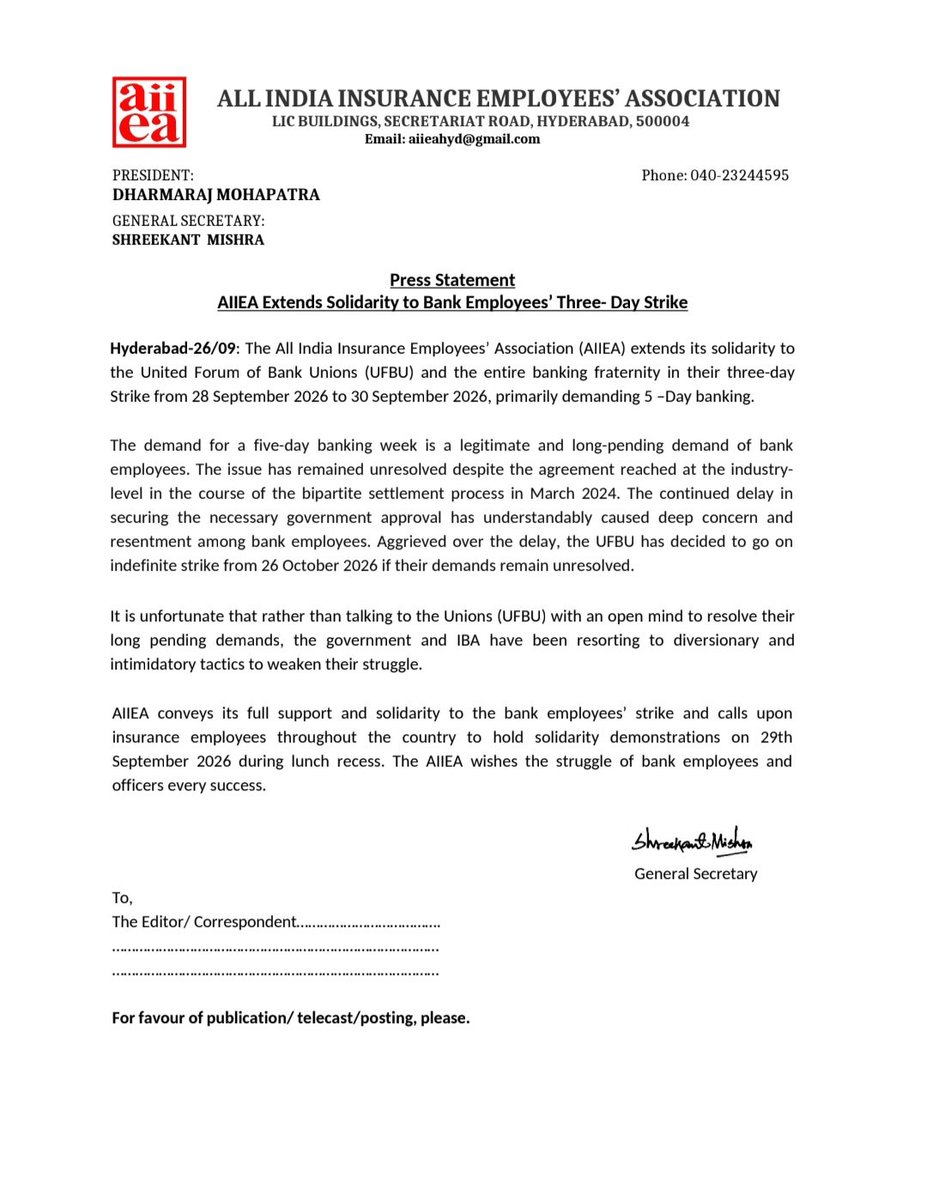
ALL INDIA INSURANCE EMPLOYEES' ASSOCIATION
LIC BUILDINGS, SECRETARIAT ROAD, HYDERABAD, 500004
Email: [email protected]
PRESIDENT:
DHARMARAJ MOHAPATRA
Phone: 040-23244595
GENERAL SECRETARY:
SHREEKANT MISHRA
Press Statement
AIIEA Extends Solidarity to Bank Employees' Three- Day Strike
Hyderabad-26/09: The All India Insurance Employees' Association (AIIEA) extends its solidarity to the United Forum of Bank Unions (UFBU) and the entire banking fraternity in their three-day Strike from 28 September 2026 to 30 September 2026, primarily demanding 5-Day banking.
The demand for a five-day banking week is a legitimate and long-pending demand of bank employees. The issue has remained unresolved despite the agreement reached at the industry-level in the course of the bipartite settlement process in March 2024. The continued delay in securing the necessary government approval has understandably caused deep concern and resentment among bank employees. Aggrieved over the delay, the UFBU has decided to go on indefinite strike from 26 October 2026 if their demands remain unresolved.
It is unfortunate that rather than talking to the Unions (UFBU) with an open mind to resolve their long pending demands, the government and IBA have been resorting to diversionary and intimidatory tactics to weaken their struggle.
AlIEA conveys its full support and solidarity to the bank employees' strike and calls upon insurance employees throughout the country to hold solidarity demonstrations on 29th September 2026 during lunch recess. The AIIEA wishes the struggle of bank employees and officers every success.
Shreekant Mishon
General Secretary
To,
The Editor/Correspondent..
For favour of publication/telecast/posting, please.