When software was expensive - thin, horizontal, best-of-breed software stacks extracted rents across every business.
Now that software is cheap - value moves to vertically integrated businesses that deliver opinionated end-to-end experiences.
"In the cloud era, enterprises accumulated data. In the AI era, they accumulate learning. The trust boundary must evolve accordingly, from protecting information to protecting the mechanisms through which organizations learn, adapt, and compound intelligence"
Just coming off of meetings with a couple dozen enterprise IT leaders discussing AI agents. Here are a few of the common themes that stand out:
* Lots of conversation that you have to solve an operating model challenge to get the full benefits of AI. Most companies have orgs that have always operated in siloes; but agents are most effectively when they are tied to a process, which often cuts across these siloes. So the big question is how do you start to deploy centrally managed agents that can work across organizational boundaries. Who manages these agents? How do they get deployed and adopted?
* Data fragmentation remains a major issue for most organizations. As long as data remains highly fragmented and not in standard formats, or data is not available to the right people and agents, enterprises are dealing with issues around being able to get answers from agents that are accurate or that conform to their business practices. This cuts across both systems with structured data (product metrics or revenue figures) and unstructured data (product roadmap or customer contracts).
* Clear sense that companies need to figure out what their core data moats are going to be in the future. If everyone has access to roughly the same superintelligence from the various models, then the context that you feed the models becomes proprietary value in the future. Capturing this data and getting it into a format that agents can use becomes very important.
* Everyone is trying to figure out the right metrics to manage to for AI adoption. General consensus that tokens are not the right metric per se, and people leaning more toward business outcomes (in an ideal world). For business outcomes (like more revenue or more shipped product), though, you have to get close to each individual workflow to figure out if it was successfully transformed with AI so it’s harder to manage top down.
* Growing view that enterprises are going to live in a multi-model world. Lots of interest (though early in actual adoption) in layers that can route workloads to different models (frontside or open weights) for cost or performance reasons. Also enterprises are trying to figure out what things do you give to the models directly vs. what do you separate as horizontal systems and context so you can swap any system in and out.
* Talent for driving AI adoption and implementation still remains a major issue and topic. Many view it as something you necessarily have to train for internally due to a shortage of talent being trained on this in the outside. As an aside, this feels like it remains a huge opportunity for those that get very good at deploying and management agents in an enterprise since most companies are looking for these skills.
* The best use-cases for AI tend to be those that fundamentally change the work being done instead of just replacing an existing process and doing it more efficiently. Companies are working through their versions of this individually because it’s different per industry, but this often remains both the most exciting and higher upside uses of AI.
Many more topics discussed recently, but overall it’s clear that there’s a ton of change going on with much more to come.
New Product Archetypes:
1. Prototyper: comes up with brand new ideas; churns out many ideas, most of which don't ship
2. Builder: quickly turns a prototype/idea into production-grade product/infra
3. Sweeper: cleans up the UI, simplifies the code and system, unships, optimizes performance
4. Grower: takes a product that has been built and iterates on it to improve Product-Market Fit
5. Maintainer: owns a mature system to make it secure, reliable, fast, and efficient as it scales
As engineering, product, design, DS, etc. melt into a new kind of role, I was reflecting on what roles might look like in the future. For example, when I look at the Claude Code team I see what I think is five archetypes:
1. Prototyper: comes up with brand new ideas; churns out many ideas, most of which don't ship
2. Builder: quickly turns a prototype/idea into production-grade product/infra
3. Sweeper: cleans up the UI, simplifies the code and system, unships, optimizes performance
4. Grower: takes a product that has been built and iterates on it to improve Product-Market Fit
5. Maintainer: owns a mature system to make it secure, reliable, fast, and efficient as it scales
Many people span across 2 roles, and sometimes 3 roles. I also notice that these roles are not really tied to job function -- eg. across Anthropic, some designers match category 1, some 2, some 3; same for engineers, PM, DS.
A healthy team needs a mix of these, depending on the product:
- A product that is new and pre-PMF needs people that are strong at 1+2+3
- A product that is growing and has found PMF needs 2+3+4 and some 5
- A product that has strong PMF needs 3+4+5 and some 2
Maybe product roles of the future will look more like this, and less like the domain-specific roles of today?
We now have de facto AI regulation. It’s not obvious why from here on out models that have certain levels of capability or are trained on certain compute sizes won’t have to be reviewed by the government before release.
Realistically, as AI models became more and more powerful this was going to be inevitable (I think it’s too early, but here we are). So now it’s mostly just interesting to think about the implications and scenarios from here. A few would be:
* America gets to control who gets access to frontier intelligence and when. This generally works as long as we remain at the frontier at all times and don’t have a risk of being surpassed. At the moment we have a clear lead in frontier intelligence so this is a good bet, but lots of motivated parties would love to change that.
* This likely creates backlog of AI releases which means that we will see less rapid fire back and forth jumps in model progress. Bull/fine case is that we just get bigger step functions per release at a slower rate and we end up at the same point we would have. Bear case is those incremental smaller jumps were necessary for the continued flywheel of innovation.
* Other countries likely have even more incentive to at least hedge their bets with sovereign AI strategies so aren’t dependent on access to US AI all times. Previously this was relatively moot because the alternative wasn’t good enough, but that could change out of necessity and what we’re seeing in China.
* Open weights obviously a big winner here as it becomes what likely sovereign AI gets built out on, and what (for now) can still be released to the market without the same controls. One interesting question would be how regulation eventually extends to open models, which would have its own set of long term consequences.
Anyway some big updates to everyone’s mental models of AI regulation as a result of the capabilities we’re now seeing in AI. Wild times.
US economic statecraft in the 21st century. US treasury secretary Scott Bessent spoke yesterday:
The nation that cannot produce what it needs is not truly secure. The nation that depends on its adversaries for critical inputs is not truly sovereign. And the nation that reduces its economics to consumption is not truly prosperous.
US economic statecraft in the 21st century. US treasury secretary Scott Bessent spoke yesterday:
The nation that cannot produce what it needs is not truly secure. The nation that depends on its adversaries for critical inputs is not truly sovereign. And the nation that reduces its economics to consumption is not truly prosperous.
Hello World!
I'm excited to share the launch of Hang Ten Systems, a new endeavor to help enterprises thrive in the age of AI.
AI is upon us all like a massive new wave. And I learned a long time ago that when there are big waves around, it is time to surf. Not just to surf, but to hang ten — to master the wave so well that you can walk all the way to the front of the board and hang your ten toes off the front.
Hang Ten is already helping some of the world's biggest and most important enterprises — like Fresenius, Siemens Energy and others — hang ten on the biggest wave of our lifetimes. Our dream is to help enterprises not just transform with AI, but use it as a force to do what no one could do before.
We're backed by a remarkable group. Mayfield leads our round; @NavinChaddha and I were students together at @Stanford and always looked for an excuse to work together. They are joined by @aramcoventures, the strategic venturing arm of Saudi @Aramco, one of the world's largest companies and a key leader in energy and infrastructure, as well as some of Silicon Valley's best-known angels. And I'm privileged that Jerry Yang — also a friend since Stanford — serves on our board. Building Hang Ten with me is the core team I've worked alongside for years: @navinb, @sanjaypaloalto, Tao Liu, Frank Yu, Pradeep Panicker, Yusuf Safdari and ten other big wave surfers.
Over time I'll share more about Hang Ten and our work. For now I'll say only this: I have seen, firsthand, the dramatic things AI delivers for the people and teams who somehow just know what to do with it — I have watched them, and myself, reach in minutes what could take teams years of toil. And I have seen the far greater number who get none of it, and who often end up causing harm instead. In that gap lies the biggest opportunity of our time.
It is time to ride this wave. If you're a surfrider — someone who lights up at the chance to help businesses solve the hardest problems they face — write to us ([email protected])!
— Vishal
When we master energy, we master our destiny.
We’re going to double the capacity of our grid by 2050 — to supply clean, reliable, affordable power across the country.
Tech sovereignty is now national strategy.
For India, self-reliance can’t stop at apps or services — it has to move down the stack: chips, cloud, models, data, energy and talent.
The next decade belongs to countries that can build, deploy and govern their own intelligence infrastructure.
Greetings on National Technology Day. We recall with pride the hard work and dedication of our scientists, which led to the successful tests in Pokhran in 1998. That landmark moment reflected India’s scientific excellence and unwavering commitment.
Technology has become a key pillar in building a self-reliant India. It is accelerating innovation, expanding opportunities and contributing to the nation’s growth across sectors. Our continued focus remains on empowering talent, encouraging research and creating solutions that serve both national progress and the aspirations of our people.
For 50 years, software engineering ran on code rationing. Writing code was expensive, so we rationed it carefully through roadmaps, RFCs, prioritization meetings, and scope reviews.
This created a role: the No Engineer. No, that won't scale. No, we don't have bandwidth. No, that's out of scope. No, we need a design doc first. The No Engineer was valuable for 50 years. Every "no" saved real money. Their judgment was the rationing system.
LLMs will be the end of code rationing. Code is cheap now. And while the No Engineer is explaining why something can't be done, the Yes Engineer has already shipped three versions of it.
If you're a Yes Engineer, the next decade is yours.
hot take :) The biggest and most productive people in the AI era are the folks who are already good at their jobs. AI as a multiplier, not an equalizer/democratizer
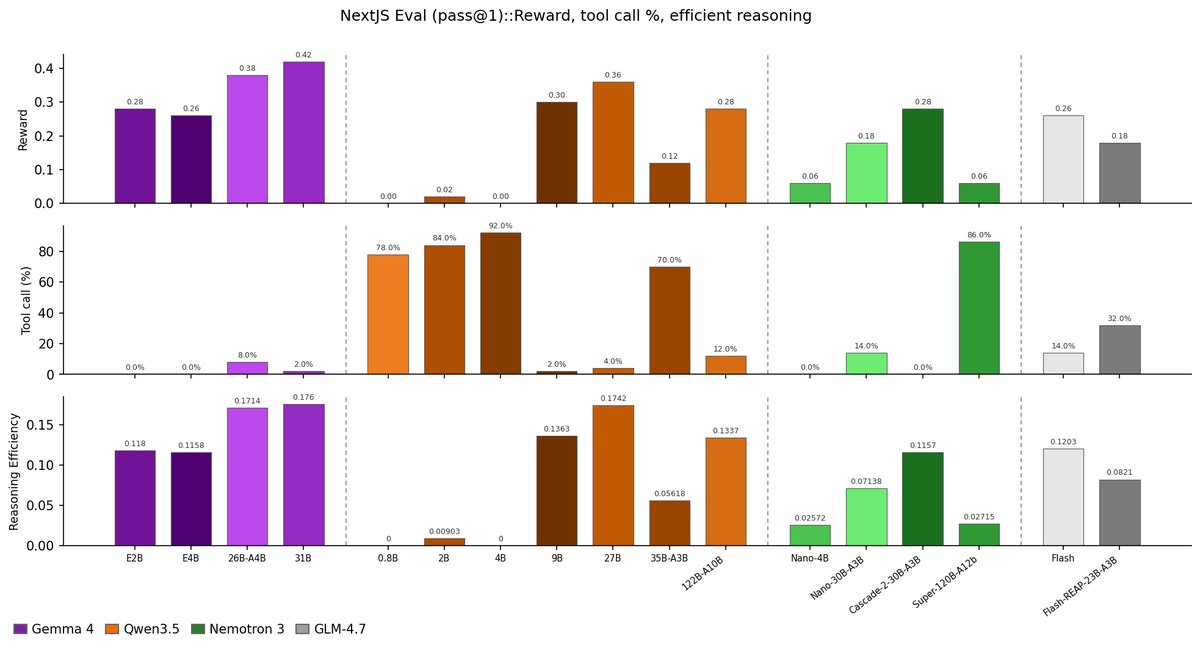
NextJS Benchmark (1st version) pass@1 on recent open source releases:
This is somewhat of unique benchmark that can be a great proxy for harness use: to identify if a tool call is needed at each step. No tool calls are needed in this benchmark, and an ideal model will have the highest reward with minimum percentage of tool calls.
Anatomy of the grid: first row is reward, second is tool call percentage, and lastly we have reasoning efficiency which is reward^2/(log10(reasoning_length)).
Gemma 4 series is better at all sizes. The smaller Gemma 4 variants are on par with Qwen3.5:9B with caveat of avoiding tool calls.
Gemma4:31B beats Qwen3.5:27B by getting a higher reward, lower tool call% and a slightly better reasoning efficiency.
Another interesting observation is Nemotron 3 series where the Cascade-2, a heavily post tuned version of Nano-30B-A3B shows clear sign of improvement.
@Mrlostnfound0@riteshmjn exceptional founders will figure out how to build MOAT on top of commodity models.
companies founded by these exceptional founder will give generational return.