Dusting off this tweet from April because this gap in shared understanding of LLM capability is *widening*. It's now less "two groups of people speaking past each other" and more a sharp funnel.
- Napkin math somewhere around 6B people (~75% of the population) have barely come in contact with LLMs at all.
- Around 1-2B (~20%) are casual and infrequent users of free-tier ChatGPT-like products. This group sees derpy chatbots and treats them a bit like a better Google search, a writing aid, or etc. Maybe an agent tries to book you a flight. I have non-tech friends who (reasonably, imo) say they have not much use for it at all. Even many professionals outside of math&code are in this tier. For example, execs and many other functions spend a lot of their time talking to other people, so while they understand what is happening intellectually, it is still second-hand and a bit abstract.
- Now we get to professional use of frontier-grade LLMs in math&code. Somewhere around 20M people (0.2%) see first-hand that large, complex projects that used to take them weeks/months can now be completed by agents with a prompt. Building apps, copying apps, translating apps, decompiling apps from binaries... This has all happened very quickly and recently - less than 1 year ago, I was writing code manually by hand, typing memorized computer code commands into a code editor character by character, occasionally pressing Tab to autocomplete a little chunk of code.
- And finally we get to the ~5,000 people (~0.00006%) with access to frontier-grade systems internally. The external world has seen the preview. It looks like swarms of thousands of agents collaborating over weeks on software mega projects: minting zero days, running cyber attacks and defenses at machine speeds, discovering new science, advancing the frontier of mathematics. Things that would have taken top professionals in the industry years of work. Meanwhile, human review and comprehension are starting to fall behind. For example, people are still involved in the "archeology" of the OpenAI-HF incident from many months ago. Mathematicians may be poring over the 722 manuscripts on frontier mathematics for a while.
The funnel is driven by a combination of factors:
1. The impact scales with ambition, problem size, and horizon. A question with a paragraph answer barely stresses the system. You need a reservoir of big, difficult problems that you really care about. This aspect drives the consumer / professional dimension of the funnel.
2. The jaggedness of the system (which I have written about a lot separately). Capability peaks in domains that are digital, verifiable and economically valuable. This is because LLM capability emerges from reinforcement learning on verifiable rewards on a curated environment mixture driven by revenue potential. This aspect primarily drives the area (e.g. math&code) dimension of the funnel.
3. Access. Free-tier, paid-tier, internal.
So this is the weirdness of the moment. The general public has mostly not interacted with these systems. When they have, it looks like a derpy chatbot. The majority of professionals still see only a modest uplift. And a small sliver of professionals are experiencing the vertigo of the curve going vertical. And it is all happening at the same time.
I benchmarked Fable 5 Low effort vs GLM 5.2 High effort and Sonnet 5 High effort using @VulcanBench 🖖
Evals were on 10 real engineering tasks from flask, aiohttp, sqlglot + more. All post-training-cutoff, so nothing memorized.
All three scored 80%. The costs were $2.27 vs $8.41 vs $15.81.
And the wildest thing is which model was the most expensive, and it wasn't Fable 👀
Results in first comment below 🔽
This 2 hour Stanford lecture shows exactly how Stanford trains it's engineers to build AI systems. It's more practical than every Claude tutorial & prompting threads you've seen.
Bookmark & give it 2 hours, no matter what. It'll be the most productive thing you do this weekend.
The @DarioAmodei interview.
0:00:00 - What exactly are we scaling?
0:12:36 - Is diffusion cope?
0:29:42 - Is continual learning necessary?
0:46:20 - If AGI is imminent, why not buy more compute?
0:58:49 - How will AI labs actually make profit?
1:31:19 - Will regulations destroy the boons of AGI?
1:47:41 - Why can’t China and America both have a country of geniuses in a datacenter?
Look up Dwarkesh Podcast on Youtube, Spotify, Apple Podcasts, etc.
WELCOME TO THE ROOM: Satya Nadella's Lesson in Executive Accountability
Most people treat a senior promotion as a destination; in reality, it is an invitation to a higher level of pressure where excuses are considered a form of professional failure. In "The Room," the distance between a "theory of success" and "actual success" is measured by one thing: Intellectual Honesty.
If you are waiting for more resources, more time, or more favorable conditions to win, you aren't leading—you’re whining. True leadership is the act of "manufacturing success" within the constraints of reality. It requires the scientific rigor to align your resources to your theory, the telemetry to admit when that theory is failing, and the courage to pivot before the runway disappears.
The Bottom Line: You are either a generator of clarity or a creator of confusion. If your "dots don't connect" from your current headcount to the final result, you are just managing decline. Stop talking, get the telemetry, and operationalize the win. Anything else is just noise.
https://t.co/T3JQrXRrDu
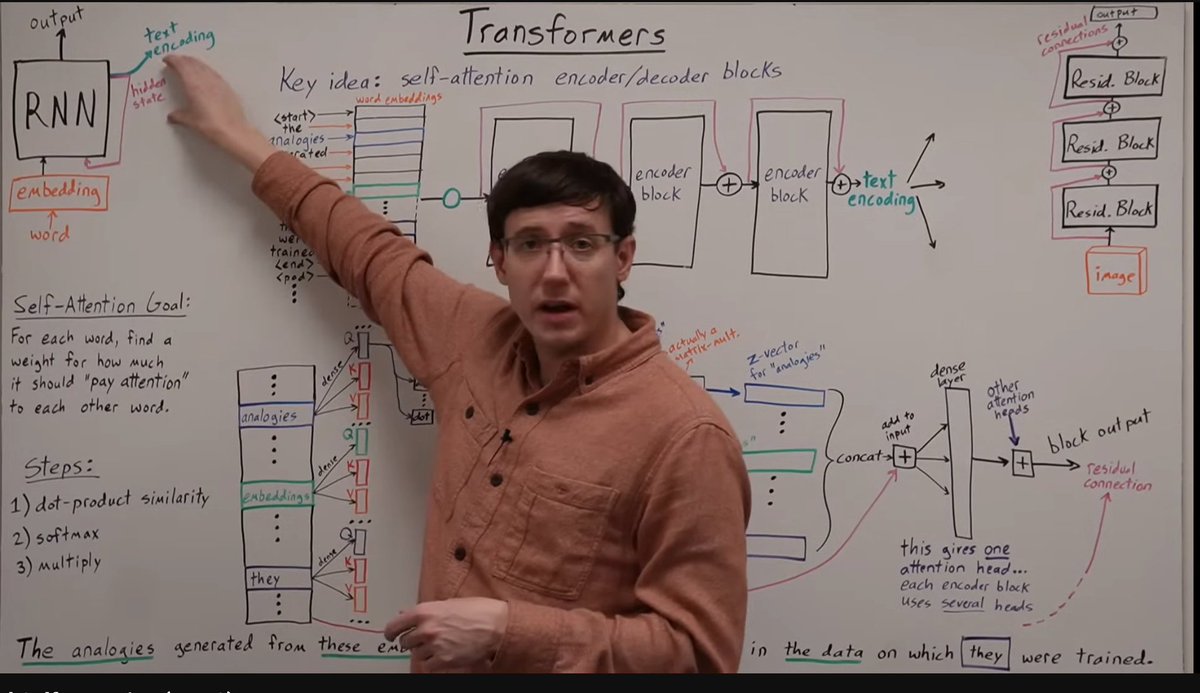
Hands down, this is the clearest and most effective explanation of Transformers on YouTube. The lecture was delivered by Professor Bryce as part of Davidson’s CSC 381: Deep Learning (Fall 2022).
If your goal is to truly understand Transformers and self-attention, this is the only video you need and there’s no reason to watch anything else.
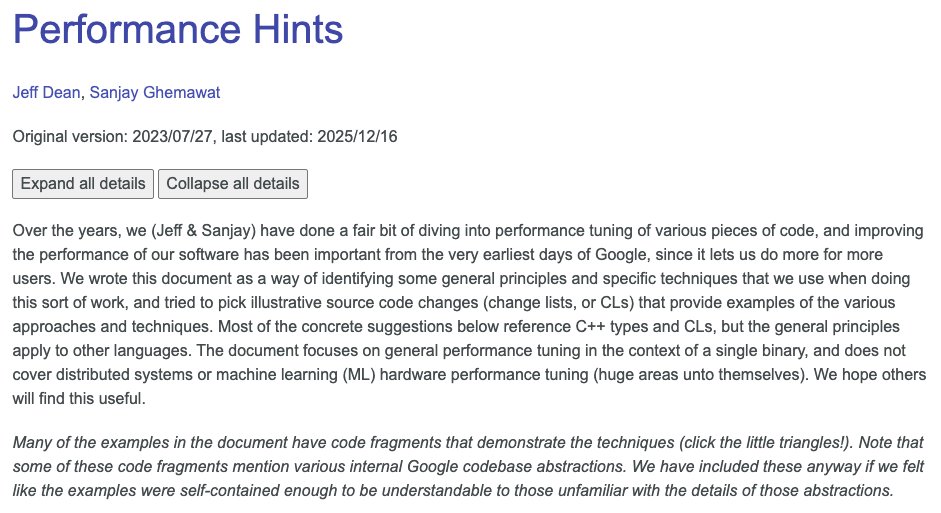
Performance Hints
Over the years, my colleague Sanjay Ghemawat and I have done a fair bit of diving into performance tuning of various pieces of code. We wrote an internal Performance Hints document a couple of years ago as a way of identifying some general principles and we've recently published a version of it externally.
We'd love any feedback you might have!
Read the full doc at: https://t.co/jej95g236P
Is there an AI bubble? With the massive number of dollars going into AI infrastructure such as OpenAI’s $1.4 trillion plan and Nvidia briefly reaching a $5 trillion market cap, many have asked if speculation and hype have driven the values of AI investments above sustainable values. However, AI isn’t monolithic, and different areas look bubbly to different degrees.
- AI application layer: There is underinvestment. The potential is still much greater than most realize.
- AI infrastructure for inference: This still needs significant investment.
- AI infrastructure for model training: I’m still cautiously optimistic about this sector, but there could also be a bubble.
Caveat: I am absolutely not giving investment advice!
AI application layer. There are many applications yet to be built over the coming decade using new AI technology. Almost by definition, applications that are built on top of AI infrastructure/technology (such as LLM APIs) have to be more valuable than the infrastructure, since we need them to be able to pay the infrastructure and technology providers.
I am seeing many green shoots across many businesses that are applying agentic workflows, and am confident this will grow. I have also spoken with many Venture Capital investors who hesitate to invest in AI applications because they feel they don’t know how to pick winners, whereas the recipe for deploying $1B to build AI infrastructure is better understood. Some have also bought into the hype that almost all AI applications will be wiped out merely by frontier LLM companies improving their foundation models. Overall, I believe there is significant underinvestment in AI applications. This area remains a huge focus for my venture studio, AI Fund.
AI infrastructure for inference. Despite AI’s low penetration today, infrastructure providers are already struggling to fulfill demand for processing power to generate tokens. Several of my teams are worried about whether we can get enough inference capacity, and both cost and inference throughput are limiting our ability to use even more. It is a good problem to have that businesses are supply-constrained rather than demand-constrained. The latter is a much more common problem, when not enough people want your product. But insufficient supply is nonetheless a problem, which is why I am glad our industry is investing significantly in scaling up inference capacity.
As one concrete example of high demand for token generation, highly agentic coders are progressing rapidly. I’ve long been a fan of Claude Code; OpenAI Codex also improved dramatically with the release of GPT-5; and Gemini 3 has made Google CLI very competitive. As these tools improve, their adoption will grow. At the same time, overall market penetration is still low, and many developers are still using older generations of coding tools (and some aren’t even using any agentic coding tools). As market penetration grows — I’m confident it will, given how useful these tools are — aggregate demand for token generation will grow.
I predicted early last year that we’d need more inference capacity, partly because of agentic workflows. Since then, the need has become more acute. As a society, we need more capacity for AI inference.
Having said that, I’m not saying it’s impossible to lose money investing in this sector. If we end up overbuilding — and I don’t currently know if we will — then providers may end up having to sell capacity at a loss or at low returns. I hope investors in this space do well financially. The good news, however, is that even if we overbuild, this capacity will get used, and it will be good for application builders!
AI infrastructure for model training. I am happy to see the investments going into training bigger models. But, of the three buckets of investments, this seems the riskiest. If open-source/open-weight models continue to grow in market share, then some companies that are pouring billions into training models might not see an attractive financial return on their investment.
Additionally, algorithmic and hardware improvements are making it cheaper each year to train models of a given level of capability, so the “technology moat” for training frontier models is weak. (That said, ChatGPT has become a strong consumer brand, and so it enjoys a strong brand moat, while Gemini, assisted by Google's massive distribution advantage, is also making a strong showing.)
I remain bullish about AI investments broadly. But what is the downside scenario — that is, is there a bubble that will pop? One scenario that worries me: If part of the AI stack (perhaps in training infra) suffers from overinvestment and collapses, it could lead to negative market sentiment around AI more broadly and an irrational outflow of interest away from investing in AI, despite the field overall having strong fundamentals. I don’t think this will happen, but if it does, it would be unfortunate since there’s still a lot of work in AI that I consider highly deserving of much more investment.
Warren Buffett popularized Benjamin Graham’s quote, “In the short run, the market is a voting machine, but in the long run, it is a weighing machine.” He meant that in the short term, stock prices are driven by investor sentiment and speculation; but in the long term, they are driven by fundamental, intrinsic value. I find it hard to forecast sentiment and speculation, but am very confident about the long-term health of AI’s fundamentals. So my plan is just to keep building!
[Original text: https://t.co/psPlIFRJsi ]
How Kubernetes Reinvented Virtual Machines 🔽
- How Virtual Machines are used to deploy services
- How Containers try to improve shortcomings of VMs
- What new problems Containers introduce
- How Kubernetes is just one but a clever way to cook Containers
https://t.co/NFf0aABhEx