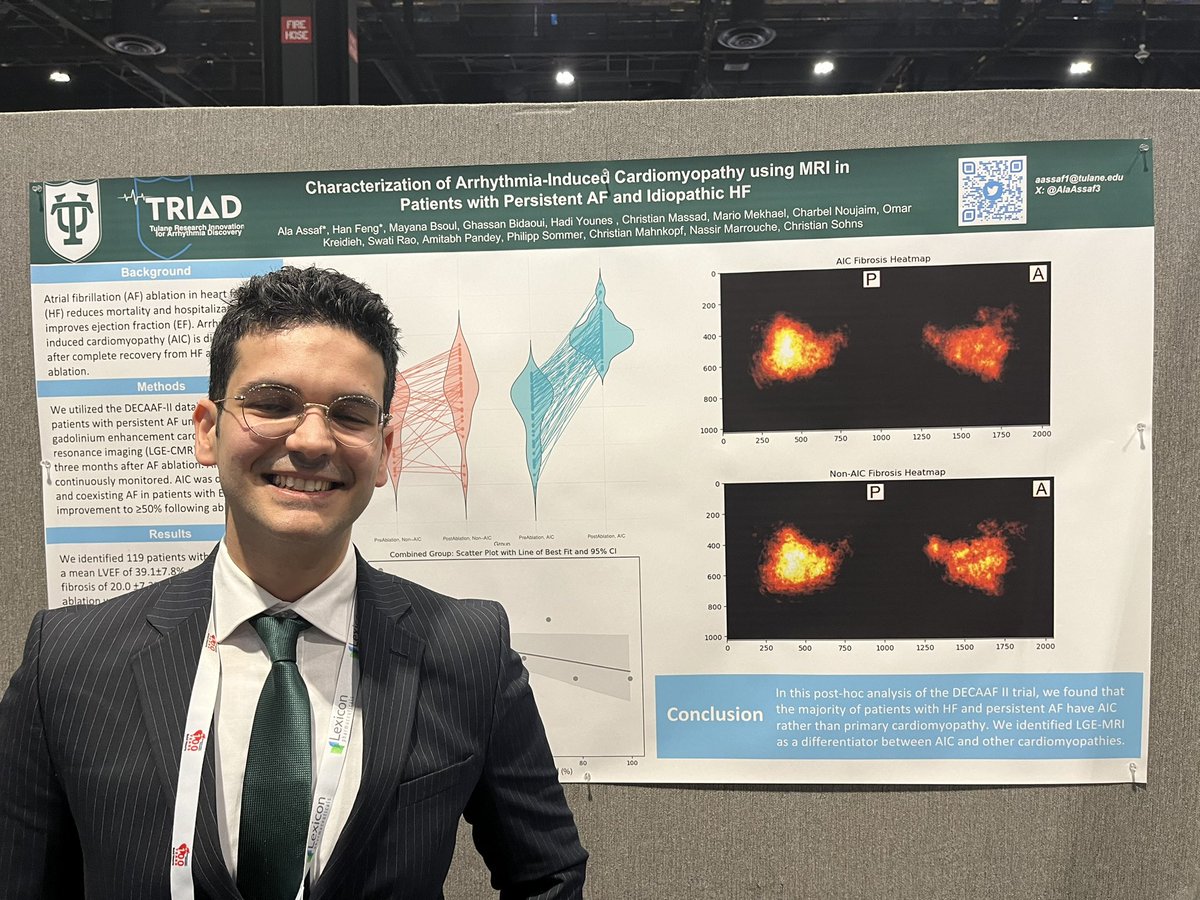
Don’t miss TRIAD at #HRS26. Our team is grateful to share a full lineup of presentations highlighting new work and scientific progress in arrhythmia research, digital health, and AI. Proud of this amazing team and excited to learn, connect, and exchange ideas with everyone here.
Excited to share our team's new publication in JCE!
Our study explores how obesity affects ablation-induced scar formation on LGE-MRI, potentially uncovering a novel mechanism by which obesity influences catheter ablation outcomes.
#MRI#obesity
https://t.co/6K2pSvHW9s
Could this be explained by impedance drop?
- Impedance drop is key marker of energy delivery during ablation, and usually associated with durable scar formation
- Obesity is known to limit effective energy transfer during ablation and thus lower obesity
With obesity projected to rise globally, understanding its direct impact on procedural outcomes is critical. @BidaouiGhassan’s work highlights the need for #personalized ablation strategies to optimize success in obese populations
Despite reduced scar formation and larger LA volumes in obese patients, we found no direct correlation between BMI and AF recurrence (p = .849). This may suggest complex remodeling dynamics in obesity, where factors beyond scar—like metabolic and tissue changes—may play a role
@HadiiYounes highlights how female patients are under represented and studied while demonstrating varying ablation outcomes in terms of scar formation, LA volume reduction and AF burden @Phiso_de@HRSonline@TulaneTriad
@HadiiYounes presenting @TulaneTriad data highlighting sex #disparities in access to catheter ablation for #AF and clinical outcomes
🚨A call to action for further research to understand the socioeconomic+ pathophysiological factors driving this gap