If you are unable to make it to one of the nationwide Stand Up for Science rallies on Friday, March 7th, consider participating in the Nationwide Walkout on Friday, March 7th at 12pm. I will be walking out of my lab on Friday! https://t.co/r5ZeF1GFi0
Do you tend to eat one thing at a time or switch between various foods on your plate? 🍽️ Recent research by @NicholasNeuwald and @KatKellerLab explores how consistent this food-switching behavior is within children across various meals. https://t.co/xOcYx1XbrZ #pennstatenutrsci
New publication❗️Excited to share my paper on food switching behavior in children. Here we look at how consistent switching behavior is within children across different meals and eating paradigms.🍽️@KatKellerLab, @AlainaLPearce, @PMCunningham23
https://t.co/YDfrlQ33rq
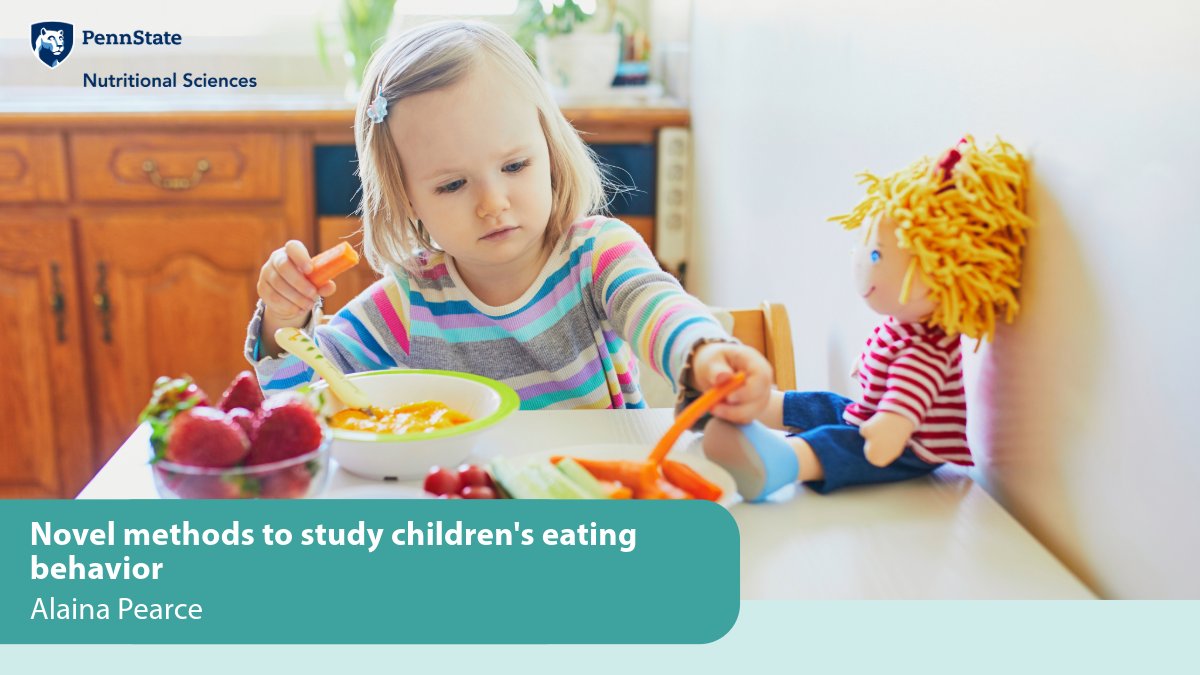
This #FacultyFriday, we are learning about developments in research methodology that will allow researchers to study children’s eating behaviors in natural settings, like their homes. Visit https://t.co/tTmKGWTeph to learn more. @AlainaLPearce#pennstatenutrsci
Great new paper out from @AlainaLPearce and the rest of our Penn State crew on Loss of Control Eating and Brain Structure in Children: https://t.co/NqTlR0C4P2
Four trainees in nutritional sciences presented at the annual ObesityWeek conference to discuss how behavioral studies may help inform interventions that aid individuals in maintaining long-term healthy dietary habits.
Visit https://t.co/OxS3JagB87 to learn more. #HHDProud
🚨Attn @PSUresearch faculty: We're accepting applications for its Early-Stage Investigator Training (KL2) Program. The KL2 provides research training needed to become successful, independent clinical and translational scientists.🗓️⏰ LOIs due Nov. 10! https://t.co/Yr7gpm7ARf
Excellent new paper from @KatKellerLab
@NicoleAReigh @TanjaKral@AlainaLPearce @marion_mh and Barbara Rolls on energy compensation in Children. Findings show wide variability in energy compensation & methods across studies. More research needed on inter-individual differences
Virtual reality headsets can be used in eating behavior studies to simulate real-world environments, according to research from @NutritionCues in @pennstateNUTR. This technology provides a sustainable method for studying eating behavior and food choice. https://t.co/BLdiJuW9ZU
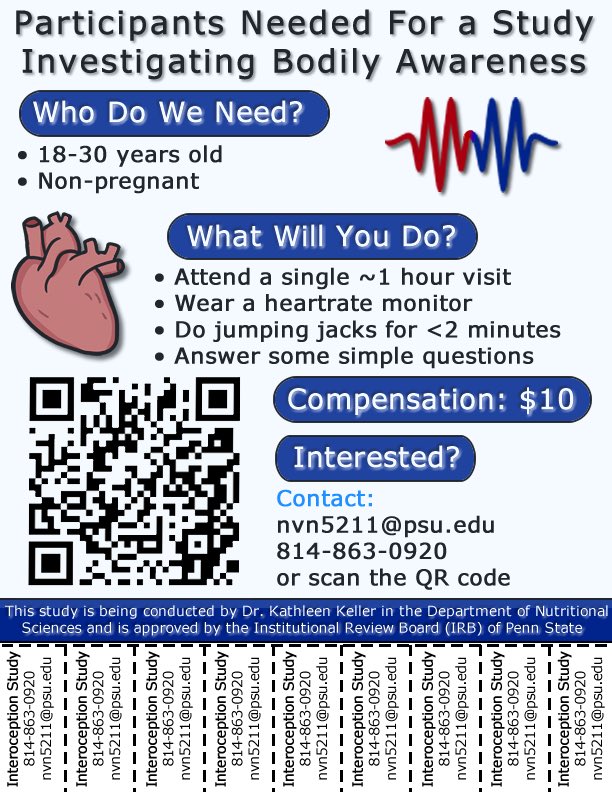
The @KatKellerLab is actively recruiting 18-30-year-old adults to participate in an in-person #interoception study. If you live in the Centre County area and want to participate email, call, or scan QR code. @PSUresearch@penn_state@pennstateNUTR
Congrats to Nick Neuwald and @KatKellerLab for another great paper on eating microstructure!
Switching between foods was associated with greater eating in the absence of hunger and reward-based eating.
@SSIBsociety@PSUresearch@pennstateNUTR
https://t.co/lPghqi2qfD
It would be hard to overstate Penny Kris-Etherton's personal impact on @pennstateNUTR or her scholarly impact on the field of cardiometabolic health. Congratulations, and happy retirement! https://t.co/JfnQ9X7dvU
While both Dr. Kissilef's (https://t.co/pYCTI4aRoM) and Dr. Thomas's (https://t.co/4Kq0GuVntU) models performed well, the Dr. Thomas's LODE model had several advantages:
1) parameters were independent
2) no non-feasible intake values
3) parameters were more distinct
Excited to share my paper validating video-coded eating behavior to measure cumulative intake curves (rather than scales), extending their utility to children and non-lab environments! More below 👇
#EatingBeahvior@FrontNutrition@SSIBsociety
@BFDGnews
https://t.co/Y28NwclwFi
Using simulations, we showed that measurement error from using average bite size and video-coded bite timing did not impact the ability to accurately extract cumulative intake curves. This means scales are not required.