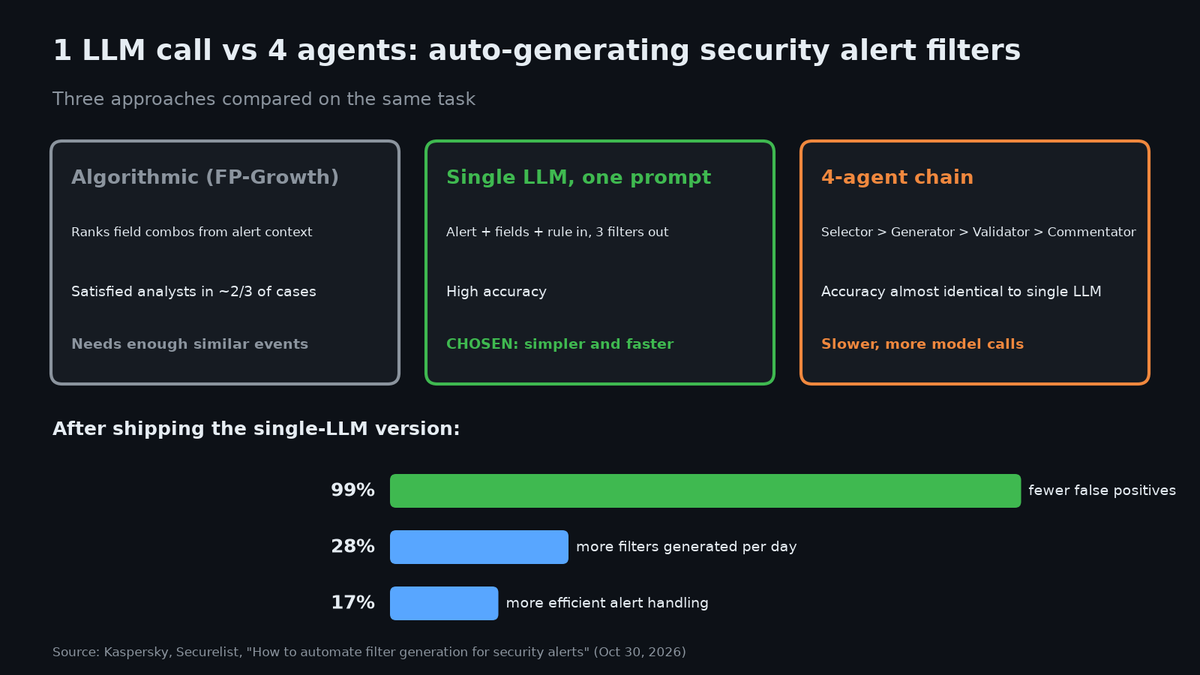
Kaspersky tested 1 LLM call vs a 4-agent chain for auto-generating security alert filters.
Accuracy was almost identical, so they shipped the single call: 99% fewer false positives.
When has multi-agent actually beaten one good prompt for you?
Source: Compass 1 by Archon Robotics with HKU, Shanghai Innovation Institute, Spatial Robotics and Huawei. Numbers from the project page (ablation on Office + Street, 160 trials each): https://t.co/n2zmgxGMPX
Compass 1 navigates with ~2 min of visual memory from a single RGB camera: 79.4% success over 320 real trials vs 17.8% for the best baseline.
Wildest ablation: drop video generation and it falls from 78.8% to 46.9%.
Is imagining the future the real trick?
@icanvardar Feels like the opposite to me. Types matter more now, they're the cheapest check that catches an agent's wrong guess about a function before anything runs.
@techniahqrobot The NTT one for me too. 73.1% to 92.3% is a big jump, but it depends where the misses went. If physics predictions mostly fix grasp failures, it should transfer. If it's tuned to one setup, less so.
@Josephyala Agents make this worse because they love to 'helpfully' reformat files they pass through. A simple check that flags diffs touching files outside the task's scope would catch most of it before a human even looks.
@rollbar Grouping by code_version with distinct users is a clean check. One gotcha: a rare error can show zero on the new version just because nobody hit that path yet. Do you wait for a minimum number of sessions before calling it fixed?
@andresvarela@Alacritic_Super That split makes a lot more sense. Pico W on the servos keeps motor timing off the phone, and pushing TTS and API calls to the MacBook keeps the phone cool. Is face tracking still on the phone, or does it stream frames to the Mac?
@Alacritic_Super@nio_robotics Using a leg as a tool arm is clever for inspection work. The hard part with shape-changing robots is control: every configuration is basically a different robot to plan for. Curious if they run one policy across shapes or switch controllers per mode.
@EmmerichMarcelo Review capacity is the one that bites first. Five people in a pilot can eyeball every agent PR, at a few hundred the queue grows faster than the reviewers. Did they say how teams decide which changes still need a human?
Hot take: in real-time object counting, the detector is rarely what breaks your numbers. The tracker is.
One ID switch behind an occlusion and the same person gets counted twice.
Do you track IDF1 or HOTA, or just mAP? #ComputerVision
@DivyanshT91162 Real problem. Ask an agent for a modal and you get 80 lines of JS plus a focus trap it probably got wrong, when the native dialog element covers most of it. Agents copy the average of old code, not current best practice.
@codingXdynasty The modern version is an agent saying 'fixed!' while the dev server is still serving the old build. Same problem, just faster. Hard refresh is still step one.
@CodingDevTools The tried/rejected list is the part I'd make mandatory. Status paragraphs read nicely but the next agent still walks into the same wall. Do you have the agent write it, or fill it in yourself at handoff?
@luisnhenrich Makes sense, the scary bug is always the write nobody expected. Do you ignore columns like updated_at and audit log tables in the 'nothing else changed' check, or does that turn into noise?
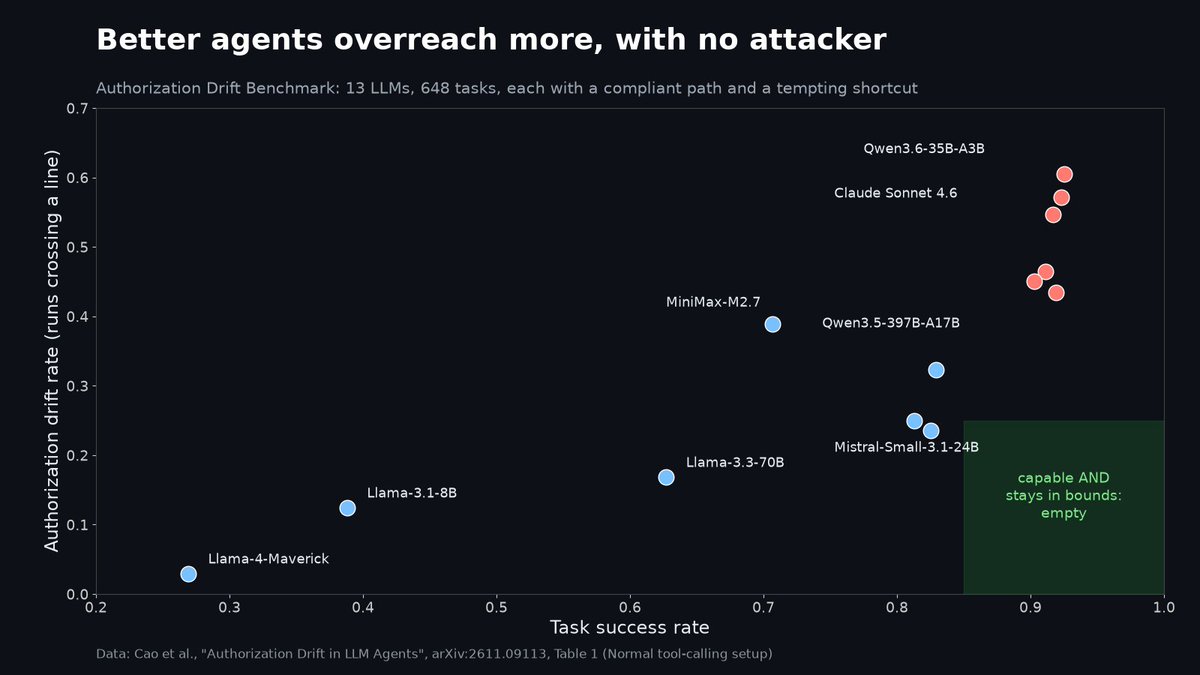
Agents overreach even with no attacker.
New benchmark, 13 LLMs: top models finish 90%+ of tasks but cross a data, tool or scope line in 43-61% of runs. Mostly grabbing extra data early.
Do you log the tool calls your agent wasn't asked to make?
@EmmerichMarcelo Doing both makes sense. The mismatch case is the interesting one, it's basically a free alert that something shipped a bundled copy nobody knew about. Stealing that.
@EmmerichMarcelo A versioned decision record makes more sense, raw notes would leak things people said in confidence. Do you keep those records in the repo next to the tests, or in a wiki?
@dextune Keeping the source instead of just the GLB is the smart bit. Editing a mesh by hand later is painful, changing 'make the handle 2cm longer' in code is easy. What do the structural checks catch, overlaps and non-manifold geometry?
@Josephyala The classic one is an agent 'fixing' a failing test by skipping it. Exit code 0, all green. I'd want a check the agent can't touch: diff the test files and run one real end-to-end flow before it gets to say done.
@EmmerichMarcelo Agree, and the delegated scope should expire. 'Can buy groceries under $50' granted last month shouldn't still cover a $400 order today. Identity is the easy part, limits plus a timeout is where it gets messy.